
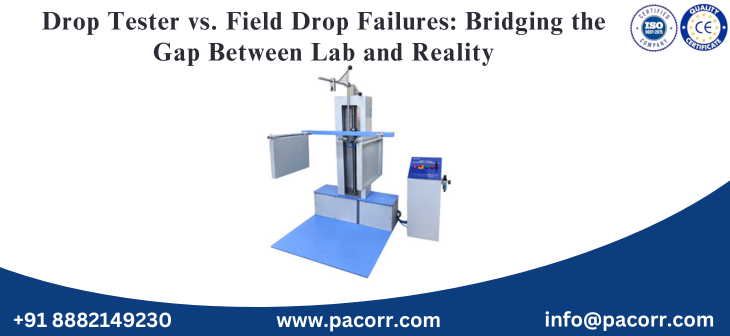
Pacorr is a leading name in the field of packaging testing equipment, dedicated to helping manufacturers ensure that their products survive the unpredictable journey from factory to consumer. One of the most essential tools in this mission is the drop tester-a machine designed to replicate the sudden impacts that occur when packages are dropped during handling, storage, or transportation.
Drop testing plays a critical role in evaluating packaging integrity and product durability. It allows manufacturers to assess whether packaging designs can protect goods against shock and impact before they reach customers. However, while lab testing provides valuable insights under controlled conditions, the real world presents countless variables-temperature shifts, human handling, irregular surfaces-that can lead to field drop failures.
This is where Pacorr steps in. By combining precision engineering, advanced simulation capabilities, and real-world testing insights, Pacorr aims to bridge the gap between laboratory consistency and field unpredictability-ensuring that what passes in the lab performs just as well in reality.
Understanding Drop Testing
A drop testing machine is used to determine how well a packaged product can endure physical shocks from free-fall drops. The goal is to simulate the stresses packages face during manual handling, loading, unloading, or accidental falls.
In a typical test, the package is dropped from a predetermined height onto a hard surface. The parameters-such as drop height, orientation (edge, corner, or flat face), and number of drops-are all carefully selected based on the product’s weight and fragility. These variables help engineers analyze how packaging materials absorb energy and prevent internal damage.
Drop testing is guided by internationally recognized standards such as ASTM D5276 and ISO 2248, which ensure consistency and repeatability across testing facilities. These standards define everything from acceptable surface conditions to the number of trials needed for a valid assessment.
In a laboratory testing environment, results are consistent and data-driven. The packaging integrity can be precisely measured, allowing manufacturers to benchmark different materials, designs, and sealing methods. However, such controlled testing does not always capture the chaos of real-world logistics. While labs simulate idealized conditions, actual shipping environments often involve uncontrolled variables-making it essential to look beyond the lab for a complete understanding of packaging performance.
Field Drop Failures: The Real-World Challenge
Field drop failures refer to instances where a product that passed lab testing suffers damage during shipping or handling in real conditions. Unlike lab tests-where every factor is predetermined-field drops occur unexpectedly, influenced by countless external elements.
Some of the most common causes include:
- Human error during manual handling or stacking.
- Uneven surfaces during loading or unloading.
- Vibrations and impacts from transport vehicles.
- Environmental factors such as humidity, temperature fluctuations, or exposure to moisture.
A packaging system that survives multiple lab drops might still fail when a courier accidentally drops it at an angle not accounted for during testing, or when it encounters temperature-induced material weakening.
For instance, an electronics manufacturer may have passed every drop testing machine evaluation under ASTM D5276, but still faces customer complaints of cracked casings or damaged components upon delivery. These incidents highlight the difference between predictable, controlled laboratory testing and unpredictable, dynamic real-world testing environments.
Field failures not only result in packaging damage and product failure in transit but also lead to customer dissatisfaction, financial losses, and reputational harm. The key challenge lies in aligning lab testing outcomes with real-world performance-and that’s where innovation in testing design becomes crucial.
Why the Gap Exists Between Lab and Reality
The discrepancy between lab results and field performance largely stems from the difference in testing environments. Laboratory testing occurs in controlled, repeatable settings. Every variable-temperature, drop surface, angle, and height-is carefully standardized. This ensures data consistency but removes the randomness that exists in actual conditions.
In contrast, the field environment is full of variables:
- Temperature and humidity fluctuations can weaken packaging materials.
- Drop angles in real life are rarely perfect 90° impacts.
- Handling behavior varies between personnel and regions.
- Vibrations, stacking pressures, and multiple impacts in transit add cumulative stress not replicated in traditional drop testing.
These differences expose the limitations of conventional testing. Most standard machines can only simulate vertical drops onto flat, uniform surfaces. In the real world, packages fall at odd angles, bounce, or slide on uneven floors. The result? Packaging that appears reliable in lab reports may underperform during distribution.
Such discrepancies directly affect product reliability. Companies face warranty claims, product returns, and potential brand damage when goods arrive damaged despite being “lab certified.” To address this, manufacturers are increasingly turning to shipping simulation solutions that bridge the gap between controlled testing and real-world variability-precisely what Pacorr specializes in.
Bridging the Gap: Pacorr’s Advanced Solutions
Pacorr’s drop testing equipment is engineered to merge laboratory precision with real-world realism. Every Pacorr drop tester is designed to replicate real-life handling conditions while maintaining data accuracy and consistency.
1. Precision Meets Realism
Pacorr’s advanced drop testing machines feature adjustable drop heights, multi-angle drop capabilities, and customizable test parameters. These allow users to simulate a variety of scenarios-from controlled vertical drops to side and corner impacts-ensuring that every potential field condition is tested.
2. Integration with Data Logging Systems
Pacorr integrates digital controls and data logging systems into its testers, enabling real-time tracking of impact forces, deformation, and material response. This helps QA teams make data-driven decisions, reducing guesswork and improving repeatability.
3. Real-World Simulation
Pacorr understands that no two shipping environments are identical. Its machines can be tailored to replicate specific handling conditions, including multi-drop sequences or uneven impact surfaces. This customization allows manufacturers to bridge the gap between lab testing and real-world simulation effectively.
4. Proven Impact - Case Studies
- Case Example 1: A glassware manufacturer experienced frequent field drop failures despite passing all standard tests. After implementing Pacorr’s adjustable-angle drop tester, they discovered a weak point on edge drops. Redesigning their corner padding reduced product breakage by over 40% in the first quarter.
- Case Example 2: A consumer electronics brand partnered with Pacorr to refine its packaging for a new tablet. Using Pacorr’s advanced drop testing system with integrated sensors, the company identified specific failure modes related to side impacts. After packaging reinforcement, in-transit product damage decreased by 30%, saving thousands in replacement costs.
Pacorr’s mission goes beyond compliance. It aims to make quality assurance a predictive science-helping manufacturers simulate the unexpected, identify weaknesses early, and deliver packaging that performs as well in the warehouse as it does on the doorstep.
In today’s competitive market, ensuring that packaging performs reliably in both lab and real-world settings is non-negotiable. Traditional lab testing methods, while essential, can only go so far in predicting field drop failures. The real challenge lies in accurately replicating the unpredictability of human handling, environmental stress, and transport dynamics.
Pacorr bridges this crucial gap through innovation, precision, and data-driven engineering. Its drop testers not only meet global standards like ASTM D5276 and ISO 2248 but also provide flexibility and realism unmatched in conventional systems.
By investing in Pacorr’s packaging testing equipment, manufacturers can ensure their products reach customers safely-reducing losses, enhancing brand reliability, and optimizing quality control processes.
Contact Pacorr today to make your packaging truly field-ready and experience the next level of packaging durability and quality assurance.
Recent Blogs
Enhance your understanding of testing and precise quality control indistinct applications with our
knowledge based articles coming from top editors of industry leaders.
Thanks to Pacorr Testing instruments, we have all the required quality testing instruments that have helped us to ensure the best quality delivered to our clients.

Danish
Fair Exports Pvt. Ltd.
