

Pacorr Testing Instruments is a renowned manufacturer and supplier of high-precision laboratory equipment, trusted by industries worldwide. Among its wide range of analytical instruments, one of the most essential devices used across laboratories and industries is the pH Meter.
A pH meter helps determine the acidity or alkalinity of a solution by measuring the hydrogen-ion concentration. Whether you work in the chemical, food, pharmaceutical, or water-treatment industry, pH measurement is crucial for maintaining product quality and ensuring safety standards.
In this detailed guide, Pacorr explains the principle, components, working, calibration, and applications of a pH meter, along with diagrams, maintenance tips, and FAQs — everything you need to know to master pH testing.
What is a pH Meter?
A pH Meter is an electrochemical measuring instrument used to measure the hydrogen-ion activity in aqueous solutions, expressing the result in pH units.
The term “pH” stands for the potential of hydrogen, representing how acidic or basic a solution is on a scale from 0 to 14:
- pH < 7 → Acidic solution
- pH = 7 → Neutral solution
- pH > 7 → Basic (alkaline) solution
By using an electrode that senses the hydrogen ions in a liquid, the pH meter converts the electrical potential difference into a numerical pH value.
Pacorr’s digital pH meters offer high accuracy, quick response, and automatic temperature compensation, making them ideal for laboratories, production floors, and research facilities.
Principle of pH Meter
The working principle of a pH meter is based on the Nernst equation, which relates the voltage generated by a pH-sensitive glass electrode to the concentration of hydrogen ions in a solution.
Electrochemical Concept
A pH meter consists of:
- A Glass Electrode (measures hydrogen-ion activity)
- A Reference Electrode (provides a stable potential)
When both electrodes are immersed in a sample solution, a potential difference develops between them. This voltage is directly proportional to the pH of the solution.
Nernst Equation
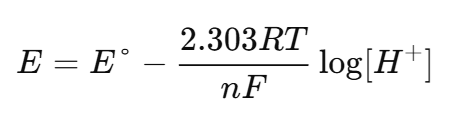
Where:
- E = Electrode potential
- E° = Standard electrode potential
- R = Gas constant
- T = Temperature in Kelvin
- n = Number of electrons involved
- F = Faraday constant
The meter interprets this electrical signal and displays it as pH value using:
pH = − log [H+]
Pacorr’s advanced microprocessor-based meters perform these calculations digitally, offering stable, precise, and repeatable results.
Diagram of pH Meter and Its Components
Here’s a simplified diagram of a standard pH meter setup:
+-----------------------------------+
| pH Meter |
|-----------------------------------|
| Display Unit | Calibration Knobs|
+-----------------------------------+
| |
Glass Electrode Reference Electrode
| |
+------------+
|
Sample Solution
Main Components Explained:
- Glass Electrode:
The main sensor that detects hydrogen-ion activity. It has a thin glass bulb containing an internal reference solution and silver chloride wire. - Reference Electrode:
Maintains a constant potential for comparison (commonly Ag/AgCl or Calomel electrode). - Temperature Sensor:
Compensates for temperature variations affecting ion activity. - Amplifier and Display:
Amplifies the weak millivolt signal and converts it to readable digital pH. - Calibration System:
Allows standardization using known buffer solutions (pH 4.00, 7.00, and 9.18).
Pacorr’s pH meters integrate these components in a compact, durable design, ensuring long-term accuracy and performance.
Types of pH Meters
1. Benchtop pH Meter
- Laboratory-grade precision.
- Used for chemical analysis, pharmaceuticals, and academic research.
- Provides high accuracy and data logging.
2. Portable pH Meter
- Lightweight, battery-operated, ideal for field testing.
- Common in water testing plants, agriculture, and food processing.
3. Pen-Type pH Meter
- Compact, easy-to-carry design.
- Used for aquariums, hydroponics, and basic field work.
4. Industrial Inline pH Meter
- Fixed in industrial pipelines for continuous process monitoring.
- Equipped with transmitters and controllers for automation.
5. Combination Electrodes
- Merge reference and glass electrodes into one unit.
- Offer faster, more stable readings and reduced maintenance.
Pacorr’s digital and portable pH meters are designed for versatility, durability, and maximum precision across all environments.
Calibration of pH Meter
Calibration ensures your meter produces accurate and traceable readings.
Steps to Calibrate:
- Clean the electrode with distilled water and gently dry it.
- Immerse in pH 7.00 buffer solution (neutral point) → adjust reading.
- Rinse and immerse in pH 4.00 (acidic) and pH 9.18 (alkaline) buffers for slope correction.
- Save calibration and proceed to testing.
Pacorr’s digital meters feature auto calibration and auto temperature compensation (ATC), minimizing manual error.
Working Procedure of a pH Meter
- Turn on and calibrate the pH meter.
- Pour the sample solution into a clean beaker.
- Immerse the electrode(s) into the sample.
- Wait for a stable reading to appear on display.
- Record the value and rinse electrodes before the next test.
This simple procedure allows accurate pH analysis across liquids, gels, and semi-solids.
Applications of pH Meter
1. Water and Wastewater Treatment
- Determines pH levels for safe drinking water and effluent treatment.
- Ensures compliance with EPA and BIS standards.
2. Food and Beverage Industry
- Monitors pH in dairy, meat, wine, and fermentation processes.
- Maintains taste, shelf life, and microbial safety.
3. Pharmaceutical Industry
- Controls acidity in drug formulations and solutions.
- Ensures product stability and effectiveness.
4. Cosmetics and Personal Care
- Maintains skin-friendly pH in creams, lotions, and shampoos.
- Prevents irritation and ensures consistency.
5. Agriculture and Soil Testing
- Determines soil pH for fertilizer optimization and crop yield.
- Helps select pH-tolerant crops.
6. Chemical and Petrochemical Plants
- pH control during acid-base reactions and corrosion-prevention treatments.
- Used in plating, dyeing, and neutralization processes.
7. Environmental Monitoring
- Tests river, lake, and rainwater for pollution control and ecological balance.
8. Education and Research
- Used in schools, universities, and R&D labs to study chemistry and environmental science.
Factors Affecting pH Meter Accuracy
- Temperature Variations – Ion activity changes with temperature.
- Electrode Condition – Dirty or damaged electrodes lead to drift.
- Calibration Errors – Infrequent calibration causes inaccuracy.
- Sample Contamination – Cross-mixing can distort results.
- Improper Storage – Electrodes must remain moist to function properly.
Pacorr meters overcome these issues with auto calibration, high-sensitivity probes, and durable design.
Advantages of Using pH Meters
- Quick and precise readings.
- Digital display for user convenience.
- Applicable across various industries.
- Low maintenance and long life.
- Reliable for ASTM and ISO testing standards.
Pacorr’s focus on quality and precision ensures users experience trusted results every time.
Maintenance and Care
Do’s:
- Always rinse with distilled water.
- Store electrode in buffer or storage solution.
- Calibrate daily if used frequently.
- Keep the glass bulb moist.
Don’ts:
- Never wipe the glass bulb dry.
- Avoid exposure to high temperatures for long durations.
- Do not store electrodes in distilled water for extended periods.
Pacorr offers calibration and maintenance support to keep your instruments performing perfectly.
Troubleshooting Common pH Meter Issues
| Issue | Possible Cause | Solution |
| Reading not stable | Electrode dirty or dry | Clean and rehydrate |
| Slow response | Aged electrode | Replace probe |
| Incorrect calibration | Temperature drift | Recalibrate with ATC |
| No display | Loose connection | Check cables and sockets |
| Large pH drift | Contaminated buffers | Use fresh standard buffers |
Pacorr’s technical team provides after-sales service, spare electrodes, and calibration kits, ensuring smooth operation for years.
Recent Innovations in pH Measurement
Pacorr’s latest digital pH meters integrate:
- Microprocessor-based systems
- Auto temperature compensation
- Backlit LCD display
- RS-232/USB connectivity for data transfer
- Waterproof portable housing
- Automatic calibration and data logging
These innovations enhance precision and make Pacorr a preferred choice among manufacturers, suppliers, and exporters of testing instruments globally.
Why Choose Pacorr pH Meters?
ISO-Certified Manufacturer – Ensures quality and compliance.
Accurate & Durable Instruments – Built for long-term lab and field use.
Strong After-Sales Support – Technical and calibration guidance.
Custom Solutions – Tailored pH meters for specific industries.
Global Reach – Trusted by clients across India and abroad.
Contact Pacorr Testing Instruments today at +91-8882149230
Visit www.pacorr.com for product details, demos, and inquiries.
Frequently Asked Questions (FAQs)
Q1. What is the working principle of a pH meter?
A pH meter works on the principle of electrochemical potential difference between a glass electrode and a reference electrode. This potential is related to the hydrogen ion concentration in a solution, which the meter converts into a pH value using the Nernst equation.
Q2. What is the pH range of a pH meter?
Most laboratory pH meters measure from 0 to 14 pH, where 0 is highly acidic, 7 is neutral, and 14 is highly alkaline. Advanced models from Pacorr can measure even beyond this range with specialized electrodes.
Q3. Why is calibration important in a pH meter?
Calibration ensures the meter gives accurate and consistent readings. Regular calibration with standard buffer solutions (pH 4.00, 7.00, 9.18) corrects electrode drift and compensates for aging or contamination.
Q4. How often should I calibrate my pH meter?
For routine testing, calibrate daily or before each testing session. In critical applications (like pharmaceuticals or food), calibration before every batch is recommended.
Q5. What is the difference between a portable and benchtop pH meter?
A benchtop pH meter provides higher accuracy and is ideal for laboratory use, while a portable pH meter is designed for field testing where convenience and mobility are key.
Q6. How can I maintain the electrode for longer life?
Always store the electrode in storage or buffer solution, avoid drying, and rinse after every test. Never wipe the glass bulb; instead, gently blot with tissue to avoid static charges.
Q7. Can a pH meter measure non-aqueous solutions?
Yes, but accuracy may reduce. Specialized electrodes and calibration methods are recommended for non-aqueous or low-conductivity samples.
Q8. What causes erratic or fluctuating readings?
Fluctuating readings are often due to dirty electrodes, low electrolyte levels, or temperature fluctuations. Regular cleaning and temperature compensation solve most issues.
Q9. What industries use pH meters most frequently?
pH meters are essential in water treatment, food & beverage, pharmaceuticals, agriculture, cosmetics, and research laboratories — wherever liquid chemistry needs monitoring.
Q10. Why choose Pacorr pH meters over other brands?
Pacorr pH meters are microprocessor-controlled, ISO-certified, durable, and easy to use, offering unmatched accuracy, support, and long life for both laboratory and field testing.
The pH meter is a cornerstone of analytical testing, enabling industries to control quality, safety, and process efficiency. Understanding its principle, structure, calibration, and applications ensures accurate results every time.
With Pacorr Testing Instruments, you gain the confidence of precision-engineered technology, backed by expert support and reliability. Whether you’re monitoring water purity, testing soil, or conducting advanced chemical research, Pacorr offers the perfect pH testing solution for your needs.
Recent Blogs
Enhance your understanding of testing and precise quality control indistinct applications with our
knowledge based articles coming from top editors of industry leaders.
Thanks to Pacorr Testing instruments, we have all the required quality testing instruments that have helped us to ensure the best quality delivered to our clients.

Danish
Fair Exports Pvt. Ltd.
