
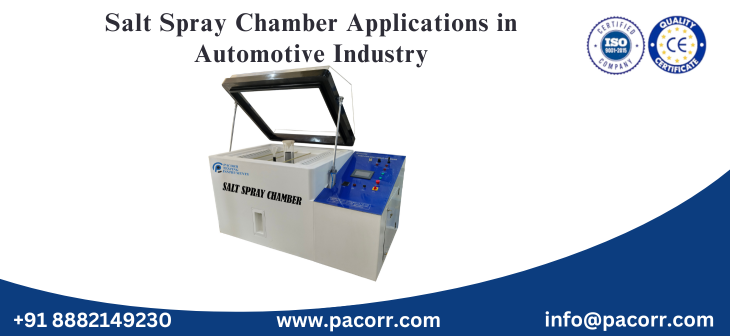
When it comes to advanced material testing for the automotive industry, Pacorr’s Salt Spray Chamber stands out as a crucial instrument for ensuring the long-term durability and quality of automotive components. The increasing complexity of vehicle manufacturing, combined with rising customer expectations for longevity and performance, makes corrosion resistance testing more important than ever. In this in-depth article, we will explore how Pacorr’s Salt Spray Chamber is revolutionizing automotive quality control, why salt spray testing is essential for automotive parts, and the multiple applications of this chamber within the automotive sector.
Understanding Salt Spray Chamber and Its Relevance in Automotive Testing
A Salt Spray Chamber, also referred to as a salt fog chamber or corrosion test chamber, is an advanced testing device that simulates harsh environmental conditions to assess the corrosion resistance of materials, coatings, and finished products. In the automotive industry, where vehicles and parts are continuously exposed to moisture, salt, chemicals, and varying temperatures, testing for corrosion resistance is a vital quality assurance step. By leveraging Pacorr’s Salt Spray Chamber, manufacturers can replicate years of weather exposure in a controlled, accelerated laboratory environment, making it possible to identify vulnerabilities in metals, coatings, paints, and assemblies before they reach the consumer.
Why Salt Spray Testing Is Critical in the Automotive Industry
Corrosion is one of the most significant challenges faced by automotive manufacturers. It affects not only the vehicle’s appearance but also its structural integrity and operational safety. Rust and corrosion can lead to premature failure of critical parts such as chassis, fasteners, brake systems, underbody components, and even decorative trims. Pacorr’s Salt Spray Chamber enables manufacturers and R&D professionals to conduct rigorous salt spray tests that predict product lifespan, compare coatings, and select materials that offer maximum protection against aggressive environments.
Major Applications of Salt Spray Chamber in Automotive Industry
1. Evaluating Metal Components for Corrosion Resistance
Most vehicles are built using a combination of ferrous and non-ferrous metals. From frames to exhaust systems and engine parts, metal is everywhere in an automobile. Pacorr’s Salt Spray Chamber is extensively used to test the corrosion resistance of these metals under simulated salty, humid conditions. By subjecting metal samples to a continuous salt fog, manufacturers can compare the performance of different metal alloys, protective coatings, or surface treatments and make data-driven decisions to reduce warranty claims and ensure consumer safety.
2. Testing Coatings, Paints, and Platings
Protective coatings and paints are critical barriers against environmental exposure. Automotive manufacturers apply a wide range of coatings including powder coating, electroplating, galvanizing, and organic paints. Salt Spray Chamber applications in automotive industry specifically focus on evaluating these coatings’ ability to resist salt-induced corrosion, chipping, blistering, or under-film rust. By using Pacorr’s advanced chambers, QA teams can optimize coating thickness, select suitable paint formulations, and benchmark supplier performance to meet global standards such as ASTM B117 and ISO 9227.
3. Ensuring Durability of Fasteners and Connectors
Automobiles rely on thousands of fasteners, bolts, nuts, and connectors to hold structural and functional components together. These small parts are often exposed to moisture and road salts, making them prone to corrosion and potential failure. Pacorr’s Salt Spray Chamber plays a vital role in the automotive industry by simulating years of exposure in days, helping engineers and quality control specialists verify the effectiveness of protective platings and lubricants applied to fasteners and connectors.
4. Verifying Plastic and Polymer Coated Parts
Many automotive parts are now manufactured using advanced plastics, polymers, or composite materials, often coated with metallic or organic films for added protection. The Salt Spray Chamber applications in automotive industry extend to these materials, allowing OEMs and suppliers to assess the adhesion and anti-corrosive properties of coatings on non-metallic substrates. This ensures that exterior trims, emblems, door handles, and interior fixtures maintain their appearance and functionality throughout a vehicle’s life.
5. Research and Development for New Materials and Surface Treatments
The automotive industry is constantly innovating with new lightweight alloys, eco-friendly materials, and high-performance coatings. Pacorr’s Salt Spray Chamber serves as a critical tool in the R&D process, enabling scientists and engineers to evaluate new surface treatment technologies, test corrosion inhibitors, and develop advanced anti-corrosive formulations. By providing reliable, repeatable data, the chamber helps accelerate product development cycles and bring safer, more durable vehicles to market.
6. OEM Supplier Quality Assurance and Compliance
Original Equipment Manufacturers (OEMs) rely heavily on a global network of suppliers for components. Salt spray testing, using Pacorr’s Salt Spray Chamber, is often a mandatory requirement for suppliers to ensure parts meet OEM corrosion resistance specifications. Routine salt spray chamber testing helps maintain strict quality standards, supports supplier audits, and reduces the risk of recalls or failures in the field.
7. Simulating Real-World Environmental Conditions
Automotive components may be exposed to a variety of climates, from coastal areas with high salt concentration to regions with extreme humidity or temperature fluctuations. Pacorr’s Salt Spray Chamber is engineered to simulate these diverse real-world conditions, providing valuable insights into how materials and assemblies will perform in different geographic markets. This is especially critical for automotive exports and for meeting international quality certifications.
Key Benefits of Using Pacorr’s Salt Spray Chamber in Automotive Applications
- Accelerated Results: Get corrosion data in days instead of months or years.
- Improved Product Reliability: Minimize the risk of premature failures and warranty issues.
- Cost Savings: Optimize material selection and reduce over-engineering by accurately predicting performance.
- Regulatory Compliance: Easily comply with international standards such as ASTM B117, ISO 9227, and various OEM-specific test protocols.
- Data-Driven Decisions: Support material scientists, engineers, and QA teams with reliable, actionable data.
Common Automotive Components Tested in Salt Spray Chambers
- Chassis and subframes
- Exhaust systems and mufflers
- Brake discs and calipers
- Body panels and trim pieces
- Fasteners, bolts, and nuts
- Fuel tanks and lines
- Suspension arms and linkages
- Mirror brackets and door handles
- Electrical connectors and harnesses
Enhancing Trustworthiness: How Pacorr Ensures Reliable Salt Spray Chamber Testing
Pacorr has established itself as a leader in material testing solutions by integrating robust engineering, user-friendly features, and strict calibration protocols into its Salt Spray Chambers. Every Pacorr chamber is designed for repeatable, reliable results with digital controls, uniform salt fog distribution, and advanced safety features. This commitment to precision ensures that automotive manufacturers can trust the results and make informed decisions about product quality.
Expert Insights: Best Practices for Salt Spray Testing in the Automotive Industry
- Standardize Test Samples: Use samples representative of real-world production to get accurate results.
- Monitor Environmental Conditions: Control temperature, humidity, and salt concentration within the chamber.
- Document and Analyze: Maintain detailed records for every test cycle to identify trends and outliers.
- Regular Calibration: Schedule periodic calibration and maintenance for the Salt Spray Chamber to ensure consistent performance.
- Combine with Other Tests: Use salt spray testing alongside humidity, cyclic, and field tests for comprehensive corrosion analysis.
Conclusion: The Future of Automotive Quality with Pacorr’s Salt Spray Chamber
As the automotive industry evolves, the demand for high-performance, corrosion-resistant vehicles grows stronger. Salt Spray Chamber applications in automotive industry have become an industry standard for validating materials, coatings, and component integrity. Pacorr’s unwavering focus on innovation and reliability makes its Salt Spray Chamber a preferred choice for automotive manufacturers, OEMs, and R&D labs worldwide. With precise testing capabilities, data-driven insights, and a reputation for trustworthiness, Pacorr empowers the automotive sector to deliver vehicles that are not only safe and durable but also ready to withstand the harshest environments on the road.
By embracing Pacorr’s Salt Spray Chamber, the automotive industry takes a decisive step towards quality, safety, and customer satisfaction—setting new benchmarks for excellence in corrosion resistance and product performance.
Recent Blogs
Enhance your understanding of testing and precise quality control indistinct applications with our
knowledge based articles coming from top editors of industry leaders.
Thanks to Pacorr Testing instruments, we have all the required quality testing instruments that have helped us to ensure the best quality delivered to our clients.

Danish
Fair Exports Pvt. Ltd.
