

Pacorr Testing Instruments, a trusted name in material testing solutions, brings you an in-depth guide on how to calculate the coefficient of static friction with precision and clarity. Understanding static friction is essential in industries ranging from automotive and packaging to rubber, plastic, and metal testing, where the control of friction directly affects product quality and performance.
Before diving into formulas and measurements, it’s vital to grasp what static friction means and why determining its coefficient is crucial in quality control and R&D applications.
What is Static Friction?
Static friction is the resisting force that prevents two surfaces from sliding over each other when an external force is applied. It comes into play when an object is at rest and needs a certain amount of force to initiate motion.
For example, when a block rests on a table, you must apply a minimum force to make it slide — that resistance is static friction.
This property is essential in engineering, manufacturing, and material testing because it helps evaluate:
- Surface roughness and texture
- Grip or slip resistance of materials
- Adhesion quality between two surfaces
- Safety and performance of packaging materials
Pacorr helps industries analyze such parameters accurately with its advanced range of testing instruments.
Understanding the Coefficient of Static Friction
The coefficient of static friction (μₛ) is a dimensionless number representing the ratio of maximum static frictional force to the normal reaction force.
It defines how easily one surface will start moving over another and varies depending on surface material, texture, and cleanliness.
Mathematically,
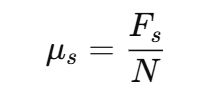
Where:
- μₛ = Coefficient of static friction
- Fₛ = Force required to overcome static friction (in Newtons)
- N = Normal force acting on the object (in Newtons)
Step-by-Step: How to Calculate Static Friction Coefficient
Here’s the smart and systematic approach recommended by Pacorr Testing Instruments:
Step 1: Determine the Normal Force (N)
Normal force is the force exerted perpendicular to the contact surface.
For a flat horizontal surface,
N = mg
Where m is the object’s mass (in kilograms) and g is acceleration due to gravity (9.8 m/s²).
Example:
If the mass of an object is 2 kg, then
N = 2×9.8 = 19.6N
Step 2: Measure the Force Required to Overcome Static Friction (Fₛ)
Using a force gauge or friction tester, slowly apply a pulling force until the object just starts to move. Record that force as Fₛ.
For example, if it takes 6 N to initiate motion, that is your static friction force.
Step 3: Apply the Formula
Now,

Hence, the coefficient of static friction is 0.31 for this surface pair.
Factors Affecting the Coefficient of Static Friction
Several factors can influence friction measurement, including:
- Surface Texture – Rougher surfaces increase friction.
- Material Type – Rubber on metal vs. metal on metal will have different coefficients.
- Surface Cleanliness – Lubrication or dust can reduce static friction.
- Contact Area and Pressure – Larger areas or uneven load distribution affect results.
- Temperature and Humidity – Environmental changes alter surface adhesion.
Pacorr’s precision instruments ensure these factors are monitored and controlled during testing to guarantee consistent and reliable results.
Pacorr’s Role in Friction Testing
Pacorr designs and supplies advanced friction testing equipment that helps manufacturers accurately determine both static and kinetic friction coefficients.
Key features of Pacorr’s testing solutions include:
- High-precision load sensors
- Digital force gauge interface
- Adjustable speed and load range
- Compliant with ASTM D1894, ISO 8295, and other international standards
- Ideal for testing plastic films, packaging laminates, coatings, rubber, and textiles
These instruments provide accurate data that helps industries optimize surface design, product safety, and performance.
Applications of Static Friction Measurement
Knowing the coefficient of static friction is critical across multiple sectors:
- Packaging Industry: To prevent slippage in stacked cartons or films.
- Automotive Industry: For tire grip and braking safety analysis.
- Textile Industry: To study the smoothness and slip behavior of fabrics.
- Rubber and Plastic Industry: For testing adhesion and mold release properties.
- Construction Materials: To analyze bonding between concrete layers.
Pacorr’s testing solutions make these applications measurable and actionable through precision results.
Why Choose Pacorr for Friction Testing?
- Accurate and repeatable results with digital calibration
- User-friendly design for lab and on-site analysis
- Compliance with international testing standards
- Dedicated technical support for installation, demo, and training
- Trusted by global manufacturers and exporters
For inquiries or demonstrations, contact Pacorr Testing Instruments at:
+91-8882149230
info@pacorr.com
www.pacorr.com
FAQs on Static Friction Coefficient
Q1. What is the unit of static friction coefficient?
It is dimensionless (no unit) since it’s a ratio of two forces.
Q2. Can the coefficient of static friction be greater than 1?
Yes, in cases of very rough or sticky surfaces, μₛ can exceed 1.
Q3. What is the difference between static and kinetic friction?
Static friction acts when the object is at rest; kinetic friction acts once motion starts.
Q4. How often should friction tests be performed?
For quality assurance, periodic testing (weekly or per batch) is recommended, depending on the industry standards.
Q5. Which instruments are used for testing static friction?
Friction testers or slip resistance testers such as those offered by Pacorr Testing Instruments.
Conclusion
Calculating the coefficient of static friction is a key process for understanding how materials interact under load. Whether it’s for packaging, automotive, or manufacturing, Pacorr ensures that your testing process is accurate, reliable, and compliant with global standards.
With Pacorr’s smart testing solutions, engineers and manufacturers can confidently measure frictional performance and enhance product quality with scientific precision.
Recent Blogs
Enhance your understanding of testing and precise quality control indistinct applications with our
knowledge based articles coming from top editors of industry leaders.
Thanks to Pacorr Testing instruments, we have all the required quality testing instruments that have helped us to ensure the best quality delivered to our clients.

Danish
Fair Exports Pvt. Ltd.
