
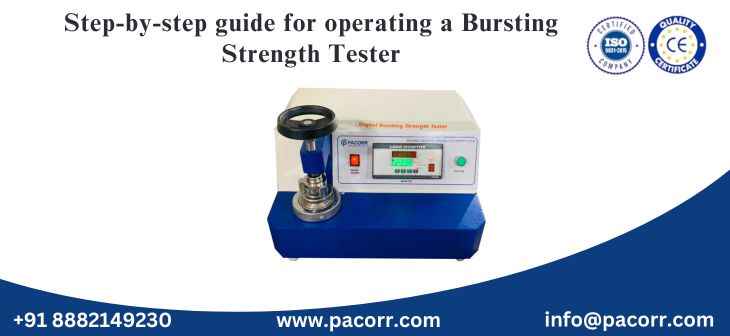
When it comes to precision in packaging and materials testing, Pacorr has emerged as a trusted name among industry professionals. Their Bursting Strength Tester is one of the most reliable instruments used in quality control laboratories for assessing the strength and durability of paper, cardboard, textiles, and packaging materials. For anyone new to quality assurance or experienced professionals seeking optimal testing accuracy, understanding the correct way to operate a bursting strength tester is vital.
This step-by-step guide to operate a bursting strength tester will not only enhance your knowledge but also help you achieve consistent, dependable results every time. If you are looking for a guide that embodies experience, expertise, authoritativeness, and trustworthiness, you are in the right place.
What Is a Bursting Strength Tester?
Before diving into the step-by-step operation, it is crucial to understand what a bursting strength tester is and why it plays a pivotal role in quality assurance. Pacorr’s Bursting Strength Tester is an advanced laboratory instrument designed to determine the bursting strength of various materials such as paper, corrugated fiberboard, textiles, and synthetic sheets. This testing instrument helps manufacturers maintain product quality by ensuring materials meet required strength standards.
Bursting strength refers to the ability of a material to withstand pressure applied perpendicular to its surface until it ruptures. This property is critical for packaging materials, as it determines their resistance against external forces during shipping and handling.
Key Features of Pacorr Bursting Strength Tester
Pacorr’s bursting strength testers are known for their robust construction, precision engineering, and user-friendly design. Here are some of the prominent features you will find in a typical Pacorr bursting strength tester:
- Microprocessor-based digital display for accurate readings
- High-grade stainless steel diaphragm to ensure consistent results
- User-friendly controls for ease of operation
- Pressure gauge with high resolution
- Adjustable clamping mechanism for secure sample placement
- Automatic and manual test cycles
- Safety features to prevent overpressure and mishandling
These features ensure that the Pacorr bursting strength tester delivers reliable results every time, making it a preferred choice among quality control professionals.
Applications of Bursting Strength Tester
The applications of a bursting strength tester are extensive across different industries. Some of the primary uses include:
- Paper and packaging industry: To test the strength of cartons, corrugated boards, paper sheets, and packaging materials.
- Textile industry: To assess the burst resistance of fabrics and synthetic sheets.
- Leather industry: To evaluate the strength of leather sheets and goods.
- Pharmaceutical packaging: To ensure blister packs and cartons are fit for transportation.
By employing a bursting strength tester, manufacturers can confidently assure the durability and performance of their products.
Step-by-Step Guide to Operate a Bursting Strength Tester
The core of this article is a detailed, step-by-step guide to operate a bursting strength tester. This guide is suitable for both new users and seasoned professionals who want to refresh their operational knowledge.
Step 1: Preparation and Calibration
Before you begin any testing, preparation and calibration of the bursting strength tester is essential.
- Power on the machine: Ensure the device is connected to a stable power source.
- Check calibration: Calibrate the tester using standard calibration weights or reference samples provided by Pacorr. Proper calibration ensures the accuracy and reliability of test results.
- Inspect the diaphragm: Examine the diaphragm for any wear, tear, or damage, as this could affect the test outcomes.
- Clean the clamping surfaces: Ensure the clamping areas are clean and free from dust, debris, or residue from previous tests.
Expert Tip: Always calibrate your bursting strength tester at the start of each testing cycle to maintain accuracy and repeatability.
Step 2: Sample Preparation
Proper sample preparation is key to obtaining reliable and consistent results.
- Select the sample: Choose a representative sample of the material to be tested. Ensure the sample is free from creases, folds, or defects.
- Cut the sample to size: Follow industry standards or testing protocols for the sample dimensions. For most packaging materials, circular or square samples are standard.
- Condition the sample: If required, allow the sample to acclimate to the testing environment to minimize the impact of humidity or temperature fluctuations.
Expert Insight: Conditioning your sample as per relevant standards (such as ASTM or ISO) ensures that results are valid and comparable.
Step 3: Positioning the Sample
Correct sample placement is crucial for accurate testing.
- Open the clamping mechanism: Most Pacorr bursting strength testers feature an easy-to-operate clamping handle or lever.
- Place the sample: Position the sample centrally over the diaphragm.
- Secure the sample: Gently lower the upper clamp to hold the sample firmly in place. Avoid overtightening, as this could damage the material or affect the test outcome.
Authoritative Note: Uniform clamping ensures that the pressure is applied evenly, resulting in consistent bursting strength measurements.
Step 4: Initiating the Test
With the sample secured, you can now proceed to conduct the actual bursting strength test.
- Set the test mode: Choose between automatic or manual testing cycles as per your requirements.
- Start the machine: Press the start button to begin the test. The machine will gradually apply hydraulic pressure to the sample via the diaphragm.
- Observe the process: Monitor the digital display and pressure gauge as the sample is subjected to increasing pressure.
Step 5: Reading and Recording Results
Capturing accurate data is critical for quality assurance and compliance.
- Watch for rupture: The test ends when the sample bursts, and the peak pressure value is automatically recorded by the digital display.
- Record the bursting strength: Note the highest pressure reading, as this represents the bursting strength of your sample. Pacorr bursting strength testers typically display results in kilograms per square centimeter (kg/cm²) or pounds per square inch (psi).
- Repeat for consistency: Conduct multiple tests on different samples from the same batch to obtain an average value and identify any inconsistencies.
Trustworthy Practice: Document all results clearly and maintain records for future reference and audits.
Step 6: Post-Test Procedures and Maintenance
Maintaining your bursting strength tester ensures its longevity and consistent performance.
- Remove the burst sample: Carefully dispose of the tested sample and clean any residue left on the diaphragm or clamps.
- Check for residue: Inspect the diaphragm for any fragments or residues that could interfere with future tests.
- Power off the machine: When all tests are complete, switch off the device and disconnect from the power source if necessary.
- Regular maintenance: Periodically lubricate moving parts, check the integrity of hoses and seals, and ensure all electronic components are functioning optimally.
Trustworthy Maintenance Advice: Regular preventive maintenance as recommended by Pacorr helps prolong the life of your bursting strength tester and reduces downtime.
Common Mistakes to Avoid When Using a Bursting Strength Tester
While operating a bursting strength tester is straightforward, avoiding common errors is vital for accurate results:
- Skipping calibration: Always calibrate before testing
- Improper sample preparation: Ensure samples are free from defects and cut to the correct size
- Incorrect clamping: Avoid over-tightening or under-tightening the sample
- Neglecting maintenance: Regular cleaning and servicing are essential for long-term accuracy
By following these best practices, you can maximize the value and reliability of your Pacorr bursting strength tester.
Conclusion
Pacorr’s Bursting Strength Tester is an indispensable tool for any quality assurance lab or production facility aiming for excellence in product quality. With its advanced features, intuitive controls, and robust construction, Pacorr’s instrument offers unmatched reliability for testing the strength of packaging and sheet materials. By adhering to this step-by-step guide to operate a bursting strength tester, you ensure that your testing process meets the highest standards of accuracy and efficiency.
Trust in Pacorr’s expertise and make every test count—consistently delivering quality products that withstand the rigors of the supply chain.
Recent Blogs
Enhance your understanding of testing and precise quality control indistinct applications with our
knowledge based articles coming from top editors of industry leaders.

Thanks to Pacorr Testing instruments, we have all the required quality testing instruments that have helped us to ensure the best quality delivered to our clients.

Danish
Fair Exports Pvt. Ltd.
