
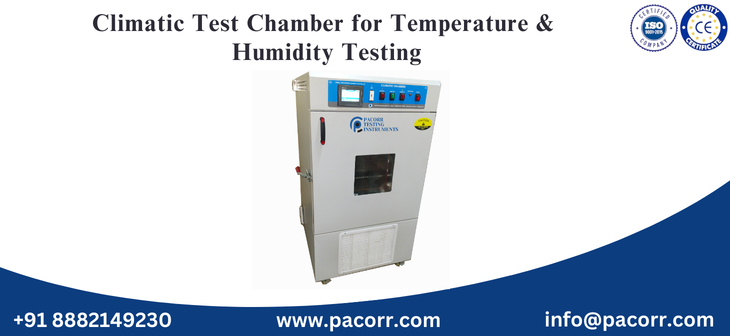
Pacorr understands that product quality today is defined not just by how something looks or functions on Day 1, but by how reliably it performs over months and years in real environmental conditions. This is where a Climatic Test Chamber becomes a critical part of modern quality assurance-helping manufacturers simulate temperature and humidity stresses before products reach the market.
From electronics and automotive to pharmaceuticals and packaging, temperature & humidity testing is now a non-negotiable requirement for compliance, durability, and customer trust.
What Is a Climatic Test Chamber?
A Climatic Test Chamber is an advanced environmental testing system designed to replicate controlled temperature and humidity conditions to evaluate a product’s performance, safety, and stability.
A climatic test chamber exposes materials, components, or finished products to programmed temperature and humidity cycles to identify failures, material degradation, or performance changes under simulated real-world environments.
These chambers allow manufacturers to:
- Detect early-stage defects
- Validate product reliability
- Ensure compliance with international standards
- Reduce field failures and warranty claims
Why Are Temperature & Humidity Tests So Critical?
Because environmental stress is one of the biggest reasons products fail prematurely.
Temperature and humidity variations can lead to:
- Expansion and contraction of materials
- Moisture absorption and corrosion
- Electrical short circuits and insulation breakdown
- Loss of mechanical strength
- Chemical instability in pharmaceuticals
A well-designed Humidity Chamber reveals these risks long before products are shipped-saving both cost and reputation.
Pacorr Insight:
Most product failures are not sudden; they are cumulative. Long-duration conditioning under controlled humidity is often where hidden weaknesses surface.
Climatic Test Chamber vs Humidity Chamber vs Conditioning Chamber
Although these terms are often used interchangeably, they serve slightly different purposes:
| Chamber Type | Core Purpose | Typical Application |
| Climatic Test Chamber | Temperature + Humidity cycling | Environmental stress testing |
| Humidity Chamber | Controlled moisture exposure | Corrosion & moisture resistance testing |
| Conditioning Chamber | Sample stabilization | Pre-test conditioning as per standards |
How Does a Climatic Test Chamber Work?
A climatic test chamber uses integrated heating, cooling, humidification, and airflow systems controlled by high-precision sensors to maintain stable environmental conditions.
Step-by-step working logic:
- User programs temperature and humidity parameters
- Sensors continuously monitor chamber conditions
- Heating, refrigeration, and humidification systems adjust in real time
- Uniform airflow ensures consistent exposure
- Test data is logged for analysis and reporting
This structured control is essential for repeatable, globally acceptable test results.
Key Technical Parameters That Matter Most
When selecting a Climatic Test Chamber, technical depth matters more than just range values.
1. Temperature Range & Accuracy
- Typical range: -40°C to +180°C
- Accuracy and uniformity are more critical than extreme limits
2. Humidity Control Capability
- Relative humidity range: 10% to 98% RH
- Stable control prevents condensation-related errors
3. Airflow Design
- Ensures even heat and moisture distribution
- Prevents localized hot or cold spots
4. Control & Data Logging
- Programmable cycles
- Alarm systems for deviations
- Traceable test data for audits
Pacorr designs chambers with testing consistency as the primary focus-because unreliable data is worse than no data.
Industries That Depend on Climatic Test Chambers
Environmental testing is essential across high-risk and compliance-driven industries:
- Electronics: PCB reliability, battery safety, connectors
- Automotive: Sensors, rubber seals, interiors
- Pharmaceuticals: Stability and shelf-life studies
- Packaging: Corrugated boxes, plastics, laminates
- Textiles & Polymers: Strength, color stability, aging behavior
Pacorr’s chambers are engineered to support industry-specific test protocols without overcomplication.
Common Testing Mistakes (And How to Avoid Them)
Even with advanced equipment, test accuracy can suffer due to process errors:
- Overloading samples inside the chamber
- Skipping stabilization time
- Poor calibration discipline
- Ignoring airflow clearance
- Running incorrect test profiles
A climatic test chamber is a precision instrument-not a storage box. Proper test planning matters as much as the machine itself.
How Pacorr Supports Reliable Environmental Testing
Pacorr brings more than just equipment to the table. Our value lies in application knowledge and long-term testing reliability.
What sets Pacorr apart:
- Deep understanding of testing standards (ISO, ASTM, IEC, BIS)
- Application-based chamber customization
- Focus on accuracy, repeatability, and durability
- Strong technical support and guidance
This makes Pacorr a trusted name among quality engineers and R&D teams.
Frequently Asked Questions (FAQs)
What is the main purpose of a climatic test chamber?
To evaluate how products behave under controlled temperature and humidity conditions over time.
Is a humidity chamber enough for all testing?
No. A humidity chamber focuses only on moisture, while a climatic test chamber handles combined thermal and humidity stress.
What standards require climatic testing?
Common standards include ISO, ASTM, IEC, BIS, and MIL-STD, depending on industry and product type.
How long does a typical climatic test run?
Test duration varies from hours to weeks, based on the test standard and product application.
Why is conditioning required before testing?
A Conditioning Chamber ensures samples reach equilibrium before testing, improving result accuracy.
Conclusion: Why Climatic Testing Is a Quality Investment
A Climatic Test Chamber is not just about compliance-it’s about confidence. Whether you call it a Humidity Chamber or a Conditioning Chamber, its real value lies in preventing failures before they happen.
With Pacorr’s engineering expertise and application-driven approach, manufacturers can achieve accurate, repeatable, and standards-compliant environmental testing-without unnecessary complexity.
Explore more technical insights on Pacorr’s blog or connect with our experts to understand the right climatic testing solution for your application.
Recent Blogs
Enhance your understanding of testing and precise quality control indistinct applications with our
knowledge based articles coming from top editors of industry leaders.
Thanks to Pacorr Testing instruments, we have all the required quality testing instruments that have helped us to ensure the best quality delivered to our clients.

Danish
Fair Exports Pvt. Ltd.
