
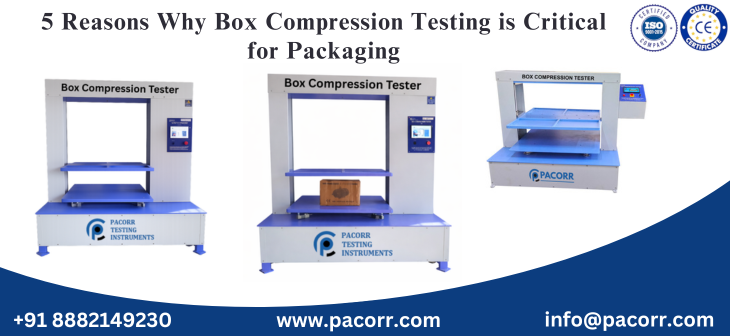
Pacorr understands that packaging is not just a protective shell; it is a performance system that directly influences product safety, warehouse efficiency, shipping reliability, and customer satisfaction. In today’s manufacturing and distribution environment, boxes are exposed to continuous compression loads during stacking, palletization, transportation, and long-term storage. If the packaging fails, the consequences go far beyond a crushed carton. Businesses may face damaged products, rejected consignments, increased return rates, customer complaints, and avoidable financial losses.
This is why the role of a Box Compression Tester has become increasingly important in packaging quality assurance. More specifically, a Box Compression Tester with Touch Screen offers a more advanced and efficient way to evaluate box performance, monitor test parameters, and improve operator control. For packaging manufacturers, corrugated box suppliers, quality engineers, and production teams, the ability to measure actual box strength is essential for making confident packaging decisions.
A properly conducted box compression test helps determine how much top load a carton can withstand before buckling, deforming, or collapsing. This test is widely used to assess corrugated box strength and verify whether boxes are suitable for storage, stacking, and transportation. The BCT test, or Box Compression Test, is one of the most practical methods for understanding the real structural performance of a finished package under compression stress.
As supply chains become more demanding and packaging optimization becomes more important, manufacturers cannot rely on assumptions alone. They need measurable results from a dependable packaging testing machine. In this article, we will explore the five major reasons why box compression testing is critical for packaging, explain the technical relevance of a Box Compression Tester with Touch Screen, and show how the right testing solution can improve both packaging quality and business performance.
What is Box Compression Tester?
A Box Compression Tester is a specialized packaging testing machine used to measure the compression resistance of boxes, cartons, and corrugated shipping containers. It evaluates how much vertical compressive load a package can bear before it loses structural integrity. In simple terms, the machine tells you whether the box is strong enough to survive stacking and handling in real distribution conditions.
This type of equipment is especially important for manufacturers and suppliers using corrugated packaging because box failure often occurs under top-load pressure rather than through visible external damage. During shipment and warehousing, cartons are stacked one over another, sometimes for extended periods. If the box at the bottom cannot support the total weight above it, it may crush, bow, or collapse, leading to product loss and supply chain inefficiency.
A Box Compression Tester with Touch Screen enhances this process by offering an intuitive digital interface for easier operation. Instead of relying on basic manual controls, operators can enter test parameters, observe real-time readings, and track results more efficiently through the touchscreen system. This improves usability, reduces handling errors, and makes the testing process more streamlined for routine lab and factory applications.
The box compression test usually involves placing a box between two compression platens and applying controlled force from the top. The machine measures the amount of force required to deform or crush the box. The resulting value gives a direct indication of the box’s compression strength and stacking capability.
This test is essential for:
- Measuring corrugated box strength
- Determining safe stacking load
- Verifying packaging durability
- Comparing different box designs
- Validating material and structural changes
- Supporting packaging quality control
- Improving supply chain reliability
When a manufacturer uses a Box Compression Tester with Touch Screen, the goal is not just to get a test result. The goal is to make packaging decisions based on actual performance data.
Importance of Box Compression Tester in Quality Testing
Packaging quality cannot be measured only by appearance, board thickness, or visual finish. A carton may look sturdy but still fail under compression when exposed to warehouse stacking or transport loads. That is why the Box Compression Tester plays such a central role in quality testing.
The main value of a box compression test lies in its ability to simulate one of the most common stress conditions a package experiences in real life: vertical load. In warehouses, distribution centers, shipping containers, and retail storage environments, boxes are regularly stacked. The packaging at the bottom of the stack must support all the weight above it. If the box cannot handle that pressure, failure becomes inevitable.
A Box Compression Tester with Touch Screen brings greater control and visibility to this process. It allows testers to set up conditions more precisely, view live force data, and capture test outcomes in a more organized way. This is especially valuable when testing is part of routine quality assurance or production approval.
Why it matters in packaging quality testing
Accurate performance validation
A finished box behaves differently from raw paper or board material. Even if the corrugated sheet itself is strong, the final box may perform poorly due to weak joints, improper dimensions, bad slotting, or poor conversion quality. A BCT test checks the strength of the finished box as a complete structure.
Reliable assessment of corrugated box strength
A Box Compression Tester provides real data about how much load a corrugated box can bear. This helps manufacturers decide whether the box is suitable for actual logistics conditions.
Consistency in production quality
By testing boxes from different batches, businesses can identify variation in packaging quality. This supports tighter control over suppliers, raw materials, and box manufacturing processes.
Lower risk of distribution damage
Weak packaging often leads to damaged products and higher return rates. A tested box is far less likely to fail unexpectedly during storage or transport.
Better packaging engineering decisions
Packaging teams can use compression test data to improve box design, reduce excess material, and create cost-effective packaging solutions without sacrificing performance.
In short, the Box Compression Tester with Touch Screen is a critical quality tool because it converts packaging assumptions into measurable facts.
5 Reasons Why Box Compression Testing is Critical for Packaging
1. It Protects Products Against Compression Damage
The first and most fundamental reason for performing a box compression test is product protection. A box that cannot maintain its structure under pressure puts the contents at risk. This is particularly serious in industries where products are fragile, heavy, high-value, or sensitive to impact.
During shipping and storage, cartons are commonly exposed to:
- Top-load stacking pressure
- Palletized storage loads
- Compression during transport vibration
- Uneven force distribution in warehouses
- Long holding periods in distribution centers
A Box Compression Tester helps determine whether a box can withstand these conditions before it is approved for use. It reveals the maximum load-bearing capacity of the carton and identifies the point at which structural failure begins.
For example, in food, electronics, pharmaceuticals, and e-commerce logistics, product safety depends heavily on packaging integrity. Even if the primary product is well-made, failure of the secondary shipping carton can result in leaks, breakage, contamination, or cosmetic damage.
A Box Compression Tester with Touch Screen makes this verification process more efficient by simplifying test control and enabling better visibility into load readings and deformation patterns. This allows quality teams to make quicker and more reliable packaging decisions.
2. It Provides Real Measurement of Corrugated Box Strength
One of the biggest benefits of the BCT test is that it measures the actual performance of the finished box, not just the raw material. This is an important distinction because packaging strength is influenced by more than just board quality.
The true corrugated box strength depends on a combination of factors such as:
- Flute type and flute geometry
- Number of plies
- Board grade
- Edge crush resistance
- Box dimensions
- Joint strength
- Conversion accuracy
- Moisture exposure
- Printing and die-cutting effects
A box may be made from good-quality corrugated board and still fail in use if its structure is not designed or manufactured properly. A Box Compression Tester with Touch Screen gives manufacturers the ability to test the complete package and evaluate how all these factors affect final performance.
This is especially useful for:
- Comparing alternative box designs
- Verifying supplier quality
- Evaluating new board combinations
- Testing cost-reduced packaging designs
- Identifying performance loss due to humidity or handling
Instead of estimating whether a box is “strong enough,” businesses can confirm its strength through measurable load values and deformation data.
3. It Supports Cost Optimization Without Sacrificing Packaging Performance
Packaging cost control is a major concern across industries. Companies are always looking for ways to reduce board usage, lower packaging weight, improve cube utilization, and cut shipping costs. But reducing material without testing can be risky. A lighter or cheaper box may fail if it does not have adequate compression strength.
A Box Compression Tester helps businesses optimize packaging scientifically. By using real test data, they can determine whether a lower-cost design still meets performance requirements. This allows them to reduce over-packaging while maintaining necessary strength.
A Box Compression Tester with Touch Screen is particularly valuable here because it allows faster test comparison and easier repeat testing across multiple box versions.
This supports decisions such as:
- Reducing board grammage
- Changing flute combinations
- Modifying box dimensions
- Revising wall construction
- Selecting better-performing materials
- Standardizing cost-effective designs
Without compression testing, packaging optimization is often based on guesswork. With a box compression test, it becomes data-driven.
That is one of the strongest reasons businesses invest in a modern packaging testing machine. It not only protects products but also helps reduce unnecessary packaging costs while maintaining performance standards.
Talk to Pacorr for Reliable Packaging Testing Solutions
If your business is looking to improve packaging quality, validate corrugated box strength, or invest in a dependable Box Compression Tester with Touch Screen, connect with Pacorr for expert guidance and advanced testing instruments.
Email: info@pacorr.com
Phone: +91 8882149230
4. It Improves Warehouse Stacking and Storage Efficiency
Warehousing efficiency depends heavily on packaging strength. In most storage environments, products are stacked vertically to maximize floor space and improve inventory management. If lower cartons are not strong enough to handle the load above them, the result can be crushed packaging, unstable stacks, and damaged goods.
A BCT test helps businesses determine the compression load a carton can safely withstand. This allows them to define realistic stacking limits and improve storage planning.
With results from a Box Compression Tester, businesses can make more informed decisions about:
- Maximum stack height
- Pallet loading patterns
- Long-term storage arrangements
- Transportation container loading
- Safe distribution conditions
This is especially useful for industries with high inventory turnover and bulk stacking needs, such as FMCG, food processing, logistics, chemicals, consumer goods, and pharmaceuticals.
A Box Compression Tester with Touch Screen makes this process easier by providing clear parameter setup and real-time result visibility. Operators can monitor the test more effectively, while managers can use the output to align packaging design with warehouse realities.
Better stacking performance leads to:
- Fewer collapsed cartons
- Lower product loss
- Improved warehouse safety
- Better use of vertical storage space
- Greater confidence in packaging consistency
5. It Builds Brand Trust and Reduces Customer Complaints
Packaging is often the first physical impression a customer gets of a brand. Even if the product inside is intact, a damaged or collapsed outer carton creates a negative perception. It suggests weak quality control, poor logistics preparation, or careless handling.
This matters even more in industries where packaging appearance is closely tied to customer satisfaction, such as:
- E-commerce
- Consumer electronics
- Retail goods
- Healthcare products
- Premium packaged products
- Export shipments
A Box Compression Tester helps prevent these issues by ensuring that boxes have enough structural strength to withstand real handling and stacking conditions. When businesses use a Box Compression Tester with Touch Screen as part of their packaging quality system, they are more likely to detect weaknesses early and correct them before the packaging reaches the market.
The result is:
- Better packaging consistency
- Lower return rates
- Improved customer confidence
- Reduced damage claims
- Stronger brand reliability
In competitive industries, packaging performance is not just an operational requirement. It is part of the brand experience.
Key Features of Box Compression Tester
A modern Box Compression Tester with Touch Screen is designed to deliver accurate, repeatable, and operator-friendly performance. The right features improve both test reliability and day-to-day usability.
Important features to look for
- Touch screen interface for simple operation
- High-precision load cell for accurate force measurement
- Strong and rigid machine frame
- Uniform platen movement for even load application
- Real-time force and displacement display
- Peak load recording
- Adjustable testing speed
- Safe overload protection system
- Digital result storage
- Easy positioning for cartons of different sizes
Why touch screen functionality matters
The keyword Box Compression Tester with Touch Screen is especially important because the touch screen is more than a convenience feature. It enhances industrial usability in several ways.
Faster setup
Operators can quickly enter testing parameters and begin the test with fewer manual steps.
Better visibility
The touch screen gives clear display of force, displacement, and peak load values.
Reduced human error
Digital input reduces the chance of incorrect settings and improves repeatability.
Improved training and operation
User-friendly controls make the machine easier for operators to learn and use consistently.
More efficient documentation
Touch-enabled systems often support better result recording and process traceability.
For quality labs that run frequent box compression tests, these usability advantages can significantly improve workflow.
Working Principle of Box Compression Tester
The working principle of a Box Compression Tester with Touch Screen is based on controlled vertical load application. The machine compresses the box from top to bottom while continuously recording the force required to deform or crush it.
Step-by-step process
- The corrugated box is placed on the lower platen of the machine.
- Test parameters are entered through the touch screen interface.
- The upper platen moves downward at a controlled speed.
- Compressive force is applied to the box.
- The machine records force, displacement, and structural response.
- The test continues until the box collapses or reaches the preset condition.
- Final results are shown on the touch screen and can be documented for analysis.
What the machine measures
A box compression test can provide information such as:
- Maximum compression load
- Deformation before failure
- Box collapse point
- Stacking strength performance
- Structural behavior under load
- Consistency across production batches
This makes the BCT test extremely valuable for evaluating corrugated box strength in a practical and repeatable way.
Applications of Box Compression Tester in Different Industries
A Box Compression Tester with Touch Screen has wide application across industries that rely on corrugated boxes, cartons, and secondary shipping containers.
Food and beverage industry
Used to test cartons carrying bottles, cans, pouches, and processed foods where stacking stability is essential.
Pharmaceutical industry
Helps ensure that medicine and healthcare product cartons maintain integrity during transit and storage.
E-commerce and retail packaging
Supports validation of delivery cartons exposed to repeated handling, sorting, and stacking.
Electronics industry
Tests outer cartons used for packing delicate electronic goods that require strong structural support.
FMCG industry
Helps manufacturers maintain consistent packaging quality across high-volume shipments.
Industrial goods and automotive parts
Useful for validating shipping containers carrying dense or heavy components that require strong load-bearing capability.
Export packaging
Important for verifying packaging performance under extended storage and transportation conditions.
In all of these sectors, a packaging testing machine like a Box Compression Tester helps reduce packaging-related failures and improve supply chain confidence.
How to Choose the Right Box Compression Tester
Choosing the right Box Compression Tester with Touch Screen requires attention to both technical performance and operational practicality.
Factors to consider
Load capacity
Select a machine that can handle the force range required for your typical cartons and shipping boxes.
Platform size
Make sure the platen size is suitable for your largest test sample dimensions.
Accuracy and repeatability
The machine should offer dependable readings for comparison, validation, and quality assurance.
Touch screen quality
A responsive, easy-to-read interface improves operator efficiency and reduces setup mistakes.
Build strength
A rigid mechanical structure ensures stable compression and more reliable results.
Data handling capability
Look for a system that supports result display, storage, and documentation.
Application suitability
The machine should match your box size range, testing frequency, and packaging type.
Service and support
Reliable installation, calibration, and after-sales support are essential when investing in a long-term testing system.
A carefully selected Box Compression Tester gives better returns because it improves product safety, packaging optimization, and quality control accuracy.
Why Choose Pacorr for Box Compression Tester
When businesses invest in a Box Compression Tester with Touch Screen, they need a trusted manufacturer that understands packaging performance, industrial quality demands, and long-term equipment reliability. Pacorr offers advanced testing solutions designed to support accurate packaging validation and efficient quality control.
Pacorr’s testing instruments are built to help manufacturers evaluate packaging strength with confidence. Whether the requirement is for regular box compression test analysis, BCT test verification, or improved corrugated box strength assessment, Pacorr provides dependable solutions for modern packaging laboratories and production environments.
Why industries choose Pacorr
- High-quality industrial testing instruments
- Reliable Box Compression Tester with Touch Screen
- Accurate compression load measurement
- Strong machine construction for routine testing
- User-friendly controls for efficient operation
- Consistent performance for packaging validation
- Technical support and customer-focused service
- Solutions suited for packaging manufacturers and quality labs
Pacorr focuses on providing testing equipment that supports smarter packaging decisions, stronger quality systems, and better protection throughout the supply chain.
Conclusion
A Box Compression Tester is one of the most important instruments for evaluating packaging performance in real-world conditions. It helps manufacturers measure load-bearing strength, validate stacking resistance, improve box design, and reduce the risk of packaging failure during storage and transportation. In industries that depend on corrugated cartons, the box compression test is essential for making sure packaging performs the way it should.
The importance of the BCT test continues to grow as businesses face higher shipping demands, greater packaging optimization pressure, and stronger customer expectations. Measuring corrugated box strength is no longer just a technical task; it is a strategic part of quality assurance, cost control, and brand protection.
A Box Compression Tester with Touch Screen adds another level of value by improving operator convenience, visibility, and test consistency. With easier parameter control, clearer result display, and better usability for daily operations, it is an ideal choice for companies that need efficient and accurate packaging evaluation.
If you want to improve packaging reliability, reduce transit damage, and choose a dependable packaging testing machine, Pacorr is ready to help.
To learn more about Pacorr’s Box Compression Tester with Touch Screen and other advanced testing instruments, contact the team today:
Email: info@pacorr.com
Phone: +91 8882149230
Frequently Asked Questions
1. What is a Box Compression Tester with Touch Screen?
A Box Compression Tester with Touch Screen is a packaging testing machine used to measure the compression strength of cartons and corrugated boxes through a digital touch-based control system.
2. Why is a box compression test important?
A box compression test is important because it determines whether a box can withstand vertical stacking loads during warehousing and transportation without collapsing.
3. What does BCT test stand for?
BCT test stands for Box Compression Test. It is used to evaluate the compressive strength and structural performance of a finished box.
4. How does a Box Compression Tester measure corrugated box strength?
The machine applies controlled compressive force to the box and records the maximum load it can withstand before deformation or failure. This helps assess corrugated box strength accurately.
5. What are the benefits of a Box Compression Tester with Touch Screen?
A Box Compression Tester with Touch Screen offers easier operation, better real-time monitoring, more precise parameter setting, and improved testing consistency.
6. Which industries use a Box Compression Tester?
Industries such as food, pharmaceuticals, e-commerce, electronics, FMCG, logistics, and industrial manufacturing commonly use this type of packaging testing machine.
7. How can a BCT test help reduce packaging costs?
A BCT test helps businesses compare packaging designs and optimize material usage while still maintaining necessary box strength and stacking performance.
8. How do I choose the right Box Compression Tester with Touch Screen?
You should evaluate load capacity, platen size, accuracy, touchscreen usability, data recording features, machine build quality, and service support before choosing the right model.
Recent Blogs
Enhance your understanding of testing and precise quality control indistinct applications with our
knowledge based articles coming from top editors of industry leaders.

Thanks to Pacorr Testing instruments, we have all the required quality testing instruments that have helped us to ensure the best quality delivered to our clients.

Danish
Fair Exports Pvt. Ltd.
