
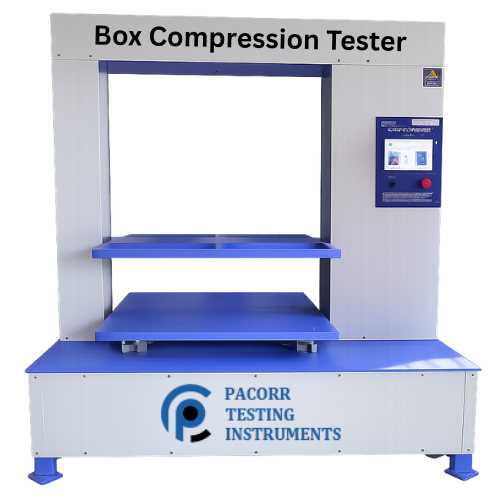
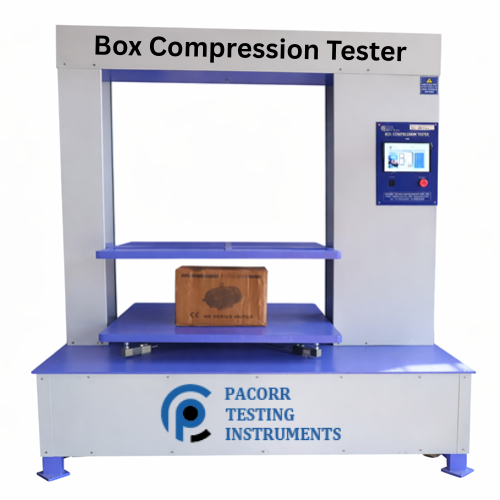
A Box Compression Tester measures the compressive resistance of an assembled corrugated box or transport package by pressing it between two platens under controlled conditions. The test helps packaging teams compare carton designs, check production consistency and investigate failures associated with vertical loading. Pacorr’s PCBCTD digital model provides load indication and peak-load measurement for routine packaging quality control. Available capacities extend from 500 to 3000 kgf, with different platform sizes to suit carton dimensions. Select the configuration according to your expected test force, largest specimen and reporting requirements. Share your carton dimensions, expected compression strength and applicable test method to request a suitable configuration and quotation.
- Shipping Area: All over the world
- Model: PCBCTD
- Brand: Pacorr
- Availability: In Stock


Pacorr Testing Instruments Pvt. Ltd. is a Box Compression Tester manufacturer and supplier in India, offering digital, computerized and touch-screen models for corrugated carton and packaging testing. Available configurations include load capacities from 500 to 3000 kgf and different platform sizes to suit varied carton dimensions. Packaging manufacturers and quality-control laboratories can select a configuration based on expected compression force, specimen size, test procedure and reporting requirements.
What Does a Box Compression Test Tell You?
Box compression testing evaluates the assembled carton, including the combined effects of its panels, corners, joints, creases and closures. This makes it useful when two boxes made from apparently similar board perform differently during handling or storage. A test to failure records the maximum compressive force reached under the specified test conditions. Packaging teams can compare this result with an approved carton specification, assess differences between suppliers or evaluate a proposed change in construction. The result must be interpreted with the specimen condition. An empty carton, a sealed carton containing partitions and a complete filled package can distribute load differently. Reports should identify which arrangement was tested.
How the Machine Works
The prepared carton is placed between the compression platens in the orientation specified by the test procedure. As the moving platen advances, the carton resists the applied force through its assembled structure. The measuring system monitors this force while the carton deforms. During a compression-to-failure test, the load generally increases until the structure loses its ability to carry additional force. The peak reading is recorded together with observations of the failure. A force reading alone does not explain the complete behaviour of a package. Operators should also note whether failure began at a corner, a panel, a closure or a damaged area.
Selecting the Required Test Function
Different compression objectives require different machine capabilities.
| Test objective | Capability to confirm |
| Measure peak compression force | Suitable force range and peak-load capture |
| Check resistance at a target load | Appropriate loading procedure and endpoint control |
| Measure force at a defined deformation | Displacement measurement and suitable result capture |
| Maintain a load for a specified duration | A verified load-holding function |
| Review a test graph | Compatible recording system and the required graph type |
A peak-hold display retains a maximum reading. It does not, by itself, mean that the machine can maintain a constant force on a carton.
Similarly, load-versus-time and load-versus-displacement graphs provide different information. Specify which measurement you need when discussing a computerized configuration.
Preparing and Testing a Carton
- Select specimens using the sampling plan required by your quality procedure.
- Identify the board construction, carton dimensions, batch and supplier.
- Condition specimens according to the applicable method.
- Assemble and close each carton consistently.
- Include the product, partitions and inserts when the method requires a filled package.
- Check machine capacity, platen clearance and the specimen’s test orientation.
- Position the sample as required by the procedure and establish the load reference.
- Apply compression at the specified speed and use the approved endpoint.
- Record the result, units and visible failure pattern.
- Compare the required set of results with the agreed acceptance criteria.
Use the applicable standard and machine operating instructions for the complete procedure. This overview does not replace their detailed requirements.
Understanding the Result
Compression force may be reported in N, kN or kgf. Record the unit with every result and use consistent units when comparing batches or suppliers. For unit conversion, 1 kgf equals approximately 9.80665 N. A result of 300 kgf therefore corresponds to approximately 2.94 kN. This is a force conversion, not an allowable storage-load calculation. A carton that reaches a particular peak during a short laboratory test is not automatically suitable for carrying that same load throughout prolonged storage.
Evaluate the result alongside:
- Specimen dimensions and construction.
- Empty or filled condition.
- Conditioning and test environment.
- Loading speed and endpoint.
- Individual specimen results and their variation.
- Location and nature of failure.
- The acceptance requirements for the intended application.
A batch average can conceal an unusually weak specimen. Review individual results and apply the acceptance rule defined in the quality specification.
Why Similar Cartons Can Produce Different Results
Changes in paper properties, flute condition, moisture, converting quality and assembly can affect compression performance. For example, a deeper score may make a carton easier to fold while also changing the behaviour of that region under load. A poorly formed joint may open before the panels reach their expected strength. Damage introduced during handling can also influence the result. When investigating a change in compression performance, compare specimens under consistent conditions. Changing the board grade, carton dimensions and conditioning at the same time makes it difficult to identify the cause. Photographs of failed specimens can help connect the measured result with the physical weakness.
Compression Strength and Warehouse Stacking
A short compression test is one part of assessing packaging performance. Warehouse conditions introduce additional factors, including storage duration, humidity, pallet support, stack alignment and uneven loading. Paper-based packaging may deform progressively while carrying a sustained load. Packaging design must therefore consider the service conditions as well as the short-term compression result. Do not calculate an approved stacking height by simply dividing the peak BCT value by the weight of one filled carton. Use the customer’s packaging requirements or a validated engineering procedure that accounts for the actual distribution environment.
How to Select the Right Capacity
Start with the expected compression force, rather than the weight of the product inside the box. A carton containing a relatively light product may still require substantial compression resistance because of its stacking arrangement. Select sufficient capacity for the expected peak while checking measurement performance at the forces you normally test. For example, a specification of ±1% full scale on a 500 kgf system corresponds to ±5 kgf. This is different from ±1% of the measured value. Resolution also differs from accuracy: a small display increment does not establish a correspondingly small measurement error. Ask for the calibration range, accuracy basis and resolution of the configuration being quoted.
Choosing the Platform and Working Space
Measure your largest carton in the required test orientation. Check its length, width and height against the usable machine space. The specimen must fit without an unintended loading arrangement. Consider whether taller filled packages, larger export cartons or future packaging formats will need to be tested. For repeatable results, the specimen positioning and platen arrangement must follow the chosen method. A larger platform does not compensate for incorrect alignment or unsuitable specimen support.
Relevant Test Standards
The appropriate procedure depends on the package, test objective and customer requirements.
- ASTM D642: Addresses compressive resistance testing of shipping containers, components and unit loads.
- ISO 12048: Covers compression and stacking tests on complete, filled transport packages using a compression tester.
- ASTM D4169: Provides a broader distribution-testing framework involving a sequence of hazards. A compression test may form part of that programme.
A compression machine alone does not perform every test within a distribution-testing programme. Confirm that the selected configuration supports the apparatus and control requirements of the specific method and edition being used.
Digital, Computerized or Touch-Screen Model?
| Configuration | Main selection consideration |
| PCBCTD digital model | Routine load indication and peak-load recording |
| Computerized model | PC-connected recording, available graphs and report generation |
| Touch-screen model | Operation and available records through the machine interface |
For software-based models, check the actual report fields, graph type, file formats, storage capacity and connectivity before ordering.
Explore the Computerized Box Compression Tester or Touch Screen Box Compression Tester for the corresponding configuration.
Applications
- Routine inspection of corrugated cartons.
- Comparison of packaging suppliers.
- Evaluation of board or carton-design changes.
- Testing of assembled export packages.
- Investigation of carton compression failures.
- Development of packaging for food, pharmaceuticals, electronics and industrial products.
- Establishment of incoming-inspection and production-control records.
Testing is most useful when the results support a defined decision, such as accepting a batch, approving a design or investigating a failure.
Box Compression Tester Price and Quotation
The price depends on load capacity, platform dimensions, usable specimen height, control system and reporting requirements. For an application-specific quotation, share your largest carton dimensions, expected test force, empty or filled testing requirement and applicable standard. Mention any need for automatic endpoints, load holding, computer connectivity or report export. Ask for the quotation to identify the supplied configuration, calibration documentation, installation scope, warranty and delivery terms.
Frequently Asked Questions (FAQ's)
What is a Box Compression Tester used for?
It measures the compressive resistance of an assembled carton or package. Results help assess carton consistency, compare designs and evaluate compliance with an agreed packaging specification.
Can it test both empty and filled cartons?
Both can be tested when the specimen fits the machine and the selected procedure permits the arrangement. The report should state which condition was used because the product and internal packaging can influence load distribution.
Does peak hold mean the machine can hold a constant load?
No. Peak hold retains the highest registered reading. Maintaining a force for a defined period requires a suitable load-holding capability.
What is a good compression-strength value?
There is no single acceptable value for every carton. Requirements depend on the package design, contents, stacking arrangement, environment and customer specification.
Can the result predict the maximum stacking height?
The result can support a stacking assessment, but it should not be used alone. Storage duration, humidity, pallet support and load distribution must also be considered.
Does a digital model automatically provide computer reports?
No. Digital indication does not establish computer connectivity or reporting capability. Select a configuration with the required interface and software functions.
How should I choose between 500 and 1000 kgf capacity?
Compare your expected peak force with each system’s capacity, accuracy and resolution. Select a range that accommodates the test load while providing suitable measurement performance for normal operation.
What is the Price of Box Compression Tester?
The price of a Box Compression Tester ranges from approximately ₹1,20,000 to ₹5,50,000, depending on the model, load capacity, automation level, software features, customization, and specific testing requirements.
Request a Demonstration or Technical Quotation
Contact Pacorr with your carton dimensions and testing requirements to discuss a suitable Box Compression Tester configuration.
Phone: +91-8882149230
Email: info@pacorr.com
Technically Reviewed by: Anand Rathore, Sr. Technical Head - Pacorr Testing Instruments Pvt. Ltd.
Reviewed on : 18-September- 2026
Write Your Review

Anand Mishra
Box Compression Tester is working fine and thanks for online installation.
Alok
Thanks for the heavy quality box compression tester.
Manish
Received best quality box compression testing machine.
Mithlesh Kumar
I recommend others to have business with Pacorr Testing Instruments.
Related Products

Our Clients
























By Test Standard
By Test Application
Our USP's
Demonstration of Machine
- Try Before You Decide
- Experience Before You Invest
- See It in Action – Free Demo
Global Reach
- Delivering Excellence Worldwide
- Serving Across Borders
- Your Global Supply Partner
On-Site Support
- Support That Comes to You
- On-Ground Assistance, Anywhere
- We Reach Where You Are
Team Strength
- Powered by Expert Minds
- Driven by Skilled Professionals
- Engineering Excellence Team
Manufacturing
- Precision-Driven Manufacturing
- Smart & Automated Production
- Engineered In-House Excellence
