
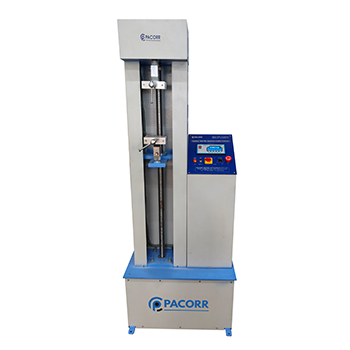
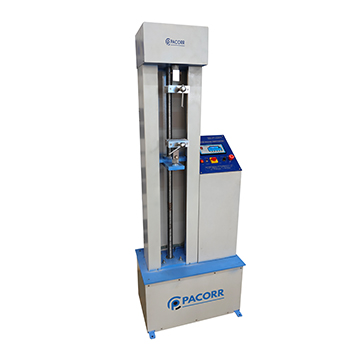
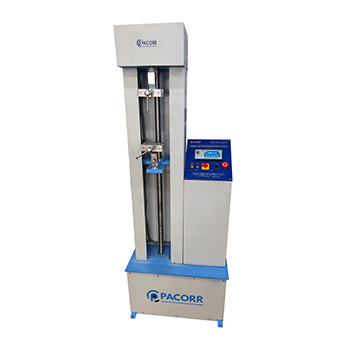
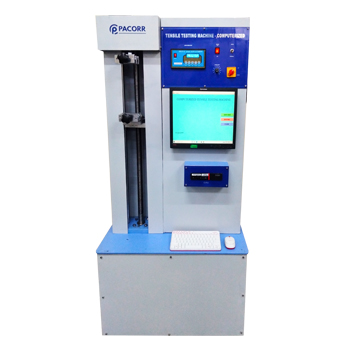
Pacorr Tensile Testing Machine is designed to measure the tensile strength, elongation and load-bearing behaviour of materials under a controlled pulling force. It helps quality-control and research teams evaluate whether plastic films, rubber, textiles, wires, paper, packaging materials and manufactured components can withstand expected service conditions. With controlled test speed, dependable gripping and clear load-and-elongation measurement, the machine supports repeatable testing for raw-material approval, process control, product development and final quality inspection.
- Shipping Area: All over the world
- Model: PCTTM-1
- Brand: Pacorr
- Availability: In Stock


What is a Tensile Testing Machine?
A Tensile Testing Machine is a material-testing instrument used to determine how a specimen behaves when it is pulled in opposite directions. The sample is held between two grips, and one grip moves at a controlled speed while the load cell measures the applied force. The machine records maximum load, elongation and failure point, allowing users to evaluate tensile strength, percentage elongation, yield behaviour and other mechanical properties according to the selected test method.
Unlike a basic pull tester, a properly configured tensile tester maintains controlled movement, suitable grip alignment and consistent testing conditions. This is important because specimen dimensions, test speed, gauge length, grip type and sample preparation directly affect the result. The equipment can therefore be used to compare materials, verify production consistency, investigate failures and confirm compliance with customer or industry specifications.
Key Features
- High-sensitivity load cell for dependable force measurement
- Digital display for clear load and elongation readings
- Adjustable test speed for different materials and test methods
- Motor-driven single-screw mechanism for controlled grip movement
- Application-specific grips for films, sheets, rubber, wires and textiles
- Rigid, powder-coated testing frame for routine industrial use
- Overload and over-travel protection for machine safety
- Emergency stop provision for immediate operation control
- Multiple load-capacity configurations for different testing requirements
Applications
The machine is used for tensile, peel, adhesion, seal-strength and push-pull evaluations when fitted with suitable fixtures. Common applications include testing plastic films, laminates, rubber specimens, woven sacks, textile yarns, paper, wires, packaging seals and moulded components. It supports incoming-material inspection, supplier comparison, production-process monitoring, research and development, complaint investigation, design verification and final product validation. Laboratories can also use the results to compare batches and establish material acceptance limits.
Benefits of Using a Tensile Testing Machine
Using a Tensile Testing Machine replaces visual judgement with measurable performance data. Manufacturers can identify weak materials, inconsistent batches, poor sealing, unsuitable formulations or processing variations before products reach the customer. The results help engineers compare suppliers, optimise material thickness, improve product design and establish realistic acceptance limits.
Controlled testing also improves traceability because specimens can be evaluated under consistent speed, grip and gauge-length conditions. By detecting performance changes early, the machine can reduce avoidable rejection, rework, excess material use and field failure. It also provides documented evidence for customer specifications, internal quality systems, audits and standard-based product validation programmes.
Working Principle
The specimen is prepared to the dimensions required by the relevant standard and secured centrally between the upper and lower grips. After the gauge length and test speed are set, the moving crosshead separates the grips at a controlled rate. This produces tensile stress in the specimen.
The load cell continuously senses the pulling force, while the displacement system measures grip movement or elongation. The test continues until the programmed endpoint is reached or the specimen breaks. The displayed maximum load and elongation data are then interpreted using the specimen’s original dimensions and the calculation method defined by the applicable testing standard.
How to Use a Tensile Testing Machine
Select the correct load capacity, grip and test method for the material. Prepare a clean, dimensionally accurate specimen and condition it when required. Enter or record its width, thickness and gauge length. Secure the sample centrally in the grips without slack, twisting or unnecessary pre-load.
Set the prescribed test speed and reset the load and elongation readings. Start the test and observe the specimen until it breaks or reaches the required endpoint. Record the result, inspect the failure location and repeat the test on the specified number of samples. Clean the grips after use and periodically verify the machine’s calibration.
Why Choose Pacorr Tensile Testing Machine?
Pacorr designs tensile testing systems for practical quality-control requirements rather than one material alone. The machine can be configured with different load capacities, speed settings and grips to suit packaging films, plastics, rubber, textiles, wires and other products.
Its controlled drive, digital measurement and safety protections support dependable routine operation. Pacorr also assists users in selecting fixtures and machine capacity according to specimen strength and the intended test method. This application-focused approach helps laboratories avoid under-capacity load cells, unsuitable jaws and inconsistent testing setups that can compromise the accuracy and repeatability of results.
Standards and Compliance
Depending on the material, specimen geometry, grips and machine configuration, testing may be conducted according to ASTM D638 or ISO 527 for plastics, ASTM D882 for thin plastic sheeting, ASTM D412 or ISO 37 for rubber, ASTM F88/F88M for seal strength, and ISO 1924-2 for paper and board. The complete procedure should follow the latest applicable standard.
Industries Served
- Plastic and polymer manufacturing
- Flexible packaging and laminates
- Rubber and elastomer products
- Paper and paperboard
- Textile, yarn and fabric manufacturing
- Woven sacks and raffia tapes
- Wire and cable manufacturing
- Automotive components
- Medical and pharmaceutical packaging
- Adhesive tapes and labels
- Research and quality-control laboratories
- Educational and material-testing institutes
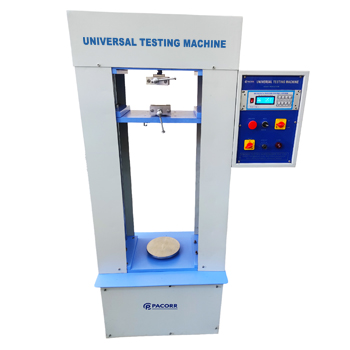
Test to be Performed: Compression Test / Top Load Test/ Push-Pull Test, Adhesion Test, Peel Bond Test, Seal Strength Test and Tensile Test.
Frequently Asked Questions
1. What does a Tensile Testing Machine measure?
It measures the force required to stretch or break a material. Depending on the test method and machine configuration, it can determine maximum load, tensile strength, elongation at break, yield behaviour and material deformation.
2. Which materials can be tested?
The machine can test plastic films, rigid plastics, rubber, textiles, paper, woven sacks, wires, laminates, adhesive products and packaging seals. Suitable grips and load capacity must be selected for each material.
3. How is tensile strength different from maximum load?
Maximum load is the highest force recorded during the test. Tensile strength is calculated by dividing the maximum force by the specimen’s original cross-sectional area, according to the applicable test method.
4. How should the correct machine capacity be selected?
The selected load-cell capacity should be higher than the expected breaking force but close enough to provide meaningful measurement resolution. Material type, thickness, specimen width and applicable standard should be considered before selection.
5. Why does a specimen sometimes break near the grip?
Grip-area failure may occur because of excessive clamping pressure, jaw damage, specimen misalignment, slipping or incorrect specimen preparation. Such results may need to be rejected according to the applicable standard.
6. Can the machine perform peel and seal-strength tests?
Yes. Peel, adhesion and seal-strength tests may be performed when the machine is equipped with suitable grips, fixtures, load capacity and speed settings required by the selected test method.
7. Does the machine require calibration?
Yes. Periodic calibration and verification of the load measurement, elongation measurement and crosshead speed are important for maintaining reliable and traceable results.
8. What is the price of a Tensile Testing Machine?
The price depends on load capacity, controller type, grips, test travel, speed range, software requirements and optional fixtures. Buyers should share their material, expected breaking load and applicable standard to receive the correct configuration and quotation.
Write Your Review
Get a Quote
Share your requirement and our team will reply shortly.
+91-8882149230
Related Products
.jpg "Universal Tensile Testing Machine (UTM)")
Our Clients
























Explore Related Tests
Find more testing instruments by test standard, application and industry.
By Test Standard
Our USP's
Demonstration of Machine
- Try Before You Decide
- Experience Before You Invest
- See It in Action – Free Demo
Global Reach
- Delivering Excellence Worldwide
- Serving Across Borders
- Your Global Supply Partner
On-Site Support
- Support That Comes to You
- On-Ground Assistance, Anywhere
- We Reach Where You Are
Team Strength
- Powered by Expert Minds
- Driven by Skilled Professionals
- Engineering Excellence Team
Manufacturing
- Precision-Driven Manufacturing
- Smart & Automated Production
- Engineered In-House Excellence
