
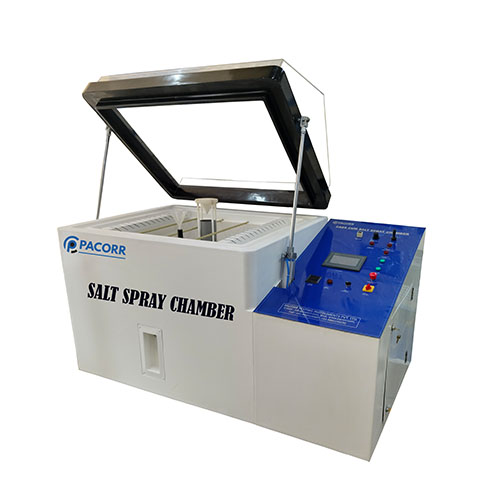
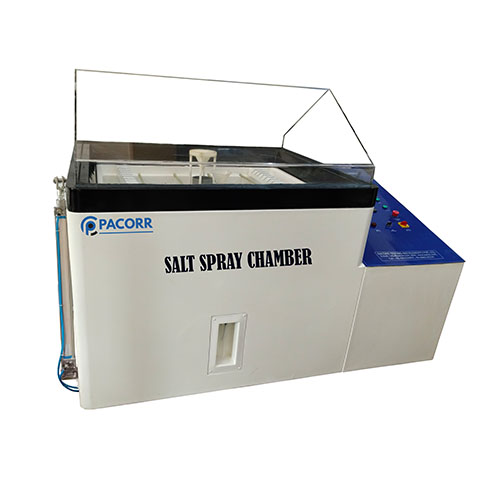
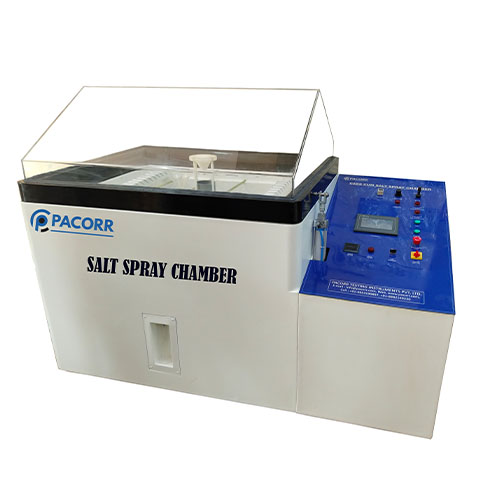
Pacorr Salt Spray Chamber is designed for controlled corrosion testing of metals, coatings, plated parts, painted components and surface-treated products. The chamber creates a uniform salt-fog environment in which specimens can be exposed for a defined period under controlled temperature, air pressure and fog collection conditions. Its corrosion-resistant FRP construction, digital PID temperature controller, air saturator, fog collection system and digital hour meter make it suitable for quality-control laboratories, coating manufacturers, automotive component producers, electroplating units and metal-processing industries. Pacorr offers Salt Spray Test Chambers in 250 litre, 450 litre and 1000 litre capacities. The standard configuration is designed around operating requirements commonly associated with ASTM B117 and ISO 9227 neutral salt spray testing. Pacorr Testing Instruments is a trusted manufacturer and supplier of high-quality Salt Spray Chambers in India, designed for accurate and reliable corrosion resistance testing. Contact us today for competitive pricing, technical guidance, and a customized quotation.
- Shipping Area: All over the world
- Model: PCSST-HMI-250-FRP
- Brand: Pacorr
- Availability: In Stock
What is a Salt Spray Chamber?
A Salt Spray Chamber, also known as a Salt Fog Chamber or Corrosion Test Chamber, is laboratory equipment used to evaluate the comparative corrosion resistance of metals and protective surface finishes. During the test, specimens are exposed to a controlled mist prepared from a sodium chloride solution. This accelerated environment helps laboratories identify coating defects, rust formation, blistering, peeling, pitting, white corrosion and other signs of surface deterioration. Salt spray testing is commonly used to compare different coating systems, inspect production consistency, qualify suppliers and verify whether a product satisfies its specified corrosion-test requirement. The test should not be treated as a direct method for predicting the exact outdoor life of a product. Test duration and acceptance criteria should be selected according to the applicable product specification, customer requirement or industry standard.
Working Principle of the Salt Spray Test Chamber
The working principle is based on the controlled atomization of a prepared salt solution. Compressed air passes through the air saturator before entering the atomizing system. The solution is converted into a fine fog and distributed throughout the enclosed test chamber. Specimens mounted on non-corrosive holders remain continuously exposed to this environment for the required test duration. The digital PID controller maintains the selected chamber temperature, while the air-pressure regulator helps control atomization. Fog collection funnels and external measuring cylinders allow the operator to monitor the salt-fog fallout rate.
For dependable and repeatable testing, laboratories should regularly verify:
- Chamber temperature
- Salt solution concentration
- Solution pH
- Compressed-air pressure
- Fog collection rate
- Specimen position and angle
- Test duration
- Cleanliness of the nozzle and chamber
What Can Be Tested?
The chamber can be used for evaluating:
- Zinc-plated and nickel-plated components
- Painted and powder-coated metal parts
- Fasteners, nuts, bolts and screws
- Automotive components
- Aluminium and steel components
- Electrical enclosures and metal cabinets
- Hardware and building fittings
- Springs and stamped metal parts
- Surface-treated industrial components
- Decorative and protective coatings
The suitability of a specimen depends on its dimensions, coating system, applicable standard and required test method.
Available Chamber Sizes
250 Litre Model
Inner dimensions: 760 × 600 × 550 mm
Suitable for laboratories testing fasteners, small automotive parts, plated samples, test panels and compact metal components.
450 Litre Model
Inner dimensions: 1000 × 750 × 600 mm
Suitable for medium-sized components, larger test panels, fabricated parts and multiple specimens tested in one cycle.
1000 Litre Model
Inner dimensions: 1500 × 950 × 700 mm
Suitable for large components, assemblies and laboratories that require higher specimen capacity.
Before selecting a model, consider the specimen size, quantity, mounting angle, spacing requirement and required exposure zone.
ASTM B117 and ISO 9227 Salt Spray Testing
ASTM B117 describes the apparatus and operating practices required to maintain a controlled salt-spray environment. ISO 9227 defines procedures for salt spray tests used to detect defects and compare the corrosion resistance of metallic materials and coatings.
The test standard does not automatically determine whether a product passes or fails. The required exposure period, specimen preparation, inspection method and acceptance criteria should come from the relevant product standard, drawing, customer specification or quality plan.
Pacorr’s standard Salt Spray Chamber is intended primarily for continuous neutral salt spray testing. Requirements involving AASS, CASS, cyclic humidity, drying or temperature-changing sequences may require a different chamber configuration.
Applications
Pacorr Salt Spray Chambers are used in:
- Automotive and auto-component manufacturing
- Paint and powder-coating industries
- Electroplating and metal-finishing units
- Aerospace component testing
- Fastener manufacturing
- Electrical and electronics industries
- Construction hardware testing
- Marine component evaluation
- Appliance manufacturing
- Research and quality-control laboratories
Benefits of Salt Spray Testing
Using a properly operated Salt Spray Test Chamber helps manufacturers:
- Compare coating formulations
- Detect weaknesses in plating or paint
- Monitor production consistency
- Evaluate supplier samples
- Verify customer-specific corrosion requirements
- Identify premature rust or coating failure
- Support research and product development
- Improve corrosion-control processes
- Maintain documented quality-control records
Salt Spray Chamber Price in India
The price of a Salt Spray Chamber depends on:
- Chamber capacity
- Control system
- Canopy opening mechanism
- Required test method
- Number and type of specimen racks
- pH measurement system
- Automatic refill and alarm requirements
- Data recording or HMI functions
- Calibration and documentation requirements
- Installation and service scope
Share the specimen dimensions, required standard, expected test method and chamber capacity with Pacorr to receive the correct technical configuration and commercial quotation.
Why Choose Pacorr?
Pacorr Testing Instruments manufactures corrosion testing equipment for industrial quality-control and research applications. Customers receive assistance in chamber selection, installation, operating guidance, maintenance and after-sales service. Pacorr also offers separate solutions for advanced requirements, including CASS testing, HMI-controlled corrosion testing and cyclic environmental corrosion testing.
Frequently Asked Questions
What is a Salt Spray Chamber used for?
It is used to compare the corrosion resistance of metals, coatings, plated parts, painted surfaces and other treated components under controlled salt-fog exposure.
Does a salt spray test show the exact service life of a product?
No. It is an accelerated comparative test. It helps evaluate coating quality and compliance with a defined specification but does not directly convert test hours into exact outdoor service life.
What temperature is used for neutral salt spray testing?
The standard test chamber configuration maintains a test temperature of 35°C ± 2°C.
What should be the pH of the salt solution?
For the neutral salt spray configuration, the solution pH is generally maintained between 6.5 and 7.2.
Why is FRP used for chamber construction?
FRP provides corrosion resistance, mechanical strength and durability in a saline test environment. It also reduces the risk of the chamber body contaminating the test atmosphere.
What chamber capacities are available?
Pacorr offers 250 litre, 450 litre and 1000 litre Salt Spray Chambers.
Is an air compressor included with the chamber?
The standard machine requires an external compressed-air supply. The compressor and main air-line filter-regulator should be confirmed separately in the quotation.
How is salt-fog collection measured?
Fog is collected through funnels placed inside the exposure area and measured using external graduated cylinders. The standard Pacorr specification provides a collection rate of 1–2 ml per 80 cm² per hour.
Can the standard chamber perform CASS testing?
CASS testing requires different solution chemistry and operating conditions. A dedicated CASS-compatible chamber configuration should be selected for this requirement.
How often should the machine be calibrated?
Calibration frequency should follow the laboratory’s quality system, usage frequency, customer requirements and applicable accreditation procedure. Critical parameters such as temperature, pressure, timing and fog collection should be verified regularly.
Write Your Review

Bhupender Singh
With Pacorr, you not only get the best precision testing instruments but also an unmatched services.
Rahim Khan
Thanks for online installation.
Vikash Goel
Pacorr has been the best decision for me as I not only got a high efficiency testing equipment but also their after service was outstanding.
Related Products
Our Clients






















By Test Standard
By Test Application
Our USP's
Demonstration of Machine
- Try Before You Decide
- Experience Before You Invest
- See It in Action – Free Demo
Global Reach
- Delivering Excellence Worldwide
- Serving Across Borders
- Your Global Supply Partner
On-Site Support
- Support That Comes to You
- On-Ground Assistance, Anywhere
- We Reach Where You Are
Team Strength
- Powered by Expert Minds
- Driven by Skilled Professionals
- Engineering Excellence Team
Manufacturing
- Precision-Driven Manufacturing
- Smart & Automated Production
- Engineered In-House Excellence
