
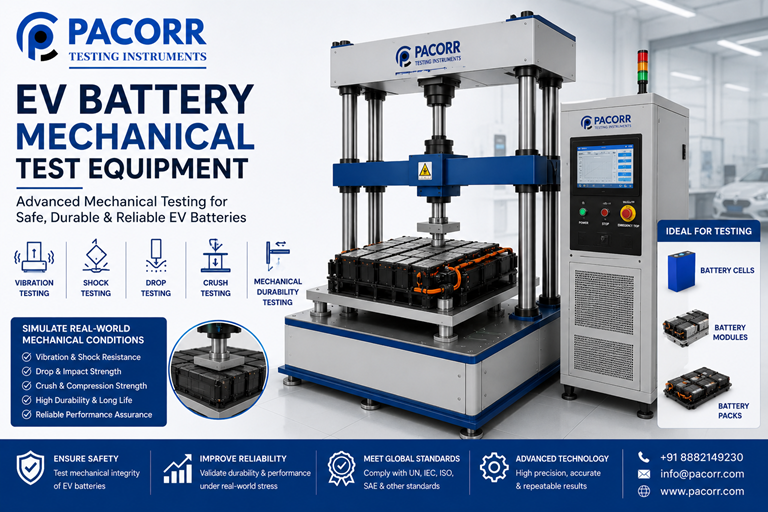
EV Battery Mechanical Test Equipment
Electric vehicle batteries face vibration, impact, compression and mechanical shock during manufacturing, transportation and vehicle operation. These forces may damage cells, electrical connections, enclosures or battery-pack structures. Pacorr manufactures EV Battery Mechanical Test Equipment for evaluating the physical strength, durability and mechanical safety of battery cells, modules, packs and related components.
What Is EV Battery Mechanical Test Equipment?
EV Battery Mechanical Test Equipment includes specialised machines that apply controlled force, vibration, impact or deformation to battery specimens. These tests help manufacturers study how batteries respond to road vibration, accidental impact, handling stress and structural loading.
Depending on the application, testing may be performed on cylindrical, pouch or prismatic cells, battery modules, complete packs, enclosures, connectors and mounting assemblies.
Types of EV Battery Mechanical Testing
Vibration testing reproduces the repetitive movement experienced by a battery during vehicle operation and transportation. It helps identify loose connections, mounting failures, material fatigue and internal component damage.
Mechanical shock and drop testing evaluate battery resistance to sudden impact or accidental handling events. Compression and crush testing apply controlled force to determine the structural strength and failure behaviour of cells, modules or enclosures.
The correct testing system depends on the specimen size, weight, force capacity, vibration profile, impact condition and applicable test procedure.
How Mechanical Battery Testing Works
The battery specimen is secured using a suitable fixture and exposed to a programmed mechanical load. Depending on the test, the machine may generate vibration, impact, compression, penetration or repeated movement.
During testing, engineers may monitor voltage, temperature, deformation and physical condition. The specimen is inspected for leakage, cracking, swelling, connection failure, enclosure damage or electrical interruption.
Results help determine whether the battery remains functional and structurally stable after mechanical exposure.
Testing Battery Cells, Modules and Packs
Small battery cells require precise fixtures and controlled loading. Modules need larger platforms and secure mounting arrangements, while complete EV battery packs may require high-capacity machines, reinforced structures and customised supports.
Equipment selection should consider specimen dimensions, weight, battery chemistry, state of charge, required force and monitoring requirements. Testing active batteries may also require additional ventilation, temperature sensing and emergency protection.
Safety Features
Mechanical testing can damage or deform lithium-ion batteries, creating a risk of heat, gas, smoke or fire. Suitable safety arrangements may include protective enclosures, emergency shutdown, ventilation, temperature monitoring, smoke detection and remote operation.
The safety configuration must be selected according to the battery energy level, test severity and expected failure condition.
Applications
EV Battery Mechanical Test Equipment is used by battery manufacturers, electric vehicle companies, automotive suppliers, research institutions and independent laboratories.
It supports product development, structural validation, transport simulation, supplier qualification and production quality control. The equipment may also be used for battery enclosures, mounts, connectors, electronic assemblies and energy-storage components.
EV Battery Mechanical Test Equipment Price
The price of EV Battery Mechanical Test Equipment depends on the type of test, machine capacity, specimen dimensions, control system, fixtures, data recording and safety features.
A cell-level compression tester will have a different price from a large vibration or crush-testing system designed for complete battery packs. Custom platforms, loading fixtures, protective enclosures and monitoring systems can also affect the final cost.
For an accurate quotation, customers should provide the battery dimensions, weight, chemistry, required test method, force or vibration range and safety requirements.
Why Choose Pacorr?
Pacorr develops mechanical testing equipment according to the battery format, test profile and laboratory requirements. Standard and customised systems are available for testing EV battery cells, modules, packs and associated components.
Our technical team reviews the specimen, loading conditions, fixture requirements and safety expectations before recommending a suitable machine. Pacorr also provides installation guidance, operating support and after-sales assistance.
Frequently Asked Questions
What is EV Battery Mechanical Test Equipment used for?
It is used to evaluate how battery cells, modules and packs withstand vibration, impact, compression and other mechanical forces.
Which mechanical tests can be performed?
Depending on the machine configuration, testing may include vibration, mechanical shock, drop, compression and crush testing.
Can complete EV battery packs be tested?
Yes. Pack-level testing requires a machine with suitable platform size, load capacity, fixtures and safety protection.
Is customised equipment available?
Yes. Pacorr can customise machine capacity, platforms, fixtures, controls, monitoring systems and safety arrangements.
What determines the equipment price?
Price depends on the test type, force or vibration capacity, specimen size, automation, fixtures and battery-specific safety features.
Recent Blogs
Enhance your understanding of testing and precise quality control indistinct applications with our
knowledge based articles coming from top editors of industry leaders.
Our USP's
Demonstration of Machine
- Try Before You Decide
- Experience Before You Invest
- See It in Action – Free Demo
Global Reach
- Delivering Excellence Worldwide
- Serving Across Borders
- Your Global Supply Partner
On-Site Support
- Support That Comes to You
- On-Ground Assistance, Anywhere
- We Reach Where You Are
Team Strength
- Powered by Expert Minds
- Driven by Skilled Professionals
- Engineering Excellence Team
Manufacturing
- Precision-Driven Manufacturing
- Smart & Automated Production
- Engineered In-House Excellence
