
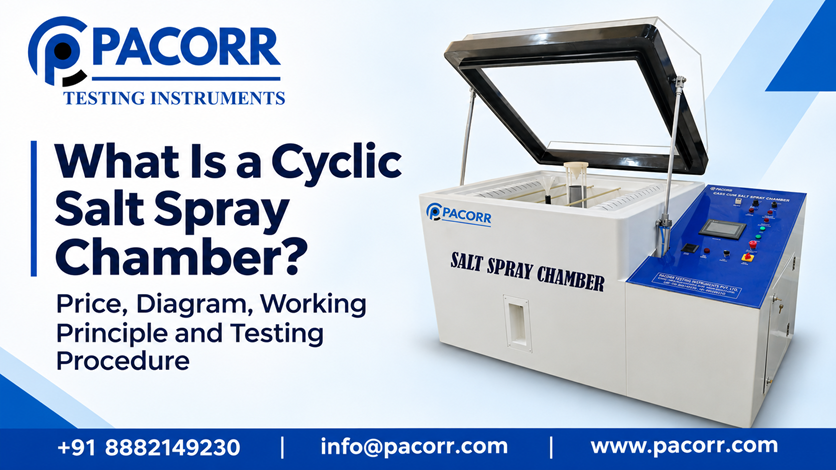
A cyclic salt spray chamber is a corrosion testing instrument that exposes specimens to a programmed sequence of salt fog, drying and, where required, controlled humidity or other specified conditions. Repeating these exposures helps laboratories evaluate how metals, coatings and assemblies respond to a defined corrosion test, rather than to continuous salt fog alone.
A painted bracket can resist continuous fog yet deteriorate when salt deposits repeatedly become wet and dry. A plated fastener may show a different failure pattern at a recess than on its exposed face. These differences explain why selecting the correct exposure cycle matters as much as selecting the chamber.
This guide explains the equipment, its working principle, the factors behind cyclic salt spray chamber prices, and the practical steps needed to produce results that a quality team can interpret.
What is a cyclic salt spray test chamber?
A cyclic salt spray test chamber automates successive corrosion exposures inside a controlled test space. Depending on the selected method, the sequence may involve salt application, a humid dwell, drying, or additional stages. The required sequence and capabilities come from the test specification.
The terms cyclic corrosion chamber and cyclic corrosion test chamber are often used for this equipment. However, the name alone does not define what a model can do. A fog/dry chamber and a chamber with adjustable relative humidity can support different test requirements.
Pacorr lists a dedicated Cyclic Corrosion Test Chamber. When discussing an application, provide the required standard, method and specimen details so the proposed configuration can be checked against the complete cycle.
What is the cyclic salt spray chamber price in India?
The cyclic salt spray chamber price depends on usable chamber size, required exposure stages, temperature and humidity control, cycle transitions, instrumentation and supplied services. Pacorr’s cyclic corrosion chamber product page provides a quotation route rather than a fixed public selling price. A current quotation is therefore needed for a specific configuration.
A price for a continuous salt spray cabinet is not a reliable substitute for a quotation for a programmable cyclic corrosion system. Likewise, two chambers with similar nominal volumes may differ significantly in their ability to achieve a required test.
| Quotation factor | What to specify | Why it matters |
|---|---|---|
| Working space and loading | Largest specimen dimensions, quantity, mass and fixture arrangement | Nominal volume does not establish how many parts can be tested with adequate spacing. |
| Exposure capability | Fog, drying, humidity and any additional required stages | Each stage needs suitable equipment and control. |
| Environmental performance | Setpoints, tolerances and permitted transition times | Reaching a condition is different from reaching it within the allowed time. |
| Measurement and records | Required sensors, data export, alarms and traceable calibration | These determine how test conditions can be demonstrated. |
| Installation and support | Utilities, commissioning, training, warranty and service scope | These affect the installed cost and ongoing operation. |
For a useful quotation, send your test method, chamber loading plan, expected tests per month, installation location and documentation requirements. Ask whether GST, freight, installation, fixtures, calibration and operator training are included. Pacorr’s guide to salt spray chamber price and features provides additional purchasing context; obtain a separate price for your cyclic test requirements.
Cyclic salt spray chamber diagram and main components
The conceptual diagram below shows how solution delivery, conditioned air, the test space and feedback control relate to each other. It represents a general arrangement, not a manufacturing drawing or a specification for a particular Pacorr model.
| Component | Function | What the laboratory should check |
|---|---|---|
| Test enclosure and lid | Contain the exposure environment | Materials compatibility, sealing and condensate management |
| Solution reservoir and feed | Supply the specified electrolyte | Cleanliness, solution identity and level |
| Atomizer and air supply | Generate and distribute fog | Air quality, regulated supply and deposition performance |
| Specimen supports | Hold samples in the required arrangement | Spacing, drainage and avoidance of unintended contact |
| Conditioning system | Create the required drying or humidity environment | Achievable conditions with the intended specimen load |
| Controller and sensors | Execute the recipe and record conditions | Recipe version, measurement accuracy and alarm response |
| Collectors, drainage and exhaust | Support verification and remove waste or fog | Correct placement and suitable disposal or extraction arrangements |
What is the working principle of a cyclic salt spray chamber?
The working principle is controlled repetition of a specified corrosive exposure sequence. A programmed recipe changes the chamber environment, while sensors and control equipment maintain the conditions required for each stage.
Salt application creates a conductive surface electrolyte. During later stages, moisture conditions change. This changes the exposure experienced by the coating, substrate and any exposed defects. A suitable cyclic method can therefore reveal behavior that continuous wet exposure alone may not show.
A basic fog/dry method alternates salt exposure with drying. More complex methods add humid dwell periods or other exposures. There is no universal requirement that every cycle contain every stage, and a hot drying stage is not evidence that a chamber also provides refrigeration, freezing or UV exposure.
The controller must do more than turn the spray on and off. The laboratory needs to establish that the required conditions are actually achieved. In particular, distinguish stage duration from transition time: the time needed to move between environments can affect the exposure and must be handled as the method specifies.
Cyclic salt spray testing versus continuous salt spray testing
| Question | Continuous salt spray | Cyclic corrosion testing |
|---|---|---|
| How does the exposure run? | Salt fog is maintained under specified conditions. | Different specified exposure stages repeat in sequence. |
| What commonly defines the method? | ASTM B117 or an applicable ISO 9227 method | A specified ASTM G85 annex, ISO 11997-1 cycle, SAE J2334 or a customer method |
| What equipment capability matters? | Stable fog generation and the required cabinet conditions | All required stages, transitions and environmental controls |
| Can equal test hours be compared directly? | No. Exposure hours from different methods do not establish equivalent corrosive severity. | |
| Does the test define product acceptance? | Use the applicable product specification or agreed acceptance criteria; do not assume an apparatus standard supplies them. | |
If your purchase specification calls for neutral salt spray, review the required configuration of Pacorr’s Salt Spray Chamber. If it calls for cycling, check the separate cyclic configuration against the complete method.
CASS is not a synonym for cyclic corrosion testing. CASS refers to copper-accelerated acetic acid salt spray. “Cyclic” describes a repeating exposure sequence. Chemistry and exposure sequence are separate aspects of the test.
Which standards apply to cyclic corrosion testing?
The standard determines the procedure; the chamber name does not. Record the standard number, edition, annex or method, and any customer amendments before programming a test.
| Standard or method | Relevant scope | Selection point |
|---|---|---|
| ASTM B117 | Operation of salt spray/fog apparatus | Do not use a B117 reference alone as a complete cyclic test recipe. |
| ISO 9227 | NSS, AASS and CASS salt spray methods | Identify the required chemistry and the applicable product specification. |
| ASTM G85 | Several modified salt spray methods, including cyclic methods | Specify the annex. A1 is continuous; A2–A5 include different cyclic exposures. |
| ISO 11997-1:2026 | Defined wet/salt fog, dry and humid cycles for coatings | Specify the cycle and solution. ISO lists the 2026 edition as the replacement for 2017. |
| SAE J2334 | Laboratory cyclic corrosion evaluation | Check the selected procedure, equipment capability and intended corrosion mechanism. |
| Customer or OEM specification | Application-specific exposure and acceptance requirements | Confirm the controlled revision and any required departures from a base standard. |
SAE describes J2334 as useful for development and validation of particular coating systems, substrates, processes or designs. Its scope also calls for field correlation when examining corrosion mechanisms beyond cosmetic or general corrosion. A method’s validation should not be generalized to every material and service environment.
Example: the ASTM G85 Annex A5 fog/dry sequence
A published equipment-manufacturer summary describes the A5/Prohesion sequence as follows. This is an orientation example, not the full standard or a universal operating recipe.
| Stage | Summary duration | Summary condition |
|---|---|---|
| Fog | 1 hour | Dilute acidified electrolyte fog; chamber at 21–27°C |
| Drying | 1 hour | Air-drying/purge stage at 35°C |
| Repeat | As specified | Continue for the exposure required by the product or test plan |
Use the controlled ASTM document for solution composition, tolerances, transitions, verification and all remaining requirements. Do not replace its electrolyte with a generic sodium chloride solution or add a humidity stage merely because the chamber has that capability.
Cyclic salt spray testing procedure: from test plan to report
A defensible cyclic salt spray testing procedure starts with a controlled test plan, then verifies the chamber, specimens, solution and programmed exposure before results are assessed. The workflow below supports laboratory planning; numerical conditions must come from the selected method.
1. Define the test question and acceptance criteria
Decide whether the test is for product qualification, routine batch checking, a coating-process change or investigation of a failure. Identify the substrate, pretreatment, coating system and intended evaluation. Agree the exposure and acceptance criteria before testing starts.
For example, a qualification plan might require assessment of corrosion around a deliberate scribe, while another plan may focus on unscribed areas. Treat these as different questions rather than combining them into a single visual judgment.
2. Identify and document the specimens
Assign each specimen a traceable identity. Record batch, material, coating condition, relevant dimensions and any preparation required by the specification. Photograph the initial condition. Include replicates or control specimens where the plan requires them.
Cleaning, edge protection and deliberate damage must follow the method. Aggressive cleaning may alter the surface being evaluated. Do not add a scribe or expose a cut edge simply to make corrosion appear sooner.
3. Prepare the specified solution
Use the required reagents and water quality, follow the stated preparation method, and record the solution batch. Verify concentration and pH as required. Keep preparation equipment suitable for the chemistry and prevent contamination between solutions.
A neutral salt spray solution is not automatically suitable for a cyclic method. The required electrolyte can differ, and a chemistry error cannot be corrected by extending the exposure time.
4. Confirm chamber readiness
Check the condition of the cabinet, nozzle, feed lines, air supply, drain and sensors. Confirm that relevant calibration and performance-verification records are available. Resolve alarms or known environmental-control faults before loading valuable specimens.
Prepare an operating record that identifies the chamber, recipe and method revision. This prevents a valid recipe from being confused with an older customer requirement.
5. Load and position the specimens
Follow the required orientation and spacing. Prevent unintended contact between specimens and avoid arranging parts so that runoff from one falls onto another. Document positions so a later failure pattern can be compared with the loading arrangement.
Check that fixtures do not shield the surface under assessment. A nominally large cabinet can still be overloaded if its racks, parts or fixtures restrict the required exposure.
6. Program and independently check the cycle
Enter the stage order, durations, setpoints, repeat count and required transition behavior. Check the units and the rules governing when each dwell begins. A second-person recipe check is useful for new or revised qualification programs.
For unfamiliar methods, consider a documented commissioning run before the formal exposure. Confirm that the proposed arrangement can meet the method under the intended loading conditions.
7. Verify the exposure and monitor the run
Use the method’s prescribed checks for solution, fog deposition and environmental conditions. Where fog stages are brief, establish an appropriate verification approach rather than assuming that a small collected volume from one short stage proves uniform deposition.
Review the actual record, including transitions and alarms. Log interruptions, maintenance, solution changes and specimen handling. If a condition exceeds the permitted limit, use the test plan’s deviation process to decide whether the run remains valid.
8. Remove and condition samples correctly
Follow the specified end-of-test handling, rinsing and conditioning instructions. Do not automatically scrub, wash or dry every specimen in the same way: post-treatment can affect the evidence available for assessment.
Preserve specimen identities and take photographs under consistent lighting. Keep separate the appearance immediately after exposure and any result recorded after prescribed post-treatment.
9. Assess the defined failure modes
Apply the agreed rating or measurement procedure to the correct area. Record the observations for each specimen rather than reporting only an average or a pass/fail statement. Identify any excluded edges, fixture marks or intentionally damaged regions as the method requires.
10. Issue a traceable test report
Include the method and revision, specimen identities, preparation, solution records, chamber identification, cycle settings, exposure completed, monitoring evidence, deviations, assessment procedure and results. State acceptance against the relevant requirement separately from the observed condition.
For introductory context on conventional exposure, see Pacorr’s salt spray test procedure guide. Use the cyclic method selected for the current job as the authority for its operating conditions.
How are cyclic corrosion test results interpreted?
Interpret results against the product specification, the exposure method and the defined assessment procedure. “Passed 500 hours” is incomplete without identifying what was exposed, how it was tested and what constituted failure.
| Observation | Possible assessment approach | Important distinction |
|---|---|---|
| Rust on painted steel | ASTM D610, where specified | A defined rust rating is more reproducible than “light rust.” |
| Blistering of paint | ASTM D714, where specified | Document the required blister classification. |
| Corrosion or coating deterioration after exposure | ASTM D1654, where applicable | Use its applicable evaluation procedure and the agreed acceptance limit. |
| Delamination or corrosion around a scribe | ISO 4628-8, where specified | Measure the defined region; do not interchange rating systems without agreement. |
| Functional degradation of an assembly | Agreed product-specific inspection or measurement | A visually acceptable part may still fail its functional requirement. |
For zinc-coated steel, the test plan may distinguish corrosion products associated with the coating from corrosion of the underlying steel. For a painted component, it may distinguish deterioration around a scribe from corrosion elsewhere. Define these distinctions before comparing treatments.
There is no universal conversion from cyclic corrosion test hours to years outdoors. Any service-life prediction needs evidence for the particular material, failure mechanism and service environment. ISO 9227 also explicitly limits using its salt spray methods to predict long-term corrosion resistance.
What are cyclic salt spray chambers used for?
A cyclic salt spray test machine supports material and process decisions when its selected method is appropriate to the application.
- Automotive components: evaluate coatings and component designs under specified cyclic exposures, with particular attention to joints, edges and deliberate coating damage where required.
- Paint and powder-coating development: investigate how a defined coating system responds after a controlled exposure and compare results within a suitable test design.
- Plating and pretreatment control: assess consistency against the applicable product or process requirement.
- Outdoor hardware and enclosures: examine vulnerable details such as fasteners, seams and interfaces, with functional checks where relevant.
- Marine and industrial equipment development: use an appropriate laboratory method alongside field evidence, rather than treating salt fog as a complete recreation of service conditions.
The most useful output is a decision: whether a coating process is consistent, whether a design change addresses a known weakness, or whether further investigation is needed. A severe-looking exposure is not automatically the right exposure.
How do you choose a cyclic corrosion test chamber?
Start with the test specification and work backward to equipment capability. Ask the supplier to address each requirement in writing.
- Match every stage. Check the required salt application, drying, humidity and any special exposures separately.
- Check performance under load. Provide the expected specimen arrangement and ask how the required conditions and transitions will be demonstrated.
- Check usable space. Compare internal dimensions and fixtures with actual parts rather than relying only on litres.
- Define verification and records. Specify the environmental data, calibration documents and commissioning evidence your quality system needs.
- Confirm installation requirements. Review electrical supply, air, water, ventilation, drainage and access for service.
- Compare total cost. Include consumables, utilities, maintenance, service support and the cost of an invalid run.
Pacorr’s guide to choosing a salt spray chamber for your laboratory provides broader selection context. For a cyclic application, send the full method with your enquiry so the configuration can be matched to the work.
Common mistakes that weaken corrosion test results
| Mistake | Better practice |
|---|---|
| Calling every programmable cabinet suitable for every cyclic method | Verify each required environment, tolerance and transition. |
| Using the same solution for all corrosion tests | Prepare and verify the electrolyte specified by the selected method. |
| Judging validity only from controller setpoints | Review actual conditions and the required performance checks. |
| Changing preparation or loading between comparison runs | Control and document these variables. |
| Selecting acceptance criteria after seeing the results | Approve the criteria before exposure. |
| Reporting only the exposure duration | Report the method, assessment and traceable observations. |
Frequently asked questions
What is the difference between a cyclic salt spray chamber and a cyclic corrosion chamber?
The names often refer to the same equipment category. “Cyclic corrosion chamber” is broader because some methods include exposures beyond salt fog. Confirm capabilities from the specification rather than the product name.
Can a regular salt spray chamber perform cyclic corrosion testing?
Only if its configuration can achieve every stage and transition required by the method. A spray timer alone does not establish controlled drying, humidity capability or compliance with a cyclic procedure.
What solution is used in a cyclic salt spray test?
The selected method defines the solution. Cyclic methods may require different electrolyte compositions and pH values. Do not assume that a solution used for neutral salt spray is suitable for every cyclic test.
What temperature is used for cyclic salt spray testing?
There is no single temperature for all cyclic tests. Each stage has the condition specified by the method. Setpoints, tolerances and transition requirements must be checked together.
How long does a cyclic corrosion test take?
The required number of cycles or exposure duration comes from the product specification or agreed test plan. Different methods can have very different cycle lengths, so equal elapsed hours do not indicate equivalent exposure.
Is cyclic corrosion testing always better than continuous salt spray?
No. Use the method required for the product and purpose. Cyclic exposures can be appropriate where changing wet and dry conditions matter; continuous salt spray remains relevant where the applicable specification requires it.
Is a cyclic corrosion chamber price available online?
Pacorr’s dedicated cyclic chamber page uses a quotation enquiry rather than a fixed public price. Request a quotation identifying your chamber size, test method, environmental requirements and installation scope.
Does passing the test guarantee a corrosion-free product?
No. Passing establishes that the tested specimens met defined criteria under the reported laboratory exposure. It does not establish unlimited life or performance in every service environment.
Discuss your cyclic corrosion testing requirements with Pacorr
Choosing a chamber begins with a clear test requirement. Share the standard and revision, specimen dimensions, loading quantity, required exposure stages and reporting needs with Pacorr.
Review the Pacorr Cyclic Corrosion Test Chamber or request a configuration-specific quotation. This gives your laboratory a practical basis for comparing capability, installation scope and price.