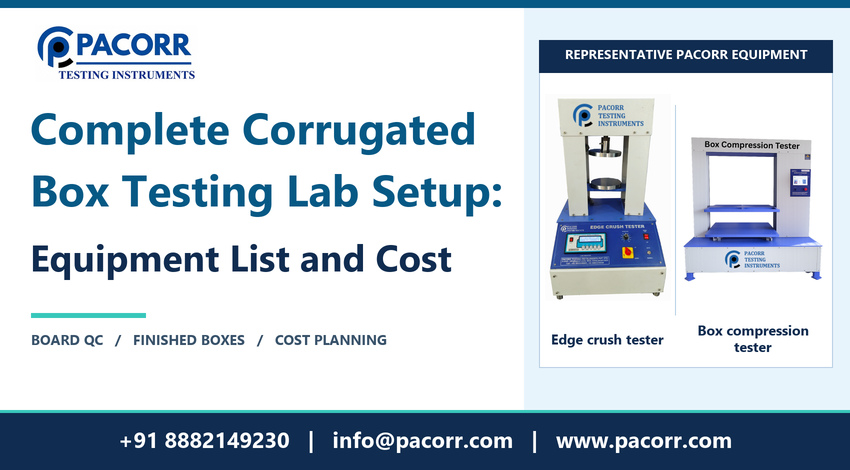
A corrugated box testing lab checks whether the paper, combined board, finished case and packed shipment meet the requirements at each stage of production. A practical starting setup combines specimen preparation and conditioning with the tests that decide whether to release a lot. For many box plants, that means an edge crush tester for corrugated board, a box compression tester for assembled cases and basic tools for grammage and caliper. Add a burst tester, Cobb apparatus, drop tester or vibration system when the customer specification or failure history justifies it.
There is no single installed cost for a corrugated box testing lab in India. Two plants may both need box compression results but test very different box sizes and force ranges. The budget also has to cover fixtures, controlled conditioning, installation, verification, consumables and service. This guide shows what to buy first, how to check the proposed equipment against your specimens and how to budget without treating a catalogue price as the cost of a working lab.
What should a corrugated box testing lab be able to decide?
Start with the decision, then work backwards to the specimen and test. Incoming inspection asks whether a liner or fluting lot matches its purchase specification. Corrugator quality control asks whether the combined board has the expected strength and structure. Finished-case inspection asks whether scores, joints, printing and conversion still produce a case that meets its drawing and compression requirement. Distribution qualification asks whether the packed product survives an agreed set of hazards with its actual cushioning, arrangement and closure.
Write one purchase requirement for each property, not one row per machine. Capture the reference method and edition, sample type, expected range, reporting units, decision limit, sampling plan and volume at peak demand. Keep customer limits with the relevant product drawing or control plan. A standard that tells you how to measure a property does not necessarily tell you what every box must achieve.
For an Indian purchase specification that invokes IS 2771 (Part 1):2022, review the box requirements, sampling and acceptance clauses that apply to the order instead of using an unrelated carton grade's limits. Where the buyer specifies an ASTM, ISO or TAPPI method, keep its edition and any written approvals beside the requirement. Do not assume two methods are equivalent based only on a shared abbreviation.
Give priority to measurements that trigger a line correction or a dispatch decision. An occasional test for a new export pack can often stay external while the plant establishes routine board and case measurements. If the customer requires an accredited result, confirm the provider's scope covers the actual method and specimen, not merely that the laboratory holds accreditation.
What equipment belongs in the lab?
Use the Pacorr paper and packaging testing instruments category to compare equipment families against your method list. The matrix below is not a fixed package. The right mix depends on whether the site makes board, converts purchased sheets, packs finished goods or qualifies complete shipments.
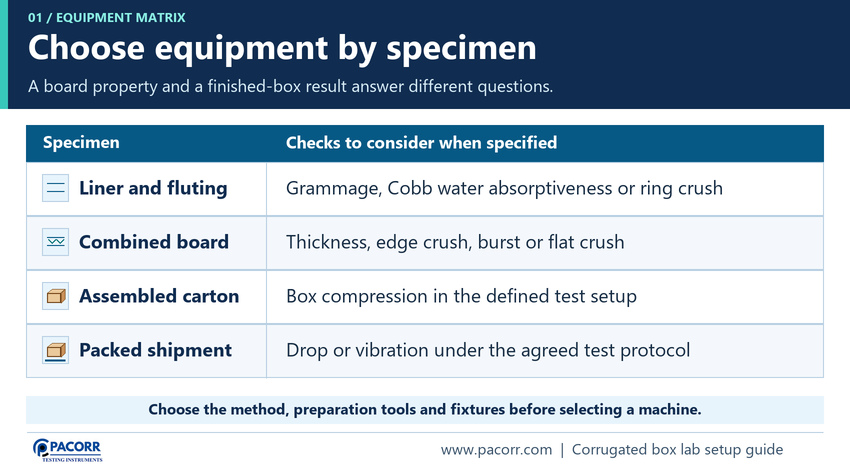
| Specimen or level | Equipment to consider |
|---|---|
| Incoming liner and fluting paper | Calibrated balance and grammage cutter, suitable paper caliper instrument, and a Cobb sizing tester or ring crush fixture where specified. |
| Combined corrugated board | Edge Crush Tester, correct cutter and fixtures, board caliper gauge, Bursting Strength Tester if required, and flat crush or adhesion accessories for relevant process investigations. |
| Assembled case | Dimensional and visual inspection tools, and a Box Compression Tester sized for the largest specified case and the force range of the weakest and strongest products. |
| Packed shipping unit | Package Drop Tester or suitable packaging vibration table for named procedures. Check whether conditioning, sustained loading or specialised simulation must also be provided. |
| Shared support | Sample racks, temperature and humidity monitoring, verified reference items, timers, equipment guards, safe sample handling and a system for capturing results and lot identity. |
Keep the consumables and accessories list with the main equipment list. An ECT frame without the prescribed coupon cutter and fixture is not a runnable method. Likewise, a Cobb station needs the correct ring and seal, balance, timing and blotting materials. Include replacement blades, diaphragms or seals when comparing proposals. Request the full list together with the expected maintenance and verification requirements.
What is the difference between ECT and box compression testing?
Edge crush test (ECT) loads a prepared corrugated board coupon edgewise. In the non-waxed ISO 3037:2022 method, compression acts along the flute axis. The result is force per unit length, commonly kN/m. The method applies to specified corrugated constructions where buckling or tipping does not occur during the measurement. Record the method variant and inspect the failure because different supports or edge preparation can change a result.
Box compression test (BCT) applies a compressive load to a complete assembled case or shipping unit under prescribed conditions. The result is a force or another method-defined outcome, not force per coupon length. For example, ASTM D642 addresses the compressive resistance of shipping containers, components and unit loads. ISO 12048 deals with compression and stacking tests on complete filled transport packages using a compression tester. Whether a case should be empty or filled comes from the specified method and test plan.
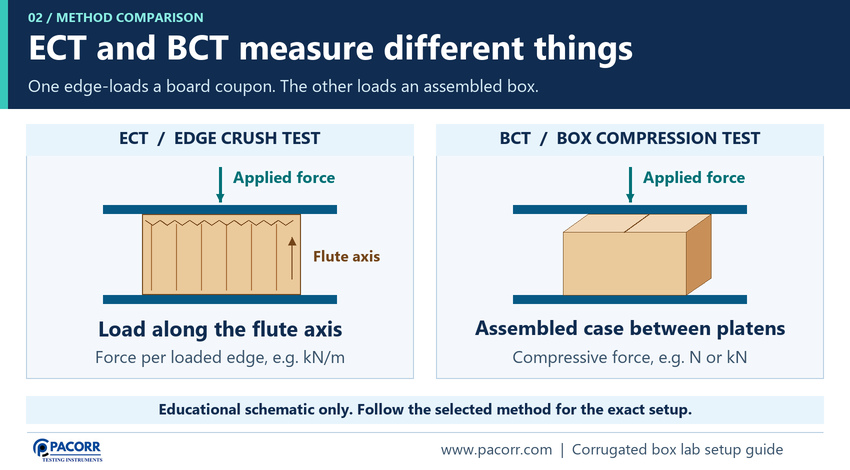
Two cases from board with the same ECT can show different BCT. Panel dimensions, flute orientation, vent holes, score damage, flap closure, joints, printing effects and moisture can all matter. If a validated design model uses ECT to estimate compression, mark the output as an estimate and check the model's box-style assumptions. An estimate is not the measured BCT required for acceptance. Do not divide a short-term peak BCT by one loaded box's weight to approve a warehouse stack. Duration, pallet support, stack pattern and humidity change the loading problem.
Pacorr's ECT, RCT and FCT comparison explains the coupon arrangements and result units. The Box Compression Test guide provides companion context for finished boxes.
How do burst, grammage, Cobb, ring crush and flat crush differ?
Bursting strength records the pressure at which a specimen ruptures under the specified hydraulic diaphragm method. ISO 2759 addresses board, including in-scope corrugated fibreboard. Confirm the pressure range, clamping arrangement and specimen requirements. A high burst result does not establish edge crush resistance, and burst pressure in kPa is not interchangeable with a case compression result in kN.
Grammage is mass per unit area in g/m². ISO 536 concerns paper and board grammage. Weigh a specimen of verified area, apply consistent units and identify whether the result is for a component sheet or combined board. Combined-board grammage includes material in the flutes and adhesive and does not reveal individual paper grades. Board caliper measures the combined thickness under the specified contact conditions, not liner grammage or flute integrity on its own.
The Cobb test measures water absorbed per unit area over the specified exposure, in g/m². ISO 535 covers applicable paper and board, including corrugated fibreboard within its scope. Specify the tested face and timing. Leaks around the clamp, unintended edge wetting and inconsistent blotting can bias results. Cobb assesses water uptake under the method. It does not measure the material's initial moisture content, prove waterproofing or establish the strength of a wet box. See Pacorr's paper and board water absorbency guide.
Ring crush compresses a strip of paper or paperboard held in a ring. ISO 12192 addresses applicable paper and paperboard thicknesses. A corrugator may use RCT to evaluate a component paper if the purchase specification requires it, but it is not ECT of combined board. Flat crush loads a board coupon perpendicular to its faces, typically to assess flute collapse in suitable constructions. ISO 3035 applies to single-faced and single-wall corrugated fibreboard and excludes double-wall and microflute board. Do not improvise a flat crush test for a construction outside the named method. Paper cores are a separate tubular specimen and need their own test if supplied as a product.
How do drop and vibration tests fit into a dispatch programme?
A standalone free-fall drop test, such as ASTM D5276 for loaded containers, addresses impact response at the specified conditions. Inspect carton and product outcomes according to the plan. A package can show little external damage while its contents or cushioning shift. Photograph dents, opened joints and damaged contents when inspection is permitted. Do not open and reclose a package mid-sequence unless the programme permits that intervention.
A vibration test challenges the packed system under repeated motion. A basic table intended for a fixed-displacement method is not automatically capable of the random profile or controller feedback a distribution procedure may require. Evaluate platform size, gross test load including fixtures, required motion type and data recording. Pacorr's package drop tester guide explains why an edge, corner and face impact are different.
A complete distribution programme may combine conditioning, compression, vibration and impacts in a defined order. ASTM D4169 is a performance-testing practice for shipping systems with defined distribution cycles. ISTA's published procedures distinguish screening from simulation and describe scope by shipment type. Select a programme based on the distribution channel and customer requirement. A passing drop result alone is not evidence that every stage in that programme passed.
How should the lab be laid out?
Give each sample a route from receiving and identification to preparation, conditioning, testing and report review. Reserve separate positions for untested, conditioned, tested and held lots. Leave workbench space for method drawings, sample cutters and records. Keep heavily used fixtures close to their frames, but place balances and condition-sensitive measurements away from vibration, drafts, cutting dust and the entry from production.
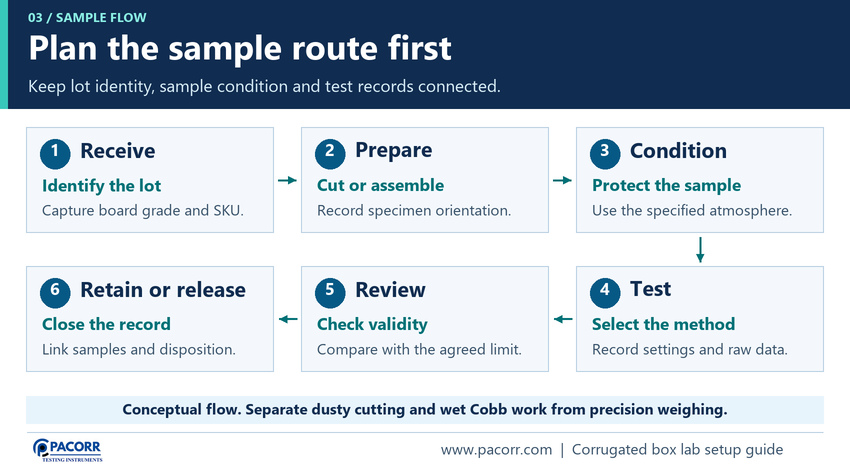
Use a wet bench for Cobb testing, separate from balances, specimen racks and electrical equipment vulnerable to splashes. Locate drop and vibration apparatus where the prescribed exclusion zone and loading equipment can be accommodated. Measure the route from the unloading point to the final machine position before purchase. Check door width, floor capacity, turning room, service clearance and whether a large carton can be brought safely to the platens without blocking another operation.
What should specimen preparation and conditioning control?
Record sampling location, board grade, lot and flute direction before cutting. Prepare edges with the method-appropriate tooling and check parallelism and dimensions. Avoid crushing the flutes with a worn blade, using a damaged panel unintentionally, or cutting from a location not allowed by the method. For finished cartons, retain the intended joint, closure and orientation. If a study specifically targets a scored area or a printing defect, identify those samples separately from release specimens.
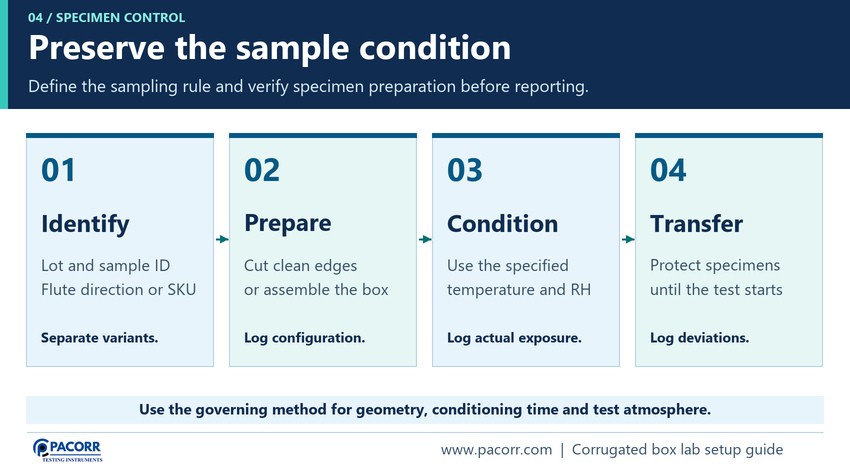
Paper and fibreboard pick up and lose moisture, which can change measured strength. ISO 187:2022 covers atmospheres, procedures and monitoring for conditioning and testing pulp, paper and board. Use the atmosphere, conditioning requirement and transfer set out in the applicable test method. Conditioning complete filled transport packs under ISO 2233 or a selected distribution programme is a different task from conditioning thin board coupons. Do not use a blanket overnight rule for both.
The ASTM route makes a similar distinction. ASTM D4332 concerns atmospheres for containers, packages and components, and its scope points to ASTM D685 for standard-atmosphere box compression strength. Follow the procedure the governing specification calls for. Record the actual temperature and relative humidity, not just the room settings, and handle out-of-condition results through the quality plan rather than grouping them with compliant readings.
Size a conditioning space by usable rack positions, largest case dimensions and peak lot arrivals. Air must be able to circulate around specimens according to the method and operating plan. Use suitable environmental monitors to document conditions in the working area, not just the controller setpoint. When assessing a Pacorr humidity chamber, check the actual space available with shelves fitted and whether the configuration can accommodate your load and the required conditions. Plan what happens to samples if an excursion occurs or testing is delayed.
How do you select the right ECT and BCT force ranges?
Ask for the verified working range and measurement uncertainty or applicable performance evidence, not just the frame's maximum capacity. Select the BCT configuration against the actual compressed-force envelope and the largest box. Check usable height, platen travel, platen size and alignment, control mode and minimum usable force. The package's gross mass is a handling input and may matter in a drop test. It is not the expected force at BCT failure.
An illustrative board result shows why measurement basis matters. If a valid edge crush force is 585 N on a 100 mm loaded edge under a method that uses that divisor, the arithmetic gives 5.85 N/mm, equivalent to 5.85 kN/m. Record the valid force, loaded-edge length basis and required statistic. By contrast, a full-box peak of 3.20 kN is a separate force reading. Neither figure sets a pass limit or converts into the other result.
Specify whether the lab only needs a peak or must retain the curve, deformation data and evidence of first structural failure. If report traceability or engineering investigations require more than a display, compare the computerized box compression tester and request a representative data export rather than assuming every channel is included. Confirm usable specifications in the quotation for the exact model and fixtures offered.
What should you buy first and what can wait?
Release testing first. A converter working from purchased corrugated sheets might start with visual inspection, case dimensions, verified grammage and caliper tools, conditioning, ECT and BCT if those decisions are made every shift. A plant with a burst-based customer specification would prioritise burst before adding optional crush fixtures. If a customer requires both properties, the release plan must provide both, either in-house or through an approved external lab.
Process diagnostics next. Add Cobb testing if water uptake matters to your lots or specifications. Consider RCT for component-paper results and FCT for applicable board where flute damage is a frequent concern. Compare observations with process records. Good ECT but weak BCT after a die-cutting change can justify looking at scores, joints, inserts and cut-outs before replacing paper grades.
Distribution simulation last, unless required upfront. Bring in drop or vibration capability when shipment volumes, package development or external lead times justify it. Outsource infrequent or specialised sequences until you can verify equipment, methods and reporting at the required level. Put retest and external lead times into the dispatch plan rather than assuming every result is available on the shipping day.
How much does a corrugated box testing lab setup cost?
Build the budget around installed setup cost and recurring operation. No comparable current public price establishes what a complete lab will cost. A plant in India should request a configuration-specific quote in INR and compare it against local facility and operating estimates. Ask whether GST, freight, unloading, commissioning and training are included. Confirm which expenses remain with the buyer and which work is stated as optional.
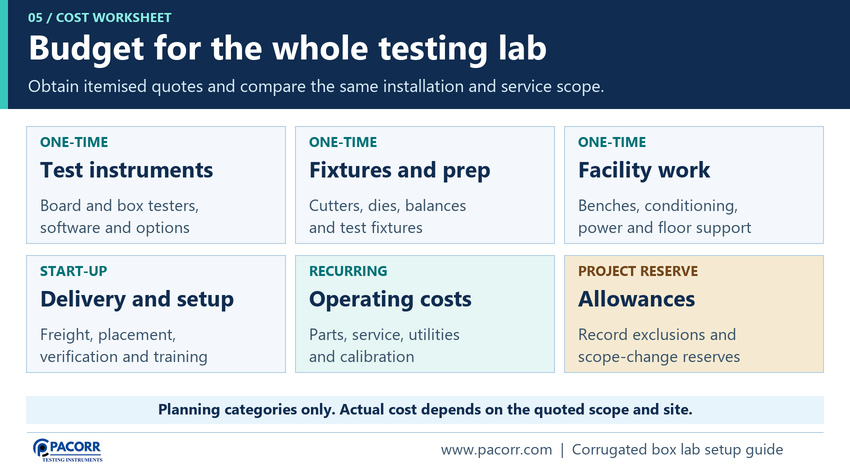
| Budget group | What to price |
|---|---|
| Instruments and accessories | Force frames, load ranges, fixtures, cutters, caliper gauges, balance, chamber or conditioning-room equipment, software and initial reference items. |
| Room and utilities | Benches, dry racks, floor or anchoring work if required, electrical services, drainage, air supply and environmental monitoring. |
| Delivery and start-up | Freight, handling, installation, verification, demonstrations on representative specimens, training and start-up documentation. |
| Recurring operation | Staff time, calibration, maintenance, repairs, blades and diaphragms, blotting material, power, software renewals and outsourced tests. |
| Scope and contingency | Allowance for known unresolved works, supplier response terms, GST treatment and replacement or downtime risks. |
What does a worked cost comparison look like?
Use a single basis for every quote. An example in hypothetical planning units assigns 100 to instruments and fixtures, 18 to room work, 8 to delivery and commissioning, and 6 to a setup reserve. The installed planning total is 132 units. With 16 units per year for operation, the three-year total is 132 + 3 × 16 = 180 units, excluding separately modelled taxes, inflation and financing. These values are not rupees, a supplier quote or a market benchmark.
If you compare a different proposal with an included first-year service visit, adjust the operating line so you do not count that same visit twice. Include external testing that both proposals still need. Compare the unit cost per reportable lot or method, not per individual machine cycle, and make the same assumption about retests and usable specimen capacity in each option. An upfront equipment discount does not solve slow turnaround caused by insufficient conditioning space or poor access to service.
What site requirements need checking before installation?
Ask for model-specific dimensions, loading and service clearances, and utility requirements. Have facilities confirm the supply, isolation, earthing and any compressed air quality or capacity for the selected configuration. Identify water and drainage where equipment uses them. Check network requirements early if the instruments must export data or print controlled reports. Obtain written confirmation of who supplies the lifting equipment, utility connections, furniture and test fixtures.
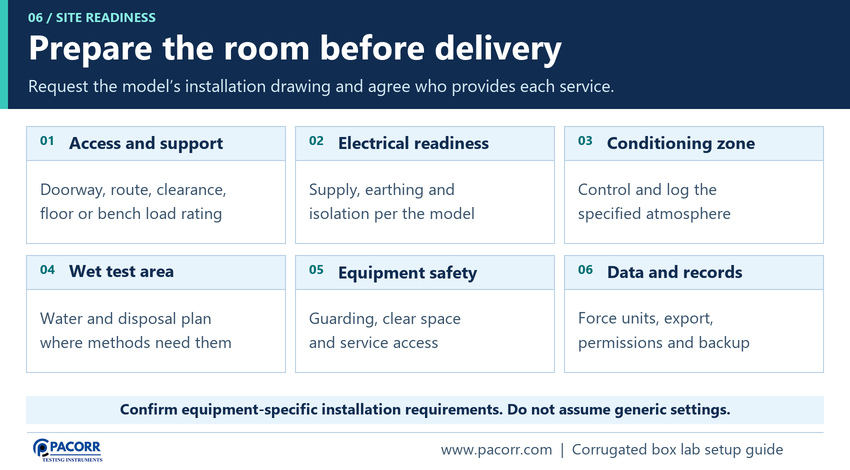
Make a clearance sketch with the actual case envelopes, not empty machine dimensions alone. Place guards, emergency controls and barriers where operators can use them without entering a movement or impact area. Review lifting and handling arrangements for heavy packed boxes. Follow the model manual and qualified site personnel for installation decisions. Do not make floor, electrical or compressed-air adjustments based on a generic catalogue specification.
How do you verify the equipment before releasing the lab for routine use?
Write the acceptance checks into the purchase specification. On delivery, match instrument identity, sensors, accessories and firmware or software to the order. Confirm installation requirements and appropriate safety functions with qualified personnel. Review calibration coverage for the actual force, speed, displacement, pressure, mass, dimensions or environment relevant to each result. Factory checks do not automatically establish performance after transport and installation.
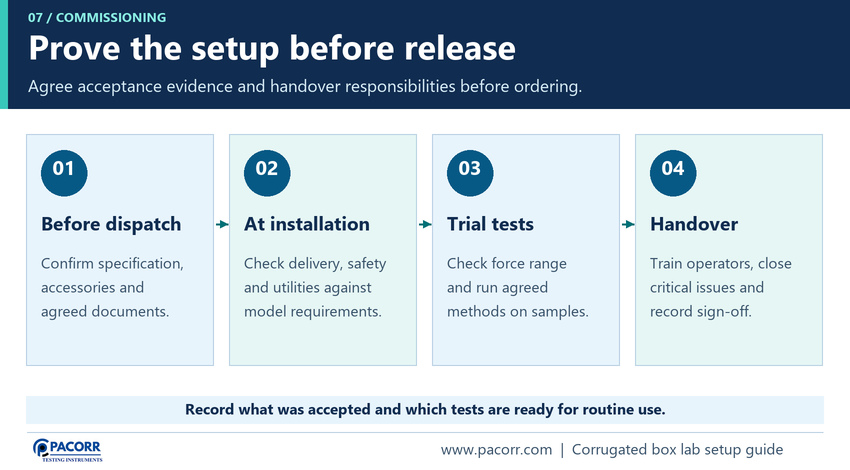
Run representative lots through the full method, starting at sample labelling and ending at the issued report. Include low-range board and large or high-force cartons if those represent vulnerable parts of the working range. Ask operators to document invalid coupon failures, case tilting, unexpected load curves or missed conditioning targets. Review the units in exported files and check the conversions against original values. Keep serial numbers, certificates, method revisions, sign-off responsibility and any open items in the handover record.
Define routine inspection, calibration and intermediate check intervals based on method requirements, history and risk. If an instrument fails a check, stop relying on the affected method, assess results since the last satisfactory check, and handle affected releases through the quality system. Shared comparison material or external cross-checks can help expose differences in preparation, conditioning or apparatus, provided both laboratories use equivalent methods. Do not adjust an instrument merely to match an unrelated lab result.
What does a practical lot-to-dispatch workflow look like?
- Identify the lot. Link board reels or supplier batches, production shift and carton order to a unique sample ID. Keep the sampling rule and planned result statistic with the order.
- Separate specimens by decision. Choose board coupons for board tests, assembled cases for compression and actual packed units for distribution validation. Do not swap one specimen level for another.
- Prepare and condition. Record specimen geometry, orientation, relevant atmosphere and time. Protect samples from handling damage or uncontrolled transfers.
- Test and review. Save individual readings and any required summary. Distinguish an invalid test handled under the method from a valid failure. Never repeat a valid failure just to obtain a passing number.
- Release, hold or escalate. Apply the agreed acceptance rule. For a hold, preserve evidence and assign investigation and customer notification as appropriate. Retain production, packing and test records according to the approved quality plan.
For a case report, include dimensions, construction, board or carton lot, empty or filled state, closure, orientation, method and applicable edition, conditioning conditions, units, individual outcomes and failure notes. Include photographs where they explain a failure. For outsourced distribution programmes, retain the package build details and sample transfer history so that an external result can be traced to the design and production lot.
What information should you send Pacorr for a quote?
Share your box sizes, board grades and wall or flute constructions, maximum packed weights, expected force range and test methods. Include daily and peak lot volumes, report and export needs, installation city, available floor space and utilities. Separate the day-one instruments from future options and identify any installation, training or verification you want included in the written quote.
Browse Pacorr's paper and packaging instrument range above, then contact Pacorr for an itemised proposal. Ask for a demonstration with a representative board coupon and a finished carton, confirmation of the usable range and fixtures, and a scope that clearly separates instruments, installation and operating costs.
Frequently asked questions
What is the minimum equipment for a corrugated box testing lab?
Start with the purchase or release specifications. For many converters the practical set includes sample preparation and conditioning, dimensional inspection, grammage and caliper tools, plus ECT and BCT where specified. Add burst, Cobb or distribution testing when your contracts or quality risks require them.
Can one machine perform ECT and BCT?
Do not assume so. The specimen geometry, fixtures, forces and verified ranges differ. Use a common platform only if the selected configuration and supporting evidence cover both named methods and the required specimens.
Is bursting strength more important than ECT?
Neither is universally more important. Burst measures resistance to rupture under pressure, while ECT measures a board coupon's edgewise crush resistance. Use the product requirement and failure mode to decide which result is needed.
Can a Cobb result replace a moisture-content result?
No. Cobb measures water taken up during a specified exposure. Moisture content describes water already present in the stock. The two results answer different process questions and need their own methods.
Do all cartons need a drop and vibration test before dispatch?
No single sequence applies to every shipment. The customer, distribution programme and quality plan identify the tests needed for routine release, design qualification or requalification after a change.
What is the cost of setting up a corrugated box testing lab in India?
Request an itemised INR quote for the test methods, machine configurations, accessories and installation scope you need. Add facility and recurring costs on a common tax and service basis. There is no reliable universal package price.
Do I need accreditation for an in-house corrugated box lab?
That depends on the intended use of the results and the applicable customer, programme or regulatory requirements. An internal process-control lab is not automatically required to be accredited. When an accredited result is required, check the laboratory's scope for the named activity.