

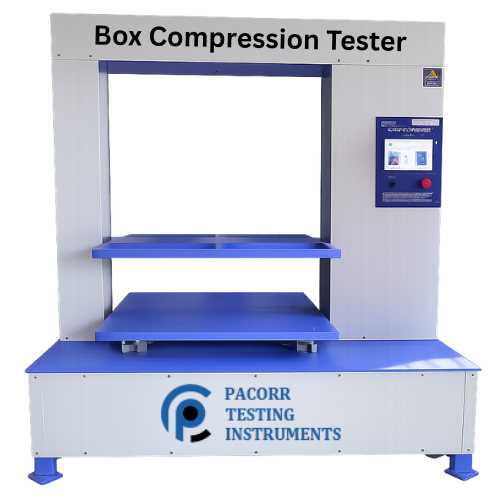
The Pacorr Computerized Box Compression Tester measures the compressive resistance of cartons and shipping boxes while recording test data through PC-connected software. This 1000 kgf configuration combines a 1000 × 1000 mm platform, a maximum test height of 1000 mm and four load sensors. It provides load-versus-time graphs, peak compression load calculation and automatic data acquisition for packaging quality control. The software organises records by date, batch number and operator, with PDF and Excel report generation and print/export facilities. It is suitable for teams that need to review individual tests and retrieve batch records for supplier assessment, carton development and packaging approval. The computer or laptop must be provided by the client.
- Shipping Area: All over the world
- Model: PCBCT-10C
- Brand: Pacorr
- Availability: In Stock


Technical Specifications
| Parameter | Specification |
| Load capacity | 1000 kgf |
| Platform size | 1000 × 1000 mm |
| Maximum test height | 1000 mm |
| Load measurement | Four load sensors |
| Load accuracy | ±1% of full scale |
| Load least count | 0.1 kgf |
| Specified test speed | 10 ± 3 mm/min |
| Variable speed range | 10–50 mm/min |
| Displacement resolution | 0.1 mm |
| Display | LCD/digital display with PC interface |
| Data interface | RS-232 / USB connectivity; confirm the supplied connection arrangement |
| Motor | Crompton 1.5 hp induction motor with dedicated gearbox |
| Power supply | 220 V AC, single phase, 50 Hz |
| Frame construction | Double-column mild steel structure |
| Lead screw material | EN9 |
| Safety features | Overload protection, over-travel protection and emergency stop |
| Return function | Built-in auto-home facility |
| Computer or laptop | To be provided by the client |
The 10 ± 3 mm/min test-speed specification and the 10–50 mm/min adjustable range describe different aspects of operation. Select the test setting required by the chosen method; an available speed is not automatically appropriate for every standard.
Understanding Accuracy and Resolution
The 0.1 kgf least count is the smallest displayed load increment. It does not mean the instrument has an accuracy of ±0.1 kgf. For a 1000 kgf full-scale capacity, ±1% of full scale corresponds to ±10 kgf. When assessing suitability for low-strength cartons, compare the specified accuracy and calibrated working range with the acceptance limits for your packaging. Similarly, 0.1 mm displacement resolution describes the measurement increment, not verified displacement accuracy or direct carton-wall strain.
Software and Key Features
Test Graphs and Peak Load
The software acquires load data automatically and plots load against time. The peak compression load identifies the highest force recorded during the test. Reviewing the graph alongside the tested carton helps the operator investigate changes in load-bearing behaviour.
A graph alone does not establish why a carton failed. Observations such as panel buckling, joint opening or local crushing should be recorded separately and reviewed with the test conditions.
Batch Records and Reports
- Organise the test database by date, batch number and operator.
- Generate reports in PDF and Excel formats.
- Print and export results for quality documentation.
- Retrieve earlier records when investigating batch variation or supplier performance.
- Reduce manual transcription of recorded load data.
For meaningful comparisons, maintain consistent sample identification and document the carton dimensions, empty or filled condition, conditioning history, test speed and method. Confirm which details appear in the supplied report template and which require supplementary laboratory records.
Mechanical Construction and Operation
- Heavy-duty double-column mild steel frame.
- Four-load-sensor measurement arrangement.
- EN9 lead screws.
- Crompton 1.5 hp induction motor with dedicated gearbox.
- Adjustable movement speed from 10 to 50 mm/min.
- RS-232 port for connection to a compatible PC or laptop.
- Built-in auto-home facility for returning the moving assembly to its home position.
- Overload and over-travel protection, plus an emergency stop.
The four-sensor arrangement is a design feature; measurement quality still depends on calibration, platen alignment, sample positioning and the test procedure.
Working Principle and Test Procedure
The machine applies compression to a carton positioned between its platens. As the moving platen advances, the load sensors measure the carton’s resistance. The connected software records the load over time and calculates the highest registered compression force.
The result represents the tested package under the recorded conditions. Carton construction, contents, closures, conditioning and loading orientation can all affect the result.
How to Carry Out a Test
- Choose the method. Define the required procedure, sample condition and acceptance criteria before testing.
- Prepare the carton. Assemble, close and condition it as required. Record whether it is empty or filled.
- Check machine suitability. Confirm that the specimen fits the usable test space and that its expected compression load is within the machine’s capacity and suitable calibrated range.
- Position the sample. Centre the carton and use the orientation specified by the method.
- Prepare the software. Connect the client-supplied computer and enter the available batch and operator details.
- Set the test speed. Use the setting required by the procedure and complete the machine’s prescribed pre-test checks.
- Run the test. Observe the test safely and follow the defined endpoint and operating instructions.
- Review and report. Save the peak load and load-time record, document visible failure and compare results with the agreed specification.
A peak reached because a test was stopped at a preset limit is not necessarily the carton’s failure load. Record the endpoint so that the result can be interpreted correctly.
Applications and Result Interpretation
The computerized configuration suits packaging manufacturers, incoming inspection teams and laboratories that need compression measurements with retrievable digital records.
Typical applications include:
- Comparing carton batches against an approved packaging specification.
- Assessing alternative board grades or carton designs under equivalent conditions.
- Reviewing packaging from different suppliers.
- Investigating reported carton collapse using retained or representative samples.
- Testing empty or filled packages where permitted by the selected procedure.
- Maintaining batch-linked reports for internal quality reviews.
Comparing Cartons Fairly
Compare like-for-like samples using the same preparation, orientation, speed and conditioning procedure. Filled and empty cartons may distribute load differently, so their results should be clearly identified. Use the number of specimens required by the chosen method or quality plan. A single result may not represent the variation within a production batch. Review individual readings and their spread before deciding whether a packaging change has improved performance.
Compression Strength and Stacking Performance
Peak compression load is useful for packaging evaluation, but it does not independently establish a safe stacking height or storage duration. A short compression test and prolonged loading in a warehouse are different conditions. Stacking decisions also depend on humidity, storage time, pallet support, box alignment and load distribution. Where a procedure requires a maintained load for a defined period, confirm the necessary loading and control capability separately.
Test Standards and Configuration Selection
Select the standard according to the package, test objective and customer requirement.
| Standard | Relevance and selection guidance |
| ASTM D642 | Compression testing of shipping containers, components and unit loads. Confirm the required loading arrangement, specimen condition and apparatus requirements. |
| TAPPI T804 | Compression testing of fibreboard shipping containers. Confirm apparatus and procedure requirements against the applicable edition. |
| ISO 12048 | Compression and stacking tests on complete, filled transport packages using a compression tester. Confirm the functions required for the selected test. |
| ASTM D4169 | A distribution-performance testing practice covering a sequence of hazards. A compression tester supports relevant compression work; it does not perform the complete distribution programme by itself. |
| ISO 2234 | A static-load stacking reference. Confirm the required loading arrangement and procedure separately before claiming suitability. |
A standards reference does not by itself certify the machine or establish that every test in that document can be performed. Confirm the selected configuration, calibration, speed, platen arrangement and any sustained-load requirements against the applicable method.
Information to Share Before Ordering
Provide the carton dimensions, expected compression load, intended test standard, sample condition and required report format. Also share the computer operating system and available connection ports so that software compatibility and the RS-232/USB arrangement can be confirmed.
For a broader overview of available configurations, explore Pacorr’s Box Compression Tester range.
Frequently Asked Questions
What makes this a computerized box compression tester?
It connects load measurement to PC software for automatic data acquisition, load-versus-time graphs, peak load calculation, database management and PDF/Excel reporting.
Is a computer or laptop included?
No. The client must provide a compatible computer or laptop. Confirm the operating system, connection requirements and software installation requirements before purchase.
What box size can it accommodate?
The specified platform is 1000 × 1000 mm, with a maximum test height of 1000 mm. Confirm usable clearance, loading access and specimen orientation for cartons close to these limits.
Does 0.1 kgf least count mean 0.1 kgf accuracy?
No. Least count describes the displayed increment. The stated load accuracy is ±1% of full scale, equivalent to ±10 kgf for this 1000 kgf configuration.
Can it test filled cartons?
Filled cartons may be tested when the selected procedure permits them and the specimen fits the machine’s capacity and usable space. Report the contents and packing arrangement because they can influence the measured resistance.
Can it hold a constant load for a stacking test?
The supplied feature list establishes peak load calculation and load-time recording. Constant-load holding is a separate capability that must be confirmed for the required procedure.
Can test reports be exported?
Yes. The specified software supports PDF and Excel reports, with print and export facilities. Confirm the required report fields during the software demonstration.
Does it produce load-versus-displacement graphs?
The confirmed graph function is load versus time. A displacement-resolution specification alone does not establish load-versus-displacement graphing or export capability.
Request a quotation or software demonstration: Share your carton dimensions, expected load and testing requirements with Pacorr.
Phone: +91-8882149230
Email: info@pacorr.com
Write Your Review
Related Products
Our Clients
























By Test Standard
Our USP's
Demonstration of Machine
- Try Before You Decide
- Experience Before You Invest
- See It in Action – Free Demo
Global Reach
- Delivering Excellence Worldwide
- Serving Across Borders
- Your Global Supply Partner
On-Site Support
- Support That Comes to You
- On-Ground Assistance, Anywhere
- We Reach Where You Are
Team Strength
- Powered by Expert Minds
- Driven by Skilled Professionals
- Engineering Excellence Team
Manufacturing
- Precision-Driven Manufacturing
- Smart & Automated Production
- Engineered In-House Excellence
