
EV Battery Environmental Test Equipment
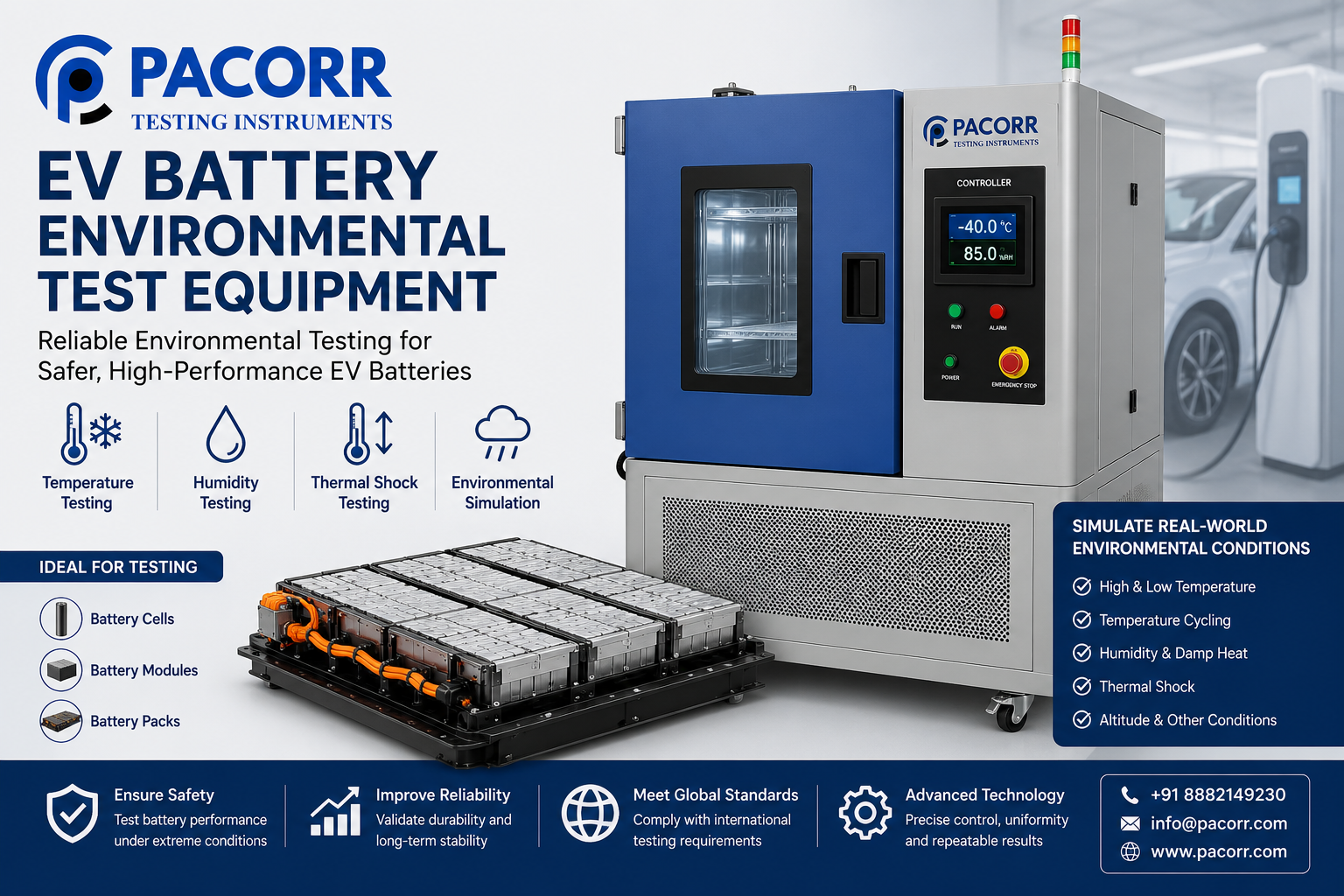
Electric vehicle batteries must operate safely in high heat, freezing temperatures, humidity and repeated climatic changes. These conditions can affect battery capacity, charging performance, insulation, sealing and long-term reliability. Pacorr manufactures EV Battery Environmental Test Equipment for evaluating battery cells, modules, packs and related EV components under controlled laboratory conditions.
What Is EV Battery Environmental Test Equipment?
EV Battery Environmental Test Equipment includes specialised chambers that simulate temperature, humidity and thermal stress. These systems allow manufacturers to study how a battery behaves during operation, charging, transportation and storage.
The equipment can be configured for cylindrical, pouch and prismatic cells, battery modules, complete battery packs, battery management systems and electronic components. Testing may include constant high or low temperature, combined temperature and humidity, repeated thermal cycling or rapid movement between hot and cold conditions.
Why EV Battery Environmental Testing Is Important
Temperature directly influences battery performance. Low temperatures can reduce available energy and charging efficiency, while excessive heat may accelerate ageing and affect battery materials. Humidity can influence insulation, electrical connections, coatings and enclosure seals.
Controlled testing helps engineers identify these risks before production. It also supports battery design improvement, thermal management development, quality control and comparison of different battery materials or suppliers.
Types of Environmental Testing Equipment
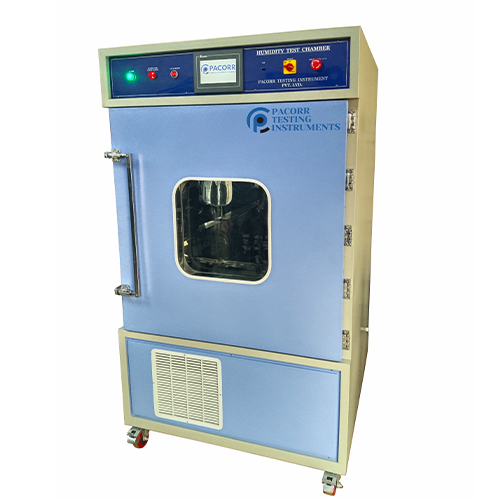
Temperature and humidity chambers are used for combined climatic exposure and moisture-resistance testing. Hot and cold chambers evaluate battery behaviour at selected elevated and sub-zero temperatures.
Temperature cycling chambers create repeated heating and cooling cycles to test seals, joints, materials and electrical connections. Thermal shock chambers produce rapid temperature changes that may reveal cracking, deformation or functional failure caused by sudden thermal stress.
The correct system should be selected according to battery size, temperature range, humidity requirement, test duration and required rate of temperature change.
How the Testing Process Works
The battery is placed inside the chamber and connected to the required monitoring or cycling equipment. The operator programs the temperature, humidity, dwell time and test sequence according to the selected procedure.
During exposure, battery voltage, current, capacity, resistance and surface temperature may be monitored. The specimen is also checked for swelling, leakage, corrosion, deformation or insulation damage. Results recorded before and after testing help determine whether the battery remains within the required performance limits.
Testing Cells, Modules and Battery Packs
The chamber configuration depends on the specimen size and energy level. Individual cells may require a compact chamber with precise temperature control and cable ports. Modules require more working space and multiple monitoring connections.
Complete battery packs are larger, heavier and may generate heat during charging or discharging. Pack testing may require reinforced flooring, loading arrangements, ventilation and additional safety systems. Pacorr recommends the chamber configuration after reviewing battery dimensions, chemistry, weight, state of charge and heat generation.
Battery Testing Safety
Lithium-ion battery testing requires proper risk assessment because an overstressed battery may release heat, smoke, gas or pressure. Depending on the application, safety options may include emergency shutdown, over-temperature protection, pressure relief, ventilation, smoke detection, gas monitoring and remote observation.
The safety configuration should always match the battery energy level and intended test condition. A chamber suitable for component conditioning may not be appropriate for testing an active, fully charged battery pack.
Features of Pacorr EV Battery Environmental Test Equipment
Pacorr environmental chambers are designed to provide stable and repeatable testing conditions. Available configurations may include programmable temperature profiles, humidity control, touchscreen operation, data recording, air circulation and safety interlocks.
Custom options can include different chamber sizes, cable entry ports, observation windows, reinforced floors, additional sensors and battery-specific safety arrangements. Equipment specifications are selected according to the actual test profile rather than using one standard configuration for every application.
Applications
EV Battery Environmental Test Equipment is used by battery manufacturers, electric vehicle companies, automotive suppliers, research institutes and independent testing laboratories. It supports product development, design validation, supplier qualification, production quality control and battery performance studies.
The equipment can also be used for battery management systems, connectors, charging components, sensors and electronic control units used in electric mobility.
EV Battery Environmental Test Equipment Price
The price of EV Battery Environmental Test Equipment depends on chamber volume, temperature range, humidity control, cooling rate, controller, data logging and safety requirements.
A compact cell-testing chamber will have a different cost from a large system designed for modules or complete battery packs. Ventilation, gas monitoring, reinforced loading systems and other custom features can also influence the final price.
For an accurate quotation, customers should provide the battery dimensions, weight, chemistry, energy capacity, temperature range, humidity conditions and required test cycle.
Why Choose Pacorr?
Pacorr develops environmental testing systems according to the battery type, test procedure and laboratory requirements. Our technical team reviews the specimen, climatic profile, thermal load and safety expectations before recommending a suitable configuration.
Standard and customised equipment is available for EV battery cells, modules, packs and associated components. Pacorr also provides technical consultation, installation guidance and after-sales support.
Frequently Asked Questions
Which EV batteries can be tested?
The equipment can be configured for cylindrical, pouch and prismatic cells, lithium-ion batteries, battery modules and complete battery packs.
Can batteries be charged and discharged inside the chamber?
Yes, when the chamber is equipped with suitable cable ports, cooling capacity, monitoring connections and safety systems.
Is customised equipment available?
Yes. Chamber size, environmental range, controls, monitoring and safety features can be customised according to the test requirement.
What determines the equipment price?
The price depends on chamber capacity, temperature and humidity range, cooling performance, automation, data recording and battery-specific protection systems.
Recent Blogs
Enhance your understanding of testing and precise quality control indistinct applications with our
knowledge based articles coming from top editors of industry leaders.
Our USP's
Demonstration of Machine
- Try Before You Decide
- Experience Before You Invest
- See It in Action – Free Demo
Global Reach
- Delivering Excellence Worldwide
- Serving Across Borders
- Your Global Supply Partner
On-Site Support
- Support That Comes to You
- On-Ground Assistance, Anywhere
- We Reach Where You Are
Team Strength
- Powered by Expert Minds
- Driven by Skilled Professionals
- Engineering Excellence Team
Manufacturing
- Precision-Driven Manufacturing
- Smart & Automated Production
- Engineered In-House Excellence
