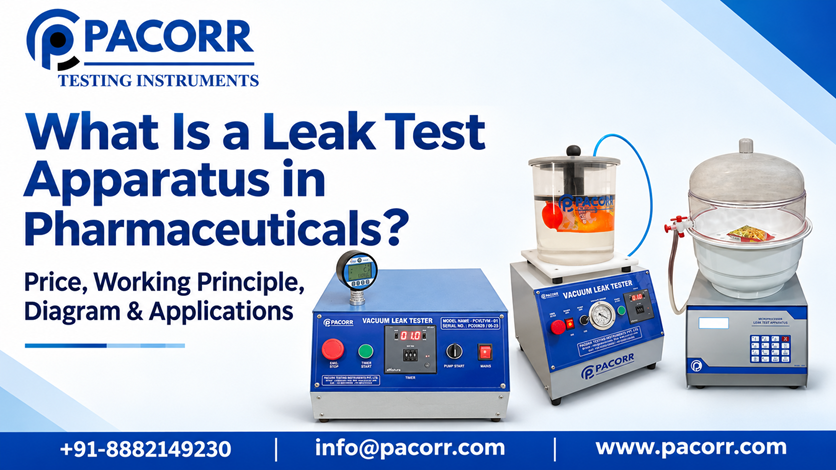
A leak test apparatus in pharmaceuticals is equipment used to evaluate whether a package or container closure has a leakage path. Depending on the method, it reveals escaping bubbles, liquid ingress, or a measured pressure change. The appropriate test depends on the package, product, and required detection capability.
A blister cavity, medicine sachet, or sealed vial can look acceptable while a channel remains at its closure. Leak testing helps quality teams investigate that risk. To obtain a useful result, the laboratory needs both suitable equipment and a test method demonstrated to work with the actual product and packaging.
This guide explains apparatus prices, working principles, components, pharmaceutical applications, and the decisions that make test results meaningful.
Leak test apparatus price in India
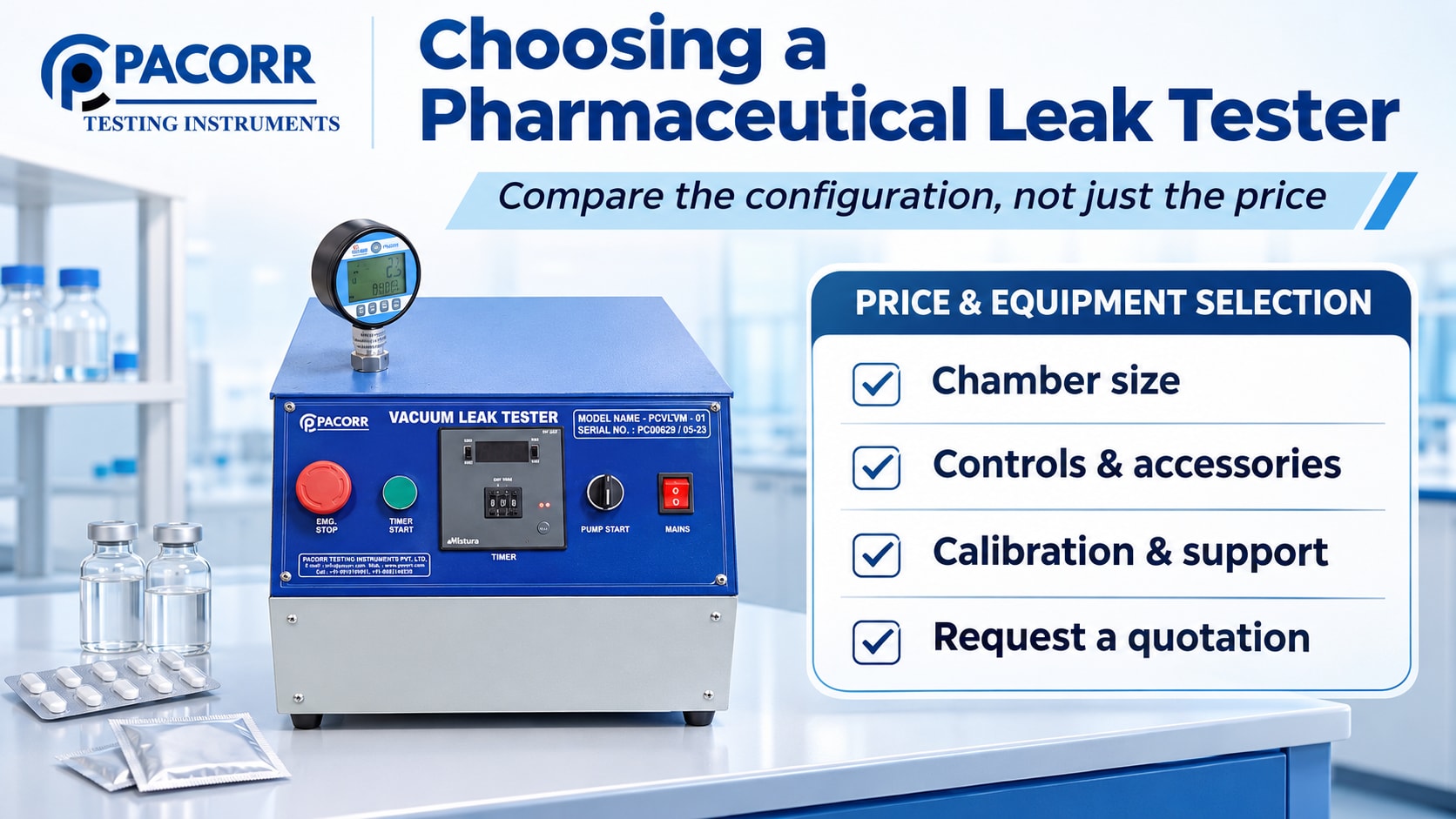 Pacorr lists a price range of ₹45,000–₹3,50,000 for its dry-and-wet vacuum leak tester, depending on specifications and features. Its pouch-and-sachet tester has a separately published range of ₹50,000–₹1,50,000. These are indicative product-page ranges checked on 5 November 2026, rather than a quotation for a particular pharmaceutical application.
| Pacorr equipment | Published price range | What to confirm |
|---|---|---|
| Vacuum Leak Tester — Dry and Wet | ₹45,000–₹3,50,000 | Selected variant, chamber, controls, and measurement method |
| Vacuum Leak Tester for Pouches and Sachets | ₹50,000–₹1,50,000 | Pack dimensions, fixtures, gauge, and automation |
Request a written quotation that identifies the model, included accessories, calibration documents, installation, freight, and GST treatment. Do not assume that the listed ranges include every service or a validated container closure integrity testing system.
What changes the purchase cost
The usable chamber size, sample restraint, vacuum control, pump, measurement resolution, and reporting functions all affect equipment selection. Laboratories may also need application trials, operator training, qualification support, and replacement seals. Comparing quotations against the same package and test objective gives a more useful comparison than comparing starting prices.
For an application-specific offer, share the filled sample, package drawing, closure material, required method, expected throughput, and documentation needs through Pacorr’s vacuum leak tester enquiry.
Leak test apparatus working principle
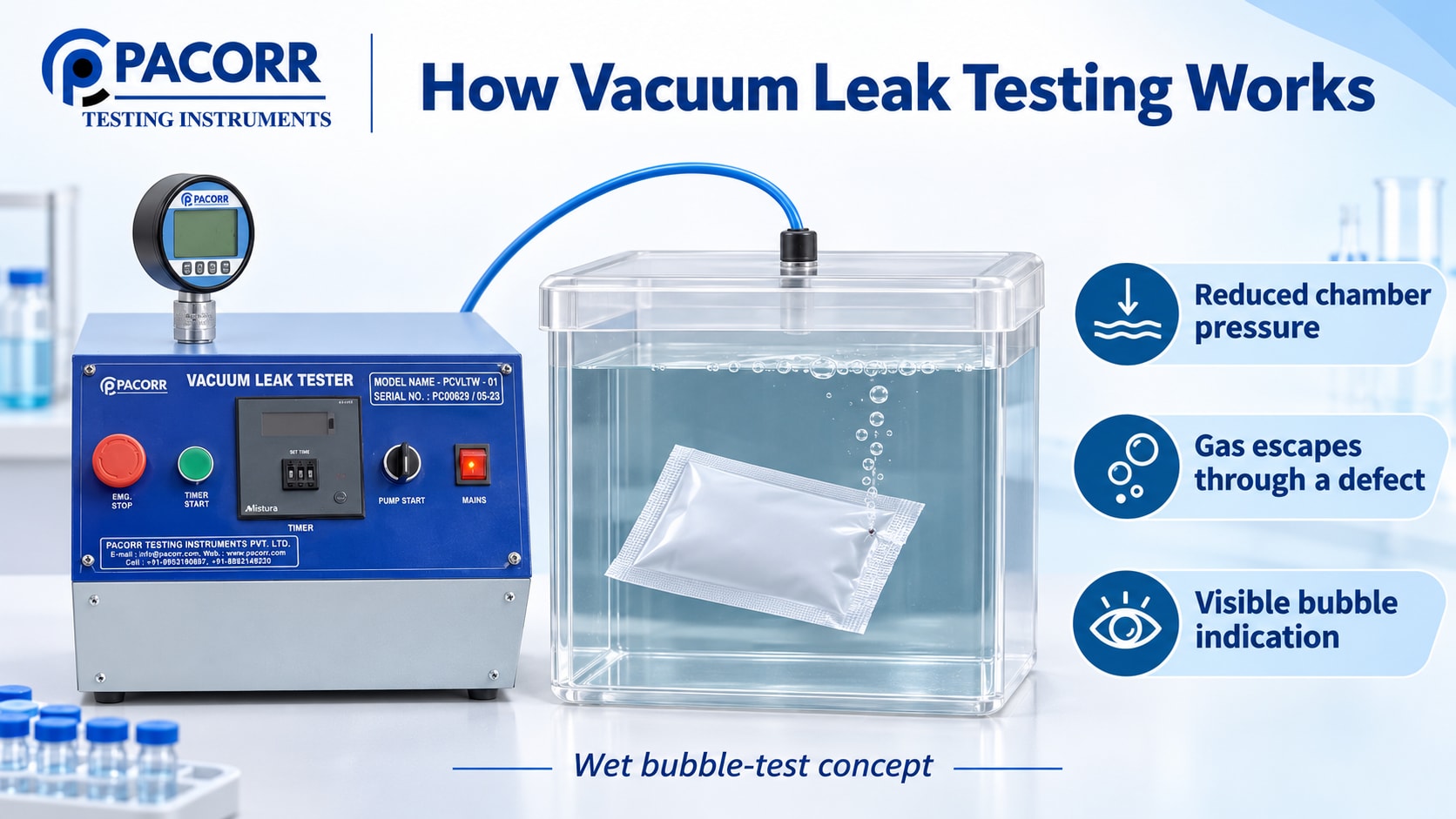 A vacuum-based leak test apparatus creates a pressure difference between a sealed package and its surroundings. If a leakage path exists, gas or liquid can move through that path. The test detects this movement by an observation or measurement defined in the selected method.
In a wet bubble test, the pump lowers pressure around an immersed package. Gas inside the package may then escape through a defect and form bubbles in the surrounding liquid. In a vacuum decay test, a measurement system monitors pressure rise in an evacuated test chamber after the prescribed evacuation and stabilization stages.
Understanding the pressure difference
The driving pressure is the package’s internal pressure minus the pressure immediately outside it. For example, if internal gas remains at 101 kPa absolute while chamber pressure is 61 kPa absolute, the nominal difference is 40 kPa, before accounting for immersion depth. This is an illustrative calculation, not a recommended operating setting.
A flexible pack may expand, changing its internal pressure. Liquid depth also adds pressure at the sample surface. These effects explain why sample position, headspace, and restraint can influence a wet test.
Always distinguish absolute pressure, measured from a vacuum reference, from gauge pressure, measured relative to local atmospheric pressure. A display labelled “mmHg vacuum” may express a reduction below atmosphere. Record the instrument’s convention so another operator can reproduce the conditions.
Why a digital gauge does not prove vacuum decay capability
A digital gauge can display chamber vacuum without providing the sensing, isolation, stabilization, and analysis needed for a validated vacuum decay method. When a supplier offers “dry testing,” ask what signal is measured, how it is evaluated, and how detection capability is demonstrated on your package.
Leak test apparatus diagram and main components
_1793874503.png)
| Component | Function | Practical check |
|---|---|---|
| Vacuum-rated chamber and lid | Enclose the sample under reduced pressure | Inspect for damage and confirm usable dimensions |
| Lid gasket and connections | Limit leakage from the test system | Keep sealing surfaces clean and check condition |
| Vacuum pump and isolation valve | Evacuate the chamber and control its connection to the pump | Confirm suitability for the required cycle |
| Gauge or pressure sensor | Indicate pressure; specialized systems also measure the test signal | Check units, range, calibration, and resolution |
| Timer or controller | Manage the selected sequence and duration | Verify the actual cycle against the method |
| Vent valve | Return the chamber to atmospheric pressure | Release pressure in a controlled manner |
| Liquid and sample holder | Support observation in a wet test | Avoid masking the seal or damaging the sample |
How do bubble testing, dye ingress, and vacuum decay differ
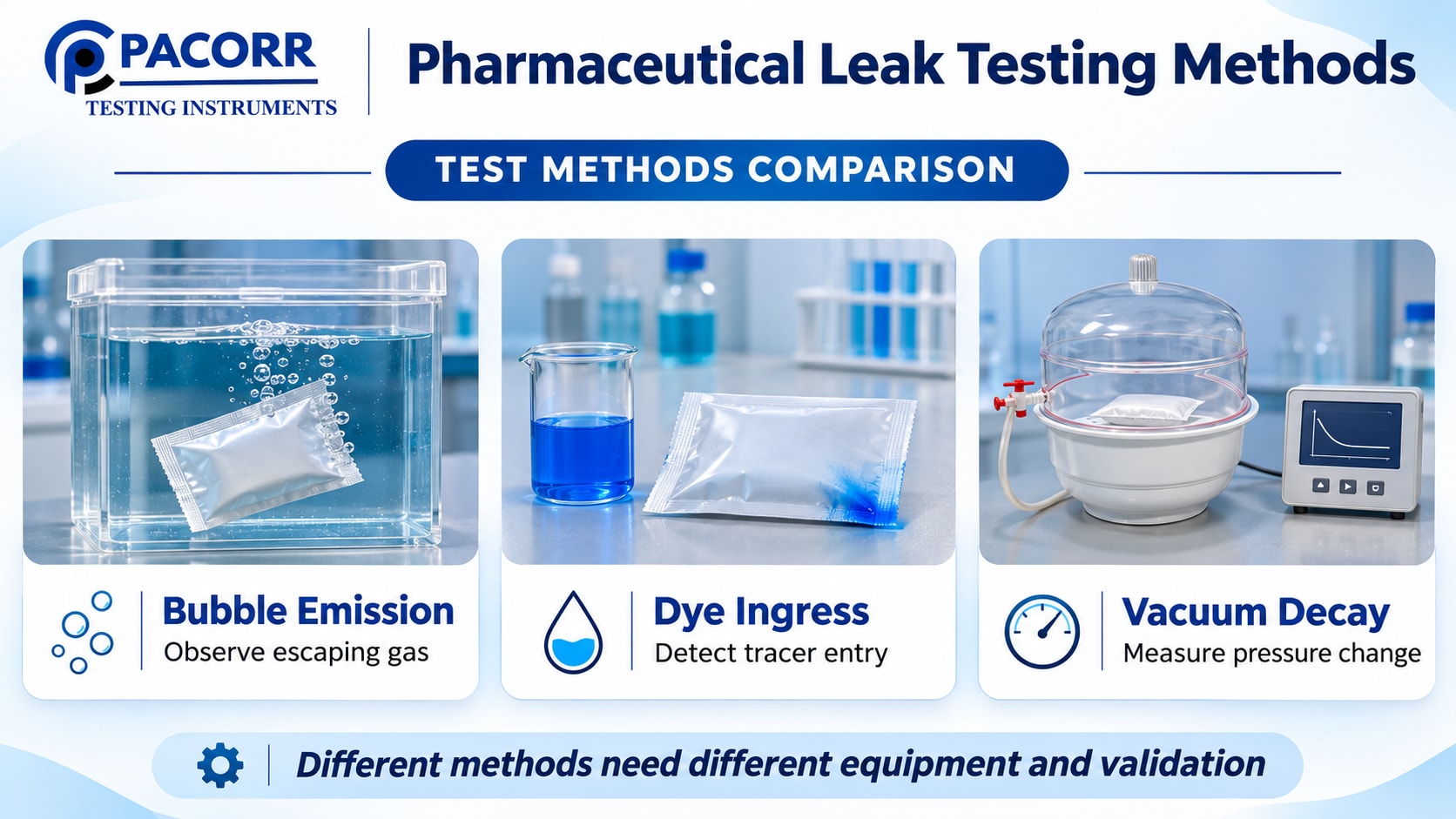
These methods answer related questions using different signals. Treating them as interchangeable can produce misleading conclusions about what an instrument or a passing result establishes.
| Method | Signal assessed | Selection consideration |
|---|---|---|
| Vacuum bubble emission | Gas escaping into immersion liquid | Requires suitable gas availability and an observable leak path |
| Dye ingress | Tracer solution entering through a defect | Depends on the tracer, package, pressure sequence, and examination method |
| Vacuum decay | Measured pressure rise in an evacuated chamber | Requires suitable sensors, fixtures, stabilization, and validated limits |
| Other specialized CCI methods | Signals such as tracer gas, electrical response, or headspace properties | Require equipment and studies matched to the product-container system |
Bubble emission and dye ingress are generally described as probabilistic methods because the observation depends on several interacting conditions. Deterministic approaches use a measurable physical response under controlled conditions. The distinction helps method selection; neither label eliminates the need to demonstrate suitability.
USP <1207.2> addresses the selection and use of package leak-test technologies. For sterile products, the appropriate approach should be established within the broader container closure integrity strategy.
Where methylene blue testing fits
Methylene blue can act as a visible tracer in a defined dye-ingress method. Finding it inside a package may reveal a leakage path. A lack of visible staining is meaningful only when the method can detect the defects of concern in that product-container combination. The dye concentration, exposure sequence, examination technique, and acceptance criteria belong in the approved method.
Dye penetration at a package seal and vacuum-assisted dye ingress are not automatically the same procedure. For example, ASTM F1929 concerns a particular porous medical-packaging seal configuration; it should not be treated as a universal method for pharmaceutical blisters or vials.
Leak test apparatus applications in pharmaceuticals

Tablets and capsules in blister or strip packs
Testing can investigate leakage associated with incomplete sealing, folds, trapped powder, or damage to the cavity and lidding. Record which cavity or seal segment is affected so production teams can relate the result to a tooling position or process change. See Pacorr’s overview of blister-pack integrity testing for additional packaging context.
Powders and granules in sachets or pouches
Flexible packs can develop channels across the sealing area or damage near folds. Product trapped in a seal is particularly relevant during filling. The test plan should account for fill level, headspace, and the possibility that the contents obstruct a leakage path.
Bottles and closures for oral products
Evaluate the assembled bottle, cap, liner, and any induction seal as a system. A result on an empty bottle does not automatically establish performance after filling, capping, or transport. Closure investigations may require dimensional checks and other measurements alongside leak testing.
Sterile vials, ampoules, and prefilled systems
These applications require a product-specific container closure integrity assessment. Method selection should consider the contents, container geometry, closure design, storage conditions, and required detection capability. A general-purpose chamber test alone is insufficient evidence that every sterile presentation is adequately protected.
Packaging development and change evaluation
Leak tests can help compare sealing conditions, investigate complaints, and assess changes to materials or tooling. For controlled sample preparation, Pacorr’s guide to laboratory heat sealing and process settings explains how temperature, pressure, and dwell time affect seal formation.
How to use a leak test apparatus for a wet bubble test
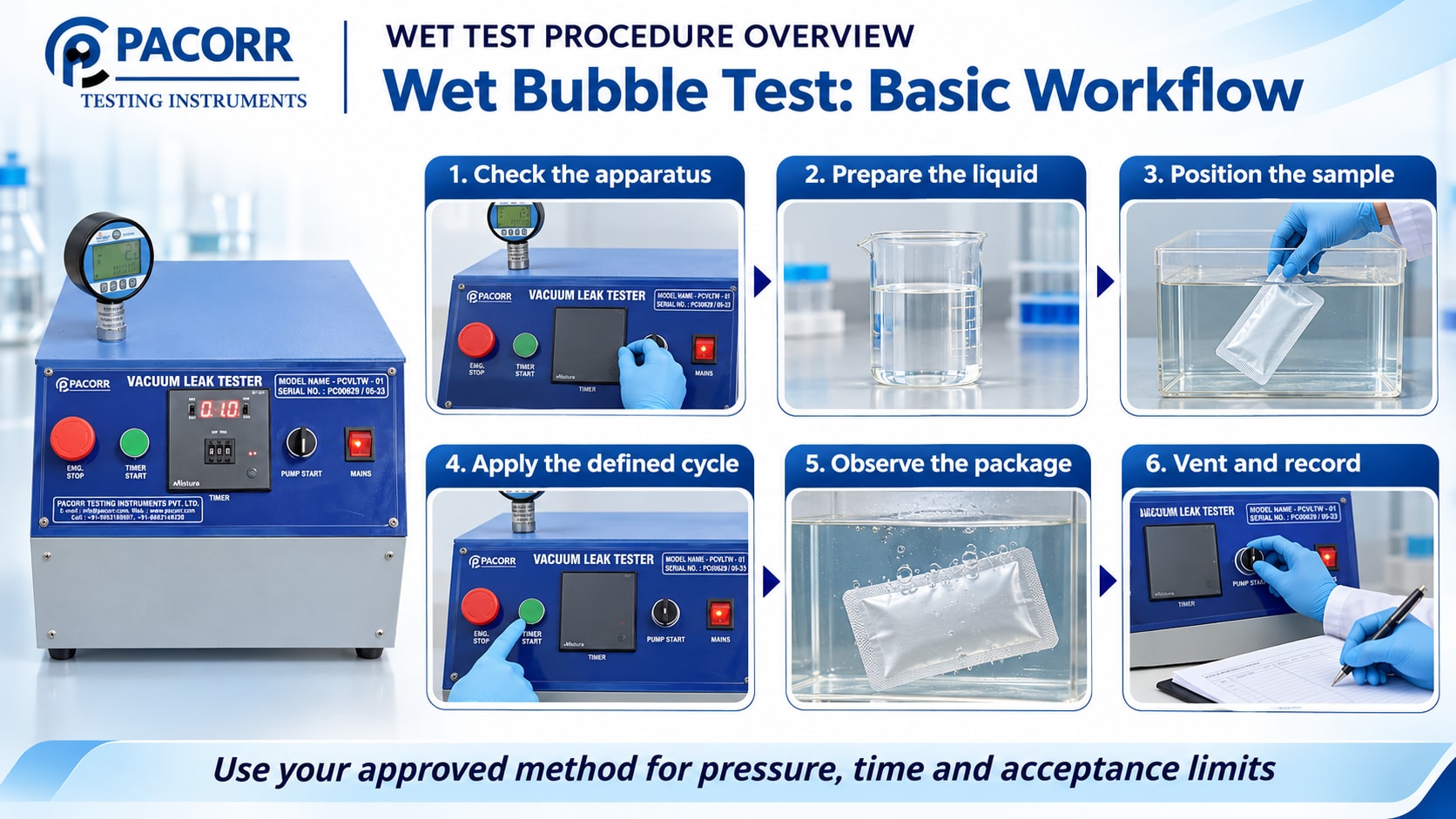 The basic sequence is to verify the setup, prepare the liquid, position the sample, apply the specified vacuum, observe the package, vent safely, and record the result. The following overview explains the workflow. Operating values must come from the applicable method, equipment instructions, and approved laboratory procedure.
- Define the test. Identify the package construction, contents, sampling plan, defect of interest, and acceptance rule. Confirm that wet bubble testing is suitable for the question being investigated.
- Check the apparatus. Inspect the chamber, lid, gasket, tubing, and valves. Verify calibration status and perform the prescribed equipment checks. A leaking chamber can prevent the intended conditions from being achieved.
- Prepare the immersion liquid. Use a compatible liquid and the specified preparation and conditioning. Maintain visibility. Control variables such as liquid condition and temperature rather than changing them between comparable tests.
- Position the sample. Keep the relevant surfaces observable and use the required immersion depth. If a holder is needed, ensure it does not compress the seal or cover the area being examined.
- Apply the defined cycle. Close the lid and use the prescribed evacuation rate, target pressure, and duration. Record the achieved conditions. Equipment capability limits are not automatically valid test settings.
- Observe and identify the source. Examine the sample under the method’s observation conditions. Distinguish gas emerging repeatedly from a specific package location from bubbles released by its surface or the surrounding liquid.
- Vent and document. Restore atmospheric pressure before opening. Record the location and nature of any indication, the control results, and the disposition of the tested samples. Handle exposed samples according to the laboratory procedure.
ASTM D3078 is a relevant reference for gross-leak bubble testing of flexible packages containing headspace gas. Its scope and limitations must be checked before applying it to a specific pharmaceutical pack.
How to interpret results and troubleshoot misleading indications
A result should answer a defined question under recorded conditions. “No leak observed at the specified test conditions” is more precise than an unrestricted claim that a package is leak-proof.
| Observation | Possible explanation | Next check |
|---|---|---|
| Repeated bubbles from one seal location | A leakage path may be present | Mark the location and evaluate against the method |
| Brief scattered bubbles at the start | Air attached to the surface or released from the liquid | Identify the source before classifying the package |
| Package expands without visible bubbles | The flexible pack is responding to the pressure difference | Do not use expansion alone as proof of leakage |
| Chamber cannot reach its target | Lid, tubing, valve, pump, or loading issue | Check the test system before judging the sample |
| A known-defect control gives no indication | The test conditions or detection setup may be unsuitable | Investigate control failure before accepting results |
| Results vary with sample position | Orientation, obstruction, or immersion differences | Review the fixture and standardize placement |
Why absence of bubbles does not establish absence of every leak
For an observable bubble indication, gas must reach a defect and pass through it under the test conditions. Product can obstruct a small opening, and a sample may have insufficient accessible headspace. The method’s demonstrated detection capability therefore matters as much as the visible observation.
Consider an illustrative investigation in which two similar sachets give different observations after their orientation changes. Before concluding that the seals differ, check whether liquid contents cover the suspected defect in one position. This scenario is a troubleshooting example, not Pacorr test data.
Leak integrity and seal strength measure different properties
A force measurement describes resistance to separation of a tested seal specimen. A leak test looks for a passage through the package system. A narrow channel can exist within an otherwise strong seal, so the two measurements should be interpreted together when the packaging specification calls for both.
For the mechanical assessment, consult Pacorr’s peel-strength testing guide. A suitably configured tensile testing machine with appropriate seal-testing grips can support the relevant force measurement. Confirm specimen geometry, capacity, and test conditions for the intended method.
Which standards apply to pharmaceutical leak testing
 Choose the reference by its scope and the actual test method. A standard number on a brochure does not establish suitability for every product or container.
| Reference | Relevant scope | Important boundary |
|---|---|---|
| USP <1207> series | Integrity evaluation of sterile-product packages | Requires an appropriate product-package strategy |
| ASTM D3078 | Bubble emission for flexible packs with headspace gas | Gross-leak method; small leaks may escape detection |
| ASTM F2338 | Leak detection by vacuum decay | Requires a suitable measurement system and method |
| ASTM D4991 | Vacuum leakage testing of empty rigid containers | Does not establish finished sterile-product CCI |
| ASTM F88/F88M | Strength of seals in flexible barrier materials | Measures separation force rather than leakage |
Use the current applicable editions and the complete procedures. Public summaries explain scope; they do not provide all requirements needed to perform a standard-compliant test.
What USP <1207> means for method selection
Container closure integrity, often abbreviated CCI, concerns the ability of the package system to maintain its protective function. For sterile products, define the leakage limit appropriate to the product and demonstrate that the selected method can assess it. There is no single vacuum setting that establishes CCI for every vial, blister, or bottle.
USP <1207.1> covers method selection and validation across development, manufacturing, and shelf-life assessments. Changes to a stopper, film, sealing process, or storage condition may require the existing evidence to be reassessed.
Leak testing also has a different role from demonstrating initial sterility. FDA guidance on CCI in stability protocols explicitly distinguishes these purposes. A passing leak test does not demonstrate that the product was sterile when filled.
Qualification, controls, and acceptance criteria
Equipment qualification and method validation address different questions. Installation qualification checks the installed system against defined requirements. Operational qualification examines operation over the intended range. Performance qualification establishes performance in the intended use. The method must also show that its results are reliable for the particular product-package combination.
A practical validation plan should address representative intact samples, suitable known-defect controls, repeatability, operator variation where relevant, and justified acceptance limits. Supplier documents can support this work; they cannot substitute for application-specific evidence.
What to record in a pharmaceutical leak-test report
- Product, batch, package construction, and sample identification.
- Method identifier and revision; instrument and calibration identification.
- Actual pressure, its reference convention, timing, and relevant conditioning.
- Sample orientation, immersion details, and fixtures where applicable.
- Control results, observations or measured signals, and acceptance criteria.
- Operator, date, deviations, investigation references, and final disposition.
How to choose a leak test apparatus for your pharmaceutical packaging
Start with the decision the laboratory needs to make. Routine checks for gross leakage in a flexible pack and a validated sterile-vial CCI study can require different equipment, fixtures, and evidence.
Ask the supplier to demonstrate the proposed configuration with representative samples and agreed controls. Confirm how the method handles product-filled packs, how results are recorded, and what happens when a control fails. Also check chamber cleaning, service access, spare gaskets, calibration arrangements, and operator training.
Published Pacorr specifications to discuss
Pacorr’s vacuum leak tester product page lists the following configuration details. Confirm the supplied model and current specification in the quotation.
| Parameter | Published detail |
|---|---|
| Vacuum range | 150–600 mmHg |
| Desiccator diameter | 300 mm |
| Hold-time capability | Up to 999 seconds |
| Pressure indication | Digital gauge |
| Controls | Programmable vacuum and hold time |
These are equipment specifications, not recommended settings for a pharmaceutical test. Ask separately about usable sample capacity, pressure reference, application suitability, and qualification-document scope.
Frequently asked questions
What is the use of a leak test apparatus in pharmaceuticals
It helps evaluate leakage paths in pharmaceutical packaging, investigate sealing defects, and support packaging development and quality control. The selected method must be suitable for the specific package and product.
What is the working principle of a leak test apparatus
Vacuum-based apparatus creates a pressure difference across the package. A leak may allow gas or liquid to move through the defect. Bubble emission, dye ingress, and vacuum decay detect this through different observations or measurements.
What is the price of a pharmaceutical leak test apparatus
Pacorr’s published dry-and-wet tester range is ₹45,000–₹3,50,000, subject to configuration. The final quotation depends on the model, package, controls, accessories, and required services. Specialized CCI applications need separate technical and commercial evaluation.
Which vacuum pressure and holding time should be used
Use the values established by the applicable method and the laboratory’s approved procedure. Settings depend on the product, package, and test objective. The instrument’s maximum vacuum or timer range is not a universal test requirement.
Is a vacuum leak test destructive or nondestructive
That depends on the method and application. Wet or dye testing can expose or contaminate samples, while vacuum decay can provide nondestructive evaluation with a suitable setup. Sample disposition must follow the approved procedure.
Can one apparatus test both blisters and injectable vials
Physical fit is only one requirement. The apparatus, method, fixtures, and detection capability must be demonstrated for each product-container combination. A method suitable for one format cannot automatically be transferred to another.
Does passing a leak test prove sterility
No. A leak test evaluates package integrity under defined conditions. It does not establish the product’s initial sterility, and its ability to detect relevant defects must be demonstrated.
How often should a leak test apparatus be calibrated
Set the interval through the quality system using the manufacturer’s guidance, usage, measurement criticality, and calibration history. Routine checks and appropriate controls complement calibration; they serve different purposes.
Discuss your packaging test with Pacorr
Share your package dimensions, fill type, closure design, required test method, and expected daily workload with Pacorr. Include any calibration, reporting, or qualification requirements so the proposed configuration can be evaluated against your application.
Explore Pacorr’s vacuum leak tester and request a quotation, or call +91-8882149230 and email info@pacorr.com.