
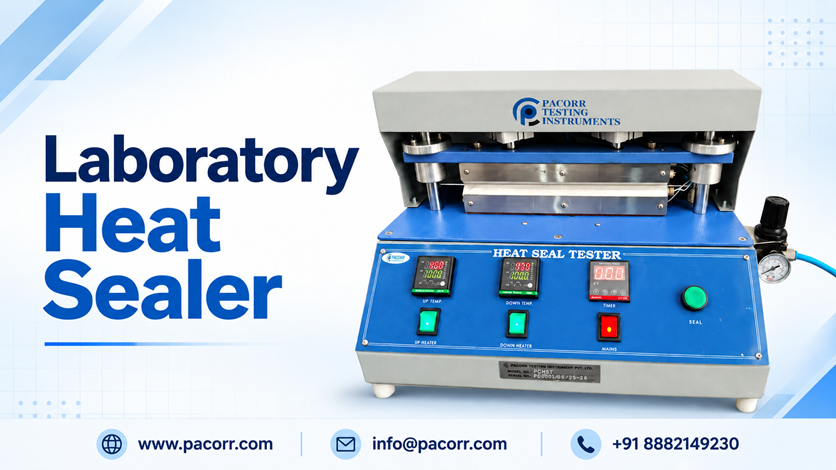
Pacorr’s Laboratory Heat Sealer helps packaging teams answer an important question: which sealing conditions will work reliably for their material? A pouch can appear neatly closed yet have weak bonding, wrinkles, or channels that compromise its performance. Controlled laboratory trials help identify these problems before a packaging structure reaches production. The 300mm configuration provides a wider sealing surface for preparing samples while allowing operators to adjust temperature, pressure, and sealing time.
What Does a Laboratory Heat Sealer Do?
A laboratory heat sealer joins compatible heat-sealable surfaces under controlled conditions. Heated jaws transfer energy through the packaging layers while pressure maintains contact between them. The jaws remain closed for a selected period, called dwell time, before releasing the sample.
Its main purpose is to prepare seals for evaluation, not to measure seal strength directly. After sealing, samples can undergo separate strength, leakage, or other appropriate tests. This distinction matters: a smooth-looking seal is not proof of adequate mechanical strength or package integrity.
Why Choose a 300mm Sealing Surface?
The 300mm option accommodates wider specimens than a smaller jaw, making it useful for pouch development and flexible-film trials. Pacorr’s published specifications list a 300mm × 15mm straight-line sealing surface alongside a 150mm option.
However, jaw length alone does not determine seal quality. Jaw alignment, sample placement, cleanliness, and temperature consistency across the working surface also matter. Buyers should confirm the required jaw configuration and usable sealing dimensions when requesting a quotation.
Technical Specifications and Key Features
Pacorr lists the following operating specifications for its laboratory heat-sealing equipment:
| Parameter | Published specification |
| 300mm sealing surface | 300mm × 15mm, straight line |
| Sealing temperature | Ambient to 300°C |
| Temperature controller | PID |
| Dwell time | 0.1–999.9 seconds |
| Pneumatic pressure | 0.05–0.7 MPa |
| Air input | 0.7 MPa |
| Operation | Switch or foot switch |
| Electrical supply | 230V AC, 50Hz |
| Installation format | Tabletop |
PID temperature control and a preset timer help operators repeat selected settings. Pneumatic actuation provides controlled jaw closure, while digital displays make temperature and timing settings easier to monitor.
The published controller range should not be confused with the usable sealing-temperature range. Confirm application-specific performance and the supplied configuration before purchase.
How Temperature, Pressure and Time Affect Results
Temperature: Insufficient heat may leave the sealant layers poorly bonded. Excessive heat can distort the film or damage the seal area. The appropriate setting depends on the sealant polymer, material thickness, and laminate construction.
Pressure: Pressure brings the surfaces into contact. Too little can produce incomplete contact; too much may deform softened material. Increasing pressure is not a universal solution to weak seals.
Dwell time: This determines how long heat and pressure act on the specimen. A thicker structure may require different settings from a thinner film, even when both use similar sealant layers.
These variables interact. A useful trial programme changes one parameter at a time, repeats each condition, and evaluates the resulting seals.
Applications in Packaging Development
A Laboratory Heat Sealer supports trials involving food pouches, personal-care sachets, pharmaceutical packaging, and other flexible packs with compatible heat-sealable layers.
It is particularly valuable when a manufacturer changes film suppliers, reduces material thickness, or introduces a new laminate. Instead of assuming the existing production settings will remain suitable, the team can compare materials under documented conditions.
For example, two films with identical overall thickness may behave differently because their sealant formulations differ. Controlled trials help distinguish material-related problems from unsuitable machine settings.
Practical Steps for Reliable Sealing Trials
Start with clean, flat specimens and identify the material’s sealing faces. Allow the equipment to stabilise at the selected temperature, then prepare repeated samples using recorded pressure and dwell-time settings.
Keep specimen preparation, cooling time, and subsequent test conditions consistent. Record wrinkles, sticking, distortion, incomplete bonding, and the failure mode observed during strength testing.
ASTM F2029 addresses laboratory preparation of heat seals for determining heat sealability. Following a suitable procedure supports meaningful comparison, but laboratory settings still require confirmation on the actual production equipment.
Laboratory Heat Sealer 300mm Price and Enquiries
The Laboratory Heat Sealer price depends on the supplied configuration, accessories, documentation, and application requirements. Request a quotation specifying the 300mm jaw, material construction, thickness range, and intended testing procedure.
Also confirm compressed-air requirements, installation arrangements, calibration scope, and after-sales support. Selecting equipment around the actual testing task is more useful than comparing purchase prices alone.
For specifications and a quotation, contact Pacorr Testing Instruments at +91 8882149230 or info@pacorr.com. Visit www.pacorr.com for product information.
Recent Blogs
Enhance your understanding of testing and precise quality control indistinct applications with our
knowledge based articles coming from top editors of industry leaders.
Our USP's
Demonstration of Machine
- Try Before You Decide
- Experience Before You Invest
- See It in Action – Free Demo
Global Reach
- Delivering Excellence Worldwide
- Serving Across Borders
- Your Global Supply Partner
On-Site Support
- Support That Comes to You
- On-Ground Assistance, Anywhere
- We Reach Where You Are
Team Strength
- Powered by Expert Minds
- Driven by Skilled Professionals
- Engineering Excellence Team
Manufacturing
- Precision-Driven Manufacturing
- Smart & Automated Production
- Engineered In-House Excellence
