A product can work well in the laboratory and behave differently during storage, transport or use. Heat, cold and moisture may affect its materials, performance or packaging. Manufacturers need a controlled way to investigate those changes before making decisions about design and quality.
A climatic chamber provides that controlled environment. It allows a laboratory to expose samples to specified temperature and humidity conditions, then assess how they respond. The same planned exposure can be repeated when comparing materials, investigating a problem or evaluating a design change.
This guide explains how a climatic chamber works, the different types available, common industrial applications and the specifications that matter when choosing equipment.
What Is a Climatic Chamber?
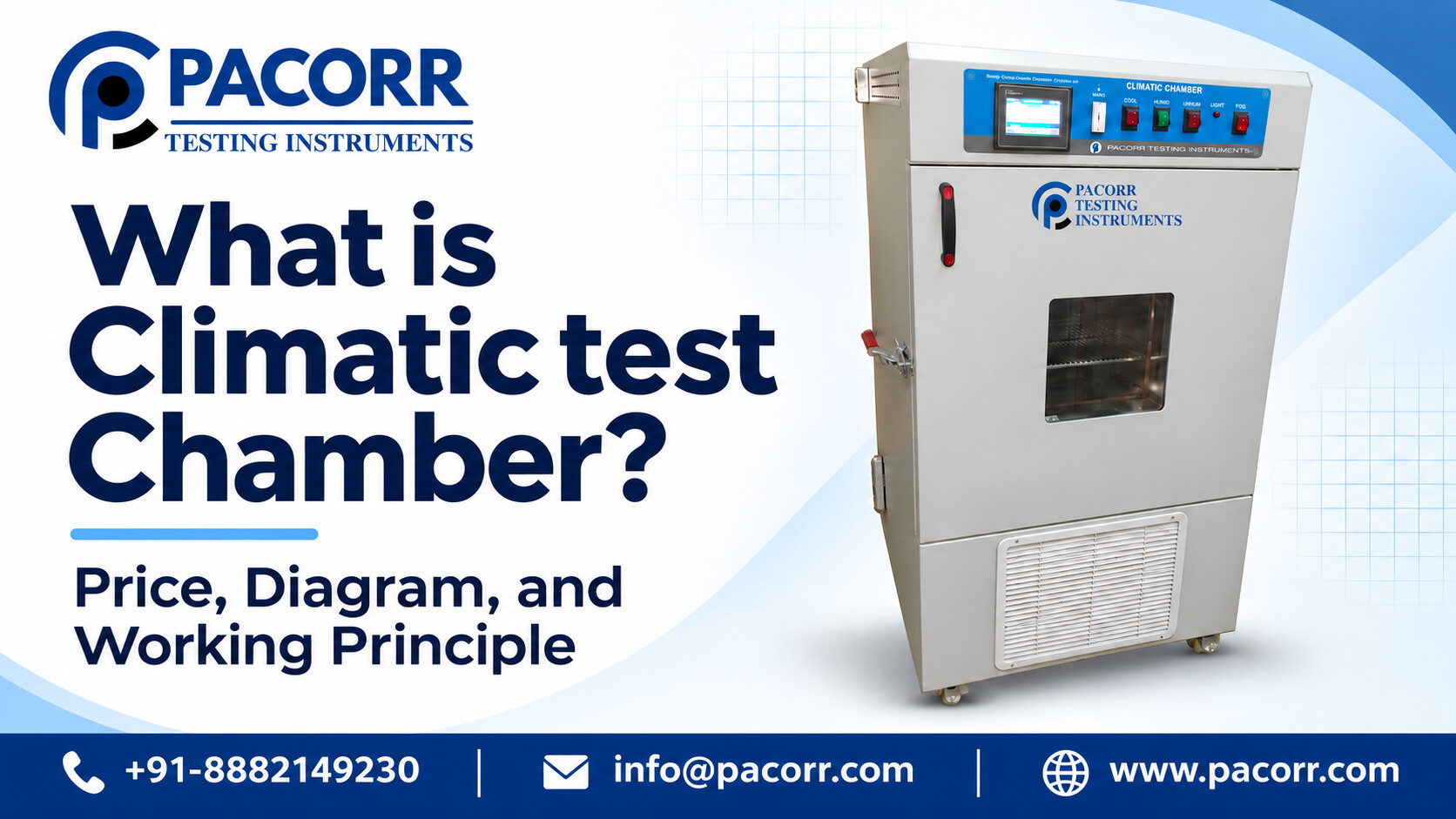
A climatic chamber is an insulated enclosure that creates and maintains controlled temperature and humidity conditions around a test sample. Laboratories use it to study how materials, components, packaging and finished products respond to a defined environment.
The equipment is also called a climate chamber or a temperature and humidity test chamber. Depending on its design, it can maintain one set of conditions or follow a programmed sequence of changes.
For example, a packaging laboratory may condition filled packages before assessing their performance. An electronics team may expose an assembly to a specified profile and check whether it still functions correctly. The chamber creates the exposure; the accompanying inspection or measurement establishes the result.
The term environmental test chamber covers a wider range of equipment. Temperature and humidity capability does not automatically include salt spray, UV exposure, reduced pressure or vibration. Those tests require an appropriate specialist or combined system.
Main Components of a Climatic Chamber
A climatic chamber combines an insulated enclosure with systems for conditioning, circulating and measuring air. Understanding these parts helps explain both the equipment's capabilities and the questions to ask before buying it.
| Component | Function | Why it matters |
|---|---|---|
| Insulated test space | Holds the samples and reduces heat exchange with the room. | Provides a controlled environment around the specimens. |
| Heating system | Adds heat to raise or maintain the air temperature. | Supports warm exposures and programmed temperature changes. |
| Refrigeration system | Removes heat through a cooling coil. | Supports cooling and, in suitable designs, moisture removal. |
| Humidity system | Adds moisture and works with the drying system to regulate humidity. | Maintains the required moisture conditions within the operating envelope. |
| Circulation fan | Moves conditioned air through the working space. | Helps distribute conditions and transfer heat to and from specimens. |
| Sensors and controller | Measure conditions and adjust the conditioning systems. | Connect the programmed settings with the actual chamber response. |
| Logging and protection features | Record measurements and respond to configured limits. | Support traceable testing and equipment protection. |
Features vary by model. A chamber intended for steady conditioning may have different refrigeration, controls and monitoring arrangements from equipment intended for rapid temperature changes. The configuration should follow the test requirement.
Climatic Test Chamber Diagram
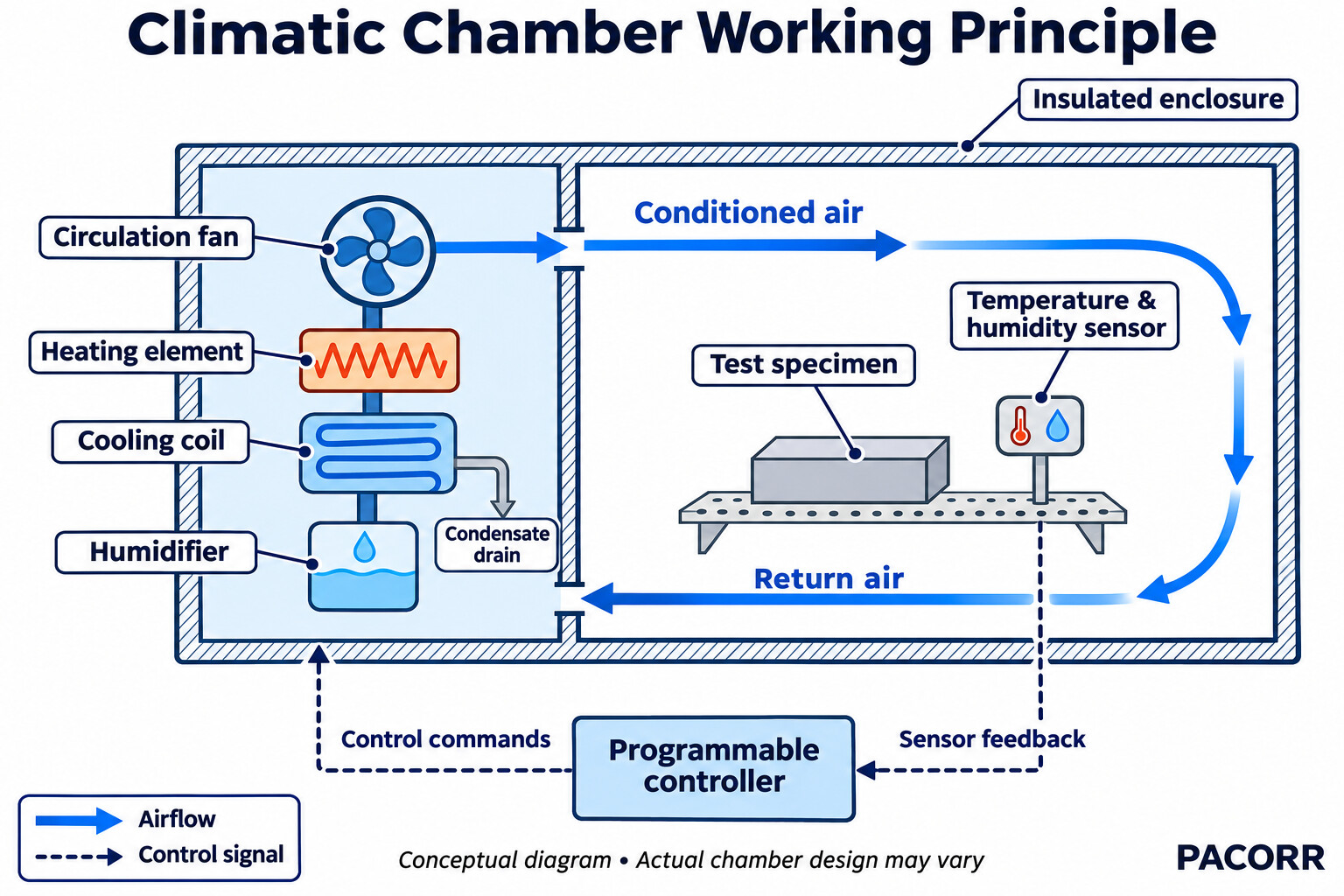
The climatic test chamber diagram shows how the air-conditioning section, insulated test space and controller work together. The conditioning components sit on the left, while the specimen and temperature–humidity sensor occupy the test space on the right. The controller connects the measurements with the required operating settings.
Reading the airflow path
Follow the solid blue arrows. Conditioned air enters the test space through the upper passage, circulates around the specimen and returns through the lower passage. The fan keeps this air moving through the conditioning section. This is a recirculating airflow path, not a separate supply of outdoor air.
Understanding the component labels
- Heating element and cooling coil: add or remove heat as required by the controller. Moisture that condenses on the cooling coil is collected and carried away through the condensate drain.
- Humidifier: introduces water vapour to raise humidity when required.
- Insulated enclosure: reduces heat exchange with the surrounding room.
- Test specimen and sensor: the specimen receives the exposure, while the sensor measures conditions in the test space.
Understanding the feedback loop
The dashed lines represent control signals. Sensor feedback travels to the programmable controller, which compares the measurements with the selected conditions and sends commands to the conditioning equipment. These signal paths are separate from the airflow arrows.
The illustration is conceptual. Component positions and control arrangements vary between models, and the measured air temperature may differ from the temperature inside the specimen.
Climatic Chamber Working Principle
The working principle is a continuous feedback process. The operator enters the required conditions, sensors measure the chamber environment, and the controller adjusts the equipment to reduce the difference between the setpoints and the measurements.
Temperature control
Electrical heaters add heat to the circulating air. A refrigeration system removes heat through a cooling coil. In a typical vapour-compression system, refrigerant passes through a compressor, condenser, expansion device and evaporator.
The controller coordinates the heating and cooling response to reach and maintain the programmed temperature. Depending on the design and operating condition, regulation can involve coordinated heating and cooling rather than a simple switch between two completely separate modes.
Humidity control
A humidification system introduces water vapour when moisture must be added. Many chambers use steam, although other arrangements are available. Moisture can be removed by cooling air so that water condenses and drains away.
The achievable humidity depends on temperature and equipment design. Before planning a test, check that the chamber can maintain the required temperature and humidity together for the full exposure period.
Air circulation and measurement
Fans move conditioned air through the test space and back to the conditioning section. This circulation helps distribute conditions and transfers heat between the air and specimens. Samples and fixtures must leave the required airflow paths clear.
Sensors provide feedback to the controller, while logging records the response over time. The programmed setpoint and measured conditions are different records: both can be useful when reviewing whether a test followed the intended profile.
Why the sample may respond more slowly
The air can reach its target before the specimen does. A heavy assembly, for example, may take longer to heat or cool than a small lightweight component. Airflow, material properties and internal heat generation also affect the response.
Where the method requires specimen temperature, use the specified measurement arrangement. Do not assume that the chamber display alone describes the temperature throughout the product.
Types of Climatic Chambers
Chambers can be grouped by function and physical format. These categories overlap: a reach-in unit may be programmable, while a walk-in enclosure may be designed for steady conditions. Choose the required test capability first, then the size and access arrangement.
| Type | Typical purpose | Selection point |
|---|---|---|
| Constant climate chamber | Maintaining a steady temperature and humidity for extended exposure. | Check stability, monitoring and the required operating conditions. |
| Programmable climatic chamber | Running a sequence of temperature and humidity stages. | Confirm achievable combinations, transition rates and dwell control. |
| Temperature-only chamber | Testing hot and cold conditions without controlled humidity. | Suitable when the method requires temperature exposure alone. |
| Benchtop or reach-in chamber | Testing smaller samples or components in a laboratory. | Check usable space, specimen loading and access. |
| Walk-in chamber | Accommodating large assemblies or batches. | Check dimensions, loading arrangements and performance with the intended load. |
| Thermal-shock chamber | Producing transitions required by a thermal-shock method. | Confirm the specified transition mechanism and transfer or change time. |
| Specialist environmental chamber | Adding stresses such as salt spray, reduced pressure or vibration. | Each additional stress requires explicitly suitable equipment. |
For conditioning applications, a humidity chamber may be worth considering. Confirm its temperature control, humidity limits and cycling capability against the intended method instead of choosing from the product name alone.
Applications of Climatic Chambers

Climatic testing supports development, investigation and quality evaluation across different industries. The exposure profile and the measurements taken afterwards should reflect the product's intended conditions and the question being investigated.
Electronics and electrical assemblies
Electronic assemblies may need to operate during exposure or be checked after recovery. A test can examine changes in function, visible condition or other defined performance measures. Powered samples also introduce heat, which must be included when assessing chamber suitability.
Automotive and aerospace components
Components used in vehicles and aircraft may encounter changing temperatures during storage and operation. Controlled exposure helps teams assess whether a component meets its specified environmental requirements. Where pressure, vibration or other stresses are required, the testing programme needs equipment capable of those additional exposures.
Packaging and transport materials
Paper-based packaging and other materials can respond to changes in moisture conditions. Conditioning allows a laboratory to prepare samples in a defined atmosphere before carrying out the relevant evaluation. Record the conditioning stage and subsequent test sequence so that comparisons remain meaningful.
When the evaluation includes carton compression, use a suitable box compression tester and follow the applicable box compression test procedure after conditioning.
Pharmaceutical stability work
Stability studies use controlled storage conditions and a defined sampling schedule to investigate product changes over time. Chamber suitability includes monitoring and the ability to maintain the required conditions. The study protocol and product assessment determine the conclusions that can be drawn.
Plastics, polymers and finished products
For plastics and assembled products, a programme may investigate appearance, dimensions or performance after exposure. Choose measurements that answer a specific design or quality question. A visible inspection alone cannot establish every property relevant to the product.
How Is a Climatic Chamber Test Performed?
A useful test begins with a written objective. The applicable method, customer requirement and equipment instructions determine the actual settings and sequence. The following steps provide a planning framework.
- Define the objective. Identify the property or function being evaluated and establish acceptance criteria before exposure.
- Record the specimens. Note the sample identity, quantity, dimensions, mass, fixtures and operating state.
- Confirm chamber capability. Check the complete profile, specimen loading, heat dissipation and required measurements.
- Prepare and position the samples. Follow the prescribed preparation and leave the required space for circulation and sensors.
- Programme the exposure. Enter the specified conditions, transitions, dwell periods and repetitions.
- Monitor the run. Record measured conditions, timing, interruptions and deviations from the intended programme.
- Recover and assess. Follow the required recovery conditions and evaluate the specimens against the original criteria.
For a complementary equipment walkthrough, read Pacorr’s guide to operating a conditioning and humidity chamber. Use the instructions supplied with your model for the actual setup.
Keep the test method and edition, chamber identification, configuration, measurement records and assessment results together. This makes it easier to review an unexpected result or repeat the work with another design.
Example of a temperature ramp-rate calculation
Suppose an illustrative temperature-only programme changes from 25°C to 65°C in 20 minutes. The average rate is calculated as follows:
Average ramp rate = Temperature change ÷ Elapsed time
Average ramp rate = (65 − 25) ÷ 20 = 2°C/min
This is an educational example, not a specified test cycle or a Pacorr performance rating. It gives the average rate across the interval. It does not show that the rate remained constant throughout, or that the specimen changed temperature at the same rate as the air.
Important Climatic Chamber Specifications
A headline temperature range or chamber volume cannot describe the complete performance of a machine. Compare specifications under their stated measurement and loading conditions.
| Specification | What it tells you | What to ask the supplier |
|---|---|---|
| Temperature range | The stated hot and cold limits. | Are these limits achievable under the required specimen load and room conditions? |
| Humidity range | The stated relative humidity capability. | At which temperatures and for how long can each RH level be maintained? |
| Usable capacity | The space available for specimens and fixtures. | What clearances and loading limits apply? |
| Temperature change rate | How quickly the chamber changes temperature. | Is the value average or linear, over which interval, and under what load? |
| Spatial uniformity | Variation between positions in the working space. | How was it measured and which locations were included? |
| Time fluctuation | Variation over time at a measurement point. | What measurement interval and operating conditions were used? |
| Measurement performance | How measurements relate to a reference. | What calibration, uncertainty and verification records are supplied? |
| Heat-load capacity | The heat the system can handle from powered specimens. | What performance is available with the sample operating? |
| Data logging and utilities | Recording features and installation requirements. | Which records, power, water, cooling and service provisions are needed? |
Pay particular attention to ratings measured with an empty chamber. Specimens and fixtures change the thermal load and circulation conditions. Ask the supplier to explain how the proposed equipment will handle the actual test arrangement.
Display resolution also needs careful interpretation. A screen that shows small increments does not, by itself, establish equivalent measurement accuracy, spatial uniformity or control performance.
Why Temperature and Humidity Must Be Considered Together
Relative humidity, usually written as RH, describes water vapour relative to saturation at the same temperature. Because saturation changes with temperature, an RH value has meaning only alongside the temperature at which it applies.
For an approximate ideal-gas treatment, the relationship can be written as:
RH (%) ≈ 100 × Actual water-vapour partial pressure ÷ Saturation vapour pressure at the same temperature
In practical terms, a temperature range and an RH range printed separately in a brochure do not establish every possible combination. The operating-envelope chart shows which combinations the model can maintain. Check any limits on continuous operation as well.
Condensation requires separate attention. A specimen surface below the surrounding air's dew point can collect moisture. Some tests require condensation, while others require it to be avoided. Plan the transitions, specimen measurements and recovery stage around the intended method.
Standards Used for Climatic Testing and Conditioning
The relevant standard depends on what is being tested and why. Temperature-change testing, steady damp heat and package conditioning have different purposes and should not be treated as interchangeable procedures.
| Standard | Relevant purpose |
|---|---|
| IEC 60068-2-78 | Steady damp-heat testing at constant temperature without condensation. |
| IEC 60068-2-14 | Testing the effects of specified changes in temperature. |
| ISO 2233 | Conditioning complete, filled transport packages and unit loads for testing. |
| ASTM D4332 | Conditioning containers, packages and packaging components using specified atmospheres. |
Use the required edition and full procedure to select conditions, durations, transitions and recovery steps. For standard-atmosphere box-compression strength work, ASTM D4332 points to ASTM D685; the applicable conditioning requirement should be checked before testing.
A brochure statement referring to IEC, ISO or ASTM does not establish that every method can be performed on that model. Confirm the specific method, equipment capability and reporting requirements together.
Benefits and Limitations of Climatic Chamber Testing
Testing without waiting for seasonal conditions
Laboratory exposure allows teams to schedule work around a defined programme. They can investigate selected hot, cold or humid conditions without waiting for those conditions to occur outdoors.
Comparing materials and design changes
Applying the same controlled exposure and assessment method helps teams compare alternative materials or designs. Record the setup carefully so that differences in loading or measurement do not obscure the comparison.
Investigating weaknesses earlier
Testing during development can reveal problems that deserve further investigation before wider production or use. The value comes from connecting the observed issue with the design, material or process decision that follows.
Creating useful quality records
A documented programme provides a record of the specimens, exposure and assessment. Those records support technical review and help teams explain how a product was evaluated against a particular requirement.
Interpreting accelerated exposure correctly
A severe short test does not automatically represent a fixed number of years in service. Lifetime predictions require a suitable failure mechanism, model and supporting data. Excessive stress can create failure modes that would not occur under normal use.
Use chamber results to answer the question the programme was designed to investigate. A successful exposure does not establish resistance to every environment or every possible product failure.
Common Mistakes to Avoid During Climatic Testing
- Overloading the working space. Samples and fixtures can obstruct circulation even when they physically fit inside the enclosure.
- Ignoring powered heat loads. An operating specimen may release heat that changes the required chamber performance.
- Confusing air and specimen temperature. Use the measurement and dwell criteria required by the method.
- Assuming the full RH range applies everywhere. Check each temperature–humidity combination against the operating envelope.
- Recording only the programme. Retain actual measurements and deviations so that the completed exposure can be reviewed.
- Changing the setup without recording it. Sample position, fixtures, sensor placement and operating state can matter when comparing runs.
Measurement confidence also depends on appropriate calibration and performance checks. Sensor calibration and mapping conditions across the working space address different questions. Arrange the checks required for the intended testing and retain the associated records.
How to Choose a Climatic Chamber and Compare Prices
Start with a specification brief rather than a preferred cabinet size. Describe the samples, required exposure and assessment needs clearly enough for suppliers to propose comparable equipment.
- The test method or complete internal profile.
- Sample dimensions, quantity, mass and fixtures.
- Whether samples operate during testing and how much heat they release.
- Required temperature–humidity combinations and exposure duration.
- Heating, cooling and transition requirements.
- Measurement, data-recording and reporting requirements.
- Available space, access and installation utilities.
- Calibration, training and ongoing support needs.
What affects climatic chamber price?
Climatic chamber prices in India vary with the configuration and supply scope. A small conditioning unit and a larger chamber designed for demanding transitions are different purchases. Compare written quotations against the same requirement.
| Cost factor | What changes the requirement |
|---|---|
| Test-space size | Larger specimens, fixtures and loading arrangements affect chamber construction. |
| Temperature and humidity capability | The required operating envelope determines the conditioning systems. |
| Dynamic performance | Faster transitions and greater specimen heat loads can require different equipment. |
| Controls and records | Programming, measurement channels and data-management requirements vary. |
| Installation and services | Utilities, access, commissioning and site preparation affect installed cost. |
| Support and documentation | Calibration, training, warranty scope and maintenance should be compared. |
Ask each supplier to identify included and optional items. Fixtures, ports, water treatment where needed, calibration, commissioning, freight, taxes and service arrangements can affect the total purchase and operating cost.
Discussing your application with Pacorr
Review the Pacorr climatic test chamber and share your test profile when requesting a proposal. Include the specimen load and the conditions that must be achieved so the discussion focuses on a suitable configuration.
Where the requirement is controlled conditioning, compare the available humidity-chamber option against the same method. Ask for model-specific confirmation of ranges, operating limits and documentation before finalising the selection.
Frequently Asked Questions
What is a climatic chamber used for?
It exposes samples to controlled temperature and humidity so their response can be evaluated. Applications include product development, environmental testing, packaging conditioning and stability work.
What is the difference between a climatic chamber and a humidity chamber?
The names can overlap. A humidity chamber may also control temperature, while a climatic chamber may offer broader temperature cycling. Compare the actual configuration and operating envelope instead of assuming a fixed distinction from the name.
Can every climatic chamber perform thermal shock testing?
No. The equipment must satisfy the transition requirements of the intended method. A programmable temperature cycle alone does not establish thermal-shock capability.
Can a chamber maintain 95% RH at every temperature?
No. Humidity capability depends on temperature, equipment design and operating restrictions. Check the model's temperature–humidity chart at the required setpoints.
How long does a climatic chamber test take?
The method and objective determine the exposure time, transitions, recovery and assessment. Some programmes maintain steady conditions, while others use repeated stages. Choose the required programme before estimating the total test duration.
How do I choose the correct chamber capacity?
Consider specimen dimensions, quantity, fixtures, circulation clearances and loading limits. Nominal capacity in litres is only one part of the decision. Also check the thermal effect of the specimens and any heat they generate.
Does passing a climatic test guarantee product life?
No. It shows how the tested specimens performed against the defined programme and acceptance criteria. A lifetime claim needs an appropriate prediction method and supporting evidence.
Conclusion
A climatic chamber gives manufacturers and laboratories a controlled way to investigate the effects of temperature and humidity. Its value depends on matching the equipment, exposure profile and assessment method to a clear testing objective.
When choosing a chamber, look beyond capacity and headline ranges. Check the operating envelope, specimen load, transition requirements, measurements and support arrangements. These details determine whether the equipment can perform the work your laboratory needs.
To discuss your application, explore the Pacorr climatic test chamber and request a configuration-specific quotation. Share your sample details and required test conditions to begin the selection process.