What is a Drop Tester?
A Drop Tester is equipment that releases a specimen from a defined height and orientation so that its response to impact can be evaluated. In packaging laboratories, the specimen is commonly a complete package containing the intended product or an authorised representative load. The assessment concerns the package, its cushioning and the condition or function of its contents after the specified drops.
This article concerns package drop testing, not a ball-impact tester that drops a separate ball onto a material. The distinction matters because the moving object, impact geometry and result interpretation are different. A carton dropped onto a rigid surface is not equivalent to a steel ball striking a plastic sheet, even if both tests involve gravity.
Pacorr's Drop Tester product page describes equipment for packaging evaluation. Buyers should confirm the exact model, load capacity, platform and release arrangement against their packages. This guide explains the principle and an educational workflow; the operating sequence and test severity must come from the delivered manual, selected method and approved distribution-test plan.
What is the working principle of a package drop tester?
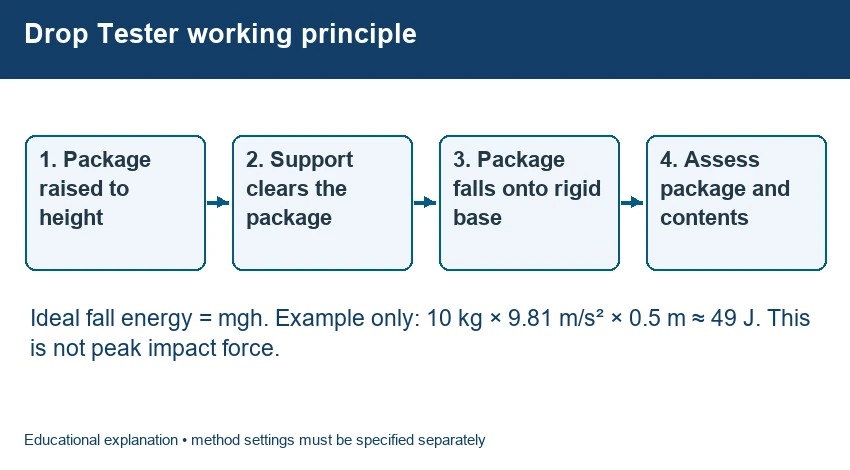
The instrument supports the package at a selected height, positions it for the required impact orientation and releases it onto an impact surface. A suitable release should avoid adding an unintended push or interfering with the package during the fall. The package then strikes the surface, and the laboratory examines the effects according to predefined criteria.
Height, mass and orientation are central variables, but they do not completely describe the impact response. The package construction, cushioning, product geometry and impact surface also matter. A corner drop concentrates loading differently from a face drop. A fragile internal component may fail without obvious external carton damage, so inspection must include the contents where the test plan requires it.
For an idealised free fall with negligible air resistance, gravitational potential energy is mgh and impact speed is approximately the square root of 2gh. These relationships help explain why height affects impact severity. They do not directly provide the peak force on the product, because that depends on how the package and cushioning deform and how quickly the motion is stopped.
A basic drop tester controls the release conditions; it does not necessarily measure acceleration, impact force or absorbed energy. Those measurements require appropriate sensors and acquisition equipment. Do not advertise a shock pulse or peak-force result unless the configured system actually measures it and the method supports the interpretation.
What does the Drop Tester diagram show?
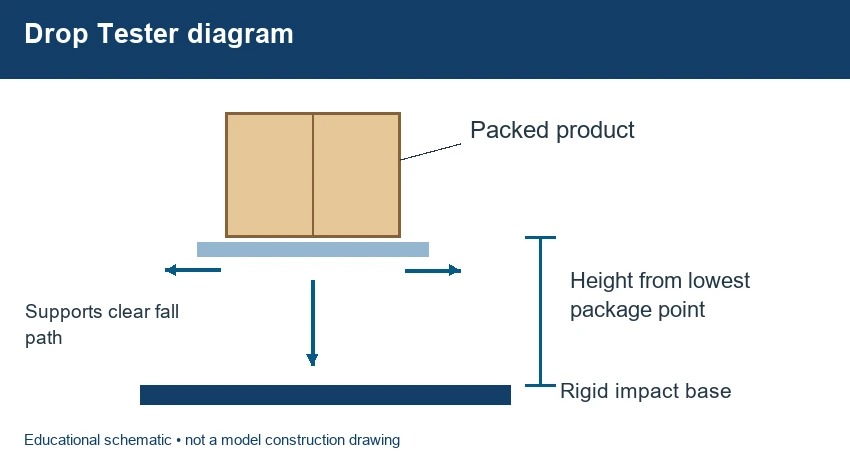
The educational diagram shows a generic package supported above a rigid impact base, a height reference, a release arrangement and the falling path. It identifies the package's lowest point as the height reference for the illustrated setup. The exact height definition and tolerances must follow the selected method. The drawing is not a model-specific operating or installation drawing.
| Component | Role and point to verify |
|---|---|
| Frame and lifting arrangement | Position the supported package at the required height. |
| Support platform or arms | Hold the package before release without damaging it. |
| Release mechanism | Clear the falling package without an unintended push or obstruction. |
| Orientation fixture | Establish the required face, edge or corner arrangement. |
| Height indication | Support the specified measurement from package reference to impact surface. |
| Impact base | Provide the surface required by the method. |
Single-flap, twin-flap and other release arrangements should not be treated as identical simply because they all drop a package. Check how the platform moves away, how the package is positioned and whether the required orientations are practical for the actual load. A demonstration with the largest package can reveal clearance issues that a small sample does not.
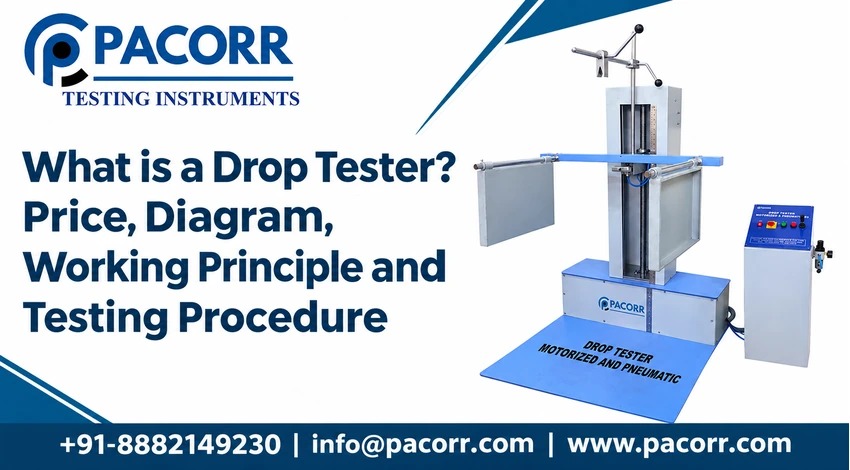
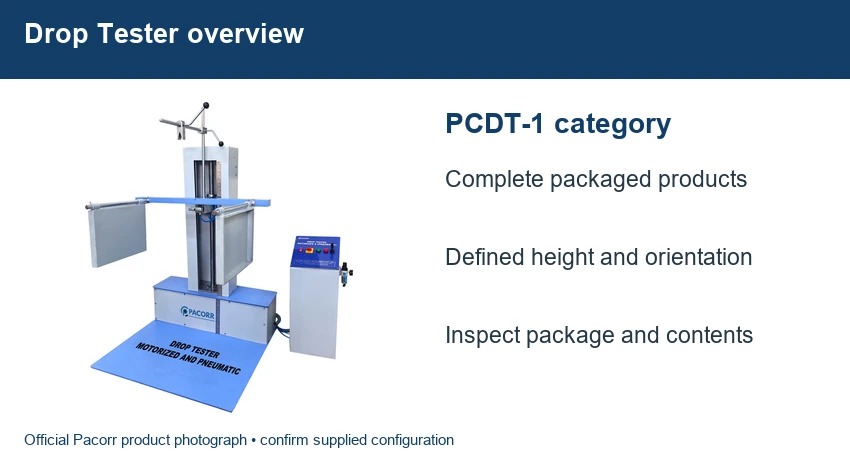
The product photograph shows an authentic Pacorr configuration. It should not be used to infer hidden controls, lifting capacities or safety functions. Confirm those details in the supplied documentation. Guards and exclusion zones must be designed for the installation and operator procedure; a simplified educational diagram omits such installation detail for clarity.
Which configurations and specimens are relevant?
Package drop testers can differ in lifting method, release mechanism, platform size and load capacity. Motorised lifting concerns how the platform is raised; pneumatic release concerns how the support is moved away. These features answer different questions and may be combined in one instrument. Ask the supplier to identify each function separately.
Face, edge and corner drops are selected according to the test programme. They are not interchangeable descriptions of the same event. The package must be oriented and released so that the intended impact occurs within the method's requirements. An accidental rotation or secondary contact with the machine can make a test unsuitable for the intended comparison.
Typical specimens include complete shipping cartons and compatible containers with the intended contents and internal packaging. Empty-box testing can answer a narrower construction question, but it does not reproduce the behaviour of a filled package. If a representative load replaces the real product, its suitability must be established for the purpose of the test.
Large, heavy or unitised loads may require different handling equipment and methods. Do not select a machine solely because the package mass is below one catalogue maximum. The package dimensions, centre of gravity, orientation fixture and loading access also determine whether the test can be performed correctly and safely.
Which Pacorr specifications need confirmation?
The live official product page identifies model PCDT-1 with a drop-height range of 300–1,800 mm and specimen weight up to 60 kg. These values describe the published configuration, not every drop tester in the range. Obtain written confirmation of the platform, release arrangement and accessories being offered for your application.
| Item to specify | Published information and purchasing action |
|---|---|
| Drop-height range | PCDT-1 listing: 300–1,800 mm; confirm the offered configuration. |
| Load capacity | Listing: up to 60 kg; confirm rating for the actual platform and orientations. |
| Platform | Listing: 800 × 800 mm standard size; confirm usable support area and clearance. |
| Operating configuration | Motorised and pneumatic options are described; identify the supplied lifting and release functions. |
| Test orientations | Face, edge and corner are described; demonstrate them with the actual package. |
Source: Pacorr Drop Tester listing, checked 10 November 2026. These are documented catalogue details, not unconditional performance promises. The quotation and supplied manual should identify the actual configuration before an equipment selection is finalised.
Also request the required impact-base specification, installation footprint, electrical and compressed-air services, loading procedure and available safety provisions. Confirm how height is measured and verified. A scale on the frame must be interpreted correctly for the supported specimen and its orientation; platform elevation is not automatically the required package drop height.
How should a drop-test programme be prepared?
Begin with the distribution question. Is the package being screened during development, compared with a previous design, qualified for a customer requirement or investigated after damage? The objective determines the relevant method and test sequence. Do not choose a convenient height first and then search for a standard name to attach to it.
Define the packaged product precisely. Record the outer container, closure or tape pattern, internal supports, cushioning, product orientation and gross mass. Use the intended packing procedure. Small assembly differences can affect impact response, so a laboratory-built specimen should reflect the agreed design rather than an unusually reinforced demonstration sample.
Select conditioning and the complete sequence from the approved programme. Some distribution evaluations combine drops with other hazards. If a package has already undergone vibration or compression, retain that history in the record. A fresh package and one that has completed earlier stages should not be treated as identical specimens without justification.
Write acceptance criteria before testing. Separate allowable packaging changes from unacceptable product damage, loss of function or other failures. Cosmetic carton damage may be acceptable in one programme and unacceptable in another. Clear criteria prevent an operator from deciding retrospectively that a surprising result is either harmless or catastrophic.
Plan inspection so that it does not unintentionally alter the sequence. Opening and repacking a container between drops can change its condition. Follow the programme's inspection requirements and document any intervention. If photographs are needed, identify when they will be taken and how package orientation and damage locations will be labelled.
How is a package drop test performed?
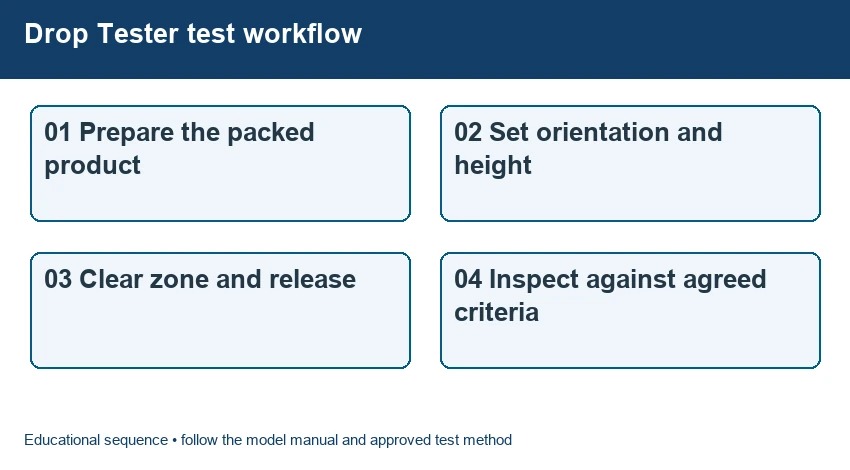
The following steps describe an educational workflow. They do not set universal drop heights, specimen counts, numbers of impacts or pass limits. Use the complete method and machine manual. Keep people clear of the release path, impact zone and moving lifting components, and use the approved handling arrangement for the package mass.
- Confirm the test plan. Identify the method, package condition, required orientations, height sequence and acceptance criteria. Check whether the package is fresh or has already completed other stages of the programme.
- Inspect the installation. Verify the impact surface, frame, support platform and release mechanism according to the manufacturer's instructions. Address loose parts, obstructions or abnormal operation before loading a specimen.
- Check equipment suitability. Confirm package mass, dimensions and centre-of-gravity considerations against the rated configuration. Ensure the intended orientation can be achieved without unstable loading or improvised supports.
- Identify and document the package. Record gross mass, external dimensions, contents, cushioning, closure method and conditioning. Photograph the initial condition when required so that later damage can be distinguished from pre-existing marks.
- Position the specimen. Use the approved arrangement for the selected face, edge or corner. Confirm that fixtures establish the orientation without obstructing the subsequent fall or unintentionally strengthening the package.
- Set and verify height. Measure from the reference defined by the method to the impact surface. Account for the actual package orientation instead of assuming that the platform setting alone gives the required distance.
- Clear the test area. Follow the equipment's operating and exclusion-zone procedure. Keep hands and other objects out of the release and impact paths before initiating the drop.
- Release the package. Operate the machine as instructed and observe from a safe position. Record abnormal rotation, contact with the equipment or an incorrect impact orientation as potential validity issues.
- Examine as prescribed. Check package damage and product condition or function at the required stage. Record the location and nature of damage, not just a general pass or fail label.
- Continue or stop according to the programme. Follow the specified sequence and stopping rules. Do not repair or repack the specimen unless that action is authorised and documented by the test plan.
- Review the complete evidence. Confirm validity, compare observations with the predetermined criteria and issue a report containing the full sequence and conditions. Retain photographs and any instrumented measurements with the specimen identity.
An invalid drop should not simply disappear from the record. Document why it was invalid and follow the replacement or retest rule in the programme. If the package was already stressed by the event, repeating the drop on the same specimen may not represent the intended fresh condition. Resolve this through the approved method rather than improvisation.
How should drop-test results be interpreted?
The most basic result is an assessment of package and product condition after the defined test sequence. Record the actual drop height, orientation and sequence position with each observation. A statement that a carton passed a drop test is incomplete if the reader cannot tell which test was performed or what counted as failure.
Separate external damage from internal consequences. A carton can show visible dents while protecting the contents, or appear relatively intact while an internal component has failed. Functional checks should be appropriate to the product and established in advance. Do not infer internal protection solely from the appearance of the outer box.
Repeated drops can accumulate damage. When comparing package designs, keep the sequence and specimen history equivalent. A package that survives one face drop has not necessarily passed a programme containing corners, edges and repeated impacts. Likewise, a failure late in a sequence should be interpreted with its preceding history.
An educational energy example uses a hypothetical 10 kg package dropped through 0.5 m. Taking gravitational acceleration as approximately 9.81 m/s² gives mgh ≈ 49 J. The corresponding ideal free-fall speed is approximately 3.13 m/s. These values explain basic mechanics; they are not prescribed test settings or measured machine performance.
Impact force cannot be obtained from energy alone. The stopping distance, deformation and time history influence the force response. Cushioning can change the way the load reaches the product, which is why package design matters. If acceleration or force is required, specify an appropriate instrumented test and verify sensor placement, range and data acquisition.
Use damage patterns to guide development investigations. Repeated failure at a product corner may suggest reviewing local support, clearance or cushioning, but the pattern alone does not prove a cause. Change one design variable at a time where practical and compare complete, controlled tests. Keep the engineering interpretation separate from the raw observations.
Which standards apply to package drop testing?
ASTM D5276 covers free-fall drop testing of loaded boxes, cylindrical containers, bags and sacks. It is relevant to evaluating impact resistance and the ability of packaging to protect contents under the defined conditions. The method's public scope also distinguishes the context of manually handled containers from larger loads that may need other approaches.
ISO 2248 addresses vertical impact testing by dropping complete, filled transport packages. Its inclusion in a procurement requirement should be accompanied by the actual edition and programme conditions. ASTM D5276 and ISO 2248 should not be treated as a licence to invent a single universal drop height for every package.
ISTA procedures define particular packaged-product test programmes. A reference such as ISTA 1A is broader than merely performing one drop on a machine. The laboratory must select the applicable procedure, complete the required sequence and use the specified acceptance approach. A drop tester alone does not make a package ISTA certified.
Older supplier literature also mentions IS 7028 Part IV. Confirm any required Indian standard edition and its suitability with the responsible laboratory before writing it into a purchase or conformity document. Product-page references are useful leads, but they are not evidence that every offered configuration meets all requirements of every named standard.
What is the Drop Tester price in India?
Pacorr publishes an indicative range of ₹85,000–₹2,20,000 on the Drop Tester product page, checked on 10 November 2026. Treat this as a category guide rather than a binding offer. Written configuration confirmation remains important because platform, lifting and release arrangements can differ between the options being compared.
The quotation depends on package mass, platform dimensions, usable height range, lifting and release arrangements, orientation fixtures and installation needs. A large or unusual package may require a different configuration from a compact carton. Instrumentation for acceleration or force, if needed, should be specified separately rather than assumed to be included.
Ask whether the offer includes the impact base, delivery, installation, operator training, verification documents and required accessories. Clarify taxes and any site preparation. Consider how the package will be loaded and removed during routine operation; practical handling arrangements can affect both installation cost and laboratory throughput.
How should buyers compare drop testers?
Start with the largest, heaviest and most awkward package formats, then check the rest of the range. Provide external dimensions, gross mass, required heights and orientations. Include details about irregular shapes or a high centre of gravity. A machine that accommodates the mass may still lack the clearance or support needed for the intended drop.
Request a demonstration of the release using representative packages. Observe whether the supports clear the specimen and whether the intended impact orientation is obtained consistently. Review how the height is established and how the operator can inspect the setup without entering a hazardous position. A successful empty-platform movement is not a complete application demonstration.
For routine quality control, consider setup changes between formats, repeatable orientation and recordkeeping. If several operators share the equipment, use clear procedures and training. Define how the laboratory identifies invalid releases and how results are reviewed before a pass statement is issued.
For development work, consider whether additional measurement is needed. High-speed observation or acceleration measurement can answer questions that visual damage inspection cannot, but these are separate capabilities requiring appropriate equipment and analysis. Ask for a sample report showing exactly what the offered system measures and what remains an operator assessment.
Drop testing can form one part of a broader distribution-test programme. Pacorr's guide to vibration testing of packaged goods introduces repeated transport-related loading, while its compression test machine guide explains compression loading. Select the sequence from the applicable distribution procedure and package requirements; passing a drop test alone does not establish performance under vibration or stacking loads.
What errors, maintenance and verification checks matter?
Common errors include measuring height from the wrong reference, using an incorrect orientation, testing an unrepresentative package and allowing the specimen to contact the machine during the fall. Another error is reporting success without inspecting the contents. A controlled test requires both a valid release and a suitable post-test assessment.
Inspect lifting and release components according to the manufacturer's schedule. Check the platform, fasteners, guides and impact surface for condition and secure installation. Keep the fall path clear. Use approved service procedures for pneumatic or electrical faults, and isolate relevant energy sources before maintenance as required by the machine instructions.
Verification should cover the quantities and functions relevant to the method. Height indication and measurement, release behaviour and impact-surface condition are central for a basic drop system. If acceleration, force or other channels are installed, they require their own appropriate calibration and verification. A certificate for one channel does not validate the entire test arrangement.
Set inspection and calibration intervals through the quality system, manufacturer guidance and service history. Recheck the installation after relocation, significant repair or abnormal operation. Keep maintenance records linked to the machine identity. Do not continue acceptance testing when a release fault could change the intended drop.
Frequently asked questions
Is a package Drop Tester the same as a Ball Drop Tester?
No. A package Drop Tester releases the package itself. A Ball Drop Tester releases a separate impactor onto a specimen. Their loading arrangements and results are different.
Does a basic drop tester measure impact force?
Not necessarily. A basic system controls release conditions and supports damage assessment. Force or acceleration measurement requires appropriate sensors, acquisition equipment and a defined analysis method.
Is there one standard drop height for every carton?
No. Height and sequence must come from the applicable test programme and package requirements. A machine's maximum height is a capability, not a universal test prescription.
Can an empty carton test prove protection of the packed product?
No. Empty-carton testing addresses a narrower condition. Protection of the contents should be evaluated using the intended packaged product or an authorised representative configuration.
Can a package pass even when the outer carton is dented?
Possibly, depending on the predetermined acceptance criteria. Assess both the packaging and the contents as required; do not decide acceptability from appearance alone after the test.
What should I confirm before requesting a quotation?
Confirm package dimensions and mass, height range, orientations, release arrangement, impact base, installation services and reporting needs. Ask Pacorr to identify the supplied model and verify its suitability for your actual package formats.
Discuss package drop testing with Pacorr
A useful drop test reproduces a defined impact condition and evaluates the package against a clear requirement. Match the machine to the actual load and orientations, preserve the test sequence and inspect the contents as well as the carton. This produces evidence that can guide packaging development and quality decisions.
Share your package dimensions, gross mass and required programme through Pacorr's enquiry page. Call +91-8882149230 or email info@pacorr.com for a model-specific demonstration and written quotation.