There is no single reliable rupee price for a complete quality control laboratory setup in India. A small factory that checks incoming material and releases a few product lines does not need the same equipment, facility or staff as a multi-method qualification laboratory. A useful budget answers a more precise question: What will it cost to produce the required, valid test reports at this site, within the turnaround we need? Price the installed and accepted setup, the annual operating budget and the testing that still goes outside. Do not compare a delivered machine price with a working laboratory.
This guide is for manufacturers planning or expanding a materials, packaging or production QC lab. It shows what changes the cost, which equipment to buy first and how to compare suppliers on the same basis. The rupee examples come from public procurement documents, published fees and indicative Pacorr equipment guidance. None is a quotation for a complete lab. Clinical, pharmaceutical, food chemistry and microbiology laboratories need separate scopes and should not be budgeted from an industrial instrument list.
What does a complete QC lab actually include?
A complete lab can take a correctly identified sample, prepare and condition it, perform the agreed method in its required range, and issue a traceable result that someone can act on. Completeness is defined by the product, method and decision, not by the number of instruments. A room with a universal testing machine and no suitable grips, specimen cutters or verified force range may be unable to release a single lot. A focused lab with five validated checks and an agreed external route for specialist work may cover every requirement.
Put each required result on a one-line test register. Add the product or material, the document and method edition, specimen geometry, expected result range, frequency, acceptance rule, report recipient and release deadline. Mark each item as routine release, troubleshooting, periodic verification or qualification. Decide what stays outside and how that result gets back into the lot record. The industrial testing laboratory installation guide gives additional detail on site and equipment planning.
Which lab scope should you price first?
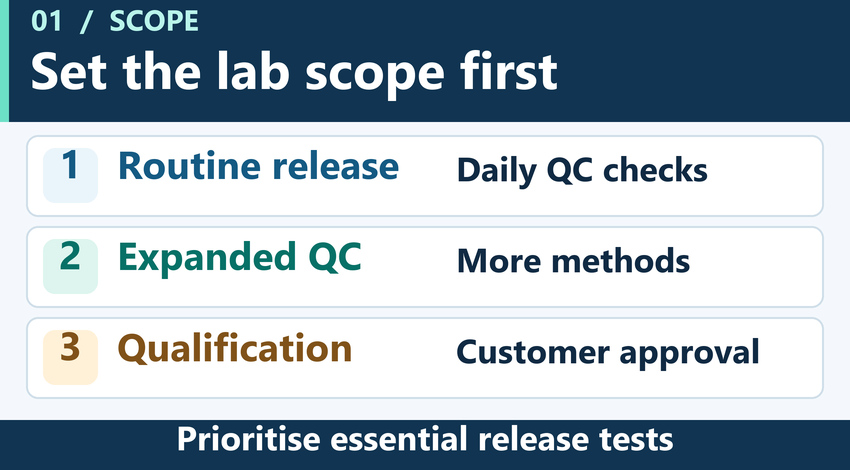
Quote a base scope that can make the decisions you cannot afford to delay. Quote each extension separately so you can add a new capability without hiding its costs inside a bundle. Include current external testing in the base if you will still use it. The scopes below describe capabilities, not budget bands or sizes.
| Scope | What the budget must cover |
|---|---|
| Routine release bench | High-frequency checks, basic specimen preparation and references, controlled measurements and report ownership. Include the outsourcing plan for tests not in this scope. |
| Expanded process lab | More material families, fixtures and ranges, better preparation or conditioning, troubleshooting methods, data export and enough resources to handle peak sampling. |
| Qualification capability | Method-specific exposure chambers or advanced tests, suitable facilities, documentary evidence, specialist staff and customer or accreditation requirements where applicable. |
A supplier transition, a new customer method or repeated line stoppages can justify moving a method into the base scope. A large catalogue list cannot. State the trigger for each option, such as a signed volume increase, a new test requirement or unacceptable outside turnaround. Also state what infrastructure the option will share. Buying space for a future chamber can be a sensible option, but its annual overhead should still appear in the budget.
What do published Indian cost figures actually tell you?
There are verified rupee figures for particular procurement scopes and accreditation fees. That does not make them comparable prices for a complete factory QC lab. Before transferring a figure into your budget, identify who published it, what it covers, what date it represents and whether it is a ceiling, an estimate, a fee or a completed purchase.
| Published Indian example | What the figure means |
|---|---|
| Approx. ₹2,00,000, CSIR–Central Road Research Institute, 2026 | The public equipment procurement plan budgets this amount for one melt index tester in its 2026–30 planning period. The document labels figures as provisional and funding-dependent. Do not treat the amount as an award or assume that fixtures, installation and taxes are included. |
| Approx. ₹80,00,000, Anna University, Tamil Nadu, 2026 | The official tender entry lists this estimate for supply and installation of a specialised horizontal universal testing machine for the Centre for Composite Materials. It is not an award value, a typical universal testing machine price or a complete lab budget. |
| ₹70,000–₹3,50,000, Pacorr's published indicative machine range | The generic price FAQ on Pacorr's tensile testing machine product page gives this range for tensile testing machines depending on model, load capacity, features and customisation. It is not a quote for the pictured configuration or a full installed lab. Confirm fixtures, the selected load range and what the quotation includes. |
| ₹11,000, NABL testing-laboratory application | The NABL testing-laboratory page lists this application fee for one product group or discipline in its stated regular testing-laboratory category. The table excludes forensic laboratories, software and IT system testing, and labs under integrated assessment from that figure. It is not the whole cost of building or accrediting a lab. |
The examples are not the lower and upper ends of a lab setup price range. They describe different scopes and must not be averaged or added to estimate a setup. For a usable figure in India, request a written INR equipment quote with the required configuration, get a separate site-fit-out estimate, then calculate your operating spend and outsourcing on the same basis.
Which equipment belongs in the budget by sector?
Start with the report your buyer or production team expects. Pay for the ability to prepare, measure and report the real specimen from each line. The equipment below is a shortlist, not a required package or a statement that every configuration complies with a named method.
| Production area | Start with the tests that drive decisions |
|---|---|
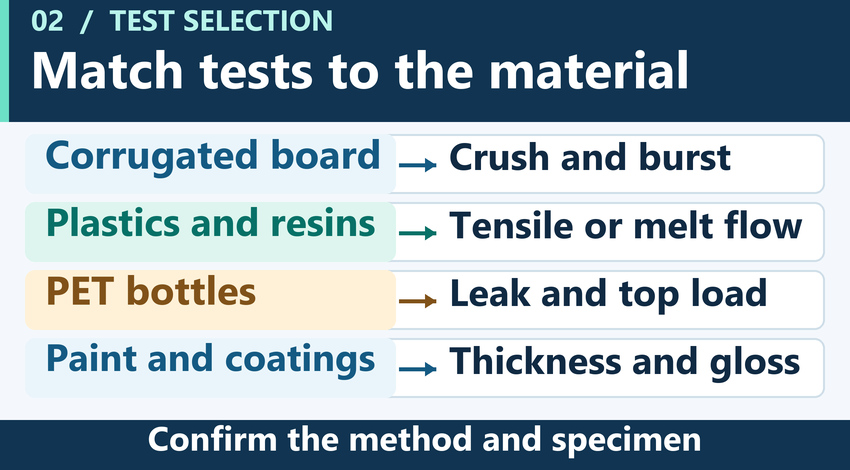
| Paper and corrugated packaging | Where specified, add grammage and caliper tools, a suitable cutting and conditioning setup, an edge crush tester for board, and a box compression tester for assembled cases. Size the latter by largest carton and valid test force, not by board strength alone. |
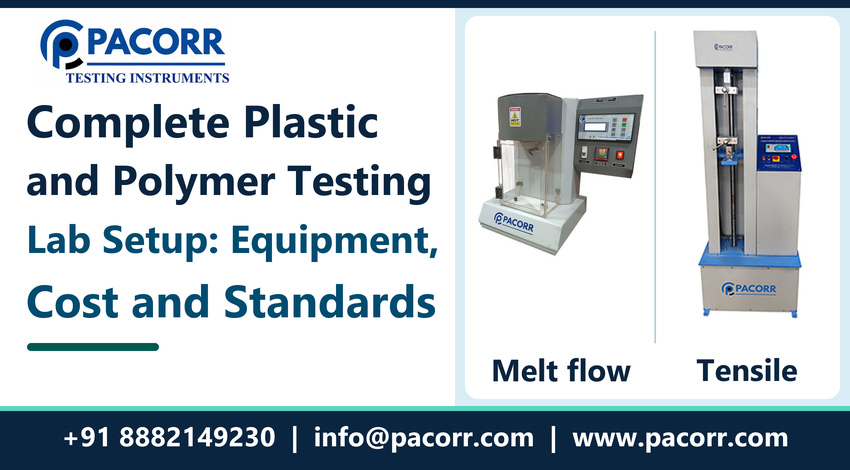
| Plastic parts and polymers | Include a melt flow index tester when the resin specification uses the applicable melt flow method. Quote force frame, strain measurement, specimen preparation and grips together for mechanical tests. |
| Films and laminates | Budget thickness and sample cutting, an instrument and fixture for tensile or seal testing as required, a coefficient of friction tester if feeding or slip is controlled, and dart impact or other puncture capability only when called for. |
| PET bottles and preforms | Price separate bottle, neck and closure tests where specified. Check arrangements for top load, cap torque, leakage or pressure-related tests against bottle, cap and thread geometry. The PET, bottle and glass equipment category lists related instrument families. |
| Paint, plating and coated components | Include the specified thickness, adhesion and appearance methods. A gloss meter measures gloss, not colour. Add a salt spray chamber or a specified outside exposure service where needed. |
If several plants share the lab, create separate lines for each sample family. For example, an instrument that handles one carton size or bottle neck may need an accessory for the next. Add an agreed turnaround and reporting rule for each site. The corrugated box laboratory guide and paint and surface-testing instrument selection guide explain why apparently similar checks need different preparation and fixtures.
What should you buy first if capital is limited?
Prioritise tests that repeatedly stop a release decision, have a stable method and can be operated by your staff on the required schedule. Put preparation tools, reference items and verification into that same first purchase. Next, list the tests that are technically possible but rarely needed or require an approved outside scope. Ask for two costs for each borderline method: the marginal cost to add it to the in-house bench and the actual all-in outsourced cost. Keep niche tools off the first purchase unless the quality risk or economics justify them.
How do you calculate the installed capital cost?
Installed setup cost = equipment and required accessories + buyer site works + delivery and handling + installation and start-up + initial method readiness + documented risk allowance. Show taxes on the chosen basis separately. Use the same installation site and currency for each quote.
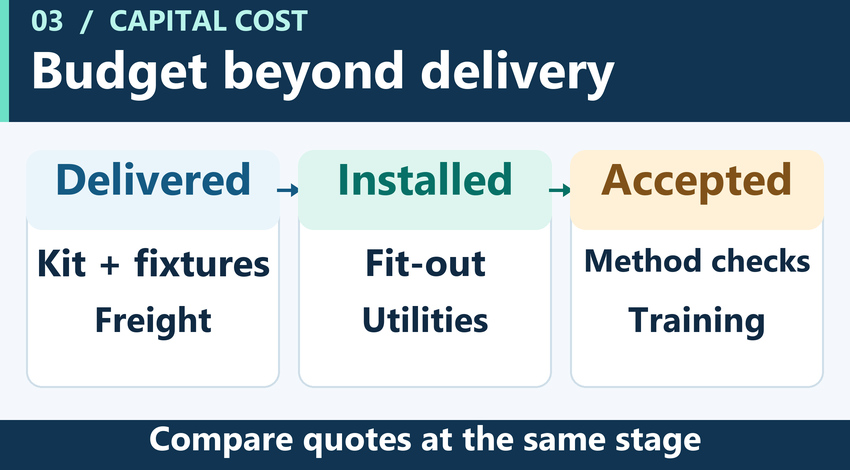
Create three subtotals. The equipment subtotal covers machines, fixtures, reference items, computers and licences supplied with them. The site-ready subtotal adds benches, utilities, environmental controls and delivery. The accepted-lab subtotal adds agreed verification, operator training, representative method trials, documentation and any remaining readiness tasks. If the same labour, calibration or training line is already in a quote, do not add it again. Conversely, mark an excluded cost as buyer priced, not zero.
Ask whether the bid includes reusable specimen tools, spread of load cells, control software, lifetime access to historical data, installation travel, calibration evidence and training beyond the first shift. Separate freight from unloading and moving the equipment to the intended room. If the machine goes to an upper floor or constrained entrance, check the measured delivery envelope and approved handling before placing the order. Convert provisional lines into written estimates before final approval, or keep them as visible allowances with a named owner.
How should you compare two quotes that include different things?
Normalize the scope line by line. If proposal A includes one grip and proposal B includes two, compare both with the same specimen coverage. If one includes initial verification and the other only a factory certificate, identify who performs the extra site work and what proof will be accepted. Keep options separate from items essential to the base methods. In India, ask for each quote to state the INR amount, tax basis, validity, delivery destination, payment schedule, and any currency or freight adjustments for imported components. Have purchasing or finance review the applicable tax treatment and show gross cash outlay separately from any amount finance has confirmed as recoverable. Do not assume all tax is a recoverable credit.
Build one comparison sheet with a row for each required result and the equipment, fixture or service it depends on. For each bid record included, buyer priced, optional or not yet priced, with an owner and evidence for anything unresolved. If two methods share a frame, cross-reference the same equipment line instead of counting it twice. Then track two totals. The first is cash due by milestone, including taxes actually payable on the relevant invoice. The second is comparable net cost on the basis approved by finance. If recovery is confirmed but occurs after payment, keep that timing gap in the cash plan. An open estimate for utilities or verification should stay visible when you rank bids rather than silently becoming zero.
How do sample size and turnaround change the cost?
Size equipment for the smallest valid reading, the largest sample and the peak workload. For example, a load frame large enough for a strong moulded part may still need a separate low-range load cell and grips for film. Ask the supplier to demonstrate performance where the result will actually be read. Confirm platen, travel, fixture and opening dimensions, not just nominal force. Compare each model-specific configuration against the test register. A servo-controlled universal testing machine is one example of a configurable platform where load range, fixtures and method support must be specified before quoting.
Now check the available minutes. If an illustrative peak shift has 12 lots with four specimens each, you need 48 cycles. At five equipment minutes per specimen, measurement alone occupies 240 minutes. Add 30 minutes for planned changes and checks and the station needs 270 minutes. If only 210 minutes are available before the dispatch decision, you are already 60 minutes short. That is a capacity example, not a recommended sampling plan or test speed. Compare earlier preparation, staggered sampling or a second verified station before paying for a larger frame that will not solve the bottleneck.
Why can a larger chamber still be the wrong purchase?
Count usable positions with the actual samples, racks and required spacing. Record loading and unloading time, incompatible programmes and recovery between runs. A larger cabinet does not guarantee more usable report capacity if specimens have to be separated by environment, fixture or programme. Conversely, two small cabinets can help with overlapping work only if each one independently meets the method and can be verified and maintained. Ask for a loaded demonstration where the method and equipment permit it. Rate capacity by complete reports under the required conditions, not cubic litres alone.
What belongs in the annual operating budget?
Separate fixed spend from spend that moves with usage. Fixed items can include staff coverage, planned service, software support, controlled space and scheduled calibration. Variable items can include specimens, cutting blades, conditioning time, reference materials and consumed standards, purge or preparation materials, electricity, waste handling, postage and outside tests. Assign operator time for receiving, preparation, checks, testing, cleanup, reporting and review. A long machine cycle is not always staffed for its full duration. An unattended exposure still needs monitoring and documented review.
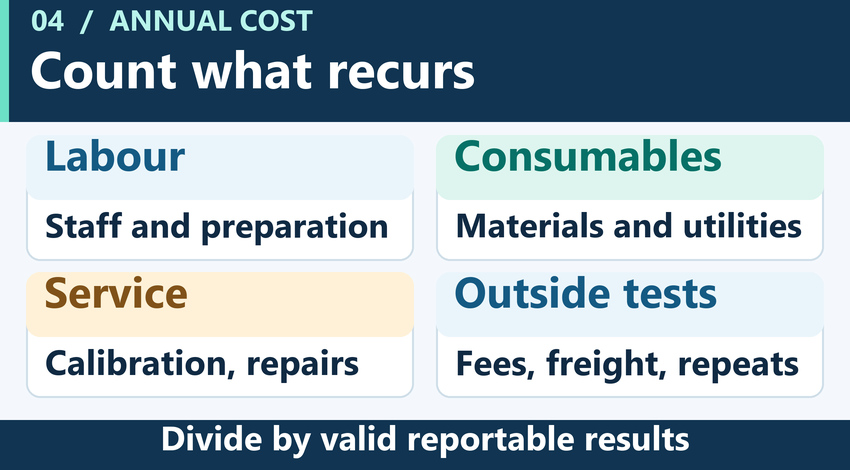
Budget normal, peak and downtime scenarios. Include service response, transit for external checks, loaner access where available, and the cost of continuing release testing if a critical station is unavailable. If repair under warranty is included, do not add that same repair amount again, but assess unavoidable production or outsourcing exposure. Keep a replenishment list for consumables with specification, quantity, supplier lead time and shelf life where relevant. A cheap proprietary fixture or consumable can turn a high-use method into the most expensive station to operate when it is difficult to replace.
How do you calculate cost per reportable lot?
Divide total attributable cost for the period by the number of valid, accepted reports for that same period. Define whether a report means one lot decision, one test method or one complete qualification package, and use the same definition across options. If a report carries several specimens and authorised repeats, spread those costs over the accepted reports, not over all machine cycles. For shared equipment, use a disclosed allocation such as booked time, keeping annual support costs visible. A low cost per test cycle can be misleading if batches remain on hold while you wait for another required result.
For example, suppose 50 lots enter a reporting period and only 44 have a complete report at close. Allocate the period's lab costs, including work on the six incomplete lots, over 44 completed reports for this simple period-productivity measure. A valid out-of-specification report still counts because it supports a disposition decision. An invalid run does not count even when it consumed paid bench time. Log whether an incomplete report is waiting for conditioning, another result, an authorised repeat or review. Track work carried forward separately if you need a matched cost per finished report. This helps distinguish a measurement bottleneck from a queue that a second instrument would not fix.
When does buying beat outsourcing?
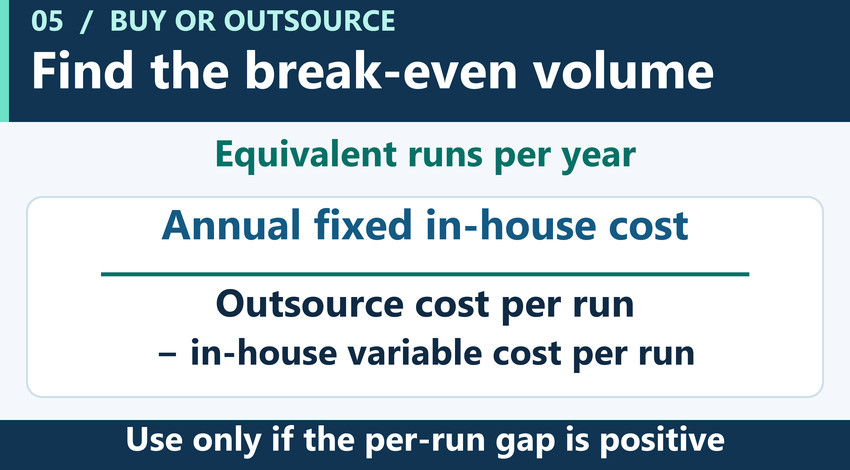
Compare the same method, specimen count, report scope and turnaround. For a simple screening model, let F be positive annual fixed in-house cost, including annualised ownership if used. Let V be the in-house variable cost per comparable accepted report, and P be the all-in outsourced cost per comparable accepted report. When P exceeds V, the simplified break-even count is F ÷ (P − V). Use the first whole count above that value to find when in-house testing is strictly cheaper. If the calculated count is already a whole number, that count gives equal costs. Check that the lab can deliver the necessary volume. If P is no greater than V, there is no positive cost-only break-even in this simplified model. Do not count the purchase both as a lump sum and as an annualised cost in the same calculation.
Outside charges should include preparation, shipping both ways if required, administrative effort, expedited fees and the cost of holding production if you choose to quantify it. Treat lost time consistently in both options. Where a customer needs independent results, required external testing may remain even with fully capable in-house equipment. For borderline cases, a hybrid setup can keep release screens close to production while leaving long or rare qualification runs with an accepted lab. Set a backup route for downtime and a trigger to revisit the decision when contracted volumes change.
For a concrete comparison, National Test House's Alipore test charge schedule lists ₹10,000 excluding taxes for a 200-hour neutral salt spray test in its customised paint and high-polymer scope. If one eligible job were sent monthly on that basis, 12 × ₹10,000 = ₹1,20,000 in annual listed test charges, before applicable taxes, specimen preparation or logistics. Two such jobs monthly would make the listed test-charge subtotal ₹2,40,000. Neither figure is a chamber price or an offer for your specimens. Confirm eligibility, how the lab bills a job, necessary evaluation after exposure, current charges and the accepted reporting scope before using the rate in a purchase decision.
Use the one-job-per-month example to ask what owning the capability would have to cost. Against the published charge alone, the in-house option ties at F + 12 × V = ₹1,20,000, on the same tax basis and for 12 comparable accepted reports. For the real decision, replace the right-hand side with 12 × P using a written all-in outside quote. If one of those twelve jobs still has to go outside under a customer approval rule, only eleven outside charges are avoidable. Keep the required outside job in both budgets and compare the in-house fixed cost plus eleven in-house reports with the cost of eleven outside reports. Use the chamber calendar to check that those reports can be delivered when required before ordering equipment.
What does a three-year ownership comparison look like?
Sum initial installed cost plus yearly operation, remaining outsourced work, planned replacements and any separately modeled financial outlays. Subtract residual value only if your finance comparison includes and supports it. Normalize the comparison horizon, tax basis, asset life, utilisation and assumptions on inflation or discounting. An inexpensive first-year proposal can become less attractive if a second fixture set becomes compulsory or if the instrument software stops exporting reports without a renewal. Present a base, low-utilisation and high-utilisation case. Switch one assumption at a time so you can see whether the decision is driven by demand, outside charges, energy, maintenance or staffing.
How do site and utilities change the quote in India?
Walk the actual delivery route and lab layout with facilities before you lock the purchase. Record access, bench and floor loads, drainage, equipment heat and installed service clearance. Confirm utility requirements from the chosen models and the approved methods. There is no single room temperature, humidity band or floor area for every QC lab. A cabinet can control a specimen environment while the rest of the room still needs services, storage, housekeeping and access suitable for the work.
Price incoming and retained sample storage, specimen preparation, conditioning, measurement and reporting as separate work zones. Keep dusty cutting, cleaning or salt handling away from sensitive optical and dimensional work where applicable. Identify which utilities are essential to each machine and who supplies them. Ask qualified site staff to review electrical protection, earthing, water, airflow, drainage or compressed air as relevant. Where your site needs a continuity plan, estimate what a power interruption invalidates before deciding what to back up. Backing up a workstation does not maintain the chamber conditions required by a test.
Do NABL accreditation and calibration cost the same thing?
No. Instrument calibration relates the indicated measurement to references under stated conditions. Laboratory accreditation is recognition of competence for defined activities, under the relevant accreditation programme. It does not follow from owning a calibrated machine. Decide whether you need accredited reports for a named test and matrix, and who accepts them. An internal QC result is not automatically required to be accredited, but a customer contract, procurement condition or applicable programme can require a specific scope. Compare external quotes for the exact test and scope, not just a laboratory logo.
What should the accreditation budget include if it is needed?
Price readiness work, documented method verification or validation as appropriate, suitable reference materials and calibration, proficiency testing or other comparisons when applicable, staff time, assessment and ongoing charges. Separately budget the work to extend or maintain the scope and make any improvements following assessment. The NABL 100A fee schedule dated 31 August 2026 lists ₹24,000 per discipline per year for the stated testing-laboratory category, excluding forensic and software or IT system testing. Assessment, other applicable charges and GST are separate. Confirm the current fee schedule, payment timing and scope when applying. Ask customers what they will accept while your internal capability is still being established.
What should happen before you release the final payment?
Agree that acceptance requires more than successful delivery and power-on. Set the test scope and proof before ordering. A factory demonstration can show that a machine has the stated functions. At site you still need to check that installed equipment can produce the agreed outputs on representative samples, with the supplied software, fixtures and services. Identify a low, typical and high result or sample size as relevant, and agree acceptable evidence for each. Ask for the delivered accessory list, manuals, verification records, spare parts information, training records and support contacts.
Never invent performance criteria at handover. Agree the methods, ranges, checks and evidence in advance with the supplier and quality team. Have the users verify the report format, units, IDs, raw data access and permissions. Describe what happens if an agreed acceptance check fails, including correction, recheck, timing and any release of payment tied to it. Remeasure or troubleshoot under the controlled procedure, not by selecting only favourable results.
How do you write an RFQ that avoids cost surprises?
Give bidders the same test register and real specimen sizes. Ask them to itemise the configured equipment, buyer-supplied scope, exclusions and options. Start with an essential scope and price named optional capabilities as additions. Ask for the part number of critical accessories and how they affect method coverage. Where fixtures or software are shared, confirm which tests can be run at the same time and which require changeovers.
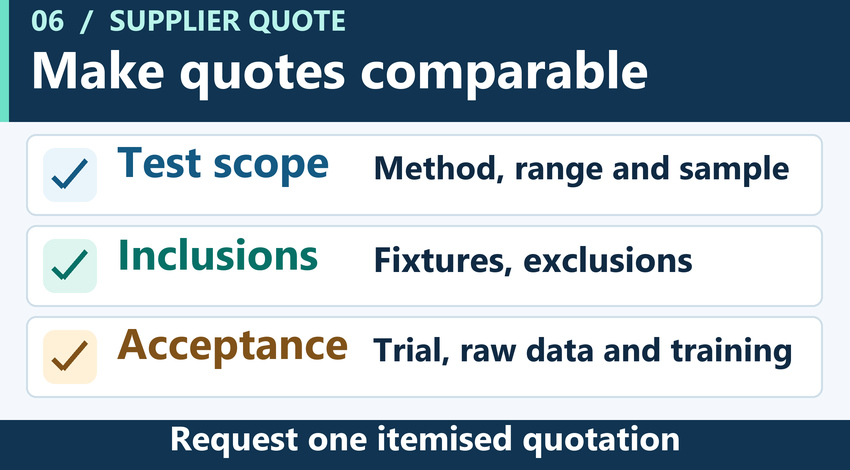
- Attach product list, specimen drawings or photos, approved methods and editions, target ranges and expected output units.
- State daily and peak volumes, maximum sample envelope, turnaround need and any special reporting or customer acceptance requirement.
- Give installation city, floor level, delivery restrictions, available utilities and who owns unresolved site work.
- Request equipment, fixtures, preparation tools, freight, installation, verification, training, tax and ongoing service as named price lines.
- Attach handover evidence, acceptance tests, exclusions, lead time, quote validity and a plan for spares and downtime.
Ask each bidder to describe deviations explicitly. Put tentative quantities and unit costs for likely changes on separate lines. For example, price a second fixture for a new neck finish separately and identify whether training, verification or a new calibration range would be needed if it is added later. Keep a dated change log showing who approved scope, cost and schedule changes. Hold a contingency against known unresolved items instead of copying a general percentage from another project.
What should you send Pacorr for a comparable INR quote?
Start with your top release tests and the material or product families they cover. Send the method revisions, range, biggest and smallest samples, fixture sketches, peak volumes, city and utility constraints. Share the target report and whether you need demonstrations using your samples. Ask for a base package, optional additions and buyer site items as separate lines. Compare instrument families through Pacorr Testing Instruments and contact Pacorr for an itemised quotation against the actual application. A quote tied to the test register is more useful than a single price for a lab with an unspecified scope.
Frequently asked questions
How much should I budget for a complete QC lab in India?
There is no reliable single amount for every industry or site. Request a written INR quote for the exact test configuration, add installation and readiness costs, and calculate annual operating and remaining outside testing separately. Tender estimates, indicative equipment ranges, test charges and accreditation fees are not interchangeable prices.
Can I set up a useful QC lab without buying every test instrument?
Yes, if the in-house and outside routes together cover the required methods and turnaround. Buy routine release capability, including preparation and verification, then consider adding low-frequency or specialist tests when a defined volume, risk or customer requirement warrants it.
Is space and utility work included in an equipment quote?
Do not assume so. Ask the supplier to distinguish supply, delivery, handling, installation, commissioning and training from buyer-provided benches, power, ventilation, environmental control, drainage or other services. Put site work in its own budget line.
How do I compare a lower quote with a more expensive one?
Bring both to the same test method, specimen range, setup, reporting and service scope. Add missing fixtures, site work, verification, consumables and operating costs on the same tax basis. Then compare the installed and accepted cost plus the cost of ownership over the same period.
Do all in-house QC labs in India need NABL accreditation?
Not automatically. The need depends on the use of results, applicable requirements and customer agreements. When an accredited report is required, verify the exact method and material against the laboratory's scope. Instrument calibration does not substitute for accreditation.
What often makes QC lab costs rise after the order?
Missing fixtures, larger specimens than quoted, site access or utility work, verification not included in installation, software costs and overlooked staffing are common things to check. Agree inclusions, exclusions and evidence in the purchase document and track changes separately.
When should I outsource an expensive test?
Outsource when low volume, specialist expertise, accredited scope or in-house turnaround makes ownership a poor fit, provided an accepted outside laboratory meets the reporting and lead-time requirement. Compare both options on comparable valid reports, including transport, repeats and any time-sensitive production impact.