
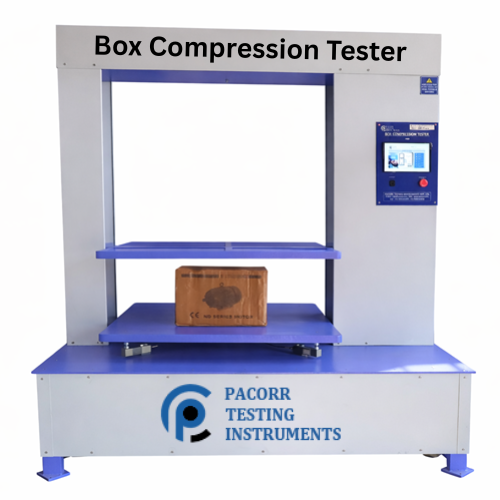
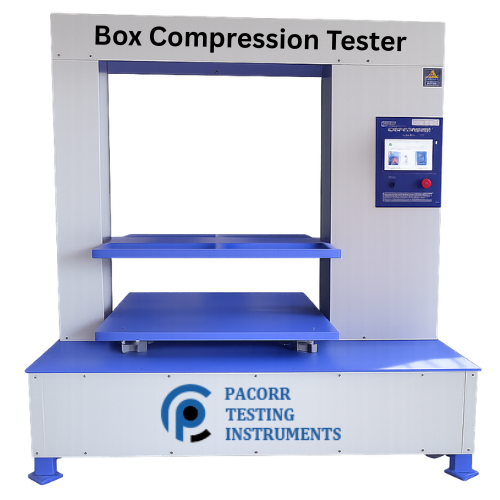
The Touch Screen Box Compression Tester, model PCBCT-1000H, measures the resistance of corrugated boxes, cartons and complete packages to vertical compressive force. Its PLC-controlled operation and HMI touch screen allow the operator to set a test, view load and displacement during compression, and review the result through one interface. With a capacity of up to 1000 kgf (10 kN), a 1000 × 1000 mm platform and accommodation for boxes up to 1000 × 1000 × 1000 mm, the instrument is designed for routine packaging quality control as well as comparative development trials. Four load cells sense the force applied across the compression assembly. The rigid double-column steel frame supports stable platen movement, while variable speed control from 10 to 50 mm/min enables the machine to be configured for the selected procedure. Automatic stop functions and overload and over-travel protection help protect the specimen, sensors and moving assembly. USB communication also supports connection to a compatible computer and supplied software configuration when external data handling is required.
- Shipping Area: All over the world
- Model: PCBCT-1000H
- Brand: Pacorr
- Availability: In Stock


What Is a Touch Screen Box Compression Tester?
A Touch Screen Box Compression Tester is a compression testing machine used to determine how a carton or complete package behaves when a controlled vertical load is applied between two platens. Depending on the chosen method and stop condition, the test can identify maximum compression force, deformation at a defined load, or the package response under a specified compressive condition.
The touch-screen designation refers to the machine’s control interface. On the PCBCT-1000H, the operator uses an HMI to enter the available test parameters, monitor live load and displacement, and view the completed result. A PLC executes the programmed test sequence and manages the machine controls and safety interlocks. This is different from a basic digital model that may only show a load value, and it should not be confused with a computer-dependent system in which the PC is the primary operating interface.
Why Is Box Compression Testing Important?
Cartons encounter vertical forces when they are stacked in warehouses, placed on pallets or carried in trucks and shipping containers. Compression performance is affected by more than board grade alone. Box dimensions, flute direction, joints, creases, printing and moisture can all influence the result. The contents, internal supports, sealing method and conditioning history can also change the way a complete package carries load.
A controlled compression test gives manufacturers a repeatable basis for comparing packaging designs, checking production batches and investigating failures. The measured value is not, by itself, a universal safe stacking limit. Storage duration, humidity, load distribution, pallet overhang and the required safety factor must also be considered before a stacking decision is made.
Key Features of Model PCBCT-1000H
- Test capacity up to 1000 kgf (10 kN)
- PLC-controlled test operation and safety logic
- HMI touch screen for parameter entry and live result monitoring
- Live display of load and displacement
- Programmable storage and retrieval of multiple test profiles
- Four-load-cell measurement configuration
- Selectable force units: kgf, N and lb
- Variable test speed from 10 to 50 mm/min
- Induction motor and drive-controlled platen movement
- Automatic stop at the programmed force or deformation limit
- USB communication for compatible PC and software integration
- Double-column rigid steel load frame
- Overload and over-travel protection
- Large 1000 × 1000 mm compression platform
- Accommodation for specimens up to 1000 mm high
Technical Specifications
| Parameter | Specification |
| Product | Touch Screen Box Compression Tester |
| Model | PCBCT-1000H |
| Test Capacity | Up to 1000 kgf (10 kN) |
| Platen/Platform Size | 1000 × 1000 mm |
| Maximum Box Accommodation | 1000 × 1000 × 1000 mm |
| Load Frame | Rigid double-column steel frame |
| Controller | Programmable Logic Controller (PLC) |
| User Interface | HMI touch screen |
| Screen Indication | Live load, displacement and test result |
| Load Measurement | Four precision load cells |
| Least Count/Resolution | 1 kgf |
| Selectable Units | kgf, N and lb |
| Speed Range | 10 to 50 mm/min, variable |
| Typical Standard Test Speed | Approximately 12.5 ± 2 mm/min, where required by the selected method |
| Drive System | Induction motor with drive |
| Test-Profile Memory | Programmable storage and retrieval of multiple profiles |
| Data Communication | USB PC communication and compatible software integration |
| Automatic Stop | At a programmed force or deformation limit |
| Safety | Overload and over-travel protection |
| Power Supply | 220 V AC, single phase, 50 Hz |
| Referenced Test Methods | ASTM D642, ISO 12048, ASTM D4169 and TAPPI T804 |
The stated accommodation is based on the supplied platform and maximum height. Confirm usable clearance, platen travel, loading access and specimen orientation for a box close to the maximum dimensions.
Important measurement note: A 1 kgf least count describes the displayed measurement increment; it does not establish measurement accuracy. State verified accuracy only from the approved calibration or technical document for the supplied machine.
How Does the PCBCT-1000H Work?
The carton is positioned centrally on the lower platform beneath the compression platen. The operator selects or enters the available test profile on the HMI, including the required speed and applicable force- or deformation-based stop condition. After the test starts, the motor-and-drive system moves the platen at the set rate and applies a progressively increasing vertical force.
Four load cells measure the applied force while the control system tracks displacement. The HMI displays the test response in real time. The PLC stops the movement when the programmed condition is reached or when the test sequence is completed. The operator can then review the result and examine the specimen for panel buckling, edge crushing, joint failure, platen contact or another visible failure mode. Where external data handling is needed, the available USB connection can be used with the compatible software arrangement supplied for the machine.
Test Modes and Result Interpretation
The precise test modes available should match the approved PLC/HMI program supplied with the instrument. Typical compression assessments may include:
- Compression-to-failure: Determines the peak force or defined failure response of a carton.
- Compression to a preset force: Stops the test when the programmed load is reached, allowing the package condition to be examined at that point.
- Compression to a preset deformation: Stops movement when the selected displacement limit is reached.
- Comparative testing: Compares board combinations, box designs, suppliers, sealing methods or conditioned sample groups under the same procedure.
Peak compression force should not automatically be reported as safe warehouse load. A valid report should also identify the specimen, box dimensions, empty or filled condition, contents or internal fitments, sealing method, conditioning environment, platen speed, stop criterion, failure mode and test method.
Applications
The PCBCT-1000H can be used for:
- Compression-strength testing of corrugated shipping boxes
- Evaluation of empty cartons and complete packages when permitted by the method
- Comparison of carton designs, flute combinations and board grades
- Production batch and incoming-packaging inspection
- Packaging development and material optimisation
- Investigation of crushed or collapsed cartons
- Assessment of export, e-commerce and distribution packaging
- Support for stacking and transit-packaging studies
Industries Served
- Corrugated box and paper packaging manufacturers
- Food and beverage packaging operations
- Pharmaceutical and healthcare packaging
- FMCG and consumer-product manufacturers
- E-commerce and logistics companies
- Electronics and appliance manufacturers
- Automotive component packaging
- Exporters and independent packaging laboratories
How to Operate the Tester
- Select the applicable test method and condition the samples as required.
- Record the carton construction, dimensions, sealing method and whether it is empty or filled.
- Check that the specimen fits within the usable test space and the expected force is within the 1000 kgf capacity.
- Place the box centrally on the lower platform with the intended compression orientation.
- Select a stored profile or enter the permitted speed and stop condition through the HMI.
- Ensure the test area is clear, then start the cycle.
- Observe the live load and displacement without touching or adjusting the specimen during movement.
- After automatic stopping, record the result and visible failure location.
- Return the platen to a safe loading position and remove the specimen according to the operating instructions.
Standards and Test-Method Alignment
The PCBCT-1000H is designed to support packaging compression testing associated with ASTM D642, ISO 12048, ASTM D4169 and TAPPI T804. These references do not all describe an identical procedure: ASTM D642 and ISO 12048 address compression testing, ASTM D4169 is a broader distribution-testing practice, and TAPPI T804 concerns compression testing of fibreboard shipping containers. The correct conditioning, specimen preparation, test speed, preload, endpoint and reporting requirements must be taken from the applicable current method and customer specification.
Instrument capacity alone does not establish compliance. Before claiming a test was performed to a standard, confirm that the machine configuration, calibration, platen geometry, control mode, software, procedure and reporting meet that method’s requirements.
Benefits of the Touch-Screen Configuration
- Centralises setup, live monitoring and result viewing on the machine
- Reduces repeated manual control steps during routine testing
- Allows authorised procedures to be saved as repeatable profiles
- Makes force and displacement information visible during the test
- Supports consistent application of programmed stop conditions
- Provides a connection route for compatible external software when required
- Helps compare packaging changes using controlled test settings
- Adds automatic safeguards for overload and platen over-travel
Why Choose Pacorr?
Pacorr supplies the PCBCT-1000H for laboratories and production teams that need a large-platform carton compression system with PLC control and direct HMI operation. Its 1000 kgf capacity, four-load-cell arrangement, variable-speed drive and double-column structure are intended for repeatable compression assessment of boxes within the stated working envelope.
Model selection should be based on actual specimen dimensions, expected failure load, required procedure, data-output needs and the desired test modes. Pacorr can review these application details before quotation so that the capacity, platform, control program, connectivity and accessories are defined for the intended packaging test.
Frequently Asked Questions
What does the PCBCT-1000H measure?
It measures the vertical compressive force applied to a box or complete package and monitors displacement during the test. The result can be used to evaluate peak compression strength or response at a programmed force or deformation limit, depending on the selected procedure.
Is the PCBCT-1000H fully automatic?
The PLC controls the programmed compression cycle and automatic stopping. Specimen preparation, loading, positioning, profile selection, result review and unloading still require an operator.
What is the largest box it can test?
The stated maximum accommodation is 1000 × 1000 × 1000 mm. For specimens close to this limit, confirm usable clearance, loading access, platen travel and test orientation before purchase.
Does a 1 kgf resolution mean 1 kgf accuracy?
No. Resolution or least count is the displayed increment. Accuracy describes agreement with a reference value and must be stated separately from verified calibration or approved technical documentation.
Can it test both empty and filled cartons?
Yes, when the selected method permits the chosen condition and the specimen remains within the machine’s size and load limits. The report should clearly state whether the carton was empty or filled because contents and internal packaging affect load distribution.
Can the machine perform a stacking test?
It can apply a programmed compressive condition that may support a stacking assessment. Confirm whether the supplied control program includes the required load-hold duration and control logic. An automatic stop at a set force is not the same as maintaining that force for a defined time.
Is a computer required to operate this model?
The primary controls and live display are available through the HMI. A compatible computer is needed only when the supplied USB/software functions are to be used. Confirm software scope, operating-system compatibility and whether a computer is included in the quotation.
Can the operator save multiple test methods?
The controller supports programmable storage and retrieval of multiple test profiles. The number of profiles, editable fields and user-access controls should be confirmed for the final HMI program.
Does it comply with ASTM D642 and ISO 12048?
The machine is designed to support testing associated with these methods. Final compliance depends on the supplied configuration, calibration, specimen preparation, selected settings, test execution and reporting required by the applicable edition.
How should test results be compared?
Use the same specimen construction, conditioning, orientation, sealing method, speed and endpoint for each sample group. Compare results against an approved packaging specification rather than a universal compression value.
Write Your Review

Our Clients
























Our USP's
Demonstration of Machine
- Try Before You Decide
- Experience Before You Invest
- See It in Action – Free Demo
Global Reach
- Delivering Excellence Worldwide
- Serving Across Borders
- Your Global Supply Partner
On-Site Support
- Support That Comes to You
- On-Ground Assistance, Anywhere
- We Reach Where You Are
Team Strength
- Powered by Expert Minds
- Driven by Skilled Professionals
- Engineering Excellence Team
Manufacturing
- Precision-Driven Manufacturing
- Smart & Automated Production
- Engineered In-House Excellence
