
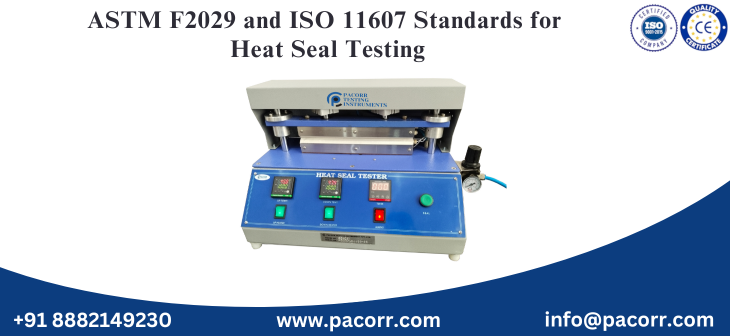
Pacorr is a recognized leader in packaging quality testing solutions, helping manufacturers meet international compliance requirements with confidence. In highly regulated industries such as medical devices, pharmaceuticals, and flexible packaging, Heat Seal Testing is a fundamental quality assurance process. A reliable seal protects products from contamination, leakage, and environmental exposure, while poor sealing can lead to recalls, compliance failures, and safety risks. Standards such as ASTM F2029 and ISO 11607 provide globally accepted guidelines to ensure that heat-sealed packages perform consistently and safely.
Importance of Heat Seal Testing in Packaging Quality
Heat seal testing refers to the evaluation of the strength and integrity of seals created through controlled heat, pressure, and dwell time. These seals act as the primary barrier that preserves product quality and sterility. Even minor deviations in sealing parameters can result in weak seals or microscopic leaks that may not be visually detectable.
In medical and pharmaceutical packaging, seal integrity directly impacts patient safety. Packages must remain sterile throughout distribution, storage, and handling. For food and consumer goods, effective sealing prevents spoilage, leakage, and reduced shelf life. As packaging materials become thinner and more complex, accurate testing of heat seals becomes increasingly critical.
ASTM F2029: Precision in Seal Strength Measurement
ASTM F2029 is a standardized test method developed by ASTM International to determine the strength of heat seals in flexible packaging using a restrained sample technique. This method is valued for its ability to produce highly repeatable and reliable results.
Purpose of ASTM F2029
The primary objective of ASTM F2029 is to measure seal strength while minimizing the influence of material stretching or deformation. In conventional peel tests, flexible films may elongate during testing, leading to inconsistent results. By restraining the specimen, ASTM F2029 ensures that the applied force is focused directly on the seal area.
Benefits for Manufacturers
This approach allows manufacturers to accurately evaluate sealing parameters, compare materials, and optimize sealing conditions. ASTM F2029 is commonly used during product development, routine quality control, and validation studies, especially in industries where precision and repeatability are essential.
ISO 11607: A Comprehensive Packaging Validation Standard
ISO 11607 is an international standard issued by the International Organization for Standardization that governs packaging systems for terminally sterilized medical devices. Unlike ASTM F2029, which focuses on a specific test method, ISO 11607 provides a complete framework for packaging design, validation, and process control.
Role of Seal Testing Under ISO 11607
ISO 11607 requires manufacturers to validate sealing processes and demonstrate that they consistently produce seals capable of maintaining sterility until the point of use. Seal strength testing serves as objective evidence that the sealing process is effective and under control.
The standard emphasizes lifecycle validation, including installation qualification, operational qualification, and performance qualification. Ongoing monitoring ensures that sealing parameters remain within validated limits throughout routine production.
How ASTM F2029 Supports ISO 11607 Compliance
In practical applications, ASTM F2029 and ISO 11607 are often used together. ASTM F2029 provides a precise and repeatable method for measuring seal strength, while ISO 11607 defines how and when such testing must be conducted within a regulated quality system.
Data generated using ASTM F2029 is frequently included in validation reports and audit documentation to demonstrate compliance with ISO 11607 requirements. This combination helps manufacturers meet both technical and regulatory expectations.
Significance in Medical and Pharmaceutical Packaging
In medical and pharmaceutical sectors, packaging is considered an extension of the product. A compromised seal can result in contamination, loss of sterility, and serious health risks. Regular evaluation of seal strength ensures that packaging can withstand sterilization processes, transportation stress, and long-term storage.
Beyond safety, standardized testing supports regulatory compliance, reduces product waste, and protects brand reputation. Authorities expect documented proof that sealing processes are reliable and repeatable, making adherence to ASTM F2029 and ISO 11607 essential.
Equipment and Best Practices for Seal Evaluation
Modern testing instruments are designed to meet international standards by offering precise control over force, speed, and alignment. Accurate results depend not only on equipment quality but also on proper sample preparation, controlled environmental conditions, and regular calibration.
Well-defined testing procedures and trained operators further improve data reliability. Digital data recording and traceable reports simplify audits and support continuous process improvement.
Common Challenges and Risk Management
Manufacturers may face challenges such as material variability, multilayer film behavior, and environmental influences like humidity and temperature. Inconsistent sample alignment can also affect results. Restrained test methods help reduce these variables, improving confidence in test outcomes.
A risk-based approach, as encouraged by ISO 11607, helps identify potential seal-related failures early and implement corrective actions before issues escalate.
Pacorr’s Role in Reliable Testing Solutions
Pacorr provides advanced testing instruments designed to support compliance with ASTM F2029 and ISO 11607. With robust construction, precise control systems, and user-friendly operation, Pacorr solutions help manufacturers achieve consistent and accurate test results.
By integrating Pacorr equipment into quality systems, organizations can streamline validation efforts, improve sealing consistency, and maintain long-term compliance with global packaging standards.
Future Direction of Seal Testing Standards
As packaging materials evolve toward sustainability and lightweight structures, seal performance evaluation will continue to gain importance. Regulatory focus on data integrity, risk management, and continuous monitoring is expected to increase.
ASTM F2029 and ISO 11607 will remain foundational standards, adapting to new materials and technologies while maintaining their core emphasis on safety and reliability.
Conclusion
ASTM F2029 and ISO 11607 together provide a strong foundation for evaluating and validating heat-sealed packaging systems. ASTM F2029 delivers accurate and repeatable seal strength measurement, while ISO 11607 establishes the regulatory framework required for medical packaging validation.
By understanding and implementing these standards effectively, manufacturers can ensure packaging integrity, protect end users, and meet global regulatory expectations. With Pacorr’s advanced testing solutions and a commitment to international standards, organizations can achieve consistent quality and long-term success in packaging performance.
Recent Blogs
Enhance your understanding of testing and precise quality control indistinct applications with our
knowledge based articles coming from top editors of industry leaders.
Thanks to Pacorr Testing instruments, we have all the required quality testing instruments that have helped us to ensure the best quality delivered to our clients.

Danish
Fair Exports Pvt. Ltd.
