
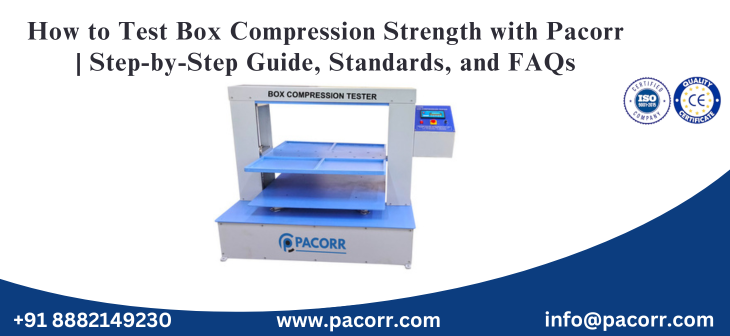
Introduction: The Importance of Box Compression Strength in Packaging
In today’s highly competitive market, ensuring that your packaging is both strong and reliable is essential for protecting your products and your reputation. Box Compression Strength (BCS) is the key indicator of a box’s ability to withstand stacking and transport stresses. Poor packaging can lead to damaged goods, customer complaints, and loss of business.
At Pacorr Testing Instruments, we are committed to providing advanced, accurate, and easy-to-use solutions like our Box Compression Tester, enabling manufacturers to meet global standards and guarantee customer satisfaction.
What is Box Compression Strength?
Box Compression Strength refers to the maximum load a packaging box can handle before it collapses or deforms. This property is critical for:
- Safe storage and stacking in warehouses
- Protection during shipping and handling
- Meeting the requirements of retailers and end-users
- Reducing losses due to damaged goods
Industry standards such as ASTM D642 and ISO 12048 make BCS testing a mandatory step for most packaging operations.
Why Choose Pacorr?
Pacorr stands apart as an award-winning and certified manufacturer, proudly holding ISO 9001:2015 and CE certifications, and recognized among the Top 10 Scientific & Analytical Instruments Manufacturers in 2023.
Under the expert leadership of Mr. Sanjay Sharma, who brings over 25 years of industry experience, Pacorr is trusted by leading clients such as Tata Group, Maruti, Honda, Nestlé, Bisleri, Philips, Tupperware, and many more. With complete in-house manufacturing, a highly skilled team, advanced production machinery, and dedicated after-sales support, we ensure the highest quality and reliability in every product.
Our wide installation base and long list of highly satisfied clients reflect our unwavering commitment to customer satisfaction and excellence.
Our USPs:
- Award-Winning Manufacturer
- International Certifications
- Decades of Expertise
- Trusted by Top Brands
- Complete In-House Manufacturing
- Advanced R&D
- Superior After-Sales Support
- Highly Satisfied Clients
When you choose Pacorr, you’re partnering with a team dedicated to your success—from product selection to after-sales service.
Step-by-Step Guide: How to Test Box Compression Strength with Pacorr
1. Sample Preparation
- Select a new, unused box identical to those used for shipping.
- Assemble and close the box as per real shipping conditions (including tape, glue, etc.).
- Condition the box for at least 24 hours at standard laboratory conditions: typically 23°C (±2°C) and 50% RH (±5%).
2. Setting Up the Pacorr Box Compression Tester
- Place the conditioned box centrally between the two compression plates of the tester.
- Adjust the machine settings as per your box size and test requirements (refer to ASTM D642 or ISO 12048).
3. Conducting the Compression Test
- Start the test using the digital control panel.
- The upper plate applies a uniform downward force at a controlled speed.
- Watch the digital display to monitor the increasing force as the box is compressed.
- The maximum force the box withstands before collapsing is the Box Compression Strength (BCS).
4. Recording & Analyzing Results
- Test at least three samples for reliable data and take the average.
- Export, save, or print your test data using Pacorr’s digital interface for quality assurance documentation.
Expert Tips for Accurate Box Compression Testing
- Always test boxes in the same orientation as they will be stacked or shipped.
- Ensure the compression plates are clean and perfectly parallel for accurate results.
- Calibrate your tester regularly (Pacorr offers calibration and technical support).
- Document every test; digital data export makes this easy.
- Factor in real-world conditions such as humidity, temperature, and closure method, as they affect BCS.
Real-world Applications of Box Compression Strength Testing
- E-commerce: Ensures packages remain intact during long transits and multiple handling stages.
- FMCG & Food: Maintains product integrity and meets hygiene standards.
- Automotive & Electronics: Protects high-value products and reduces returns.
- Pharmaceutical: Ensures safe delivery and regulatory compliance.
Frequently Asked Questions (FAQs)
Q1: What speed is recommended for box compression testing?
A: ASTM D642 suggests a standard speed of 12.5 mm/min (0.5 in/min). Always check your industry or client-specific requirements.
Q2: How often should I calibrate my Pacorr Box Compression Tester?
A: We recommend calibration every 6 months, or as suggested by our engineers for frequent use.
Q3: Can Pacorr testers accommodate different box sizes?
A: Yes, Pacorr offers multiple models with customizable plate sizes and load capacities for a variety of packaging needs.
Q4: Do I need training to operate Pacorr’s tester?
A: Our testers are user-friendly, but we provide full training and detailed manuals for your team.
Q5: How do I get a quote or request a demo?
A: Simply contact us via the details below, or fill out the enquiry form on our website.
Conclusion
Investing in reliable box compression testing with Pacorr is a smart move for any packaging operation. Our Box Compression Tester ensures your packaging meets the highest international standards, protects your products, and upholds your brand’s reputation.
Choose Pacorr for superior quality, advanced technology, and exceptional customer support—trusted by industry leaders across India and beyond.
Contact Us:
📞 Phone: +91 8882149230
✉️ Email: info@pacorr.com
Written by Kishore Gupta, Head of Technical Department. With 15 years of experience in testing instruments.
Recent Blogs
Enhance your understanding of testing and precise quality control indistinct applications with our
knowledge based articles coming from top editors of industry leaders.
Thanks to Pacorr Testing instruments, we have all the required quality testing instruments that have helped us to ensure the best quality delivered to our clients.

Danish
Fair Exports Pvt. Ltd.
