
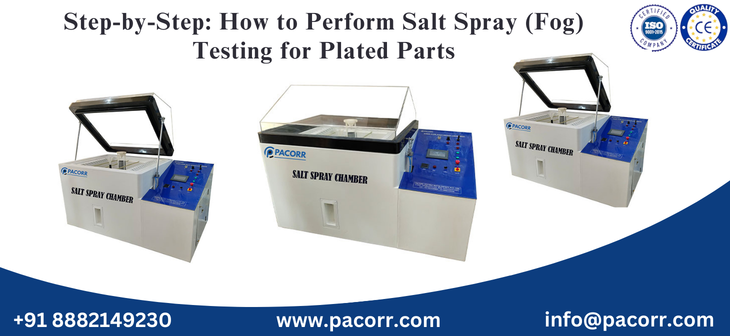
Pacorr serves manufacturers and quality teams that need practical, standards-aligned testing instruments for demanding industrial environments, and a salt spray chamber is one of the most important tools for evaluating plated parts before they go into service. In sectors such as automotive, electrical hardware, appliances, industrial machinery, and export manufacturing, corrosion resistance is not just a cosmetic issue. It directly affects durability, field performance, warranty risk, and brand trust.
A Salt Spray Test Chamber, also called a Salt Fog Chamber, Corrosion Test Chamber, or Salt Mist Chamber, is used to expose plated or coated components to a controlled corrosive environment so engineers can identify pores, discontinuities, weak plating, or process inconsistency much faster than they could through natural weather exposure. ISO 9227 and ASTM B117 both make clear that salt spray testing is intended to create a controlled test environment and is especially useful for detecting coating defects, while the product specification, not the chamber standard itself, defines specimen type, exposure duration, and pass/fail interpretation.
That distinction matters. A salt spray test does not automatically predict exact service life in the field. ASTM B117 states that real-world performance has seldom been correlated with salt spray results when used alone, and ISO 9227 likewise says the method is not meant for ranking unlike materials or predicting long-term behavior. In practice, the chamber is best used for process control, qualification, supplier comparison within similar coating systems, and defect detection in plated parts.
What is a Salt Spray Chamber?
A salt spray chamber is a controlled cabinet that atomizes a saline solution into a fine fog and maintains a defined environment so test specimens are continuously exposed to corrosive mist. ISO 9227 covers three main variants: neutral salt spray (NSS), acetic acid salt spray (AASS), and copper-accelerated acetic acid salt spray (CASS). NSS is broadly used for metals, metallic coatings, conversion coatings, anodic oxide coatings, and organic coatings on metals, while AASS and CASS are especially relevant for decorative copper-nickel-chromium or nickel-chromium systems and some anodized aluminum applications.
For plated parts, the chamber is not just “spraying salt.” It is controlling several interacting variables at the same time: salt concentration, pH, atomizing air pressure, humidification, fog collection rate, chamber temperature, specimen loading, and exposure continuity. If any of these drift, results become less comparable. That is why both ASTM B117 and ISO 9227 focus heavily on apparatus control rather than promising a universal number of hours that equals a certain field life.
In day-to-day quality work, a Salt Spray Test Chamber helps answer questions such as: Is the plating bath under control? Is passivation consistent? Did a supplier change surface preparation? Is white rust appearing too early on zinc-plated parts? Is the decorative nickel-chrome system appropriate for the service environment? Those are the kinds of practical decisions the test is designed to support.
Importance of Salt Spray Chamber in Quality Testing
The biggest value of a Corrosion Test Chamber is speed. Real atmospheric exposure may take months or years to reveal coating defects. A salt spray method compresses that evaluation window so manufacturers can make production and release decisions faster. ISO 9227 specifically notes that salt spray tests are particularly useful for detecting pores, discontinuities, and damage in metallic, organic, anodic oxide, and conversion coatings.
For plated parts, this is critical because corrosion often starts at the weakest point rather than uniformly across the surface. That weak point may be a pore in nickel, a thin edge deposit, an unprotected cut edge, poor post-treatment, contamination left from handling, or a geometry-related shadow area in electroplating. A properly controlled Salt Fog Chamber helps make those vulnerabilities visible before the part reaches customers. ASTM B117 also emphasizes that reproducibility depends strongly on specimen type, evaluation criteria, and operating-variable control, which is why disciplined setup matters so much.
The chamber is also important for supplier management and batch release. If your business buys plated fasteners, terminals, brackets, or machine components from multiple vendors, a consistent salt spray method gives your quality team a common reference point. It becomes easier to spot lot-to-lot variation, verify incoming quality, and identify process drift before it becomes a warranty issue.
Key Features of Salt Spray Chamber
A good salt spray chamber is defined less by marketing language and more by how well it maintains stable, repeatable exposure conditions.
Controlled fog generation
The spraying system should atomize the solution into a fine mist and distribute it uniformly through the cabinet. ISO 9227 requires that spray not be directed straight onto the specimen but spread throughout the cabinet so it falls naturally, and ASTM B117 similarly requires the nozzle arrangement to avoid direct impingement on samples.
Chamber material and corrosion resistance
All wetted components should resist attack by the test solution and must not change the corrosivity of the fog. ISO 9227 states that all components in contact with the spray or test solution should be made of or lined with corrosion-resistant materials that do not influence the test.
Accurate temperature control
Temperature stability is essential because it influences fog behavior, condensate characteristics, and corrosion rate. The chamber and its contents must be maintained at the specified temperature, and the measuring point should be positioned away from walls and radiant heat sources.
Air filtration and humidification
ISO 9227 requires compressed air to be filtered to remove oil and solids, then humidified before entering the atomizer so the fallout solution remains within specification. The standard notes a typical atomizing overpressure around 98 kPa, though acceptable values depend on chamber design.
Fog collection monitoring
A serious Salt Mist Chamber should allow verification of spray homogeneity. ISO 9227 requires at least two collectors of about 80 cm² collecting area placed in the exposure zone, and ASTM B117 specifies a collection rate of 1.0 to 2.0 mL per hour per 80 cm² based on an average run of at least 16 hours.
Safe specimen support
Supports must not contaminate the test. ASTM B117 states specimens should not contact each other or materials capable of acting as a wick, and bare metal supports should not be used.
Working Principle of Salt Spray Chamber
The working principle of a Salt Spray Test Chamber is straightforward in concept but precise in execution.
First, a sodium chloride solution is prepared using distilled or deionized water. ISO 9227 specifies a concentration of 50 g/L ± 5 g/L and limits water conductivity to not higher than 20 µS/cm at 25 °C ± 2 °C for solution preparation. For NSS testing, the pH of the collected sprayed solution is adjusted to 6.5 to 7.2. For AASS, the collected sprayed solution is maintained at pH 3.1 to 3.3. For CASS, copper(II) chloride dihydrate is added at 0.26 g/L ± 0.02 g/L, with the pH adjusted similarly to AASS.
Second, compressed air is filtered, humidified, and delivered to the atomizer. The atomizer converts the salt solution into aerosol droplets that fill the cabinet. ISO 9227 notes that the humidified air should be saturated and heated appropriately so the fallout solution and collection rate remain within specification; it also provides guiding saturation-tower temperatures tied to atomizing pressure.
Third, the fog settles naturally on the specimen surfaces. Corrosion begins where the coating system is weak: pores, scratches, thin deposits, edge conditions, or damaged passive layers. The evaluation then focuses on when and where visible corrosion products appear, how fast they spread, and whether the underlying substrate becomes exposed.
Step-by-Step: How to Perform Salt Spray (Fog) Testing for Plated Parts
Step 1: Define the applicable specification before touching the chamber
This is the most common mistake in corrosion testing: teams start with chamber settings before deciding what they are trying to prove. ASTM B117 and ISO 9227 do not set the exposure period or interpretation for a specific product. Those must come from the drawing, OEM material specification, customer requirement, coating standard, or internal quality plan.
Before the test begins, document:
- coating system and substrate
- plating thickness or nominal requirement
- whether the test is NSS, AASS, or CASS
- required exposure duration
- pass/fail criteria
- post-test evaluation method
- whether the sample is as-produced, scribed, assembled, or edge-protected
For zinc-plated parts, many specifications separate acceptance for white corrosion products and red rust because the two indicate different failure stages. For decorative nickel-chrome systems, CASS is often specified because it is more aggressive and better aligned with those finishes than neutral salt spray alone. ISO 9227 and ASTM B368 both point to AASS/CASS as especially useful for decorative copper-nickel-chromium or nickel-chromium coatings.
Step 2: Select representative plated samples
A meaningful result starts with representative production samples. ASTM B117 says the type and number of test specimens, and the evaluation criteria, should be defined in the applicable product specification or agreed between buyer and seller.
In practice, record:
- supplier and lot number
- plating line or batch
- substrate alloy
- finishing sequence
- passivation, sealing, or topcoat condition
- any rack marks, blind holes, threads, edges, or formed areas likely to behave differently
If your goal is supplier comparison, test like-for-like parts with the same substrate and coating family. ISO 9227 warns that salt spray methods are not intended to rank dissimilar materials against each other as though they were directly comparable in service life.
Step 3: Prepare the specimens correctly
ASTM B117 says specimens should be suitably cleaned and not recontaminated by careless handling. That sounds simple, but it matters. Fingerprints, polishing residue, shop oil, and packaging contamination can distort results.
For plated parts, good practice is to:
- avoid abrasive cleaning that changes the surface
- handle with clean gloves
- protect cut edges only if the governing specification requires it
- record any intentional scratch or scribe used for the test method
ASTM B117 also notes that unless otherwise specified, cut edges of plated or coated specimens and identification-marked areas should be protected with a stable coating.
Step 4: Prepare the salt solution accurately
The solution is a controlled reagent, not shop-floor brine. ASTM B117 calls for a solution prepared by dissolving 5 ± 1 parts by mass sodium chloride in 95 parts water, with impurity limits for the salt and no anti-caking agents. ISO 9227 similarly specifies 50 g/L ± 5 g/L and places impurity limits on sodium chloride.
For NSS, target the collected solution pH at 6.5 to 7.2. ASTM B117 notes that temperature and dissolved carbon dioxide can shift pH, which is why proper preparation and pH adjustment matter. For AASS and CASS, the collected solution should be pH 3.1 to 3.3.
Step 5: Verify the chamber before loading
Before every run, check:
- solution reservoir level
- nozzle cleanliness
- air supply quality
- atomizing pressure
- saturation tower or humidification status
- chamber temperature
- collector placement
- drainage path
- cabinet cleanliness
ISO 9227 also warns that if a cabinet has been used for AASS or CASS, it should not be reused for NSS until a thorough cleaning has been completed and collected-solution pH has been verified. That matters because acid or copper contamination can change results.
Talk to Pacorr About the Right Salt Spray Chamber
If your team is comparing a salt spray chamber, Salt Spray Test Chamber, or Corrosion Test Chamber for plated-part qualification, supplier QC, or lab setup, contact Pacorr for guidance on choosing the right configuration for your workflow.
Email: info@pacorr.com
Phone: +91 8882149230
Step 6: Position specimens the right way
Specimen loading has a major effect on result quality. ASTM B117 says specimens should typically be supported or suspended 15° to 30° from the vertical, should not touch each other, and should be placed so one specimen does not drip onto another.
For irregular plated parts, the goal is the same:
- allow free fog exposure
- avoid shielding
- prevent pooling in recesses unless the part naturally traps liquid in service
- avoid cross-contamination between unlike substrates
- keep supports inert
ISO 9227 adds that supports should be constructed so different substrate types do not influence each other and that spray should fall naturally rather than hit the specimen directly.
Step 7: Confirm fallout rate and homogeneity
This step separates controlled testing from guesswork. ASTM B117 specifies that the chamber fog should produce a collection rate of 1.0 to 2.0 mL/h per 80 cm² on an average run of at least 16 hours, with the collected solution at 5 ± 1 mass % sodium chloride and pH 6.5 to 7.2 for neutral testing. ISO 9227 requires at least two collecting devices in the exposure zone to check homogeneity.
If the fallout rate is too low, the test is starved. If it is too high, the chamber may be over-spraying and producing misleading washdown conditions. Consistent collector verification is one of the best indicators that your Salt Fog Chamber is actually operating correctly.
Step 8: Run the test continuously
ASTM B117 says the test should be continuous for the entire exposure period unless the governing specification states otherwise, and daily interruptions should be short and controlled.
That means:
- do not repeatedly open the cabinet for casual inspection
- do not rearrange specimens mid-test unless the method allows it
- keep replenishment and checks disciplined
- record any abnormal interruption in the test report
For long-duration tests, trend records of pH, fallout volume, chamber temperature, and salt concentration help defend the validity of the results.
Step 9: Remove, condition, and evaluate samples correctly
At the end of exposure, remove parts carefully. Your governing product specification should define whether samples are rinsed, air-dried, stabilized, or examined immediately. Since the standards do not prescribe a universal interpretation method for every product, consistency in post-test handling is essential.
For plated parts, inspection usually focuses on:
- first appearance of white corrosion products
- first appearance of red rust
- blistering or underfilm attack
- pitting
- peeling or flaking
- edge corrosion
- thread corrosion
- localized attack at formed areas, welds, rack points, or scratches
Record what appears, where it appears, and whether it falls inside or outside the allowed evaluation area.
Step 10: Interpret results with engineering judgment
This is where a lot of reports go wrong. A salt spray chamber result is best read as a comparative quality-control signal inside a defined coating system, not as a simple promise of real-world life. ASTM B117 explicitly warns against using stand-alone salt spray data as a reliable predictor of natural performance, and ISO 9227 says the tests are not intended for ranking different materials or predicting long-term corrosion resistance.
The strongest interpretation combines:
- coating thickness data
- plating-process records
- adhesion or porosity results where relevant
- field-return evidence
- substrate geometry
- service environment
That is how a Corrosion Test Chamber becomes a decision tool, not just a lab ritual.
Applications of Salt Spray Chamber in Different Industries
A salt spray chamber is used across industries wherever plated or coated metal parts must survive humidity, salt, or cyclic exposure.
In automotive manufacturing, it is widely used for brackets, clips, fasteners, decorative trim, connectors, and underhood hardware. In electrical and electronics, it supports assessment of plated terminals, connectors, enclosures, and hardware where corrosion can affect conductivity and reliability. In appliance, hardware, and industrial equipment sectors, it helps qualify finishes on hinges, locks, screws, machine parts, and fabricated assemblies. ISO 9227 and ASTM B368 also make clear that CASS and AASS have particular relevance to decorative copper-nickel-chromium and nickel-chromium systems, which are common in appearance-critical components.
How to Choose the Right Salt Spray Chamber
Choosing the right Salt Mist Chamber starts with your actual workload.
First, size the cabinet for the largest and most numerous specimens you expect to test. ISO 9227 notes that in cabinets smaller than 0.4 m³, loading can affect spray distribution and temperature more strongly, so capacity should not be treated as a minor purchase detail.
Second, look beyond chamber volume and ask about control quality:
- how temperature is controlled and measured
- how humidification is managed
- whether atomizing pressure is stable
- how easy it is to verify fallout rate
- whether collectors and reservoirs are easy to access
- whether NSS, AASS, and CASS can be run without contamination risk
- how the system handles drainage and fog exhaust
Third, think about documentation. In real quality systems, the best chamber is one that helps your team keep consistent records of pH, concentration, fallout rate, temperature, and interruptions.
Why Choose Pacorr for Salt Spray Chamber
When buyers evaluate a salt spray chamber, they usually need more than a cabinet and nozzle. They need a system that supports repeatable corrosion testing, practical operation, and clear quality decisions. That is where Pacorr fits naturally into the conversation.
For businesses testing plated parts, Pacorr can be a relevant choice when you need:
- a Salt Spray Test Chamber aligned with routine QC and product-validation work
- support in selecting chamber capacity based on specimen size and throughput
- a testing solution that fits industrial manufacturing and packaging environments
- a straightforward path from lab testing to release decisions and supplier evaluation
The real value of a Salt Fog Chamber is not just creating fog. It is creating confidence that the fog was controlled, the exposure was repeatable, and the result is credible enough to act on.
Conclusion
A salt spray chamber is one of the most practical tools available for assessing the corrosion resistance of plated parts, but it only delivers value when used with discipline. The strongest programs define the right standard first, prepare specimens correctly, control solution chemistry, verify collection rate, avoid poor loading practices, and interpret results inside the context of the coating system rather than treating test hours as a universal promise of field life. ASTM B117, ISO 9227, and ASTM B368 all point in the same direction: the apparatus and operating variables matter, product specifications define acceptance, and the test is especially useful for detecting coating defects and maintaining process quality.
For manufacturers that need a dependable Salt Spray Test Chamber, Salt Fog Chamber, Corrosion Test Chamber, or Salt Mist Chamber, Pacorr is worth contacting for a solution tailored to plated-part testing and industrial quality control.
Contact Pacorr
Email: info@pacorr.com
Phone: +91 8882149230
Frequently Asked Questions
1. What is the purpose of a salt spray chamber?
A salt spray chamber creates a controlled corrosive fog environment to evaluate the corrosion resistance of plated, coated, or metallic parts and to detect pores, discontinuities, and coating defects more quickly than natural exposure methods.
2. Does salt spray testing predict real service life?
Not reliably on its own. ASTM B117 says real-world performance has seldom been correlated with stand-alone salt spray results, and ISO 9227 says the method is not intended to predict long-term corrosion resistance directly.
3. What solution is used in a Salt Spray Test Chamber?
For neutral salt spray, the solution is typically sodium chloride in distilled or deionized water at about 50 g/L ± 5 g/L under ISO 9227, with pH of the collected sprayed solution controlled to 6.5 to 7.2.
4. What is the difference between NSS, AASS, and CASS?
NSS uses a neutral 5% salt solution, AASS uses an acidified salt solution, and CASS uses an acidified salt solution with added copper chloride. AASS and CASS are especially relevant for decorative copper-nickel-chromium and nickel-chromium coatings.
5. How should plated samples be positioned in a Salt Fog Chamber?
In ASTM B117-style loading, specimens are typically positioned 15° to 30° from vertical, must not touch each other, and should be arranged so solution from one sample does not drip onto another.
6. What is a correct fog collection rate in a Corrosion Test Chamber?
ASTM B117 specifies a fog collection rate of 1.0 to 2.0 mL per hour per 80 cm² of collection area, averaged over at least 16 hours, for neutral salt spray operation.
7. Why is chamber maintenance important in a Salt Mist Chamber?
Because pH, contamination, nozzle condition, humidification, and fallout rate all affect result quality. ISO 9227 even requires thorough cleaning before reusing a cabinet for NSS after AASS or CASS exposure.
8. When should CASS be used instead of neutral salt spray?
CASS is commonly used when evaluating decorative nickel-chromium or copper-nickel-chromium coatings, especially where a more aggressive accelerated test is specified for severe service.
Recent Blogs
Enhance your understanding of testing and precise quality control indistinct applications with our
knowledge based articles coming from top editors of industry leaders.

Thanks to Pacorr Testing instruments, we have all the required quality testing instruments that have helped us to ensure the best quality delivered to our clients.

Danish
Fair Exports Pvt. Ltd.
