
Last updated: 24 October 2026
Verified by: Kishore Gupta - Editorial checks
Importance of GSM and How to Calculate it?
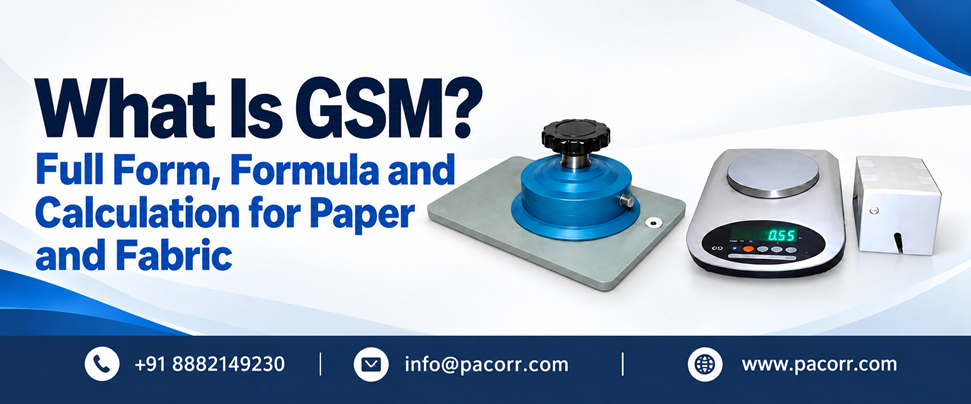
GSM stands for grams per square metre. It measures the mass of a material per unit area and is expressed as g/m². To calculate GSM, divide the sample’s mass in grams by its area in square metres. For a sample measuring exactly 100 cm², multiply its mass in grams by 100.
GSM is used to describe paper, fabric, cardboard and other sheet materials. Manufacturers and quality teams measure it to compare materials, check production consistency and verify whether a batch meets its agreed specification.
A higher GSM means more mass per square metre. It does not automatically mean greater thickness, higher strength or better quality.
What Does GSM Mean in Paper and Fabric?
GSM in paper
In paper testing, GSM is also called grammage. An 80 GSM paper has a mass of 80 grams per square metre.
GSM is different from the weight of an individual sheet. The weight of a sheet depends on both its GSM and its dimensions. Two sheets cut from the same paper can have different weights while retaining the same GSM.
Paper manufacturers, printers and packaging suppliers use grammage to specify materials and compare batches.
GSM in fabric
In textiles, GSM describes the mass of one square metre of fabric. For example, a 200 GSM fabric has a mass of 200 grams per square metre under the relevant measurement conditions.
Fabric GSM helps buyers and manufacturers compare material weight. However, fibre composition, yarn, weave or knit structure, and finishing also influence how the fabric feels and performs.
The meaning of GSM remains the same across materials. The sampling and testing procedures may differ.
What Is the Formula for Calculating GSM?
The basic GSM formula is:
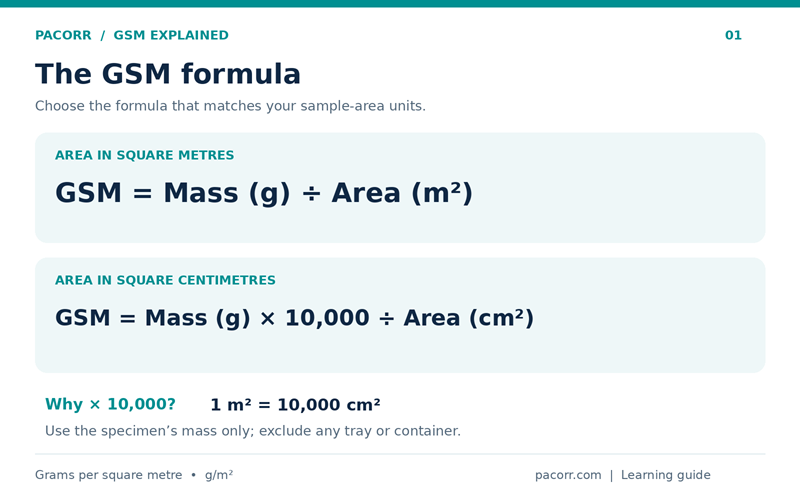
GSM = Sample mass in grams ÷ Sample area in square metres
If you measure the area in square centimetres, use:
GSM = (Sample mass in grams × 10,000) ÷ Sample area in cm²
For a rectangular specimen:
GSM = (Mass in grams × 10,000) ÷ (Length in cm × Width in cm)
The conversion factor comes from:
1 m² = 10,000 cm²
| Available measurements | Formula |
| Mass in grams and area in m² | GSM = Mass ÷ Area |
| Mass in grams and area in cm² | GSM = Mass × 10,000 ÷ Area |
| Mass in grams and rectangular dimensions in cm | GSM = Mass × 10,000 ÷ (Length × Width) |
| Mass of an exactly 100 cm² specimen | GSM = Mass × 100 |
Always use the mass of the specimen itself. Exclude the weight of any container or weighing tray.
How to Calculate GSM of Paper
To calculate paper GSM, weigh a specimen of known area and divide its mass by that area in square metres.
Paper GSM calculation example
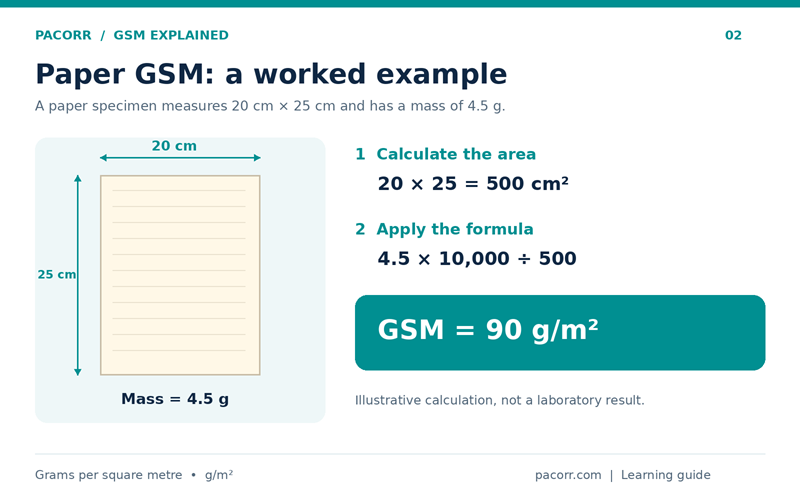
Suppose a paper sample has these measurements:
- Length: 20 cm
- Width: 25 cm
- Mass: 4.5 g
First, calculate the area:
Area = 20 × 25 = 500 cm²
Then apply the formula:
GSM = 4.5 × 10,000 ÷ 500
GSM = 90 g/m²
The paper sample therefore has a grammage of 90 GSM.
This example demonstrates the calculation. Formal acceptance testing also requires appropriate sampling, conditioning and measurement equipment.
How to Calculate GSM of Fabric
Fabric GSM uses the same mass-per-area formula as paper.
Fabric GSM calculation example
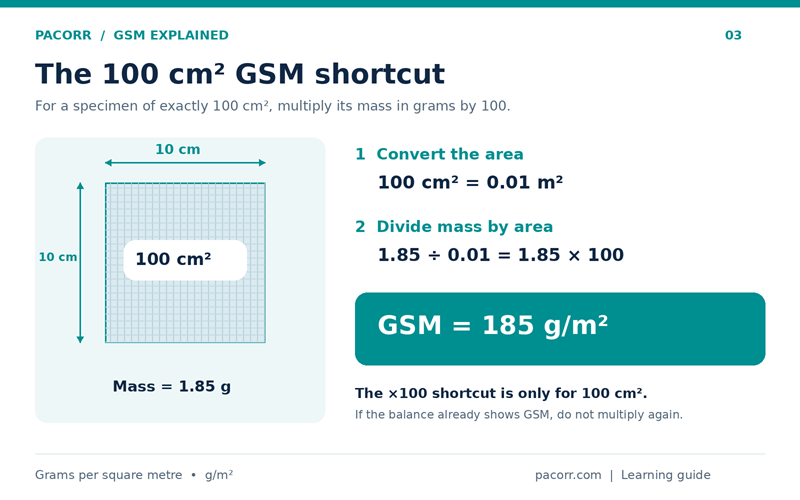
Suppose a fabric specimen measures 10 cm × 10 cm and weighs 1.85 g.
Its area is:
Area = 10 × 10 = 100 cm²
Calculate GSM:
GSM = 1.85 × 10,000 ÷ 100
GSM = 185 g/m²
The fabric therefore has a GSM of 185.
Avoid stretching the fabric while preparing or measuring the specimen. Stretching changes its area and can affect the calculated result.
How to Calculate GSM Without a GSM Cutter
For a basic check, you can use a ruler, a suitable cutting tool and a balance capable of measuring the specimen’s mass reliably.
- Select a representative sample. Choose an undamaged part of the material.
- Cut a rectangular specimen. Avoid stretching, folding or distorting it.
- Measure its actual dimensions. Record the length and width in centimetres.
- Calculate the area. Multiply length by width.
- Weigh the specimen. Zero the balance and record the mass in grams.
- Calculate GSM. Multiply the mass by 10,000 and divide by the area in cm².
A 10 cm × 10 cm specimen provides the convenient 100 cm² shortcut. Other dimensions also work, provided you calculate using the actual area.
For formal quality testing, follow the specimen dimensions and procedure required by the applicable test method or customer specification.
How to Measure GSM Using a Round Cutter and Weighing Balance
A GSM round cutter prepares a specimen of known area. A weighing balance measures its mass. The cutter alone does not measure GSM.
For a cutter verified to produce a 100 cm² specimen, follow these steps:
- Prepare and condition the material according to the selected test method.
- Confirm the cutter’s specimen area and suitability for the material.
- Cut the specimen using the equipment’s operating and safety instructions.
- Check for incomplete cuts, folds, missing fibres or attached scraps.
- Zero the balance and place the specimen on the weighing pan.
- Record the stable mass in grams.
- Multiply the mass by 100 to obtain GSM.
- Repeat testing according to the sampling plan and record the individual results and average.
Example: If a 100 cm² specimen weighs 2.36 g:
GSM = 2.36 × 100 = 236 g/m²
Some balances can display GSM directly. If yours does, confirm that its specimen-area setting is correct. Do not multiply an existing GSM reading by 100 again.
Explore Pacorr’s GSM round cutter with weighing balance and confirm the appropriate configuration for your material and testing requirements.
Why Is the Weight of a 100 cm² Sample Multiplied by 100?
A specimen with an area of 100 cm² covers 0.01 m².
To convert its mass into grams per square metre:
GSM = Mass ÷ 0.01
Dividing by 0.01 is equivalent to multiplying by 100.
This shortcut applies only when the specimen area is exactly 100 cm².
| Specimen area | Mass | Calculation | Result |
| 50 cm² | 0.90 g | 0.90 × 200 | 180 GSM |
| 100 cm² | 1.80 g | 1.80 × 100 | 180 GSM |
| 200 cm² | 3.60 g | 3.60 × 50 | 180 GSM |
These illustrative specimens have different masses but the same GSM because their mass-to-area ratio is equal.
Why Is GSM Important in Quality Control?
GSM helps manufacturers compare material against an agreed mass-per-area specification. It supports incoming inspection, production monitoring and material consumption estimates.
Paper and printing
Paper grammage helps identify the grade specified for a printing or converting job. Measuring it can reveal differences between supplied batches.
However, grammage does not replace checks for thickness, opacity, surface finish or printer compatibility. Papers with equal GSM can perform differently.
Fabric and textiles
Fabric GSM helps monitor material weight between production batches and before or after finishing.
Consistent testing conditions matter because moisture, finishing treatments and specimen distortion can affect the result. Compare measurements taken using the same preparation and testing procedure.
Packaging and corrugated board
GSM helps describe packaging material mass, but it cannot establish packaging strength by itself.
Corrugated board performance also depends on factors such as flute geometry, paper properties, bonding and moisture. Distinguish the GSM of individual liner and fluting papers from the mass per projected area of assembled board.
Fluted paper uses more material length than its projected board length, and adhesive adds mass. Simply adding the nominal GSM of the component papers does not fully describe the assembled board’s grammage.
Use the strength tests required by the packaging specification alongside GSM measurements. Pacorr’s paper and packaging testing instruments support related quality-control applications.
Does Higher GSM Mean Better Quality?
Higher GSM means a heavier material for the same area. It does not automatically mean better quality.
The suitable GSM depends on the application. A lightweight material may be appropriate where flexibility or low mass is important. A heavier material may suit a different construction or appearance.
Quality assessment should consider GSM alongside the performance requirements of the finished product.
Before accepting a material batch, agree on:
- The target GSM.
- The permitted tolerance.
- The sampling and testing method.
- Other required properties, such as strength, thickness or print performance.
What Is the Difference Between GSM and Thickness?
GSM measures mass per unit area. Thickness measures the distance between the material’s surfaces.
| Property | What it measures | Typical unit |
| GSM | Mass per unit area | g/m² |
| Thickness | Distance between surfaces | mm or µm |
| Density | Mass per unit volume | kg/m³ |
Two materials can have the same GSM and different thicknesses because their density, porosity or construction differs.
There is no universal conversion from GSM to thickness. Measure thickness separately when it is part of the product specification.
Common Mistakes That Affect GSM Test Results
Using the wrong specimen area
Multiplying mass by 100 is correct only for a 100 cm² specimen. For other areas, use the general formula.
Stretching or damaging the specimen
Distortion changes the measured area. Incomplete cuts or lost fibres can also affect the result.
Ignoring moisture conditions
Paper and textiles can absorb or release moisture, changing their mass. Follow the conditioning requirements of the applicable method.
Using an unsuitable balance
The balance must be suitable for the specimen mass and required measurement precision.
For a 100 cm² specimen, a mass difference of 0.01 g corresponds to 1 g/m². This illustrates the effect of mass measurement; it is not a statement of overall instrument accuracy or test uncertainty.
Relying on one specimen
A single result may not represent variation across a sheet, roll or batch. Follow the required sampling plan and retain individual readings.
Misreading the balance display
Check whether the displayed value represents grams or GSM. Applying the conversion twice produces an incorrect result.
Which Standards Are Relevant to GSM Testing?
For paper and board, ISO 536 addresses determination of grammage. For fabrics, ASTM D3776/D3776M covers measurement of mass per unit area.
Sampling, preparation, conditioning, apparatus and reporting requirements depend on the applicable method. Use the edition specified by your customer or quality system.
A general calculation guide does not replace the full standard. A cutter and balance must be selected and used as part of an appropriate testing procedure.
Frequently Asked Questions
What is the full form of GSM in paper?
GSM stands for grams per square metre. In paper testing, the property is called grammage and is expressed in g/m².
What does 200 GSM fabric mean?
It means one square metre of the fabric has a mass of 200 grams under the relevant measurement conditions. It does not mean that a finished garment weighs 200 grams.
Can paper and fabric use the same GSM formula?
Yes. For both materials, GSM equals mass in grams divided by area in square metres. Their sampling, conditioning and testing procedures may differ.
How do you calculate sheet weight from GSM?
Multiply GSM by sheet area in square metres:
Sheet mass in grams = GSM × Sheet area in m²
For an A4 sheet measuring 0.210 × 0.297 m:
Area = 0.06237 m²
At 80 GSM:
Sheet mass = 80 × 0.06237 = approximately 4.99 g
This calculated mass excludes any subsequently added printing or other material.
Can GSM be calculated from thickness alone?
No. Thickness alone does not establish mass per unit area. Density and material structure also matter. Weighing a specimen of known area provides a direct GSM measurement.
How do you calculate average GSM?
Add the individual GSM results and divide by the number of specimens.
For example:
Average GSM = (178 + 181 + 181) ÷ 3 = 180 GSM
Keep the individual results because an average can hide variation. Follow the applicable method for the required number and distribution of specimens.
Choose GSM Testing Equipment for Your Material
Reliable GSM measurement depends on a known specimen area, suitable weighing equipment and a consistent testing procedure.
Tell Pacorr which material you test, its expected GSM range and the customer specification or test method you follow.
View the GSM round cutter with weighing balance or contact Pacorr to discuss a suitable testing setup.
Recent Blogs
Enhance your understanding of testing and precise quality control indistinct applications with our
knowledge based articles coming from top editors of industry leaders.


Our USP's
Demonstration of Machine
- Try Before You Decide
- Experience Before You Invest
- See It in Action – Free Demo
Global Reach
- Delivering Excellence Worldwide
- Serving Across Borders
- Your Global Supply Partner
On-Site Support
- Support That Comes to You
- On-Ground Assistance, Anywhere
- We Reach Where You Are
Team Strength
- Powered by Expert Minds
- Driven by Skilled Professionals
- Engineering Excellence Team
Manufacturing
- Precision-Driven Manufacturing
- Smart & Automated Production
- Engineered In-House Excellence
