
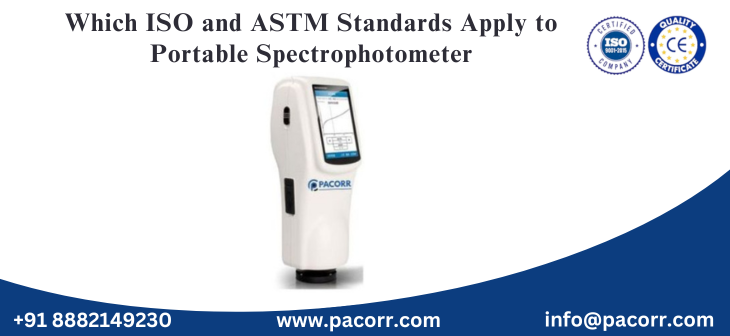
Pacorr’s Portable Spectrophotometer is a sophisticated and indispensable tool for accurate color measurement, quality assurance, and research across multiple industries. With growing demands for product consistency and stringent regulatory compliance, the use of a portable spectrophotometer has become critical for manufacturers, laboratories, and research institutions. As color, gloss, and reflectance measurements can greatly impact the perception and performance of products, ensuring these readings are reliable and consistent is vital. This is precisely where internationally recognized standards like ISO and ASTM come into play. In this blog, we will explore which ISO and ASTM standards apply to Portable Spectrophotometer and how adhering to these guidelines enhances trust, efficiency, and global acceptance of test results.
Understanding Portable Spectrophotometer Technology
A Portable Spectrophotometer by Pacorr offers cutting-edge optical technology in a compact, lightweight device, making it ideal for on-site analysis and fieldwork. It measures the intensity of light as a function of color or wavelength reflected from or transmitted through a sample. Such devices are designed for accurate and repeatable measurement of color in plastics, paints, textiles, paper, food, pharmaceuticals, and many other sectors. Its portability allows quality professionals to bring laboratory-grade precision directly to the production floor or even to external sites, ensuring real-time quality control.
The increasing demand for reliable color quality and the drive for global standardization require that such equipment complies with specific ISO and ASTM standards for both instrument design and testing procedures. Using a Pacorr Portable Spectrophotometer that aligns with these standards not only ensures accuracy but also supports the credibility of your quality management system.
Why International Standards Matter in Spectrophotometry
For industries dealing with products where color accuracy is essential, such as automotive, coatings, packaging, plastics, textiles, and food processing, the use of internationally recognized standards is not optional but mandatory. ISO and ASTM standards are the most widely respected globally, setting the benchmark for test methods, calibration protocols, and reporting requirements.
Adhering to these standards guarantees the reliability, repeatability, and comparability of results—regardless of where the tests are performed. For manufacturers using a Pacorr Portable Spectrophotometer, understanding which ISO and ASTM standards apply to Portable Spectrophotometer is the foundation for regulatory compliance, customer trust, and market access.
Key ISO Standards for Portable Spectrophotometer
Several ISO standards are relevant to the use and calibration of portable spectrophotometers. Below are the most critical ones:
ISO 7724 Series (Paints and Varnishes - Color Measurement):
- ISO 7724-1: Specifies general principles for color measurement of paints and varnishes, including instrumental geometry and light source.
- ISO 7724-2: Focuses on the calculation of color differences, a key parameter in quality control using portable spectrophotometers.
- ISO 7724-3: Describes the calculation of color differences from instrument readings, essential for product consistency.
ISO 11664 Series (Colorimetry):
- ISO 11664-1: Establishes fundamental definitions and methods for colorimetric measurement.
- ISO 11664-2: Covers standard illuminants for color measurement, crucial for portable spectrophotometer calibration.
- ISO 11664-3: Details CIE tristimulus values and chromaticity diagrams—essential calculations in spectrophotometry.
- ISO 11664-4: Discusses color spaces and color difference equations relevant to industrial color measurement.
ISO 15076 (Color Management – ICC Profile Format):
- Ensures standardized color management workflows and file compatibility, which is vital when integrating data from a Pacorr Portable Spectrophotometer into digital systems.
ISO 2469 (Paper, Board and Pulps – Measurement of Diffuse Radiance Factor):
- Relevant for paper and packaging industries, this standard specifies methods for measuring optical properties using a spectrophotometer.
ISO 105-A05 (Textiles – Tests for Color Fastness):
- Sets guidelines for instrument calibration and performance verification in textile applications, making it an important standard for users of portable spectrophotometers in the fabric industry.
Other Noteworthy ISO Standards:
- ISO 15798 (Ophthalmic Implants): Focuses on colorimetry in medical applications.
- ISO 18314-1 (Analytical colorimetry): Provides principles and procedures for evaluating color characteristics, widely used across various sectors.
ASTM Standards Relevant to Portable Spectrophotometer
The American Society for Testing and Materials (ASTM) has established comprehensive standards specifically for color and appearance measurement. Here are some that are particularly relevant for portable spectrophotometer users:
ASTM E308 (Practice for Computing the Colors of Objects by Using the CIE System):
- This practice standard describes the methods for computing the color of objects from spectral data, forming the backbone of modern spectrophotometric color evaluation.
ASTM E1164 (Practice for Obtaining Spectrometric Data for Object-Color Evaluation):
- It provides detailed instructions for acquiring spectral reflectance or transmittance data, the most common measurement performed by portable spectrophotometers.
ASTM D2244 (Practice for Calculation of Color Tolerances and Color Differences):
- Defines how to calculate and interpret color differences, a vital process for color quality control in manufacturing and research.
ASTM D523 (Test Method for Specular Gloss):
- Used in conjunction with spectrophotometers to assess gloss characteristics alongside color.
ASTM D1003 (Test Method for Haze and Luminous Transmittance of Transparent Plastics):
- While primarily for haze, this test often requires spectrophotometric evaluation.
ASTM E1331 (Test Method for Reflectance Factor and Color by Spectrophotometry Using Hemispherical Geometry):
- Specifies methods for measuring reflectance and color, essential for comparing samples across different production runs.
ASTM E1347 (Test Method for Color and Color Difference Measurement by Tristimulus Colorimetry):
- While focused on colorimeters, many principles overlap with spectrophotometry, especially for portable devices.
ASTM E179 (Guide for Selection of Geometric Conditions for Measurement of Reflection and Transmission Properties of Materials):
- Outlines geometry best practices for spectrophotometric measurement setups.
Selecting the Right Portable Spectrophotometer for Standardized Color Measurement
When choosing a portable spectrophotometer, it is important to ensure that the device can support the ISO and ASTM standards relevant to your specific application. Pacorr Portable Spectrophotometer is engineered to deliver compliance-ready performance, offering features such as:
- Multiple measurement geometries (45°/0°, d/8°, etc.) as required by international standards.
- Standard and customizable illuminants.
- Compatibility with widely accepted color spaces (CIE Lab, CIE LCH, Hunter Lab, etc.).
- Calibration protocols that align with ISO and ASTM requirements.
- Traceable calibration standards and detailed documentation for audit readiness.
With Pacorr’s commitment to precision, innovation, and customer support, organizations can confidently use their portable spectrophotometer for both R&D and quality control, knowing their results will meet the strictest global standards.
Benefits of Using Pacorr Portable Spectrophotometer in Compliance with ISO and ASTM Standards
- Global Recognition: Results are universally accepted by regulatory bodies and customers worldwide.
- Enhanced Credibility: Certification to ISO and ASTM standards supports claims of product quality and consistency.
- Efficient Audits: Documentation and traceability simplify regulatory or customer audits.
- Reduced Risk: Compliance minimizes risk of rejection, rework, or recalls due to color discrepancies.
- Competitive Advantage: Demonstrates a commitment to quality that differentiates your brand in a crowded market.
Practical Applications and Industry Use Cases
Pacorr Portable Spectrophotometer finds applications in a wide array of industries, each benefiting from adherence to international standards:
- Automotive: Consistent color matching for paints, coatings, and interiors.
- Plastics: Ensuring batch-to-batch color uniformity in masterbatch production.
- Textiles: Verifying dye lot consistency and compliance with fastness standards.
- Printing and Packaging: Accurate color reproduction on paper, board, and films.
- Pharmaceuticals: Quality control for tablet coatings and packaging.
- Food Industry: Monitoring color in processed foods for quality and appeal.
By following ISO and ASTM standards, industries can avoid costly disputes and ensure smooth supply chain operations.
Conclusion: Why Compliance Matters for Pacorr Portable Spectrophotometer Users
The importance of which ISO and ASTM standards apply to Portable Spectrophotometer cannot be overstated. Pacorr’s Portable Spectrophotometer is designed to help industries achieve accurate, consistent, and globally recognized color measurement. By using a device that supports and complies with leading ISO and ASTM standards, you not only ensure regulatory compliance but also foster trust, efficiency, and product excellence. Whether your goal is to improve product quality, streamline audits, or expand into new markets, leveraging a standards-compliant spectrophotometer from Pacorr is a step toward guaranteed success.
Recent Blogs
Enhance your understanding of testing and precise quality control indistinct applications with our
knowledge based articles coming from top editors of industry leaders.
Thanks to Pacorr Testing instruments, we have all the required quality testing instruments that have helped us to ensure the best quality delivered to our clients.

Danish
Fair Exports Pvt. Ltd.
