
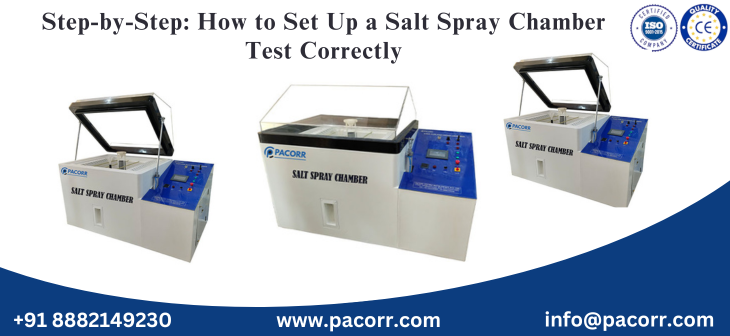
Pacorr offers advanced testing instruments designed to help manufacturers maintain product quality, durability, and compliance across demanding industrial environments. Among these instruments, the salt spray chamber plays a critical role in evaluating corrosion resistance for metals, coatings, plated components, automotive parts, packaging materials, and engineered products exposed to aggressive environments.
A properly configured Salt Spray Test Chamber is essential for generating reliable and repeatable corrosion data. Even a high-quality Salt Fog Chamber can produce misleading results if the test solution is mixed incorrectly, specimen placement is poor, chamber temperature is unstable, or collection rates are not verified. For quality managers, R&D teams, and production engineers, understanding the correct setup procedure is just as important as selecting the right Corrosion Test Chamber.
This guide explains, step by step, how to set up a Salt Mist Chamber correctly, why each stage matters, and how to avoid the most common mistakes that affect test accuracy.
What is Salt Spray Chamber
A salt spray chamber is a laboratory testing instrument used to simulate corrosive environmental conditions in a controlled way. It creates a fine mist of salt solution inside an enclosed chamber to accelerate corrosion on test specimens. This allows manufacturers to assess the corrosion resistance of metals, coatings, plated parts, paints, fasteners, and surface-treated products in a shorter time than real-world exposure testing.
A Salt Spray Test Chamber is also known by related names such as:
- Salt Fog Chamber
- Corrosion Test Chamber
- Salt Mist Chamber
- Salt spray tester
- Corrosion resistance testing chamber
The purpose of the test is not to reproduce every exact field condition. Instead, it provides a standardized accelerated method to compare materials, verify coating performance, support supplier qualification, and validate product durability.
Most salt spray testing follows widely recognized standards such as ASTM B117, ISO 9227, JIS Z 2371, or customer-specific testing requirements. These standards define factors such as solution concentration, pH range, chamber temperature, spray collection rate, and specimen positioning.
Importance of Salt Spray Chamber in Quality Testing
Corrosion can lead to product failure, safety issues, aesthetic damage, customer complaints, and warranty losses. In industries where metal parts or coated components are exposed to humidity, marine air, chemicals, or outdoor weather, corrosion testing becomes a critical part of quality assurance.
A salt spray chamber helps companies:
- Evaluate coating performance before product launch
- Compare different materials or surface treatments
- Check plating quality and paint adhesion
- Support supplier approval and incoming quality checks
- Reduce the risk of premature field failure
- Improve product design and protective finishes
- Meet industry specifications and compliance standards
For packaging and manufacturing industries, corrosion resistance matters more than many businesses realize. Metal closures, fasteners, tools, equipment parts, structural hardware, and machine components all need reliable performance over time. A well-operated Salt Spray Test Chamber provides actionable data that helps engineers make better decisions.
Why correct setup matters
Improper setup can cause:
- Non-uniform salt deposition
- Inconsistent corrosion rates
- False pass or fail results
- Poor repeatability between batches
- Test data that does not align with standards
That is why every step-from solution preparation to specimen loading-must be controlled carefully inside the Corrosion Test Chamber.
Key Features of Salt Spray Chamber
A modern salt spray chamber is designed to create a stable and repeatable corrosive environment. While features vary by model, a high-quality Salt Fog Chamber typically includes the following:
- Corrosion-resistant chamber body
- Precision temperature control system
- Atomizing nozzle for fine salt mist generation
- Solution reservoir for saltwater mixture
- Air saturation system for humidified compressed air
- Specimen support racks with proper angle positioning
- Collection funnels and measuring cylinders
- Digital timer and control panel
- Transparent viewing window
- Safety and drainage systems
Important technical capabilities
When evaluating a Salt Mist Chamber, look for these performance-oriented features:
- Uniform fog distribution across the chamber
- Stable internal chamber temperature
- Easy pH and solution monitoring
- Accurate spray rate control
- Durable construction for long-term testing
- User-friendly controls for test programming
- Low-maintenance design for routine lab use
These features directly influence test reliability, operator convenience, and compliance with corrosion testing standards.
Working Principle of Salt Spray Chamber
The working principle of a salt spray chamber is based on accelerated corrosion exposure. A prepared salt solution-typically sodium chloride dissolved in purified water-is atomized into a fine fog using compressed air. This salt mist fills the chamber and settles on the surface of test specimens.
Inside the Salt Spray Test Chamber, the environment is controlled to maintain the required temperature and exposure conditions. Over time, corrosion products begin to appear on the samples. Engineers then evaluate the specimens for rusting, blistering, pitting, coating breakdown, or substrate attack based on the test standard and product requirement.
Basic process inside a Salt Fog Chamber
- Salt solution is prepared to the specified concentration.
- Compressed air is saturated and conditioned.
- The nozzle atomizes the solution into fine droplets.
- Salt fog circulates uniformly within the chamber.
- Test specimens remain exposed for a defined duration.
- Corrosion development is assessed visually or by rating methods.
The Corrosion Test Chamber does not simply spray saltwater on parts. It creates a controlled, repeatable environment where corrosion resistance can be compared objectively.
Step-by-Step: How to Set Up a Salt Spray Chamber Test Correctly
Setting up a salt spray chamber correctly requires discipline and attention to detail. The following step-by-step method can help laboratories achieve more accurate and repeatable results.
1. Review the applicable test standard
Before starting the Salt Spray Test Chamber, identify the correct standard or customer specification. This will determine:
- Salt concentration
- pH range
- Chamber temperature
- Test duration
- Specimen angle
- Collection rate
- Evaluation criteria
Never assume all salt spray tests use the same settings. ASTM, ISO, OEM, and internal protocols may differ.
2. Inspect and clean the chamber
Before every test, inspect the Salt Fog Chamber to ensure it is clean and free from contamination.
Check the following:
- Chamber interior is washed and residue-free
- Nozzle is clean and unobstructed
- Collection funnels are clean
- Reservoir and tubing are free from old deposits
- Air regulator and saturation system are functioning correctly
- Drain lines are open and not blocked
Any leftover contamination can alter corrosion behavior and compromise test validity.
3. Prepare the salt solution accurately
This is one of the most critical steps in setting up a Corrosion Test Chamber.
In most neutral salt spray tests, the solution is made by dissolving sodium chloride in purified or deionized water. Use high-purity salt and clean water only. Impurities can cause abnormal corrosion patterns and unreliable results.
Key checkpoints:
- Measure salt concentration carefully
- Mix until fully dissolved
- Filter the solution if required
- Confirm pH is within the required range
- Use freshly prepared solution when possible
Do not use tap water or industrial-grade salt unless the standard explicitly permits it.
4. Verify compressed air quality
A Salt Mist Chamber depends on clean, regulated compressed air for atomization. Air supply problems often lead to unstable fog generation.
Ensure:
- Air is oil-free and dry before conditioning
- Pressure is set as recommended by the instrument manufacturer
- Saturator system is working properly
- No pressure fluctuation occurs during testing
Poor air quality can change droplet size and spray distribution, which affects the deposition rate on specimens.
Contact Pacorr for the Right Testing Solution
If your lab needs a dependable salt spray chamber for corrosion resistance evaluation, Pacorr can help you select the right model for your industry and testing standard. Whether you need a Salt Spray Test Chamber for metal components, coated parts, packaging hardware, or automotive products, our team can guide you with the right solution.
Email: info@pacorr.com
Phone: +91 8882149230
5. Set the chamber temperature
The chamber temperature must match the specified test requirement. Neutral salt spray testing often uses a controlled chamber condition, and temperature stability is essential for reproducibility.
Before loading specimens:
- Switch on the chamber
- Allow it to reach the set temperature
- Confirm the display matches the actual condition
- Let the system stabilize before starting exposure
Inconsistent temperature changes corrosion behavior and makes comparison between tests difficult.
6. Arrange test specimens properly
Correct specimen placement is essential in any Salt Fog Chamber. Samples should be mounted so that the fog can settle naturally without pooling or shielding.
Best practices include:
- Position specimens at the specified angle
- Avoid contact between samples
- Prevent dripping from one sample onto another
- Keep specimens away from chamber walls if required
- Ensure labels or markings do not interfere with exposure surfaces
Improper loading is one of the most common causes of inconsistent results in a Salt Mist Chamber.
7. Place collection funnels and measuring cylinders
Spray collection rate is a key control parameter. Collection devices help verify whether the Corrosion Test Chamber is generating the correct volume of fog over time.
Make sure:
- Funnels are placed in designated locations
- Collection points are not blocked by specimens
- Measuring cylinders are clean and readable
- Collection is checked over the standard time interval
This step confirms that the chamber is not under-spraying or over-spraying.
8. Start the chamber and stabilize fog generation
Once the solution, temperature, air pressure, and specimen loading are ready, start the salt spray chamber and allow the fog to stabilize.
Observe:
- Fine and uniform mist generation
- No nozzle sputtering
- No visible liquid dripping directly onto samples
- Stable chamber conditions
The test should only begin officially after stable operating conditions are achieved.
9. Monitor during the test
A Salt Spray Test Chamber should not be treated as a run-and-forget instrument. During long exposure periods, routine monitoring is necessary.
Check at defined intervals:
- Solution level
- Chamber temperature
- Air pressure
- Fog generation
- Collection rate
- pH stability if applicable
- Water supply for saturator or humidification systems
Opening the chamber unnecessarily should be avoided, because it disturbs the internal environment.
10. End the test and evaluate specimens correctly
At the end of the exposure time, remove the specimens carefully and evaluate them according to the relevant standard or customer criteria.
Depending on the requirement, evaluation may include:
- Visual appearance
- Percentage of rust
- Blistering or coating failure
- Pitting corrosion
- Corrosion creep from scribe lines
- Photographic documentation
- Rating scale comparison
Some standards specify rinsing or drying procedures before evaluation, so always follow the correct method.
Applications of Salt Spray Chamber in Different Industries
The salt spray chamber is widely used across industries where corrosion resistance affects performance, reliability, and brand reputation.
Automotive industry
Automotive manufacturers use Salt Spray Test Chamber systems to test:
- Fasteners
- Brake components
- Painted panels
- Plated fittings
- Underbody parts
- Connectors and metal brackets
Packaging industry
In packaging and allied manufacturing, corrosion testing is relevant for:
- Metal closures
- Tin containers
- Aerosol cans
- Caps and fittings
- Coated packaging hardware
- Storage and handling equipment
Electronics and electrical industry
A Salt Fog Chamber helps test:
- Connectors
- Terminals
- Plated contacts
- Enclosures
- Hardware assemblies
Construction and infrastructure
Construction-related applications include:
- Coated steel components
- Hardware
- Hinges
- Locks
- Fasteners
- Protective finishes
Marine and industrial equipment
Because marine and coastal environments are highly corrosive, a Corrosion Test Chamber is important for:
- Marine fittings
- Outdoor equipment
- Industrial machinery parts
- Surface-treated structural components
Aerospace and defense suppliers
High-performance materials and coatings are screened for corrosion resistance before approval for demanding service conditions.
How to Choose the Right Salt Spray Chamber
Choosing the right salt spray chamber depends on more than chamber size. The best instrument should match your testing volume, standards, product types, and quality expectations.
Key selection factors
Chamber capacity
Choose a size based on the dimensions and number of samples you test regularly.
Standard compatibility
Ensure the Salt Spray Test Chamber supports the methods your customers or certification bodies require.
Control accuracy
Reliable temperature, spray rate, and pressure control improve repeatability.
Build quality
A durable Salt Fog Chamber should resist internal corrosion and provide long-term laboratory performance.
Ease of maintenance
Look for accessible nozzles, drains, reservoirs, and control systems.
Data and usability
Digital controls, timers, and user-friendly operation can improve lab efficiency and reduce operator error.
Service and support
Local technical support, installation guidance, and calibration assistance are important when investing in a Corrosion Test Chamber.
Questions to ask before buying
- What standards do I need to comply with?
- What sample size and throughput do I have?
- Do I need neutral salt spray only, or more advanced cyclic corrosion capability?
- How easy is the instrument to maintain?
- Does the supplier provide training and after-sales support?
Why Choose Pacorr for Salt Spray Chamber
Pacorr is known for providing reliable quality testing instruments that support modern manufacturing and packaging operations. When businesses invest in a salt spray chamber, they need more than equipment-they need dependable performance, technical guidance, and confidence in the test results.
What makes Pacorr a trusted choice
- Precision-engineered testing instruments
- User-friendly and robust machine design
- Consistent performance for corrosion testing applications
- Support for quality labs across manufacturing sectors
- Focus on accuracy, durability, and operational ease
- Solutions tailored to industrial testing needs
A Pacorr Salt Spray Test Chamber is designed to help quality teams evaluate corrosion resistance with better confidence and process control. From lab setup to routine use, Pacorr supports customers with practical testing solutions that align with industry needs.
Practical value for manufacturers
When you choose a Pacorr Salt Fog Chamber, you gain:
- Better test repeatability
- Improved quality validation
- Faster decision-making in material and coating selection
- Stronger confidence in product durability
- Dependable support for inspection and R&D teams
Conclusion
A salt spray chamber is one of the most valuable instruments for accelerated corrosion testing, but its effectiveness depends heavily on proper setup. From selecting the correct standard to preparing the salt solution, regulating air pressure, positioning specimens, verifying collection rate, and monitoring test conditions, each step has a direct impact on result quality.
A well-operated Salt Spray Test Chamber, Salt Fog Chamber, Corrosion Test Chamber, or Salt Mist Chamber helps manufacturers reduce product risk, improve coating performance, and maintain higher quality standards. For packaging, automotive, engineering, electronics, and industrial manufacturers, accurate corrosion testing is not optional-it is a core part of product reliability.
If you are looking for a high-performance salt spray chamber backed by expert support, connect with Pacorr today.
Email: info@pacorr.com
Phone: +91 8882149230
Frequently Asked Questions
1. What is a salt spray chamber used for?
A salt spray chamber is used to test the corrosion resistance of metals, coatings, plated parts, and treated surfaces by exposing them to a controlled salt fog environment.
2. How does a Salt Spray Test Chamber work?
A Salt Spray Test Chamber atomizes a prepared salt solution into a fine mist using compressed air. The fog settles on test specimens under controlled temperature conditions to accelerate corrosion.
3. What is the difference between a Salt Fog Chamber and a Salt Mist Chamber?
In most industrial usage, Salt Fog Chamber and Salt Mist Chamber refer to the same type of corrosion testing equipment. The terminology may vary by manufacturer or region.
4. Why is specimen placement important in a Corrosion Test Chamber?
Specimen placement affects how salt deposits on the surface. Incorrect positioning can cause dripping, shielding, or uneven exposure, which leads to unreliable corrosion test results.
5. What solution is used in a salt spray chamber?
Most standard tests use a sodium chloride solution prepared with purified or deionized water. The exact concentration and pH depend on the test standard being followed.
6. How long does a salt spray test usually take?
Test duration depends on the product specification and standard. Some tests run for 24 hours, while others continue for several hundred or even thousands of hours.
7. Which industries use Salt Spray Test Chambers?
Industries that commonly use Salt Spray Test Chambers include automotive, packaging, electronics, construction, marine, metal finishing, and industrial manufacturing.
8. How do I choose the right salt spray chamber for my lab?
Choose a salt spray chamber based on chamber size, compliance standards, control accuracy, durability, ease of maintenance, and the supplier’s service support.
9. Can a salt spray chamber predict real outdoor corrosion exactly?
No. A salt spray chamber provides accelerated comparative testing under controlled conditions. It is highly useful for quality control and material comparison, but it does not replicate every real-world environment exactly.
10. Why should I choose Pacorr for a Salt Spray Chamber?
Pacorr offers dependable testing instruments, practical industry support, and quality-focused solutions designed for manufacturers that need accurate and repeatable corrosion testing.
Recent Blogs
Enhance your understanding of testing and precise quality control indistinct applications with our
knowledge based articles coming from top editors of industry leaders.
Thanks to Pacorr Testing instruments, we have all the required quality testing instruments that have helped us to ensure the best quality delivered to our clients.

Danish
Fair Exports Pvt. Ltd.
