
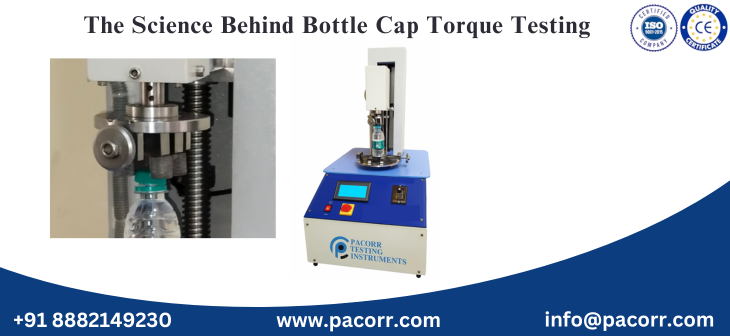
Pacorr has long recognized that packaging quality is not defined solely by materials or visual appeal, but by how reliably a product is sealed and how consistently it performs throughout storage, transport, and end use. One of the most critical yet often underestimated parameters in packaging performance is cap torque. Incorrect torque can lead to leakage, contamination, customer dissatisfaction, and regulatory issues. This is why bottle cap torque testing plays a vital role in modern quality control systems.
This article explores the science behind bottle cap torque testing, explaining how torque behaves mechanically, why it changes over time, and how a Bottle Cap Torque Tester helps manufacturers achieve controlled, repeatable, and consumer-friendly packaging.
What Is a Bottle Cap Torque Tester
A Bottle Cap Torque Tester is a precision testing instrument used to measure the rotational force required to apply or remove a screw cap from a bottle or container. Torque is the force that causes rotational movement and is a key indicator of sealing performance.
In packaging applications, torque is measured to ensure that caps are applied within a defined range that provides adequate sealing without compromising usability.
Two torque values are typically evaluated:
- Application torque, measured during cap tightening
- Removal torque, measured during cap opening
Both measurements are essential for maintaining packaging consistency and performance.
Why Bottle Cap Torque Testing Is Essential
Seal Integrity and Leakage Prevention
If a cap is applied with insufficient torque, the seal may fail during transportation or storage, especially under temperature and pressure variations. Excessive torque, on the other hand, can damage threads, deform liners, or cause stress cracking in plastic caps. Torque testing ensures the cap performs its sealing function reliably without causing structural damage.
Consumer Usability and Brand Perception
Consumers expect bottles to open easily while remaining secure. Over-tightened caps are a common source of frustration and complaints. Torque testing allows manufacturers to balance safety and ease of opening, directly influencing customer satisfaction and brand trust.
Regulatory and Quality Compliance
Industries such as pharmaceuticals, food and beverages, and cosmetics operate under strict quality regulations. Torque testing records provide documented evidence of process control and are frequently reviewed during quality audits.
The Science Behind Bottle Cap Torque Testing
Friction and Thread Interaction
Torque is directly influenced by friction between the cap threads and the bottle neck finish. Material composition, surface roughness, thread geometry, and liner properties all affect friction levels. Higher friction results in higher torque for the same applied force, making material selection and consistency critical.
Material Deformation and Elastic Behavior
During tightening, plastic caps and liners undergo elastic deformation. This deformation generates the sealing pressure required to prevent leaks. However, excessive deformation can lead to permanent damage, reduced torque retention, and inconsistent sealing performance.
Torque Relaxation Over Time
Torque relaxation is a natural and unavoidable phenomenon. After cap application, torque values gradually decrease due to liner compression, plastic stress relaxation, and environmental factors. As a result, the torque measured immediately after capping is higher than the torque experienced by the consumer. For this reason, delayed torque testing, often after 24 hours, is considered a best practice.
Types of Bottle Cap Torque Testers
Manual Bottle Cap Torque Testers
Manual torque testers are commonly used in laboratories and low-volume production environments. They are simple and cost-effective but depend heavily on operator technique, which can affect repeatability and accuracy.
Digital Bottle Cap Torque Testers
Digital torque testers provide higher precision, automatic peak torque detection, and data recording capabilities. They are widely used in quality control laboratories and production facilities where accuracy, traceability, and consistency are required.
Motorized Torque Testers
Motorized torque testers automate the testing process, reducing operator influence and improving repeatability. These systems are ideal for high-volume production and validation environments.
Standard Bottle Cap Torque Testing Procedure
A typical torque testing procedure involves:
- Securing the bottle firmly on the tester base
- Applying or removing the cap at a controlled, consistent speed
- Measuring the peak torque at the point of cap movement
- Recording the result and comparing it with predefined specifications
- Analyzing trends across multiple samples
Maintaining consistent testing conditions such as temperature, handling method, and timing is essential for reliable results.
Determining the Ideal Torque Range
There is no universal torque value suitable for all packaging applications. Ideal torque depends on factors such as cap size, cap and bottle material, liner type, product viscosity, and distribution conditions. Manufacturers typically establish acceptable torque ranges through validation testing, leakage studies, and consumer usability trials.
Common Mistakes in Bottle Cap Torque Testing
Common issues observed in packaging operations include:
- Measuring torque only immediately after capping
- Ignoring torque relaxation effects
- Infrequent calibration of torque testers
- Inconsistent testing techniques across operators
- Assuming higher torque always improves seal quality
Avoiding these mistakes significantly improves packaging reliability and consistency.
Best Practices for Accurate Torque Testing
- Measure both application and removal torque
- Perform torque testing after defined time intervals
- Maintain calibration and verification records
- Standardize testing procedures across teams
- Revalidate torque settings after changes in cap or bottle suppliers
These practices enable manufacturers to move from basic inspection to data-driven packaging optimization.
Frequently Asked Questions
What is bottle cap torque testing
Bottle cap torque testing measures the rotational force required to apply or remove a bottle cap to ensure sealing performance and consumer usability.
Why does torque decrease after cap application
Torque decreases due to liner compression and stress relaxation in plastic components over time.
How often should a bottle cap torque tester be calibrated
Calibration is generally recommended every six to twelve months or according to quality system requirements.
Are digital torque testers more accurate than manual testers
Digital torque testers offer higher accuracy, better repeatability, and improved data traceability compared to manual testers.
Conclusion
Bottle cap torque testing is a critical quality control activity that directly affects product safety, customer satisfaction, and regulatory compliance. By using a reliable Bottle Cap Torque Tester and understanding the scientific principles behind torque behavior, manufacturers can reduce packaging failures and ensure consistent sealing performance.
Pacorr continues to support packaging professionals by providing accurate testing solutions that help maintain high standards of quality and reliability.
Recent Blogs
Enhance your understanding of testing and precise quality control indistinct applications with our
knowledge based articles coming from top editors of industry leaders.
Thanks to Pacorr Testing instruments, we have all the required quality testing instruments that have helped us to ensure the best quality delivered to our clients.

Danish
Fair Exports Pvt. Ltd.
