
Pacorr is a globally recognized brand in the field of packaging and material testing instruments, offering precision-driven solutions that help manufacturers meet stringent quality and regulatory requirements. In today’s highly competitive and compliance-focused packaging environment, even a minor defect in bottle closure can result in product recalls, safety risks, and reputational damage. One of the most reliable and widely accepted methods to ensure the performance and integrity of bottle caps is torque testing. This testing process plays a foundational role in guaranteeing sealing efficiency, product protection, consumer convenience, and regulatory conformity across multiple industries.
What Is Torque Testing? – A Technical Overview
Torque testing is a quantitative method used to measure the rotational force applied to or required to remove a bottle cap or closure. In technical terms, torque is the product of force and the distance from the axis of rotation, and it directly influences how securely a cap seals a container.
There are two primary torque parameters evaluated during testing:
- Application Torque: The rotational force applied when the cap is initially tightened during the capping process
- Removal Torque: The force required to open the cap after sealing, typically measured at different stages of the product lifecycle
Both values are critically important. Application torque ensures proper sealing, while removal torque ensures that the package remains user-friendly without compromising safety.
Torque values are measured using calibrated torque testing instruments and are typically expressed in Newton-meters (Nm), inch-pounds (in-lb), or kilogram-force centimeters (kgf-cm) depending on industry standards and regional practices.
Why Torque Testing Is Critical for Bottle Caps
1. Seal Integrity and Product Protection
The primary function of a bottle cap is to create a secure seal that protects the product from external contaminants such as oxygen, moisture, dust, and microorganisms. Incorrect torque application can compromise seal integrity, leading to oxidation, microbial growth, or chemical degradation-especially in food, beverage, and pharmaceutical products.
Torque testing ensures that the applied torque falls within a validated range that maintains seal integrity throughout storage, transportation, and shelf life.
2. Leakage Prevention During Distribution
Products are exposed to vibration, pressure changes, stacking loads, and temperature fluctuations during logistics. Under-torqued caps are highly susceptible to loosening under these conditions, causing leakage and product loss. Torque testing verifies that closures can withstand real-world distribution stresses without failure.
3. Consumer Safety and Usability
From a human-factors perspective, removal torque is just as critical as sealing torque. Excessively high removal torque can lead to:
- Consumer frustration
- Risk of injury (especially for elderly users)
- Damage to tamper-evident features
Torque testing helps manufacturers achieve ergonomic packaging design, ensuring accessibility without compromising safety or tamper resistance.
4. Consistency in Automated Production Lines
High-speed bottling lines rely on automated capping machines. Over time, factors such as worn chuck heads, misalignment, or inconsistent cap materials can cause torque variation. Routine torque testing allows manufacturers to monitor process capability and maintain consistency across large production volumes.
5. Regulatory and Quality Compliance
Torque testing is not only a quality practice but also a compliance requirement in many regulated industries. Documented torque data supports audits, certifications, and traceability demanded by regulatory authorities.
International Standards Governing Torque Testing
Torque testing procedures and acceptance criteria are guided by globally recognized standards, including:
- ASTM International
- ASTM D2063 – Standard Test Methods for Measurement of Torque Retention for Packages with Continuous Thread Closures
- ASTM D3198 – Application and Removal Torque of Threaded or Lug-Style Closures
- ISO
- ISO 7500 / ISO 6789 – Guidelines related to torque measurement accuracy and calibration
- FDA
- Requires validated packaging systems for pharmaceuticals and food-contact materials
- USP
- Provides packaging performance expectations for pharmaceutical containers
Compliance with these standards ensures that torque testing results are repeatable, reliable, and legally defensible.
How Torque Testing Is Performed
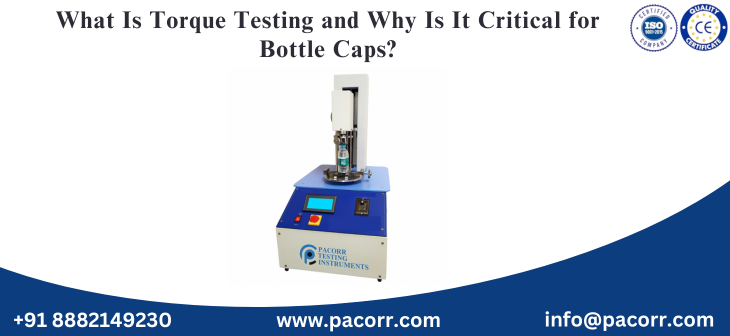
Torque testing is conducted using a digital or manual torque tester. The container is held firmly in place while the closure is rotated until it loosens (removal torque) or reaches a defined tightening point (application torque). Advanced digital torque testers automatically record peak torque values with high accuracy.
Modern torque testers from Pacorr offer:
- Digital peak-hold measurement
- High-resolution sensors for repeatability
- Data logging and statistical analysis support
- Calibration traceability as per ISO and ASTM requirements
These features allow seamless integration into quality assurance and statistical process control (SPC) systems.
Industries That Depend on Torque Testing
Food and Beverage
Maintains carbonation, prevents spoilage, and ensures hygiene for bottled drinks, sauces, and oils.
Pharmaceuticals
Critical for child-resistant closures, tamper-evident seals, and sterility assurance.
Cosmetics and Personal Care
Prevents leakage of lotions, creams, and serums while maintaining premium user experience.
Chemical and Industrial Packaging
Ensures safe containment of hazardous or volatile substances.
Common Packaging Issues Identified Through Torque Testing
Torque testing helps detect:
- Over-torquing leading to cap or neck deformation
- Under-torquing causing leakage and seal failure
- Torque decay over time due to liner relaxation
- Variability caused by inconsistent cap or bottle materials
Early detection minimizes scrap, rework, and customer complaints.
Advantages of Pacorr Torque Testing Instruments
Pacorr designs torque testers with a focus on precision, durability, and compliance. Key advantages include:
- Exceptional measurement accuracy
- Long-term mechanical stability
- User-friendly interfaces
- Compliance with ASTM, ISO, and FDA expectations
By implementing Pacorr torque testing solutions, manufacturers gain confidence in packaging reliability and regulatory readiness.
Torque Testing as Part of a Robust Quality System
Torque testing should not be treated as a one-time inspection but as an integral part of a comprehensive quality management system. When combined with other packaging tests such as leakage testing, compression testing, and seal integrity evaluation, torque testing ensures end-to-end packaging performance.
Conclusion
Torque testing is a scientifically grounded, standards-driven process that directly impacts product safety, shelf life, consumer satisfaction, and regulatory compliance. For bottle caps, where even minor deviations can cause major consequences, torque testing is not optional-it is essential.
With advanced testing technologies and deep industry expertise, Pacorr continues to support manufacturers in achieving consistent, compliant, and high-performance packaging solutions. Investing in accurate torque testing is an investment in product integrity, brand reputation, and long-term success.
Recent Blogs
Enhance your understanding of testing and precise quality control indistinct applications with our
knowledge based articles coming from top editors of industry leaders.
Thanks to Pacorr Testing instruments, we have all the required quality testing instruments that have helped us to ensure the best quality delivered to our clients.

Danish
Fair Exports Pvt. Ltd.
