
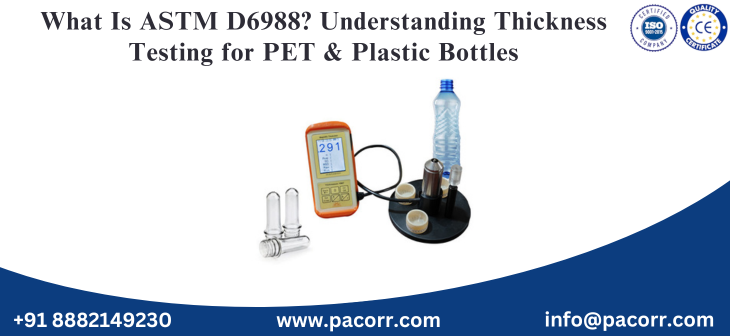
Pacorr Testing Instruments is widely recognized for delivering precise and reliable testing solutions for the packaging industry. One of the most essential quality parameters for PET bottles, plastic containers, and flexible packaging films is material thickness, and the globally accepted standard that guides this evaluation is ASTM D6988. Understanding this standard helps manufacturers maintain consistency, reduce defects, and ensure the strength and performance of their packaging.
What Is ASTM D6988? A Complete Guide
ASTM D6988 is a standardized testing method developed by ASTM International for measuring the thickness of plastic film and sheeting. While its primary application is thin films, the same principles apply broadly across PET bottles, HDPE containers, shrink wraps, laminated films, and various flexible packaging materials.
The standard defines:
- How to sample the material
- How to condition specimens
- Correct equipment characteristics
- How to perform the thickness test
- How to calculate and interpret results
Brands like Pacorr design advanced digital thickness gauges that follow these guidelines, ensuring precise and repeatable measurements across different types of packaging materials.
Why Thickness Testing Matters in PET & Plastic Packaging
The thickness of a plastic material is directly linked to its strength, durability, performance, and cost efficiency. Even a small variation can significantly affect product quality.
Here’s why manufacturers rely on ASTM D6988 thickness testing:
1. Maintains Structural Integrity
Accurate thickness ensures that PET and plastic bottles can withstand:
- Internal pressure from carbonation
- Impact during transportation
- Stress from stacking and handling
2. Ensures Consistency in Blow Molding
Thickness affects how PET preforms stretch and distribute material during bottle formation.
3. Controls Barrier Properties
Film and bottle thickness influences:
- Oxygen transmission rate (OTR)
- Moisture vapor transmission rate (MVTR)
- Shelf life of packaged goods
4. Reduces Material Costs
Avoids both under-materialization (weak spots) and over-materialization (waste).
5. Supports Regulatory and Quality Compliance
Industries like beverages, pharma, and FMCG require strict quality validation ASTM D6988 provides a uniform, dependable approach.
How ASTM D6988 Applies to PET Bottles, Plastic Containers & Films
Though written for films, ASTM D6988 has become an industry benchmark for packaging materials of different thickness levels.
PET Bottles
Thickness uniformity ensures:
- Proper load-bearing strength
- Burst resistance
- Shape stability
Plastic Bottles (HDPE/PP/LDPE)
Thickness testing helps:
- Detect weak zones
- Prevent leakage
- Improve molding consistency
Flexible Films
Micron-level precision is essential for:
- Food packaging films
- Laminated pouches
- Shrink sleeves
- Blister foils
Pacorr Testing Instruments supports all these applications with highly accurate and user-friendly thickness gauges.
Step-by-Step ASTM D6988 Thickness Testing Procedure
This simplified process reflects the core steps of ASTM D6988, suitable for PET bottles, films, and other packaging materials.
Step 1: Sample Selection
- Select representative samples from the batch.
- Avoid samples with wrinkles, folds, or contamination.
Step 2: Conditioning the Samples
- Condition samples at 23°C ± 2°C and 50% ± 5% relative humidity.
- Follow these conditions to ensure reproducibility.
Step 3: Preparing the Thickness Gauge
A professional instrument like a Pacorr Digital Thickness Gauge should include:
- Flat, parallel anvils
- A stable pressure-applying mechanism
- High-resolution reading capability (typically 0.001 mm)
Step 4: Zero Calibration
- Clean the anvils
- Close and set the gauge to zero to eliminate error
Step 5: Placing the Sample
- Insert the sample between the anvils without stretching
- Ensure smooth contact with no trapped air
Step 6: Applying Pressure & Recording Thickness
- Apply the standardized pressure
- Record the thickness reading shown on the digital display
Step 7: Repeat Across Multiple Points
Perform measurements at:
- 6–12 points for bottles (shoulder, body, base)
- Regular intervals for films and laminates
Step 8: Calculate Average Thickness
Evaluate:
- Average thickness
- Minimum and maximum deviations
- Uniformity across the material
Common Thickness Measurement Methods Used Under ASTM D6988
ASTM D6988 accommodates different techniques depending on material type and testing needs.
1. Mechanical Contact Method
Most widely used; suitable for:
- PET bottles
- Films
- Laminates
- Plastic sheets
2. Ultrasonic Thickness Testing
Non-contact method ideal for rigid containers.
3. Magnetic Inductive Method
Useful when only one side of the sample is accessible.
4. Optical / Laser Measurement
Common in automated high-speed production lines.
Pacorr thickness gauges primarily use highly reliable mechanical contact methods for laboratory and field applications.
Common Problems Detected Through Thickness Testing
Thickness testing helps identify defects that may otherwise go unnoticed:
1. Uneven Wall Distribution
Occurs due to improper heating or stretching in blow molding.
2. Thin Spots / Weak Zones
Often found near shoulders or base of bottles.
3. Excessive Material Usage
Overly thick areas increase cost without improving performance.
4. Preform Thickness Variations
Directly impact final bottle shape and strength.
5. Pinholes or Very Thin Areas in Films
Lead to leakage, sealing issues, and contamination risks.
Routine testing using ASTM D6988 ensures early detection and correction of these issues.
Importance of ASTM D6988 Testing for Key Industries
Packaging Industry
- Ensures stable pouch and film properties
- Reduces sealing failures
- Improves barrier consistency
Pharmaceutical Industry
- Guarantees integrity of blister packs and sterile packaging
- Ensures compliance with global packaging standards
FMCG Sector
- Enhances packaging reliability
- Prevents deformation and leakage
Beverage Industry
- Ensures PET bottle strength during filling, capping, and transport
- Reduces bottle shrinkage or collapse issues
Manufacturers in these sectors trust Pacorr Testing Instruments for delivering reliable, easy-to-operate thickness measurement solutions.
Real Example: Thickness Optimization for a Beverage Manufacturer
A leading beverage company used ASTM D6988-compliant thickness testing to adjust the wall distribution of their 1-liter PET bottles.
Outcome:
- 1.2 grams reduction in bottle weight
- Better burst strength
- Lower production cost
- Reduced environmental footprint
This demonstrates how accurate measurements with Pacorr thickness gauges contribute directly to manufacturing efficiency.
Thickness testing is a cornerstone of packaging quality assurance. ASTM D6988 provides a clear, precise, and repeatable method for evaluating thickness in PET bottles, plastic containers, and films.
When combined with advanced tools like those from Pacorr Testing Instruments, manufacturers gain the ability to optimize material usage, improve product quality, and maintain global compliance.
Contact Pacorr for High-Precision Thickness Testing Solutions
Want to implement ASTM D6988-compliant testing in your production?
Reach out to the experts at Pacorr Testing Instruments today.
Email: info@pacorr.com
Phone: +91 8882149230
Ensure accuracy, reliability, and global-standard quality with Pacorr’s advanced thickness testing solutions.
Recent Blogs
Enhance your understanding of testing and precise quality control indistinct applications with our
knowledge based articles coming from top editors of industry leaders.
Thanks to Pacorr Testing instruments, we have all the required quality testing instruments that have helped us to ensure the best quality delivered to our clients.

Danish
Fair Exports Pvt. Ltd.
