

Pacorr is a leading manufacturer of packaging testing instruments, supporting industries worldwide in ensuring packaging strength, durability, and compliance with international standards. Among all packaging performance tests, the Box Compression Test (BCT) conducted as per ASTM D642 standard is one of the most critical evaluations for determining the structural integrity of corrugated boxes used in storage, stacking, and transportation.
In modern supply chains where goods are stacked for long durations in warehouses and transported across vast distances, packaging failure can lead to product damage, financial loss, and reputational harm. The Box Compression Test provides scientific data to prevent such failures by accurately measuring the load-bearing capacity of a box.
This article offers a deep technical explanation of the Box Compression Test, ASTM D642 methodology, influencing factors, industrial relevance, and why Pacorr is the preferred brand for compression testing solutions.
What is a Box Compression Test (BCT)?
The Box Compression Test is a laboratory test that measures the maximum vertical compressive force a corrugated box can withstand before structural failure occurs. The test simulates real-life stacking conditions where boxes are placed on top of each other during warehousing and transportation.
BCT helps determine:
- Whether a box can safely support stacked loads
- The maximum stacking height
- The durability of corrugated packaging under static load
- Packaging suitability for long-term storage
The results of this test are crucial for packaging engineers, quality managers, and logistics planners.
ASTM D642 Standard - Technical Overview
ASTM D642 is a standardized test method published by ASTM International for measuring the compressive resistance of shipping containers, unit loads, and packaging components.
Scope of ASTM D642
The standard applies to:
- Corrugated fiberboard boxes
- Rigid and semi-rigid shipping containers
- Empty or filled packages
- Unitized loads
ASTM D642 ensures that compression testing is conducted under controlled conditions, allowing results to be repeatable, comparable, and internationally accepted.
Why ASTM D642 Compliance is Critical
ASTM D642 compliance ensures:
1. Consistency Across Global Supply Chains
Manufacturers and buyers across different countries can rely on standardized data.
2. Accurate Prediction of Real-World Performance
The test simulates vertical stacking forces encountered during storage and transit.
3. Regulatory and Customer Acceptance
Many multinational companies require ASTM-based test reports before approving packaging.
4. Reduction in Packaging Failures
Scientific testing prevents guesswork and costly packaging breakdowns.
Detailed Box Compression Test Procedure as per ASTM D642
The ASTM D642 procedure follows strict guidelines to ensure precision and reliability.
1. Sample Conditioning
Before testing, boxes are conditioned at standard atmospheric conditions:
- Temperature: 23 ± 2°C
- Relative Humidity: 50 ± 5%
This step is critical because corrugated board strength is highly sensitive to moisture.
2. Sample Placement
- The box is placed centrally between two rigid, parallel compression platens
- Proper alignment ensures uniform load distribution
3. Load Application
- A controlled vertical load is applied at a constant speed
- Load rate is selected based on package size and test objective
4. Failure Detection
The test continues until:
- The box collapses
- Excessive deformation occurs
- A predefined load limit is reached
5. Data Recording
The maximum force sustained is recorded in:
- Newtons (N)
- Kilograms-force (kgf)
This value represents the Box Compression Strength.
Failure Modes Observed During BCT
Understanding failure modes helps optimize packaging design:
- Panel Buckling: Side walls collapse inward
- Corner Crushing: Load concentrates on weak corners
- Top/Bottom Panel Failure: Inadequate board strength
- Progressive Collapse: Gradual loss of structural integrity
Each failure mode provides insights into material or design weaknesses.
Factors Affecting Box Compression Strength
1. Corrugated Board Properties
- Paper grammage
- Fiber quality
- Flute profile (A, B, C, E, BC)
2. Box Geometry
- Box dimensions
- Height-to-width ratio
- Type of container (RSC, FOL, die-cut)
3. Manufacturing Processes
- Excessive printing pressure weakens flutes
- Die-cut windows reduce load-bearing area
- Poor joint adhesion lowers strength
4. Environmental Conditions
- High humidity can reduce compression strength by up to 50%
- Long-term storage under load causes creep failure
Relationship Between BCT and Stacking Strength
BCT data is commonly used to calculate safe stacking limits using formulas such as the McKee Formula, which estimates stacking strength under real warehouse conditions.
This allows companies to:
- Optimize pallet stacking height
- Prevent bottom-layer box collapse
- Improve warehouse space utilization
Importance of Box Compression Testing in Modern Industries
Box Compression Testing is essential in:
- Packaging development and validation
- Supplier quality audits
- Export packaging certification
- E-commerce logistics optimization
- Cost reduction initiatives
Pacorr Box Compression Tester - Precision You Can Trust
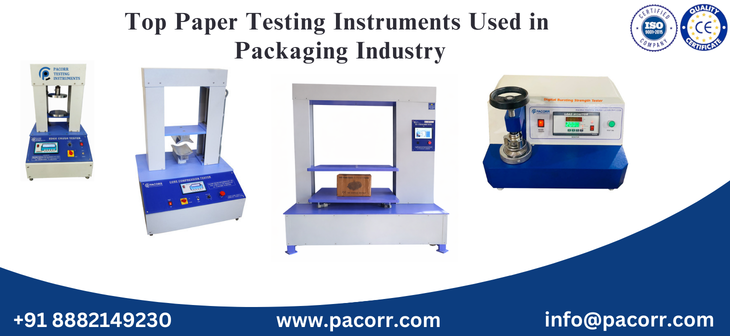
Pacorr designs and manufactures high-performance Box Compression Testers that fully comply with ASTM D642, ISO, and TAPPI standards.
Key Technical Features:
- High-accuracy digital load cells
- Microprocessor-controlled testing
- Rigid platen construction for uniform loading
- Real-time data display and storage
- Robust industrial design for long-term use
Pacorr instruments are trusted by packaging manufacturers, laboratories, and multinational brands.
Advantages of Choosing Pacorr
- Proven testing accuracy
- International standards compliance
- Customizable load capacities
- Expert technical support
- Long equipment life and reliability
Common Errors to Avoid in Box Compression Testing
- Testing without proper conditioning
- Misaligned sample placement
- Using damaged or pre-compressed boxes
- Ignoring environmental effects
- Using non-calibrated equipment
Pacorr ensures accurate results through calibrated, certified, and validated machines.
Frequently Asked Questions (FAQs)
1. What is ASTM D642 used for?
ASTM D642 is used to measure the compression resistance of shipping containers and packaging under vertical load.
2. What does the Box Compression Test determine?
It determines the maximum load a box can withstand before failure.
3. Why is BCT important for packaging design?
BCT data helps optimize material usage while ensuring stacking safety.
4. How does humidity impact BCT results?
Higher humidity weakens paper fibers, significantly reducing compression strength.
5. Is Box Compression Testing required for exports?
Many export markets and global buyers require ASTM-based compression test data.
6. Can Pacorr customize Box Compression Testers?
Yes, Pacorr offers customized solutions based on box size, load range, and industry needs.
Conclusion
The Box Compression Test as per ASTM D642 standard is a foundational test for ensuring packaging safety, durability, and performance throughout the supply chain. Accurate compression testing reduces product damage, lowers logistics costs, and ensures customer satisfaction.
With advanced technology, proven accuracy, and global trust, Pacorr stands as a reliable partner for all packaging testing requirements.
Email: info@pacorr.com
Phone: +91 8882149230
For expert guidance on Box Compression Testing and ASTM-compliant solutions, connect with Pacorr today.
Recent Blogs
Enhance your understanding of testing and precise quality control indistinct applications with our
knowledge based articles coming from top editors of industry leaders.
Thanks to Pacorr Testing instruments, we have all the required quality testing instruments that have helped us to ensure the best quality delivered to our clients.

Danish
Fair Exports Pvt. Ltd.
