
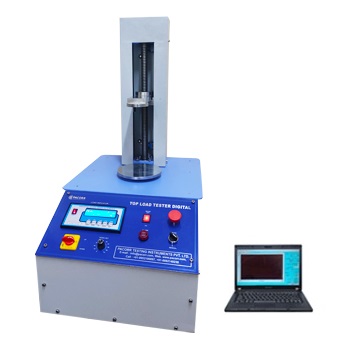
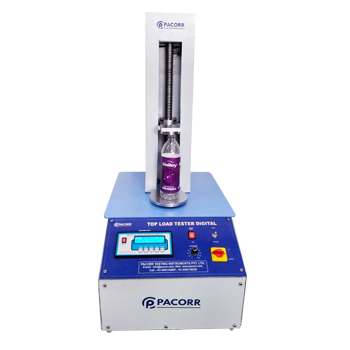
Pacorr’s Bottle Top Load Tester (Computerized Model) is an advanced testing system engineered to precisely evaluate the axial compressive strength of PET, HDPE, and other plastic bottles. In packaging industries where lightweighting, durability, and quality compliance are critical, this instrument plays a vital role in determining how a bottle reacts under vertical compression load until the point of deformation or failure. The instrument replicates the real-world compressive forces that bottles experience during filling, sealing, stacking, storage, and transportation. This ensures that every container produced is structurally sound, cost-efficient, and aligned with global quality standards.
- Shipping Area: All over the world
- Model: PCTLTD-1


Purpose and Importance of Top Load Testing
Every packaging engineer aims to design bottles that are lightweight yet strong enough to endure stress during distribution. Top Load Testing helps achieve this balance by measuring the bottle’s ability to withstand compressive forces without buckling.
Through this testing process, manufacturers gain scientific insights into:
- How much vertical pressure a bottle can handle before structural failure.
- The effect of design geometry, preform weight, and resin type on strength.
- The influence of cap torque and closure pressure on bottle stability.
- Opportunities to reduce material usage while maintaining required load-bearing capacity.
By implementing bottle top load testing, manufacturers can ensure:
- Consistent product quality and stacking stability.
- Compliance with ASTM D2659, ASTM D642, and ISO 12048 standards.
- Reduced risk of leakage, deformation, and product recalls.
- Data-driven optimization of bottle design and blowing process parameters.
Technical Overview - How the Bottle Top Load Tester Works
The Pacorr Bottle Top Load Tester operates on the principle of axial compression, where a controlled downward force is applied to the bottle’s top surface until the structure yields. The test simulates the stacking pressure a bottle faces when several units are placed on top of one another during storage or transportation.
The machine includes a rigid frame structure, S-type load cell, and computer-controlled servo motor drive. The compressive force is applied at a constant speed through a crosshead movement system, and all data including load, displacement, and time - are captured in real-time through specialized software.
The software generates a load-displacement curve, which provides detailed information about the bottle’s stiffness, deformation pattern, and failure point. This data allows engineers to study elastic and plastic behavior, ensuring that even minor variations in material or design can be detected.
Key Features of Pacorr’s Computerized Bottle Top Load Tester
- High-Precision Load Cell: Advanced S-type sensor ensures accurate load detection with minimal error.
- Closed-Loop Motor Control: Enables precise crosshead movement and stable load application.
- Real-Time Data Acquisition Software: Displays and records load vs. displacement graphs, peak load, and energy to buckle.
- Automatic Peak Detection: The system automatically identifies the maximum load at which failure occurs.
- Self-Aligning Grips: Specially designed concave jaws eliminate off-center loading errors and ensure uniform compression.
- Programmable Parameters: Test speed, pre-load force, and stopping conditions can be customized.
- Safety Mechanisms: Built-in overload protection, emergency stop, and travel limit sensors ensure operator safety.
- Data Export Options: Results can be exported in PDF, Excel, or CSV formats for audit and report documentation.
- Calibration and Support: Indian calibration traceability with service centers across major industrial hubs ensures reliable, long-term performance.
Testing Procedure for Bottle Top Load Evaluation
- Sample Conditioning:
Prior to testing, samples should be stabilized at 23 ± 2°C temperature and 50 ± 5% relative humidity to standardize environmental conditions. - Specimen Preparation:
Record preform weight, wall thickness, cap torque, and filling condition (if applicable). These parameters are essential to correlate mechanical behavior with material consistency. - Machine Setup:
- Apply a pre-load between 1–5 N to ensure proper contact.
- Set crosshead movement speed between 10–20 mm/min, depending on bottle size and standard requirements.
- Define the failure criteria (peak load or specific displacement).
- Sample Placement:
Position the bottle centrally between the concave grips to ensure the axial load is evenly distributed along its vertical axis. - Test Execution:
The machine applies compressive force through the top platen until the bottle shows deformation or collapse. The software continuously records the load-displacement data. - Data Recording and Analysis:
The system automatically captures parameters such as peak compressive load, deformation at load, and energy absorbed until failure. These readings provide a complete mechanical fingerprint of the bottle’s structural behavior. - Replication and Validation:
Conduct multiple trials (typically 5–10 bottles per batch) to establish statistical reliability and process capability indices (Cpk).
Design Insights from Top Load Testing
Top load test data provide valuable feedback for bottle designers and production engineers. The relationship between geometry, resin properties, and processing parameters can be quantified to make informed improvements. For example:
- Optimizing shoulder and base geometry to distribute stress evenly.
- Adjusting preform heating zones during the stretch blow molding process.
- Modifying wall thickness or rib reinforcement for better load resistance.
- Evaluating closure torque interactions to prevent premature deformation.
This analytical approach allows manufacturers to fine-tune their processes and maintain consistent strength performance, even under aggressive lightweighting programs.
Applications and Industry Use
Pacorr’s Bottle Top Load Tester is used across a wide spectrum of industries where container stability is critical:
- Beverage and Water Industry: Testing PET and HDPE bottles used for mineral water, soft drinks, juices, and milk-based products.
- Pharmaceutical Industry: Ensuring the mechanical integrity of medicine and syrup bottles.
- Food and Edible Oil Packaging: Validating strength for oil, sauce, and condiment bottles subjected to stacking pressure.
- Cosmetics and Personal Care: Evaluating packaging for shampoos, creams, and lotions.
- Chemical and Cleaning Products: Testing structural rigidity of household cleaner and industrial chemical containers.
Each sector benefits from the ability to ensure consistent quality, avoid transport damage, and reduce resin consumption through design validation.
Compliance and Standards
Pacorr’s Bottle Top Load Tester conforms to globally recognized testing methods:
- ASTM D2659: Standard Test Method for Top Load Strength of Plastic Containers.
- ASTM D642: Test Method for Determining Compressive Resistance of Shipping Containers.
- ISO 12048: Compression and stacking tests for transport packages.
These standards guarantee that the results obtained are universally acceptable and can be compared across production facilities and countries.
The Pacorr Computerized Bottle Top Load Tester is a comprehensive, precision-engineered instrument designed to support modern packaging innovation, quality assurance, and cost optimization. By combining mechanical accuracy, intelligent software, and durable construction, it provides actionable insights into bottle performance under load.
Whether your goal is to reduce resin usage, ensure packaging stability, or comply with international testing standards, Pacorr’s top load testing system delivers reliable, repeatable, and data-backed results.
Contact Pacorr today to request a customized quotation and discover how our Bottle Top Load Tester can help strengthen your packaging reliability and enhance your brand’s quality assurance program.
FAQs - Bottle Top Load Tester
Q1. Can both filled and empty bottles be tested using a Bottle Top Load Tester?
Yes, both filled and empty bottles can be evaluated using Pacorr’s Bottle Top Load Tester. The choice depends on the nature of your testing objective. Empty bottle testing is commonly performed during routine quality checks because it is faster, easier to handle, and helps assess the uniformity of production batches. Filled bottle testing, on the other hand, is preferred during validation or performance testing since the internal pressure from the product influences how the bottle reacts under vertical load. Testing bottles in both conditions gives a realistic understanding of how the container behaves during capping, transportation, and stacking, ensuring that the final product maintains its structural integrity throughout its lifecycle.
Q2. How many samples should be tested per production batch?
For accurate evaluation, it is recommended to test a minimum of five to ten bottles from each production batch. This sample size allows manufacturers to detect variations in raw material quality, wall thickness, or molding parameters that may affect the compressive strength of the bottles. When conducting process capability studies or lightweighting validations, a larger number of samples—typically thirty or more—is advisable to generate statistically valid data. Testing multiple specimens ensures repeatability, reliability, and confidence that the production process consistently meets the required load-bearing standards.
Q3. How can manufacturers determine if lightweighting is feasible?
The feasibility of lightweighting can be established only after analyzing process capability through top load testing. If a manufacturer achieves a process capability index (Cpk) of 1.33 or higher at the current bottle weight, a small weight reduction trial, usually by one gram, can be conducted. If the modified design maintains a Cpk value of at least 1.0 and still meets top load performance requirements, lightweighting can be safely implemented. This approach helps ensure that material optimization does not compromise stacking strength, filling stability, or packaging safety. In essence, top load testing provides the data-driven assurance required to balance cost reduction with consistent product quality.
Q4. Why do top load test results sometimes vary between samples?
Variations in top load test results are generally due to inconsistencies in preform heating, mold conditions, or cap torque during the blow molding process. Uneven heating of the preform can lead to irregular material distribution and wall thickness, which directly affects the compressive strength of the bottle. Similarly, excessive or insufficient torque applied during capping can introduce stress points that influence the overall load-bearing capacity. Mold wear or contamination can also create subtle changes in bottle geometry. Maintaining precise temperature control, regular mold maintenance, and consistent torque application are essential to achieve stable and repeatable test outcomes. Pacorr’s advanced computerized top load tester minimizes such variability by providing highly accurate, repeatable measurements under controlled conditions.
Q5. What standards are typically followed for Bottle Top Load Testing?
Bottle Top Load Testing is governed by internationally recognized standards that ensure uniformity and credibility of results. The most widely used standards include ASTM D2659, which defines methods for determining the top load strength of plastic containers; ASTM D642, which covers the compressive resistance of containers and packaging components; and ISO 12048, which specifies procedures for compression and stacking tests for transport packages. These standards are followed across the beverage, food, pharmaceutical, and packaging industries to validate product design, guarantee regulatory compliance, and maintain consistent performance across global supply chains. Pacorr’s Bottle Top Load Tester is fully compliant with these standards, ensuring that the test data generated are both accurate and globally accepted.
Related Products

Our Clients






















Recent Blogs
Enhance your understanding of testing and precise quality control indistinct applications with our
knowledge based articles coming from top editors of industry leaders.
Thanks to Pacorr Testing instruments, we have all the required quality testing instruments that have helped us to ensure the best quality delivered to our clients.

Danish
Fair Exports Pvt. Ltd.
