
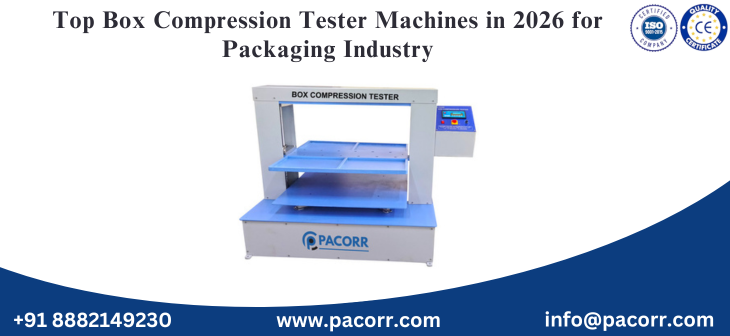
Pacorr continues to lead the packaging testing equipment market by delivering technologically advanced, reliable, and industry-compliant solutions for quality assurance. As the packaging industry evolves rapidly in 2026, manufacturers face increasing pressure to ensure packaging strength, durability, and sustainability. One critical testing solution that has become indispensable across industries is the box compression tester. With growing demand for safe transportation, optimized packaging design, and regulatory compliance, selecting the right box compression testing machine is now a strategic business decision rather than a technical formality.
This comprehensive guide explores the top box compression tester machines in 2026 for the packaging industry, their working principles, advanced features, applications, and why computerized models are shaping the future of packaging quality control.
What Is a Box Compression Tester?
A box compression tester is a laboratory testing instrument used to determine the compressive strength of corrugated boxes and cartons. The test evaluates how much load a box can withstand before deformation or collapse when force is applied from the top. This test simulates real-life stacking conditions during warehousing, palletization, and transportation.
The test result, often expressed as Box Compression Strength (BCT), plays a critical role in packaging design decisions and logistics planning.
Why Box Compression Testing Is Critical in 2026
The packaging ecosystem in 2026 is shaped by automation, global logistics, sustainability goals, and strict quality standards. Compression failure can lead to damaged products, financial losses, and reputational harm.
Key Reasons Box Compression Testing Is Essential:
- Increased warehouse stacking heights
- Growth of e-commerce and long-distance shipping
- Use of lightweight and recyclable packaging materials
- Stricter international packaging standards
- Higher customer expectations for damage-free delivery
Without proper testing using a reliable box compression tester, companies risk packaging failure at multiple points in the supply chain.
Types of Box Compression Tester Machines in 2026
Modern box compression testing machines are available in multiple configurations to meet diverse industry needs. Below are the most relevant types dominating the market in 2026.
1. Digital Box Compression Tester
Digital models are widely adopted due to their balance of accuracy, affordability, and ease of operation.
Key Characteristics:
- High-precision load cell sensors
- Digital display showing real-time compression force
- Peak value hold function
- Manual or semi-automatic operation
Advantages:
- Cost-effective solution
- Ideal for routine quality checks
- Minimal operator training required
Best Use Cases:
- Corrugated box manufacturers
- Packaging quality control labs
- Small to mid-sized production units
2. Box Compression Tester Computerized (Advanced Technology Leader)
The box compression tester computerized category represents the most advanced and future-ready solution available in 2026. These machines integrate software-driven control systems with precision mechanics to deliver unmatched accuracy and data reliability.
Advanced Features:
- Computer-controlled load application
- Real-time force vs. deformation graph generation
- Automatic test data storage
- Customizable test parameters
- Exportable test reports for audits and compliance
Why Computerized Models Are Dominating in 2026:
- Enable data-driven packaging decisions
- Reduce manual errors significantly
- Support ASTM D642 and ISO standards
- Essential for export-oriented and regulated industries
Best Use Cases:
- Large-scale packaging manufacturers
- Research & development laboratories
- Export houses and multinational brands
A box compression tester computerized system is no longer a luxury—it is a necessity for organizations focused on long-term quality excellence.
3. Heavy-Duty Box Compression Tester
Heavy-duty machines are engineered to test large boxes and high-load applications commonly found in industrial and export packaging.
Key Features:
- High load-bearing capacity
- Reinforced steel frame
- Large testing platform
- Long operational lifespan
Applications:
- Heavy machinery packaging
- Bulk export cartons
- Industrial storage solutions
4. Automatic Box Compression Tester
Automation is a defining trend in 2026, and automatic box compression testers reflect this shift.
Key Benefits:
- Fully automated testing cycles
- Minimal operator involvement
- Faster throughput
- Highly repeatable results
Ideal For:
- High-volume production facilities
- Automated testing environments
How to Choose the Best Box Compression Tester in 2026
Selecting the right machine requires evaluating both technical specifications and business requirements.
Key Selection Criteria:
- Load capacity based on box size
- Accuracy and calibration standards
- Compliance with ASTM and ISO norms
- Data recording and reporting capability
- Future scalability and software upgrades
For businesses focused on traceability, audits, and global exports, a box compression tester computerized model offers the highest return on investment.
Industry Applications of Box Compression Testers
Corrugated Packaging Industry
Ensures uniform strength across production batches and prevents structural failure.
E-commerce & Retail Packaging
Simulates stacking stress during transit and last-mile delivery.
Food & Beverage Packaging
Protects packaged goods from crushing during storage and logistics.
Pharmaceutical Packaging
Meets strict quality and safety regulations.
Export Packaging
Reduces damage risks during international shipping and container stacking.
Role of Box Compression Testing in Brand Reputation
In 2026, packaging quality is directly associated with brand credibility. A damaged package often leads to customer dissatisfaction—even if the product inside is intact.
By using a reliable box compression tester, brands can:
- Reduce customer complaints
- Minimize returns and replacements
- Improve distributor confidence
- Build long-term trust
Strong packaging communicates professionalism, reliability, and quality.
Sustainability and Material Optimization
With rising sustainability goals, manufacturers are shifting toward lightweight and recyclable packaging. Box compression testing helps balance material reduction with strength performance.
Benefits include:
- Reduced raw material usage
- Lower packaging costs
- Environment-friendly packaging solutions
- Compliance with sustainability regulations
Why Pacorr Is a Preferred Choice in 2026
Pacorr has established itself as a dependable partner for packaging quality testing by combining engineering excellence with customer-centric design.
Pacorr Advantages:
- High-accuracy testing solutions
- Robust machine construction
- Advanced box compression tester computerized systems
- Excellent technical support and service
Pacorr machines are designed to meet the demands of modern packaging environments while ensuring long-term operational reliability.
Future Trends in Box Compression Testing
The future of compression testing is aligned with smart manufacturing and digital transformation.
Key Trends:
- AI-powered data interpretation
- IoT-enabled remote monitoring
- Integration with ERP and quality systems
- Predictive maintenance features
Companies investing in advanced testing today are better positioned to compete globally tomorrow.
Conclusion
The packaging industry in 2026 demands precision, compliance, and innovation. Choosing the right box compression tester is critical for ensuring packaging performance, cost efficiency, and brand integrity. From digital to heavy-duty and fully automated systems, the most impactful solution for forward-thinking businesses is the box compression tester computerized, offering superior accuracy, data control, and compliance readiness.
With proven expertise and advanced technology, Pacorr continues to support the packaging industry with world-class box compression testing solutions that meet today’s challenges and tomorrow’s expectations.
Frequently Asked Questions (FAQs)
1. What is a box compression tester?
A box compression tester measures the maximum compressive force a box can withstand before collapsing.
2. Why is a box compression tester computerized better?
A box compression tester computerized provides automated testing, accurate data analysis, report generation, and compliance support.
3. Which standards apply to box compression testing?
Most machines follow ASTM D642 and ISO standards.
4. How often should compression testing be performed?
Testing should be conducted regularly, especially when materials, suppliers, or box designs change.
5. Can box compression testing reduce packaging costs?
Yes, it helps optimize material usage while maintaining strength, reducing over-packaging costs.
6. Is compression testing necessary for e-commerce packaging?
Absolutely. E-commerce packages face stacking and transit stress, making compression testing essential.
Recent Blogs
Enhance your understanding of testing and precise quality control indistinct applications with our
knowledge based articles coming from top editors of industry leaders.
Thanks to Pacorr Testing instruments, we have all the required quality testing instruments that have helped us to ensure the best quality delivered to our clients.

Danish
Fair Exports Pvt. Ltd.
