
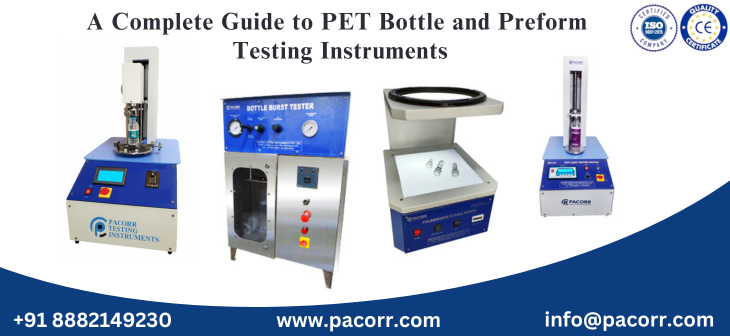
Pacorr is a leading name in the field of quality testing instruments, trusted by manufacturers across the packaging industry for delivering accurate, reliable, and standards-compliant testing solutions. With years of expertise in designing and supplying advanced testing equipment, Pacorr helps manufacturers ensure product safety, durability, and performance. For expert guidance or product inquiries, Pacorr can be contacted at info@pacorr.com or +91 8882149230.
In today’s highly competitive packaging industry, quality is not optional it is a necessity. PET bottles and preforms are widely used for packaging water, carbonated soft drinks, edible oils, pharmaceuticals, and a wide range of FMCG products. Any compromise in their quality can lead to leakage, deformation, product contamination, or even brand damage. This is where PET bottle and preform testing instruments play a critical role. This comprehensive guide explores the importance of PET testing, the key instruments involved, applicable standards, and best practices for achieving consistent quality.
Understanding PET Bottles and Preforms
Polyethylene Terephthalate (PET) is a lightweight, transparent, and durable plastic material extensively used in packaging. PET preforms are injection-molded test tube–shaped components that are later stretch-blown into bottles of various shapes and sizes. The quality of the final PET bottle largely depends on the quality of the preform, making testing at both stages essential.
PET packaging must withstand internal pressure, external loads, transportation stress, and varying environmental conditions. Even minor defects—such as uneven wall thickness or weak sealing can cause product failure. Therefore, systematic testing using specialized instruments is crucial throughout the production cycle.
Why PET Bottle and Preform Testing Is Critical
PET bottle and preform testing ensures that packaging meets functional, safety, and regulatory requirements. The key reasons for conducting these tests include:
- Quality Assurance: Identifying defects early prevents defective products from reaching the market.
- Regulatory Compliance: Many industries must comply with ASTM, ISO, and other international standards.
- Cost Reduction: Detecting flaws during production minimizes wastage, rework, and recalls.
- Product Safety: Prevents leakage, contamination, and breakage during use.
- Brand Protection: High-quality packaging enhances brand image and consumer trust.
By using reliable testing instruments, manufacturers can maintain consistency and improve overall operational efficiency.
Key PET Bottle and Preform Testing Instruments
Wall thickness uniformity is one of the most critical parameters in PET bottles and preforms. A thickness gauge measures the thickness at various points to ensure even material distribution.
Purpose:
- Detects thin or thick areas that may weaken the bottle.
How It Works:
- Uses ultrasonic or mechanical probes to measure wall thickness without damaging the sample.
Standards:
- ASTM D6988, ISO guidelines for plastic thickness measurement.
Defects Identified:
- Uneven wall thickness, weak spots, excessive material usage.
PET bottles must withstand vertical compressive loads during stacking, storage, and transportation. A top load tester measures the maximum load a bottle can bear before deformation or collapse.
Purpose:
- Ensures structural strength under stacking conditions.
How It Works:
- Applies a downward force on the bottle until deformation occurs.
Standards:
- ASTM D2659, ISO 12048.
Defects Identified:
- Poor bottle design, insufficient material strength.
For carbonated beverages and pressurized liquids, bottles must tolerate high internal pressure. A burst pressure tester evaluates the pressure resistance of PET bottles.
Purpose:
- Ensures safety and durability under internal pressure.
How It Works:
- Gradually increases internal air or water pressure until the bottle bursts.
Standards:
- ASTM D1599, ISO 11114.
Defects Identified:
- Weak bottle walls, improper molding, sealing failures.
4. Drop Tester
PET bottles often experience drops during handling and transportation. Drop testing simulates real-world impacts to evaluate bottle strength.
Purpose:
- Assesses impact resistance and durability.
How It Works:
- Drops the bottle from a predetermined height onto a rigid surface.
Standards:
- ASTM D5276, ISO 2248.
Defects Identified:
- Cracks, leakage, base or neck failure.
Leakage is one of the most common and costly issues in PET packaging. Leakage testers ensure airtight and watertight sealing.
Purpose:
- Detects leaks in bottle bodies, caps, and closures.
How It Works:
- Applies internal pressure or vacuum and monitors pressure loss.
Standards:
- ASTM F2052, ISO 11621.
Defects Identified:
- Improper sealing, micro cracks, cap defects.
Torque testing measures the force required to open or close bottle caps. Proper torque ensures leak-proof sealing while remaining consumer-friendly.
Purpose:
- Verifies cap application consistency.
How It Works:
- Measures opening and closing torque using digital sensors.
Standards:
- ASTM D2063, ISO 7500.
Defects Identified:
- Over-tightening, under-tightening, closure mismatch.
7. Visual Inspection Systems
Visual inspection systems use manual or automated methods to detect surface and structural defects in PET bottles and preforms.
Purpose:
- Identifies cosmetic and structural flaws.
How It Works:
- Uses cameras, sensors, or magnification tools for inspection.
Standards:
- Industry-specific quality guidelines.
Defects Identified:
- Black spots, contamination, bubbles, improper neck finish.
Applications of PET Testing Across Industries
PET bottle and preform testing instruments are used across multiple industries, including:
- Bottled Water: Ensuring leak-proof and lightweight bottles.
- Carbonated Soft Drinks (CSD): Testing pressure resistance and burst strength.
- Edible Oils: Verifying leakage resistance and top load strength.
- Pharmaceuticals: Maintaining strict safety and hygiene standards.
- FMCG Products: Ensuring durability during transportation and storage.
Each industry has unique requirements, making customized testing solutions essential.
How to Choose the Right PET Testing Instruments
Selecting the right testing instruments depends on several factors:
- Application Type: Still water, carbonated drinks, oils, or pharmaceuticals.
- Production Volume: High-speed lines require automated or digital instruments.
- Compliance Requirements: ASTM, ISO, or customer-specific standards.
- Budget and Scalability: Instruments should support future expansion.
- Accuracy and Repeatability: Reliable results are critical for decision-making.
Pacorr offers a wide range of PET testing instruments designed to meet diverse industrial needs with precision and reliability.
Best Practices for PET Testing Laboratories
To achieve consistent and accurate results, manufacturers should follow these best practices:
- Calibrate testing instruments regularly
- Train quality control personnel thoroughly
- Maintain controlled testing environments
- Document and analyze test results systematically
- Perform preventive maintenance on equipment
A well-organized testing lab not only ensures compliance but also enhances overall production efficiency.
Conclusion
PET bottle and preform testing instruments are indispensable tools for ensuring packaging quality, safety, and performance. From thickness measurement and top load testing to burst pressure, leakage, and torque testing, each instrument plays a vital role in identifying defects and maintaining consistency. As packaging demands continue to evolve, investing in reliable and standards-compliant testing equipment is essential for long-term success.
Pacorr stands as a trusted partner for manufacturers seeking high-quality PET bottle and preform testing solutions. With advanced technology, expert support, and a commitment to quality, Pacorr helps businesses meet global standards with confidence. For more information, customized solutions, or expert consultation, reach out to info@pacorr.com or call +91 8882149230 today.
Recent Blogs
Enhance your understanding of testing and precise quality control indistinct applications with our
knowledge based articles coming from top editors of industry leaders.
Thanks to Pacorr Testing instruments, we have all the required quality testing instruments that have helped us to ensure the best quality delivered to our clients.

Danish
Fair Exports Pvt. Ltd.
