
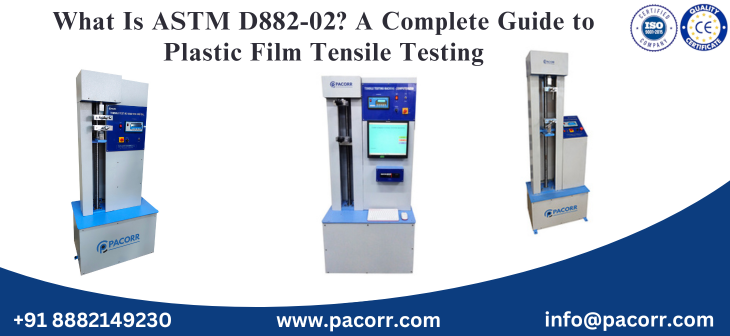
 Pacorr plays a vital role in helping manufacturers achieve accurate, reliable, and globally compliant quality testing results. When it comes to evaluating the tensile properties of thin plastic films and flexible packaging materials, ASTM D882-02 is one of the most widely recognized international testing standards. This comprehensive guide explains everything you need to know about ASTM D882-02-including its purpose, testing methodology, required equipment, industry relevance, and the benefits of full compliance.
Understanding ASTM D882-02
ASTM D882-02 is a standardized test method established by ASTM International for determining the tensile properties of thin plastic sheeting. These materials typically include:
- Plastic films
- Flexible packaging substrates
- Thin polymeric sheets (generally less than 1 mm thickness)
The test measures critical mechanical properties such as:
- Tensile strength
- Elongation at break
- Tensile modulus
- Yield stress (if applicable)
The goal of ASTM D882-02 is to provide a consistent, repeatable approach for manufacturers, laboratories, and product developers to evaluate material performance under controlled loading conditions.
Why Tensile Testing of Plastic Films Matters
Plastic films are used across multiple high-performance and high-demand applications. Their mechanical behavior directly impacts the durability, stability, and safety of end products. Pacorr’s advanced tensile testing instruments are widely used across industries to fulfill these requirements.
Key Reasons Tensile Testing Is Critical
- Material Strength Assessment
Films must withstand mechanical stresses during processing, handling, and use. - Quality Assurance & Process Control
Testing ensures production consistency, allowing manufacturers to adjust formulation or manufacturing parameters. - Predicting Performance in Real-World Conditions
Tensile properties indicate how films behave under tension during stretching, sealing, or packaging processes. - Regulatory & Customer Compliance
ASTM D882-02 certification is often required for export, procurement, or product validation. - Research & Development Applications
Helps compare new polymer blends, additives, and processing conditions.
Step-by-Step Testing Procedure Under ASTM D882-02
ASTM D882-02 outlines a precise methodology to ensure consistency. Below is a practical, easy-to-understand breakdown of the complete process.
Step 1 – Sample Preparation
- Cut specimens into standardized shapes (typically strips).
- Common dimensions include:
- Width: 25 mm
- Length: Between 150 mm and 200 mm
- Ensure specimens are uniform, free from creases, nicks, or defects.
- Condition the samples at 23°C ± 2°C and 50% ± 5% RH for at least 40 hours.
Step 2 – Equipment Setup
- Calibrate the tensile testing machine.
- Ensure the load cell capacity is appropriate for thin films.
- Set the crosshead speed as per material type (commonly 50 mm/min or 500 mm/min).
Step 3 – Clamping the Specimen
- Use pneumatic or mechanical grips to securely hold the film.
- Ensure the specimen is perfectly aligned to avoid slippage or uneven loading.
Step 4 – Running the Test
- Start the test by initiating the crosshead movement.
- The machine applies a controlled tensile force until the specimen breaks.
- Real-time data acquisition systems record force, elongation, stress, and strain.
Step 5 – Data Processing & Reporting
- Determine tensile strength by dividing the maximum load by the cross-sectional area.
- Calculate elongation at break using final gauge length data.
- Report modulus, stress-strain curves, and failure characteristics.
Equipment Required for ASTM D882-02 Testing
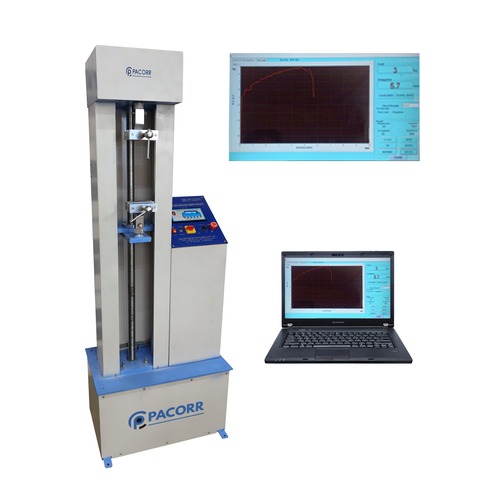
Pacorr provides laboratory-grade testing equipment compliant with the ASTM D882-02 standard. Below are the essential components required for accurate results.
A specialized universal testing machine (UTM) or dedicated tensile tester capable of:
- Micro-load application
- High-speed data acquisition
- Flexible gripping mechanisms
- Configurable crosshead speed
Gripping Fixtures
- Pneumatic grips (ideal for thin, slippery films)
- Mechanical screw-action grips
- Serrated or rubber-faced grips
Load Cell
- High-sensitivity load cell appropriate for low-strength materials
- Must be calibrated with traceable standards
Extensometer or Optical Measurement System
Used to measure:
- Strain
- Modulus
- Elongation
Conditioning Chamber
Ensures consistent temperature and humidity control.
How to Interpret ASTM D882-02 Test Results
Interpreting tensile data correctly is essential for understanding material behavior.
Tensile Strength
Indicates maximum stress the film can endure before breaking.
- Higher values → stronger, more durable films
- Useful for packaging requiring resistance to puncture or stretching
Tensile Modulus
Measures stiffness.
- High modulus → rigid films
- Low modulus → flexible, elastic films
Elongation at Break
Represents ductility.
- High elongation → suitable for stretch films, flexible packaging
- Low elongation → brittle materials
Stress-Strain Curve
Helps analyze:
- Yield point
- Elastic limit
- Failure mode
- Strain hardening behavior
Consistency Between Test Specimens
Variations may indicate manufacturing issues such as:
- Uneven thickness
- Inadequate mixing
- Improper extrusion conditions
Industry Applications of ASTM D882-02
Industries utilizing ASTM D882-02 testing rely on Pacorr testing instruments to ensure accuracy and compliance.
Common Sectors Include
- Flexible Packaging
Food packaging films, laminates, and pouches. - Agricultural Films
Mulch films, greenhouse covers, and silage wraps. - Pharmaceutical Packaging
Blister films, medical-grade pouches. - Consumer Goods
Shopping bags, shrink films, protective wraps. - Industrial Films
Construction films, geomembranes, and barrier films. - Polymer Manufacturing
R&D labs testing polymer formulations.
Benefits of ASTM D882-02 Compliance
Using certified testing equipment from Pacorr ensures that your testing meets global standards.
Key Advantages
- International Acceptance
Essential for export-oriented businesses. - Improved Product Quality
Ensures films withstand real-world stress conditions. - Reduced Manufacturing Errors
Detects issues early in the production cycle. - Better Material Selection
Compare multiple polymers or blends effectively. - Enhanced Customer Confidence
Demonstrates commitment to safety and quality. - Regulatory Compliance
Required by many OEMs and contract manufacturers.
Why Choose Pacorr for ASTM D882-02 Testing Equipment?
Pacorr is known for delivering high-precision, durable, and globally compliant testing solutions. Their tensile testing machines are designed to meet ASTM, ISO, and other international standards while providing unmatched reliability and accuracy.
Key features include:
- High-resolution load cells
- Intuitive touchscreen control
- Advanced software with real-time graphing
- Durable, industrial-grade construction
- Exceptional after-sales support
Conclusion
Pacorr remains a trusted name in material testing equipment, offering cutting-edge solutions that help manufacturers meet ASTM D882-02 requirements with confidence. By ensuring accurate tensile property evaluation of plastic films, businesses can enhance product reliability, meet regulatory demands, and gain a competitive edge in global markets. With the right equipment and adherence to standard procedures, tensile testing becomes a powerful tool for quality assurance and innovation.
Contact Details
Email: info@pacorr.com
Phone: +91 8882149230
Recent Blogs
Enhance your understanding of testing and precise quality control indistinct applications with our
knowledge based articles coming from top editors of industry leaders.
Thanks to Pacorr Testing instruments, we have all the required quality testing instruments that have helped us to ensure the best quality delivered to our clients.

Danish
Fair Exports Pvt. Ltd.
