
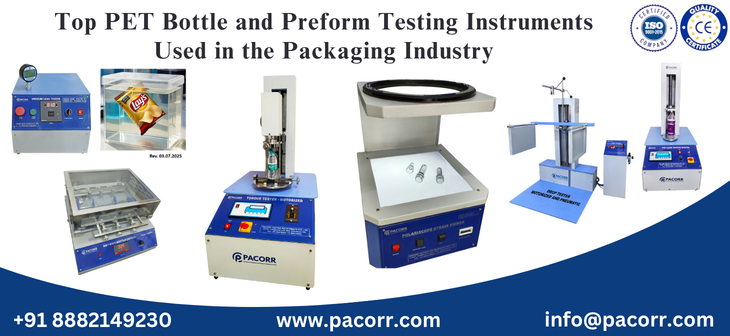
Pacorr understands that in the packaging industry, PET Bottle and Preform Testing Instruments are essential for maintaining product quality, ensuring production efficiency, and protecting brand reputation. These advanced testing solutions enable manufacturers to assess whether PET bottles and preforms can perform reliably throughout filling, capping, transportation, storage, and final use. Even the smallest defect in a preform or bottle can result in leakage, deformation, poor sealing, or complete product failure in the market.
As packaging designs become lighter and production speeds continue to increase, quality control can no longer rely on visual inspection alone. Manufacturers need accurate, repeatable, and application-focused testing methods to detect problems before they affect output. This is where PET Bottle and Preform Testing Instruments become essential for both quality assurance and process improvement.
What is PET Bottle and Preform Testing Instruments
PET Bottle and Preform Testing Instruments are specialized instruments used to evaluate the strength, consistency, dimensional accuracy, sealing performance, and structural integrity of PET preforms and finished bottles.
In simple terms, these instruments help packaging manufacturers answer an important question: Will this preform or bottle perform reliably under real production and supply chain conditions?
These instruments are used to measure parameters such as:
- Top load strength
- Burst resistance
- Leak integrity
- Torque performance
- Wall thickness distribution
- Residual stress
- Dimensional consistency
- Impact resistance
The term includes both Preform Testing Instruments and PET Bottles Testing Instruments because the performance of the final bottle is directly influenced by the quality of the preform.
Importance of PET Bottle and Preform Testing Instruments in Quality Assurance
PET Bottle and Preform Testing Instruments are important because packaging quality problems often begin long before the product reaches the customer. A slight variation in preform thickness, material distribution, neck dimensions, or bottle strength can create major issues during production or transit.
Without proper testing, manufacturers may face:
- Bottle collapse under stacking load
- Leakage due to weak sealing
- Cap loosening or overtightening
- Burst failure under internal pressure
- Cracks caused by residual stress
- Uneven wall thickness in blown bottles
- Increased rejection rates and customer complaints
Why these instruments matter in real production
In high-speed packaging environments, consistency is everything. A bottle that looks acceptable may still fail under pressure, vacuum, or compression. By using PET Bottle and Preform Testing Instruments, manufacturers can identify weak points early and take corrective action before defects scale across an entire batch.
Key quality assurance benefits
- Improves product reliability
- Reduces line rejection and wastage
- Supports bottle lightweighting without compromising performance
- Enhances closure and seal performance
- Helps maintain batch-to-batch consistency
- Strengthens customer confidence in the final packaging
For companies focused on long-term packaging quality, PET Preform quality testing is not just a technical step. It is a strategic part of quality assurance.
Key Features of PET Bottle and Preform Testing Instruments
The effectiveness of PET Bottle and Preform Testing Instruments depends on how accurately and consistently they generate test data. In industrial packaging environments, results must be reliable enough to support production decisions, process optimization, and customer specifications.
Common features of advanced testing instruments
- High accuracy measurement systems
- Digital or computerized operation
- User-friendly interface
- Stable and repeatable test performance
- Strong fixtures for different bottle sizes
- Fast testing cycles for production efficiency
- Data storage and reporting capability
- Low-maintenance and durable design
What manufacturers should expect
A good testing system should not only produce numbers. It should help teams understand what those numbers mean. For example, if a top load value drops from one batch to another, the instrument should help engineers connect that result to bottle geometry, material distribution, or blowing conditions.
This is why modern packaging quality testing instruments are used not only by QA teams, but also by R&D, packaging development, and process engineering departments.
Working Principle of PET Bottle and Preform Testing Instruments
The working principle of PET Bottle and Preform Testing Instruments depends on the parameter being tested, but the basic approach remains the same: the instrument applies a controlled condition to the sample and records its response.
That controlled condition may include:
- Force
- Pressure
- Torque
- Vacuum
- Light
- Impact
- Dimensional measurement
How the testing process works
- A PET preform or bottle is placed in the instrument.
- The instrument applies a specific test condition.
- The sample reacts to that condition.
- The instrument records measurable results.
- The operator compares the result to acceptable quality limits.
Example-based explanation
- In a top load test, the bottle is compressed vertically until it deforms or reaches a preset load.
- In a burst test, internal pressure is increased to determine how much pressure the bottle can handle.
- In a torque test, the force required to open or tighten a cap is measured.
- In a vacuum leak test, a pressure difference is created to check if the package leaks.
- In a stress analysis test, polarized light reveals internal stress patterns in transparent PET.
This structured testing process helps manufacturers make objective quality decisions instead of relying on guesswork.
Types of PET Bottle and Preform Testing Instruments
There are several types of PET Bottle and Preform Testing Instruments used in the packaging industry. Each one focuses on a different performance characteristic of the preform or bottle.
A Top Load Tester is used to measure the vertical compressive strength of PET bottles. It determines how much load a bottle can withstand before it buckles or collapses.
Why it matters
This is one of the most important tools for bottle strength testing, especially for bottles that will be stacked during storage and transportation.
Common applications
- Water bottles
- Beverage bottles
- Pharmaceutical containers
- Lightweight bottle evaluation
A Bottle Burst Tester checks the internal pressure resistance of PET bottles. It is especially useful for packaging applications where the bottle must handle internal stress.
Why it matters
Burst testing helps ensure that bottles do not fail during filling, carbonation, transport, or temperature-related expansion.
Common applications
- Carbonated beverage bottles
- Pressure-sensitive liquid packaging
- Product development trials
A Torque Tester measures the opening and closing torque of bottle caps and closures.
Why it matters
If the cap is too tight, customers may struggle to open it. If it is too loose, leakage and seal failure may occur.
Common applications
- Beverage packaging
- Pharmaceutical bottles
- Personal care products
- Household liquid containers
A Vacuum Leak Tester is used to detect seal failure and leakage in bottles or closures.
Why it matters
Leakage can damage products, reduce shelf life, and result in transit failures. This makes vacuum testing one of the most important PET Bottles Testing Instruments for packaging reliability.
Common applications
- Liquid packaging
- Pharmaceutical products
- Food and beverage containers
- Export packaging checks
A Polariscope Strain Viewer is used to detect residual stress in transparent PET preforms and bottles.
Why it matters
Residual stress may lead to cracks, structural weakness, or inconsistent performance. Stress analysis is especially useful when troubleshooting molding or blowing problems.
Common applications
- Preform inspection
- Bottle clarity analysis
- Mold process validation
- Quality troubleshooting
A Hot Wire Bottle Cutter is used to cut PET bottles cleanly for sectional analysis.
Why it matters
By cutting the bottle into sections, operators can study thickness variation, shape consistency, and material distribution in different zones.
Common applications
- Sectional bottle analysis
- R&D studies
- Wall thickness comparison
- Blow-molding process evaluation
A Wall Thickness Gauge measures the thickness of different parts of the bottle or preform.
Why it matters
Uneven thickness often leads to weak spots, inconsistent performance, and material waste. It is a valuable tool in PET Preform quality testing.
Common applications
- Preform wall analysis
- Bottle sidewall measurement
- Lightweight bottle design validation
- Dimensional consistency checks
8. Drop Tester
A Drop Tester evaluates how well a bottle can withstand impact during handling and transit.
Why it matters
PET bottles may experience accidental drops at multiple stages of the supply chain. Drop testing helps manufacturers understand packaging durability under realistic handling conditions.
Common applications
- Logistics simulation
- Transport packaging validation
- Filled bottle handling studies
Applications Across Industries
PET Bottle and Preform Testing Instruments are used across many industries because PET packaging is common in products that require strength, clarity, and lightweight handling.
Beverage Industry
The beverage sector is one of the largest users of PET packaging.
Typical applications
- Packaged drinking water
- Carbonated drinks
- Juice bottles
- Dairy beverages
- Functional drinks
In this sector, PET bottle testing equipment is used to evaluate top load performance, burst resistance, leak integrity, and cap torque.
Pharmaceutical Industry
Pharmaceutical packaging requires precision and reliability.
Typical applications
- Syrup bottles
- Oral liquid bottles
- Nutraceutical containers
Here, plastic packaging testing is focused on leakage prevention, closure reliability, and dimensional consistency.
Food Industry
Food products packaged in PET containers must remain protected throughout storage and distribution.
Typical applications
- Edible oil bottles
- Sauce containers
- Condiment bottles
Testing helps ensure that the bottle remains stable, sealed, and suitable for real-world use.
Personal Care and Cosmetic Industry
Presentation and functionality both matter in this sector.
Typical applications
- Shampoo bottles
- Lotion containers
- Cosmetic product bottles
Manufacturers use preform inspection tools and closure testing systems to ensure both appearance and packaging performance.
Household and Chemical Packaging
Household products often face repeated handling and transport stress.
Typical applications
- Cleaning liquid bottles
- Detergent containers
- Chemical product packaging
Testing is used to prevent leakage, improve bottle handling strength, and maintain safe packaging performance.
How to Choose the Right PET Bottle and Preform Testing Instruments
Selecting the right PET Bottle and Preform Testing Instruments requires a clear understanding of the packaging problem you want to solve. The best instrument is not always the most advanced one. It is the one that matches your product, process, and quality goals.
Start with the failure risk
Ask these questions first:
- Are bottles collapsing during stacking?
- Are caps leaking after capping?
- Are preforms showing uneven material distribution?
- Are bottles failing under pressure?
- Is customer feedback linked to packaging defects?
The answers help identify which instrument is most relevant.
Match instrument to testing need
| Testing Need | Recommended Instrument |
| Bottle compression strength | Top Load Tester |
| Pressure resistance | Bottle Burst Tester |
| Seal integrity | Vacuum Leak Tester |
| Closure performance | Torque Tester |
| Residual stress detection | Polariscope Strain Viewer |
| Thickness distribution | Wall Thickness Gauge |
| Sectional inspection | Hot Wire Bottle Cutter |
| Transit durability | Drop Tester |
Other factors to consider
- Bottle size and shape range
- Preform geometry
- Required test frequency
- Manual vs computerized operation
- Data recording needs
- Ease of calibration
- Service and technical support
- Future scalability for new products
Soft CTA: Improve your packaging decisions
If your team is trying to reduce bottle failures, improve lightweight designs, or strengthen packaging validation, exploring the right combination of PET Bottle and Preform Testing Instruments can make a measurable difference. A solution-led discussion with experienced testing professionals can help identify the most suitable setup for your application.
Why Choose Pacorr for PET Bottle and Preform Testing Instruments
When manufacturers invest in PET Bottle and Preform Testing Instruments, they are not only buying equipment. They are choosing a testing partner that understands the realities of packaging production, quality control, and product development.
Pacorr is known for offering testing solutions that align with the needs of modern packaging industries. Its approach is centered on precision, usability, and practical relevance for industries working with PET bottles, preforms, and other packaging materials.
What makes Pacorr a strong choice
- Strong focus on packaging and material testing
- Solutions designed for real industrial quality control needs
- Reliable instruments for preform and bottle analysis
- Support for both QA and R&D applications
- Balanced approach that combines performance with usability
Value beyond the instrument
Pacorr’s strength lies in helping manufacturers address real packaging challenges such as:
- Lightweight bottle failure
- Closure inconsistency
- Pressure-related bottle issues
- Leak detection
- Preform quality variation
- Material distribution analysis
For businesses that want dependable PET Bottles Testing Instruments and better PET Preform quality testing, Pacorr offers a practical and professional choice without relying on aggressive sales messaging.
Conclusion
PET Bottle and Preform Testing Instruments are a vital part of modern packaging quality control. They help manufacturers verify strength, consistency, sealing, and structural performance before products move into filling lines, warehouses, and the market.
From Preform Testing Instruments that check stress and thickness to finished PET Bottles Testing Instruments that measure top load, burst pressure, torque, and leak integrity, every instrument serves a specific purpose in building reliable packaging.
For packaging manufacturers, converters, and quality teams, investing in the right testing systems supports better process control, lower rejection rates, improved customer satisfaction, and more confident product performance.
Contact Pacorr for the right testing solution
If you are looking to improve packaging reliability, strengthen quality assurance, or identify the right PET Bottle and Preform Testing Instruments for your application, connect with Pacorr for expert guidance and suitable testing solutions.
Email: info@pacorr.com
Phone: +91 8882149230
FAQs
1. What are PET Bottle and Preform Testing Instruments?
PET Bottle and Preform Testing Instruments are devices used to test the strength, pressure resistance, leak integrity, torque, thickness, and structural quality of PET preforms and bottles.
2. Why are PET Bottle and Preform Testing Instruments important?
They help manufacturers detect packaging defects early, reduce failure rates, improve product consistency, and maintain better quality assurance across production batches.
3. Which are the most common Preform Testing Instruments?
Common Preform Testing Instruments include wall thickness gauges, polariscope strain viewers, and sectional analysis tools used to inspect stress, dimensions, and material distribution.
4. What is PET Preform quality testing?
PET Preform quality testing is the process of evaluating preforms for dimensions, wall thickness, stress, and consistency so they can produce reliable finished bottles after blow molding.
5. Which instrument is used for bottle strength testing?
A Top Load Tester is commonly used for bottle strength testing because it measures how much vertical force a bottle can handle before deformation or collapse.
6. Are PET Bottles Testing Instruments useful for beverage packaging?
Yes, they are widely used in beverage packaging to test burst resistance, top load strength, closure torque, and leak performance under production and transport conditions.
7. How do I choose the right PET Bottle and Preform Testing Instruments?
Start by identifying the packaging issue you want to control, such as leakage, pressure failure, or weak bottle strength, then select the instrument that directly addresses that risk.
8. Why should manufacturers choose Pacorr for PET Bottle and Preform Testing Instruments?
Manufacturers choose Pacorr for its practical industry focus, reliable testing solutions, and strong understanding of packaging quality control requirements.
Recent Blogs
Enhance your understanding of testing and precise quality control indistinct applications with our
knowledge based articles coming from top editors of industry leaders.
Thanks to Pacorr Testing instruments, we have all the required quality testing instruments that have helped us to ensure the best quality delivered to our clients.

Danish
Fair Exports Pvt. Ltd.
