
Pacorr understands that in the automotive industry, surface quality is more than a visual requirement. It is a critical factor that influences corrosion resistance, paint durability, product aesthetics, regulatory compliance, and long-term customer satisfaction. From painted body panels to plated components and coated trims, every automotive surface must meet strict performance standards before it reaches the market.
That is why paint testing instruments, plating testing instruments, automotive testing instruments, paint and coating testing equipment, and automotive material testing instruments play a vital role in laboratory and production environments. These instruments help manufacturers verify coating thickness, adhesion strength, hardness, gloss, corrosion resistance, impact resistance, and other essential surface properties. In an industry where even minor surface defects can lead to warranty claims, rework, or brand damage, precise testing is indispensable.
Automotive OEMs, component suppliers, coating manufacturers, and quality control teams rely on advanced laboratory instruments to maintain consistency and meet demanding specifications. This article explores the top laboratory instruments used in automotive surface testing, how they work, why they matter, and how to choose the right testing solutions for your quality assurance process.
What Are Paint Testing Instruments, Plating Testing Instruments, and Automotive Testing Instruments?
Paint testing instruments are devices used to evaluate the physical, mechanical, and visual performance of automotive paints and coatings. They are designed to assess properties such as adhesion, hardness, flexibility, gloss, impact resistance, and film thickness.
Plating testing instruments are specialized tools used to test plated surfaces on automotive parts. These instruments help measure plating thickness, coating uniformity, corrosion performance, and the integrity of protective metallic layers such as zinc, nickel, chromium, and other electroplated finishes.
Automotive testing instruments refer to a broader category of quality control and laboratory equipment used to test automotive materials, components, and finished surfaces. In the context of surface testing, they support the evaluation of painted, plated, powder-coated, and treated surfaces on metal and plastic substrates.
Similarly, paint and coating testing equipment and automotive material testing instruments support quality assurance by generating measurable, repeatable data for product development, incoming material inspection, process validation, and final quality checks.
In practical terms, these instruments help answer questions such as:
- Is the paint film thick enough to protect the substrate?
- Will the coating resist peeling or cracking under stress?
- Is the plated layer uniform across the component?
- Can the surface withstand corrosion, abrasion, or weather exposure?
- Does the finish meet customer and industry appearance standards?
Importance of Paint Testing Instruments and Automotive Testing Instruments in Quality Testing
Automotive surfaces are exposed to demanding service conditions. Vehicles face UV radiation, temperature fluctuations, moisture, road salts, chemicals, stone chipping, abrasion, and mechanical wear. Without reliable paint and coating testing equipment, manufacturers cannot accurately predict how a surface will perform in real-world use.
Here is why these instruments are essential in automotive quality testing:
1. Ensuring corrosion protection
Paints, coatings, and plated layers act as a barrier between the base material and the environment. Testing confirms whether the protective layer is sufficient to resist corrosion and oxidation.
2. Maintaining appearance standards
Automotive buyers expect smooth, glossy, uniform finishes. Surface testing instruments help identify defects such as poor gloss, inconsistent thickness, blistering, peeling, and poor leveling.
3. Supporting process control
Manufacturing lines require repeatable coating application. Testing instruments allow quality teams to detect variation early and prevent defective batches from moving downstream.
4. Reducing warranty claims and rework
Poorly tested surfaces can fail in the field, leading to repainting, replacement, or customer complaints. Accurate testing lowers these risks by validating surface performance before shipment.
5. Meeting OEM and regulatory requirements
Automotive manufacturers often follow strict standards for coating thickness, salt spray resistance, adhesion, and durability. Automotive material testing instruments help ensure compliance with internal and industry specifications.
6. Improving product development
R&D teams use paint testing instruments and plating testing instruments to compare formulations, optimize coatings, and validate new materials before commercialization.
Key Features of Paint and Coating Testing Equipment
When selecting paint and coating testing equipment for automotive applications, the most valuable instruments typically offer a combination of precision, repeatability, ease of operation, and standards compliance.
Key features include:
- High measurement accuracy for reliable quality control
- Repeatable test results across operators and batches
- User-friendly interfaces for laboratory and shop-floor teams
- Robust construction for regular industrial use
- Standards-based testing methods aligned with ASTM, ISO, DIN, or OEM protocols
- Digital data recording for traceability and quality documentation
- Fast testing cycles to support production efficiency
- Versatility for testing different substrates, coating types, and finishes
For automotive manufacturers, features such as calibration stability, ease of specimen handling, and low maintenance requirements are also important because they directly affect productivity and long-term testing reliability.
Working Principle of Paint Testing Instruments and Plating Testing Instruments
Different automotive testing instruments work on different scientific and mechanical principles depending on the property being evaluated. Below is a practical overview of how the most commonly used automotive surface testing instruments work.
A coating thickness gauge measures the thickness of paint, plating, or coating on metallic substrates. Depending on the substrate, it may use magnetic induction or eddy current technology.
- Magnetic induction is used for non-magnetic coatings on ferrous metals
- Eddy current is used for non-conductive coatings on non-ferrous metals
The instrument detects how the coating affects the electromagnetic field and converts that response into a thickness reading.
Cross Hatch Adhesion Tester
This instrument evaluates how well a coating adheres to the substrate. A pattern of cuts is made through the coating film, adhesive tape is applied and removed, and the amount of coating detachment is assessed.
The working principle is simple: the stronger the bond between the coating and substrate, the less material will detach during the test.
Gloss Meter
A gloss meter measures the amount of light reflected from a coated surface at a fixed angle. Smooth, highly reflective surfaces return more light and produce higher gloss readings.
This helps quality teams compare finishes and maintain appearance consistency across painted automotive parts.
A salt spray chamber simulates corrosive conditions by exposing test panels or components to a controlled saline mist environment. Over time, technicians observe signs of rust, blistering, underfilm corrosion, or coating failure.
This test is widely used to evaluate corrosion resistance in painted and plated automotive parts.
Impact Tester
An impact tester checks whether a coating can withstand sudden deformation or force without cracking, peeling, or losing adhesion. A weighted object is dropped from a specified height onto the coated specimen, and the damaged area is evaluated.
This is useful for surfaces exposed to stone chips, handling stress, or road impact.
Pencil Hardness Tester
This instrument determines coating hardness by pushing pencils of known hardness grades against the surface under controlled pressure and angle. The hardest pencil that does not scratch the surface indicates the coating hardness level.
Abrasion and Rub Resistance Tester
This equipment measures how well a surface resists wear caused by repeated rubbing or abrasion. A coated sample is subjected to a controlled abrasive action, and the resulting wear or coating loss is measured.
Plating Thickness Tester
Used in plating testing instruments, this equipment measures metallic coating thickness on plated parts. Depending on the application, it may use magnetic, X-ray fluorescence, coulometric, or microscopic methods.
Its purpose is to confirm whether the plated layer is thick enough to provide protection and functional performance.
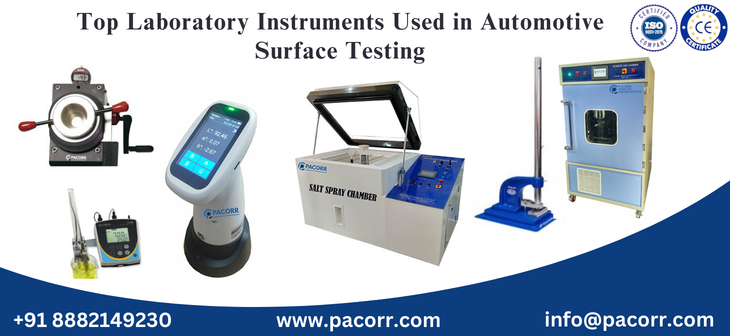
Top Laboratory Instruments Used in Automotive Surface Testing
The automotive industry uses a range of specialized laboratory tools. Below are the most important automotive material testing instruments for surface evaluation.
1. Coating Thickness Tester
This is one of the most essential paint testing instruments for automotive quality control. It verifies whether paint or coating layers are applied within the specified range. Too thin a coating may fail prematurely, while too thick a layer can cause curing and appearance issues.
2. Salt Spray Chamber
A critical piece of paint and coating testing equipment, the salt spray chamber helps assess corrosion resistance. It is widely used for painted panels, electroplated components, fasteners, trims, and underbody parts.
3. Cross Hatch Adhesion Tester
Adhesion is one of the most important coating performance indicators. This instrument is frequently used to evaluate primer, topcoat, and plated surface bonding.
4. Gloss Meter
Surface appearance matters greatly in automotive manufacturing. A gloss meter ensures painted parts match visual quality expectations and remain consistent across production lots.
5. Impact Resistance Tester
This tester evaluates how coatings respond to sudden mechanical force. It is highly relevant for automotive body panels and coated components exposed to service shocks.
6. Hardness Tester
Hardness testing helps determine a coating’s resistance to scratching and marring. This is especially useful for decorative and high-touch automotive surfaces.
7. Humidity and Environmental Test Chamber
While not limited to surface testing, environmental chambers are often used to evaluate how coatings perform under heat, moisture, and cyclic climate conditions. They help simulate long-term aging.
8. Abrasion Resistance Tester
This instrument is useful for surfaces that experience repeated contact or wear, such as interior trims, switches, and coated functional parts.
9. Plating Thickness Measurement Equipment
For plated automotive components, this is one of the most important plating testing instruments. It confirms thickness consistency and helps validate corrosion protection capability.
10. Surface Inspection and Visual Evaluation Tools
Although often combined with instrumental testing, visual surface inspection systems support the detection of pinholes, orange peel, inclusions, color inconsistency, and other coating defects.
How Paint Testing Instruments Are Applied in Quality Testing
The effectiveness of paint testing instruments depends not only on the equipment itself but also on how they are integrated into the quality control workflow.
Typical stages include:
- Incoming material inspection to verify coated raw materials or outsourced plated parts
- In-process testing to monitor coating consistency during manufacturing
- Final inspection before dispatch
- Failure analysis to determine the cause of coating defects
- R&D validation for new coating systems and treatment methods
In many automotive labs, multiple instruments are used together rather than in isolation. For example, a quality team may combine thickness testing, adhesion testing, gloss measurement, and salt spray testing to build a full performance profile for a painted component.
Applications of Paint Testing Instruments, Plating Testing Instruments, and Automotive Material Testing Instruments in Different Industries
Although these instruments are strongly associated with automotive manufacturing, their value extends across several sectors.
Automotive industry
Used for body panels, bumpers, trims, fasteners, plated hardware, chassis parts, and interior coated components.
Auto component manufacturing
Suppliers use automotive testing instruments to meet OEM requirements for coatings, plating, and surface durability.
Paint and coating industry
Coating manufacturers use paint and coating testing equipment to develop and validate formulations for automotive and industrial use.
Metal finishing and electroplating
Plating testing instruments are used to inspect zinc, chrome, nickel, and decorative plating quality on automotive and industrial parts.
Packaging and manufacturing industry
In the broader manufacturing space, surface testing ensures that coated metal packaging, industrial tools, appliances, and fabricated parts meet durability and appearance specifications.
Aerospace and engineering sectors
These industries also rely on corrosion resistance, coating adhesion, and surface quality testing for mission-critical parts.
How to Choose the Right Automotive Testing Instruments
Choosing the right automotive testing instruments requires a clear understanding of your products, quality objectives, testing standards, and production environment.
Consider the following factors:
Define the surface property you need to evaluate
Do you need to measure coating thickness, gloss, hardness, adhesion, corrosion resistance, or abrasion performance? The answer will determine the instrument category.
Consider substrate and coating type
Different instruments are designed for metal, plastic, painted, plated, powder-coated, or multi-layer surfaces. Make sure the equipment matches your application.
Check standards compliance
The right instrument should support testing methods aligned with ASTM, ISO, or customer-specific requirements.
Evaluate accuracy and repeatability
Industrial quality control depends on dependable results. Always prioritize precision and consistency over basic functionality.
Look for operator-friendly design
An instrument should be easy to use, calibrate, and maintain, especially in high-throughput testing environments.
Assess service and technical support
Instrument performance depends on calibration, maintenance, and after-sales support. Reliable supplier support is essential for long-term value.
Why Choose Pacorr for Paint Testing Instruments and Automotive Material Testing Instruments
When it comes to dependable paint testing instruments, plating testing instruments, automotive testing instruments, paint and coating testing equipment, and automotive material testing instruments, Pacorr stands out as a trusted partner for quality-focused industries.
Pacorr delivers testing solutions designed for accuracy, durability, and practical industrial use. With a strong focus on quality assurance and performance validation, Pacorr supports manufacturers who need reliable instruments for demanding laboratory and production applications.
Why businesses choose Pacorr:
- Precision-engineered instruments for industrial testing
- Reliable performance for routine quality control
- Solutions suitable for packaging, automotive, coatings, and manufacturing sectors
- Commitment to technical excellence and customer support
- Instruments designed to improve testing confidence and process efficiency
For manufacturers looking to strengthen their surface testing capability, Pacorr offers dependable solutions that align with modern quality expectations.
Get Expert Guidance from Pacorr
Whether you are evaluating paint adhesion, coating thickness, corrosion resistance, or plating quality, choosing the right instrument can significantly improve your inspection process and product reliability.
To discuss the best testing solution for your application, contact Pacorr today:
Email: info@pacorr.com
Phone: +91 8882149230
Conclusion
Automotive surface quality is a direct reflection of engineering discipline, process control, and brand commitment. From corrosion resistance and coating adhesion to gloss consistency and plating thickness, every parameter matters. That is why paint testing instruments, plating testing instruments, automotive testing instruments, paint and coating testing equipment, and automotive material testing instruments are essential tools in modern quality assurance systems.
The right laboratory instruments help automotive manufacturers prevent defects, meet standards, improve product durability, and maintain a premium finish across every component. As surface technologies continue to evolve, the need for accurate, repeatable, and application-specific testing will only become more important.
If your business is looking for reliable testing solutions for automotive and industrial surface evaluation, Pacorr can help you choose the right instruments for your quality requirements.
Contact Pacorr at info@pacorr.com or call +91 8882149230 to find the right testing instrument for your application.
Frequently Asked Questions
1. What are paint testing instruments used for in the automotive industry?
Paint testing instruments are used to evaluate coating thickness, adhesion, hardness, gloss, impact resistance, and overall surface durability on automotive parts. They help ensure coating quality and long-term performance.
2. Why are plating testing instruments important for automotive components?
Plating testing instruments help verify plating thickness, uniformity, and corrosion resistance on metallic automotive parts. This is important because plated layers protect components from rust, wear, and environmental damage.
3. Which automotive testing instruments are most commonly used for surface testing?
The most common automotive testing instruments for surface testing include coating thickness gauges, salt spray chambers, gloss meters, adhesion testers, impact testers, hardness testers, and abrasion resistance testers.
4. How does paint and coating testing equipment improve quality control?
Paint and coating testing equipment improves quality control by providing measurable data on surface performance. It helps manufacturers detect defects early, maintain process consistency, and ensure compliance with quality standards.
5. What is the difference between paint testing instruments and automotive material testing instruments?
Paint testing instruments focus specifically on coating and surface properties, while automotive material testing instruments cover a broader range of tests on automotive materials, including strength, durability, and environmental resistance.
6. How do I choose the right paint and coating testing equipment?
Choose the right equipment based on the coating property you want to measure, the substrate type, required testing standards, instrument accuracy, ease of use, and available technical support.
7. Can automotive testing instruments be used in industries other than automotive?
Yes. Many automotive testing instruments are also used in metal finishing, packaging, coatings, engineering, appliance manufacturing, and other industrial sectors where surface quality and durability are important.
Recent Blogs
Enhance your understanding of testing and precise quality control indistinct applications with our
knowledge based articles coming from top editors of industry leaders.

Thanks to Pacorr Testing instruments, we have all the required quality testing instruments that have helped us to ensure the best quality delivered to our clients.

Danish
Fair Exports Pvt. Ltd.
