
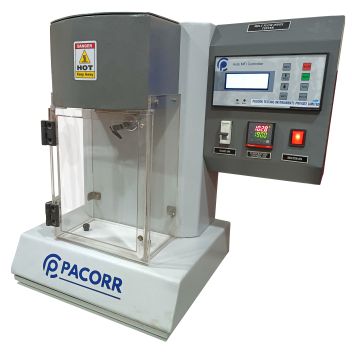
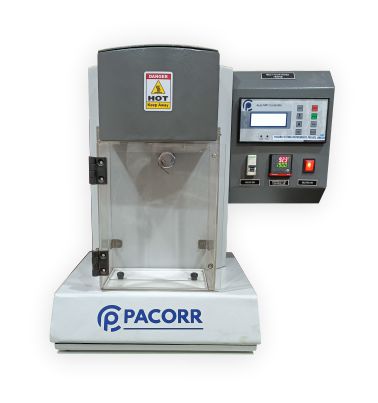

A Melt Flow Index Tester is used to determine the flow behaviour of thermoplastic materials under controlled temperature and load conditions. The test helps plastic manufacturers and quality-control laboratories compare polymer batches, verify incoming raw materials and monitor changes that may affect moulding or extrusion performance. Also known as an MFI Tester or Melt Flow Rate Tester, the instrument is commonly used for testing plastic granules, resins, masterbatches, compounds and recycled thermoplastics. Melt flow testing is performed according to standardized procedures such as ASTM D1238 and ISO 1133. Pacorr is a leading manufacturer and supplier of Melt Flow Index Tester in India. Get high-quality testing equipment at the best price. Contact us today.
- Shipping Area: All over the world
- Model: PCAMFIC-1
- Brand: Pacorr
- Availability: In Stock


What is a Melt Flow Index Tester?
A Melt Flow Index Tester determines the amount of molten thermoplastic that passes through a standard die under specified testing conditions. The polymer sample is heated inside a controlled barrel until it reaches the required molten condition. A defined load is then applied through a piston, forcing the material through a precisely sized die. For mass-based testing, the extruded polymer is measured and the result is generally expressed as Melt Mass-Flow Rate (MFR) in g/10 min. This value provides a useful reference for comparing materials of the same polymer type and grade when they are tested under identical conditions.
Why is Melt Flow Testing Important?
Plastic materials from two different batches may look identical but can behave differently during processing. Variation may result from differences in polymer grade, formulation, processing history, contamination or repeated recycling. Melt flow testing helps identify these differences before the material enters production.
It is useful for:
- Incoming raw-material inspection
- Polymer batch comparison
- Resin and masterbatch quality control
- Monitoring virgin and recycled plastics
- Injection moulding material evaluation
- Extrusion material testing
- Compound formulation development
- Production and R&D quality control
An MFR value should not be considered a complete measurement of plastic quality. Mechanical, thermal and physical properties may require separate testing.
Working Principle of Melt Flow Index Tester
The instrument works by extruding molten polymer through a standard die at a controlled temperature and applied load. A prepared polymer sample is introduced into the heated barrel. After the required preheating period, a piston carrying the specified test weight applies pressure to the molten material.
The polymer then flows through the die installed at the bottom of the barrel. The extrudate produced during a defined time interval is measured to calculate the Melt Mass-Flow Rate. Computerized systems can simplify this process through automatic cutting, weighing and MFR calculation, helping reduce manual handling during routine testing.
How is Melt Flow Index Testing Performed?
A typical test involves the following process:
- Select the temperature and test load specified for the polymer.
- Clean the barrel, piston and die before inserting the sample.
- Load a representative quantity of polymer granules into the heated barrel.
- Allow the material to preheat for the specified period.
- Apply the required load to the piston.
- Allow the molten polymer to extrude through the standard die.
- Measure the extruded material according to the selected test method.
- Calculate and record the Melt Flow Rate.
Temperature, applied load and test timing must remain consistent when different samples are compared.
Understanding MFI, MFR and MVR
MFI – Melt Flow Index is the commonly used industry term for describing polymer melt-flow behaviour.
MFR – Melt Mass-Flow Rate represents the mass of material extruded during the test and is normally expressed in g/10 min.
MVR – Melt Volume-Flow Rate represents the volume of material flowing through the die and is normally expressed in cm³/10 min.
MFR and MVR are different measurement methods. Laboratories requiring MVR testing should ensure that the selected equipment configuration supports the required displacement-based measurement method.
Factors That Affect Melt Flow Test Results
Melt-flow results can change significantly if test conditions are not properly controlled.
Important factors include:
- Temperature: Polymer flow is highly temperature dependent, so even unwanted temperature variation can influence the result.
- Applied Load: Different loads produce different flow conditions. Results should only be compared when the same specified load is used.
- Moisture: Moisture-sensitive polymers may require proper drying or conditioning before testing.
- Preheating Time: Incorrect heating time can affect the condition of the polymer before extrusion.
- Material Contamination: Mixing different resin grades or foreign particles can change the measured flow behaviour.
- Thermal History: Reprocessed or recycled polymer may behave differently after repeated heating and processing.
- Barrel and Die Cleanliness: Residual material from a previous test can restrict flow and affect repeatability.
How to Interpret MFI/MFR Results
A higher MFR generally means that more polymer has flowed through the die under the specified conditions, while a lower result indicates less flow during the same test period.
However, a higher value does not automatically mean better material quality. The correct melt-flow range depends on the polymer grade, processing method and intended application. The most useful approach is to compare test results with:
- Supplier specifications
- Approved reference materials
- Previous production batches
- Internal quality-control limits
- Customer material requirements
Melt-flow values obtained using different temperatures or loads should not be directly compared.
Applications of Melt Flow Index Tester
The instrument is commonly used in:
- Plastic and polymer manufacturing
- Injection moulding units
- Extrusion industries
- Masterbatch manufacturing
- Resin and compound production
- Plastic recycling facilities
- Packaging material manufacturing
- Polymer research laboratories
- Quality-control laboratories
Typical thermoplastic materials include PE, PP, ABS, polystyrene, polycarbonate, nylon and suitable polymer compounds, depending on the applicable test method.
ASTM D1238 and ISO 1133
ASTM D1238 and ISO 1133 are widely used standards for determining the melt-flow characteristics of thermoplastics.
Reliable testing requires more than simply recording a flow value. The correct temperature, load, sample preparation, preheating period, equipment condition and measurement procedure must be followed according to the applicable method.
Melt flow testing is particularly valuable for controlled material comparison and routine polymer quality control rather than as a complete simulation of actual injection moulding or extrusion conditions.
Benefits of Computerized Melt Flow Testing
A computerized Melt Flow Index Tester can reduce several repetitive manual operations during routine laboratory testing.
Key advantages include:
- Automatic extrudate cutting
- Automatic weighing
- Automatic MFR calculation
- Reduced manual calculation errors
- Consistent data recording
- Faster comparison of polymer batches
- Digital test result management
- Convenient laboratory reporting
Automation improves testing efficiency, but accurate results still depend on correct sample preparation, test conditions, cleaning and calibration.
Frequently Asked Questions
What does a Melt Flow Index Tester measure?
It measures the flow rate of molten thermoplastic through a standard die under specified temperature and load conditions.
Is MFI the same as MFR?
MFI is a commonly used industry term, while MFR specifically refers to Melt Mass-Flow Rate, normally reported in g/10 min.
Does a higher MFI mean better plastic?
No. Higher MFI indicates greater melt flow under the selected test conditions. The required value depends on the material grade and intended processing application.
Can recycled plastics be tested?
Yes. Melt-flow testing can be used to compare recycled or reprocessed thermoplastics with reference materials or specified quality limits.
What causes variation in MFI results?
Temperature variation, incorrect load, moisture, contamination, improper preheating, material degradation and dirty test components can affect the result.
Which standards are used for Melt Flow Index testing?
ASTM D1238 and ISO 1133 are widely used standards for determining melt-flow characteristics of thermoplastics.
What is the price of Melt Flow Index Tester in India?
The price of a Melt Flow Index Tester in India typically ranges from ₹60,000 to ₹3,00,000 INR, depending on the model type, features, level of automation, software compatibility, and included accessories.
Write Your Review

Santosh Kumar
Reliable and easy to use great melt flow index tester from Pacorr.
Sohan
Excellent performance and user-friendly design highly recommend Pacorr.
Kishan
Great build quality and highly accurate results the melt flow index tester from Pacorr is reliable and easy to operate.
Mrityunjay
The Melt Flow Index Tester is highly accurate, easy to use, and delivers consistent results. Perfect for quality testing needs.
Kishore
product working is fine
Related Products

Our Clients
























By Test Standard
By Test Application
Our USP's
Demonstration of Machine
- Try Before You Decide
- Experience Before You Invest
- See It in Action – Free Demo
Global Reach
- Delivering Excellence Worldwide
- Serving Across Borders
- Your Global Supply Partner
On-Site Support
- Support That Comes to You
- On-Ground Assistance, Anywhere
- We Reach Where You Are
Team Strength
- Powered by Expert Minds
- Driven by Skilled Professionals
- Engineering Excellence Team
Manufacturing
- Precision-Driven Manufacturing
- Smart & Automated Production
- Engineered In-House Excellence
