
Pacorr believes that surface finishing is not just about appearance it is about long-term durability, corrosion resistance, regulatory compliance, and brand credibility. In industries such as automotive, aerospace, construction, electronics, appliances, and heavy engineering, paint and plating quality directly impact product lifespan and customer satisfaction. A poorly coated surface can lead to corrosion, peeling, blistering, cracking, premature failure, warranty claims, and reputational damage.
This is why establishing a fully functional Paint & Plating Quality Control Lab is not optional for serious manufacturers it is a strategic necessity. A properly designed lab ensures that coatings meet international standards, adhere to precise thickness requirements, resist environmental exposure, and perform under real-world conditions.
In this in-depth guide, we will walk you through every step involved in setting up a Paint & Plating Quality Control Lab, including infrastructure planning, equipment selection, testing standards, documentation systems, safety compliance, manpower training, budgeting, and continuous improvement strategies.
Understanding the Purpose of a Paint & Plating Quality Control Lab
Before investing in equipment and infrastructure, manufacturers must clearly define the lab’s objective. A paint and plating lab serves multiple purposes:
- Verifying coating thickness compliance
- Ensuring adhesion strength between coating and substrate
- Testing corrosion resistance performance
- Evaluating surface hardness and scratch resistance
- Measuring gloss and surface finish consistency
- Validating impact and flexibility performance
- Identifying process defects before dispatch
The lab acts as a gatekeeper between production and dispatch, ensuring only compliant products reach customers.
Step 1: Define the Scope of Testing
The first and most critical step is defining the testing scope. The scope depends on the type of coating processes used in your manufacturing unit.
Common Paint & Plating Processes:
- Powder coating
- Liquid spray painting
- Electroplating (zinc, nickel, chrome, copper)
- Galvanizing
- Anodizing
- Phosphating
- E-coating
Each coating type requires specific quality parameters and test methods.
Identify Key Testing Parameters:
- Dry Film Thickness (DFT)
- Wet Film Thickness (WFT)
- Adhesion strength
- Corrosion resistance
- Impact resistance
- Flexibility
- Surface hardness
- Gloss level
- Salt spray durability
- Chemical resistance
Defining these parameters ensures you purchase the correct testing equipment and design a lab that supports your quality objectives.
Step 2: Laboratory Infrastructure Planning
A Paint & Plating QC Lab must be carefully designed to maintain accuracy and prevent contamination.
Space Requirements
The lab should include:
- Sample preparation area
- Testing equipment section
- Corrosion testing chamber zone
- Chemical storage cabinet
- Calibration storage space
- Documentation and reporting workstation
Adequate spacing between instruments prevents cross-interference and ensures operator safety.
Environmental Control
Environmental factors significantly influence coating test results.
- Temperature: Ideally maintained at 23 ± 2°C
- Humidity: Around 50 ± 5% RH
- Dust-free environment
- Proper ventilation system
Fluctuating environmental conditions can distort thickness readings, adhesion performance, and curing results.
Electrical & Utility Setup
- Stabilized power supply
- Grounded electrical outlets
- Emergency power backup
- Water supply (for salt spray chamber)
- Drainage system
Proper utility planning prevents operational downtime.
Step 3: Essential Equipment for Paint & Plating QC Lab
Equipment selection determines lab capability and credibility. Below is a detailed breakdown of critical instruments required.
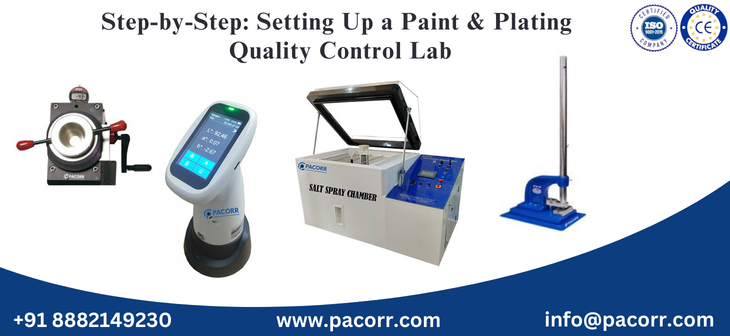
This is one of the most important instruments in a plating quality lab. It simulates aggressive corrosion conditions using a controlled salt fog environment.
Purpose:
To evaluate corrosion resistance of coated or plated components under accelerated conditions.
Key Standards:
- ASTM B117
- ISO 9227
- JIS Z 2371
Technical Considerations:
- Chamber material must be corrosion resistant (FRP or PVC)
- Uniform salt fog distribution
- Precise temperature control
- Fog collection measurement system
Salt spray testing helps predict product life in coastal or humid environments.
A coating thickness gauge measures dry film thickness on metal substrates.
Measurement Methods:
- Magnetic induction (for ferrous metals)
- Eddy current method (for non-ferrous metals)
Importance:
- Ensures coating meets design specification
- Prevents excessive paint usage
- Confirms plating thickness compliance
- Maintains performance consistency
Thickness variation is one of the most common causes of coating failure.
3. Cross Hatch Adhesion Tester
Adhesion testing determines how well the coating bonds to the substrate.
Procedure:
- Grid pattern is cut into coating
- Adhesive tape applied and removed
- Coating removal evaluated
Standards:
- ASTM D3359
- ISO 2409
Poor adhesion can result in peeling, flaking, and blistering.
Used to assess coating resistance to sudden mechanical shock.
Why Important?
Products like automotive parts and industrial equipment experience mechanical stress during handling and transportation. Impact testing ensures coating integrity under such stress.
5. Pencil Hardness Tester
Determines scratch resistance and surface hardness.
Hard coatings resist wear and extend product lifespan.
6. Gloss Meter
Gloss measurement ensures surface reflectivity consistency. In decorative applications, gloss uniformity is critical for aesthetic appeal.
7. Bend Test Apparatus
Used to determine coating flexibility.
Coatings that crack under bending indicate improper curing or poor formulation.
Evaluates elongation and deformation resistance of coatings.
This test is important in industries where sheet metal forming is common.
Step 4: Compliance with International Standards
To ensure credibility and global acceptance, your lab must align with international quality standards.
Relevant Standards Include:
- ASTM standards for coating tests
- ISO coating and corrosion standards
- DIN standards
- BIS standards in India
Certification under ISO 9001 and ISO 17025 further strengthens lab credibility.
Compliance ensures uniform testing procedures and international recognition.
Step 5: Develop Standard Operating Procedures (SOPs)
Standard Operating Procedures eliminate variability.
Each test must have a documented SOP covering:
- Sample preparation
- Equipment calibration
- Test duration
- Acceptance criteria
- Reporting format
SOPs ensure repeatability and traceability.
Step 6: Calibration & Maintenance Protocol
Testing instruments require routine calibration.
Best Practices:
- Annual third-party calibration
- Periodic internal verification
- Maintain calibration certificates
- Record equipment maintenance history
Uncalibrated equipment can lead to incorrect quality decisions.
Step 7: Data Recording & Digital Integration
Modern QC labs must adopt digital data systems.
Recommended Systems:
- ERP integration
- Digital test reports
- Cloud-based record storage
- Statistical analysis tools
Data analysis helps identify process trends and preventive actions.
Step 8: Skilled Manpower & Training
Equipment alone does not ensure quality trained personnel are essential.
Training areas include:
- International testing standards
- Equipment handling
- Chemical safety
- Report interpretation
- Root cause analysis
Continuous training improves lab reliability.
Step 9: Safety & Environmental Compliance
Paint and plating labs deal with chemicals, acids, and corrosive materials.
Safety protocols must include:
- PPE kits
- Chemical storage cabinets
- Fire safety equipment
- Emergency showers
- MSDS documentation
- Spill containment kits
Environmental waste disposal regulations must be strictly followed.
Step 10: Budget Planning & Cost Optimization
The cost of setting up a QC lab varies depending on:
- Number of tests required
- Automation level
- Industry compliance standards
- Lab size
However, the return on investment is substantial due to reduced rework, warranty claims, and customer complaints.
Continuous Improvement Strategy
Quality control is an evolving process.
Implement:
- Internal audits
- External audits
- Customer feedback review
- Process capability studies
- New technology adoption
Continuous improvement strengthens long-term competitiveness.
Common Mistakes to Avoid
- Ignoring environmental controls
- Buying non-standard equipment
- Lack of documentation
- Skipping calibration schedules
- Inadequate staff training
Avoiding these mistakes ensures lab efficiency and reliability.
Why Choose Pacorr for Your Paint & Plating Lab Setup?
Pacorr offers advanced, industry-compliant testing instruments tailored for paint and plating quality evaluation. With years of expertise in manufacturing precision testing equipment, Pacorr supports businesses in building reliable quality control systems.
Pacorr Offers:
- High-precision Salt Spray Chambers
- Coating Thickness Gauges
- Adhesion Testers
- Impact Testers
- Gloss Meters
- Technical consultation support
- Installation and training services
- After-sales service and calibration support
Pacorr ensures that your lab meets global standards and delivers accurate, repeatable, and dependable results.
Final Conclusion
Setting up a Paint & Plating Quality Control Lab is a long-term investment in product reliability, regulatory compliance, and customer trust. A structured approach starting from defining scope to equipment selection, infrastructure planning, standard compliance, and digital documentation ensures your lab operates at peak efficiency.
Manufacturers who prioritize coating quality not only reduce failures but also strengthen their market position and brand value.
If you are planning to establish or upgrade your Paint & Plating Quality Control Lab, Pacorr is ready to assist you with expert guidance and advanced testing solutions.
Email: info@pacorr.com
Contact: +91 8882149230
Partner with Pacorr and build a world-class Paint & Plating Quality Control Lab that sets industry benchmarks and ensures superior product performance.
Recent Blogs
Enhance your understanding of testing and precise quality control indistinct applications with our
knowledge based articles coming from top editors of industry leaders.
Thanks to Pacorr Testing instruments, we have all the required quality testing instruments that have helped us to ensure the best quality delivered to our clients.

Danish
Fair Exports Pvt. Ltd.
