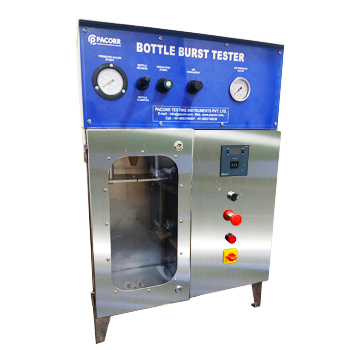
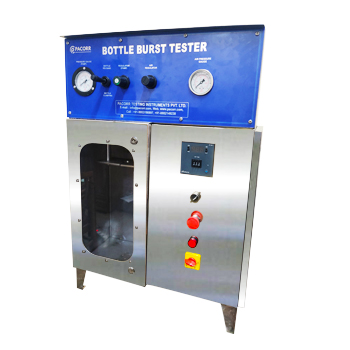
A Bottle Burst Tester is a precision testing instrument used to measure the pressure resistance and structural integrity of PET and plastic bottles. It helps manufacturers determine how much internal pressure a bottle can withstand before it leaks, deforms, or bursts. This test is essential for maintaining product safety, packaging reliability, and consistent quality during production, storage, and transportation.
- Shipping Area: All over the world
- Model: PC-Burst-Tester
- Brand: Pacorr
- Availability: In Stock

The Pacorr Bottle Burst Tester is an industry-leading quality control instrument engineered to deliver exceptionally accurate and repeatable burst pressure evaluations for PET and plastic bottles. In high-stakes sectors like beverage production, pharmaceuticals, cosmetics, and industrial packaging, containers are constantly exposed to intense internal pressures driven by carbonation, high-speed filling lines, thermal expansion, warehouse stacking, and rigorous transit handling. If a bottle lacks the requisite structural resilience, it will inevitably leak, deform, or catastrophically fail before ever reaching the end consumer. By simulating these intense real-world forces under highly regulated laboratory conditions, this advanced instrument empowers quality assurance teams to isolate physical vulnerabilities, optimize material usage, and safeguard their brand's market reputation.
The Mechanics of Failure: Why Do Bottles Explode?
To design a highly resilient bottle, quality assurance teams must understand exactly how and where a polymer structure degrades under stress. The Pacorr Bottle Burst Tester maps out these precise points of vulnerability:
Base Roll-Out: Before a bottle physically ruptures, the concave base (especially in petaloid designs meant for carbonation) may pop outward due to internal pressure. This causes the bottle to lose its vertical stability and tip over on automated conveyor belts.
Sidewall Thinning: Inconsistent material distribution during the stretch blow-molding process results in localized thin spots. Under pressure, these microscopic thinned regions act as the path of least resistance, leading to immediate structural failure.
Gate Failure: The injection point (gate) at the very center of a PET preform base is a common site for molecular stress concentration, making it highly susceptible to micro-cracking and splitting under pressure spikes.
How the Pacorr Bottle Burst Tester Works
Modern bottle burst testing relies on precise pneumatic or hydrostatic pressurization to capture real-time material expansion metrics. The operational workflow is highly streamlined for daily laboratory routines:
- Clamping and Sealing: The test bottle is placed inside a heavy-duty, reinforced steel safety cage. The neck of the bottle is locked tightly into a specialized quick-clamping fixture, ensuring a hermetic, leak-proof seal that prevents pressure loss through the threads.
- Pressurization (The Ramp Phase): The system injects a fluid medium (typically water for hydrostatic testing to ensure ultimate safety) or compressed air into the bottle. The pressure is increased using a Linear Ramp Test (where pressure increases at a constant, predetermined rate like 5 psi per second until failure) or a Pre-set Limit/Hold Test (where the bottle is pressurized to a specific target and held for a set duration).
- Data Extraction: As the pressure climbs, digital sensors track the volume expansion. The moment the material ruptures or experiences a sudden drop in pressure, the microprocessor freezes the display, capturing the exact Ultimate Burst Pressure (UBP).
Key Industry Compliance and Testing Standards
When evaluating packaging integrity, compliance with strict regulatory protocols is vital for global market acceptance and legal safety standards. The Pacorr Bottle Burst Tester is engineered to align seamlessly with international benchmarks such as ASTM guidelines for pressure retention in carbonated beverage containers, ensuring precise replication of real-world shelf stresses. Furthermore, its calibration workflows strictly adhere to ISO 9001 quality management systems, providing verifiable and repeatable data across worldwide supply chains. For regional compliance and specialized food safety applications, the instrument fully supports standards like IS 15414, which governs the specific structural tolerances required for PET bottles handling alcoholic, non-alcoholic, and highly carbonated beverages.
Technical Features of the Pacorr System
- Microprocessor-Based Digital Displays: Provides crystal-clear, real-time readouts of peak pressure values, eliminating human transcription error.
- Auto-Cutoff and Peak Hold Technology: Automatically detects the precise millisecond of structural failure and retains that data point for logging.
- Reinforced Safety Interlocking Enclosure: High-pressure testing carries inherent physical risks. Pacorr testers feature thick, shatterproof safety cages that prevent operation if the enclosure door is left open.
- Corrosion-Resistant Fixtures: Because water is frequently used as the pressurization medium, the clamping assemblies are crafted from high-grade stainless steel to prevent rust and long-term wear.
- Customizable Testing Profiles: Allows users to alternate between quick destructive burst tests and prolonged pressure-holding evaluations depending on R&D needs.
Industrial Applications
The application of bottle burst testing spans multiple multi-billion-dollar sectors, each with its own strict quality criteria:
- Beverage and Carbonated Drink Production: Ensures that sodas, sparkling water, and energy drinks can withstand internal pressures that often exceed 4 to 6 bars under ambient conditions.
- Pharmaceutical and Medical Packaging: Containers for liquid medications, saline drops, and eye solutions must maintain absolute seal integrity to prevent contamination.
- Personal Care and Cosmetics: Shampoos, lotions, and aerosol-alternative pump bottles rely on burst testing to confirm that container walls won't rupture under the mechanical stresses of automated filling lines.
- Raw Material and Preform R&D: Plastic converters use burst testers to experiment with lightweighting—reducing the amount of plastic resin per bottle without compromising consumer safety.
Business Benefits: Turning Quality Control into Profit
- Optimized Material Costs: By identifying exactly how much pressure a bottle can take, R&D teams can safely reduce wall thickness, saving fractions of a cent per bottle—which translates into hundreds of thousands of dollars across massive production runs.
- Drastic Reduction in Rejection Rates: Catching a blowing flaw or a bad batch of preforms at the start of a shift prevents thousands of defective bottles from reaching the expensive filling stage.
- Mitigating Brand Liability: Exploding bottles on retail shelves or during transit can result in lawsuits, distributor penalties, and devastating public relations crises.
Frequently Asked Questions (FAQ)
1. What is the fundamental difference between a burst test and a leak test?
A leak test checks if a bottle can maintain a sealed environment under low, steady pressure over time without letting air or liquid escape. A burst test is a destructive test designed to push the container to its absolute physical limits to find the exact pressure point where the structural material completely fails.
2. Can a single machine test different bottle shapes and sizes?
Yes. The Pacorr Bottle Burst Tester features adaptable modular fixtures. By swapping out the neck-clamping rings, operators can quickly pivot from testing a small 200 ml pharmaceutical vial to a large 2-liter carbonated beverage bottle.
3. Why is water preferred over air for high-pressure burst testing?
Water is virtually incompressible. When a bottle ruptures under water pressure, the release of energy is instantaneous but contained. If high-pressure compressed air were used, the sudden expansion of air upon rupture could cause a violent explosion, posing a safety risk to operators.
4. How frequently should a Bottle Burst Tester be calibrated?
To maintain compliance with ISO and ASTM standards, it is highly recommended to calibrate your instrument at least once a year, or more frequently if it is utilized daily in high-volume, multi-shift manufacturing environments.
5. What is the typical price range of a professional Bottle Burst Tester?
Depending on the level of automation (manual vs. fully automated PLC touchscreens), safety features, and pressure capacities, industrial Bottle Burst Testers generally range from INR 80,000 to INR 5,00,000. Custom specifications and data-logging software integrations can influence final pricing.
Write Your Review
Get a Quote
Share your requirement and our team will reply shortly.
+91-8882149230
Related Products
Our Clients
















Explore Related Tests
Find more testing instruments by test standard, application and industry.
By Test Application
Our USP's
Demonstration of Machine
- Try Before You Decide
- Experience Before You Invest
- See It in Action – Free Demo
Global Reach
- Delivering Excellence Worldwide
- Serving Across Borders
- Your Global Supply Partner
On-Site Support
- Support That Comes to You
- On-Ground Assistance, Anywhere
- We Reach Where You Are
Team Strength
- Powered by Expert Minds
- Driven by Skilled Professionals
- Engineering Excellence Team
Manufacturing
- Precision-Driven Manufacturing
- Smart & Automated Production
- Engineered In-House Excellence
