
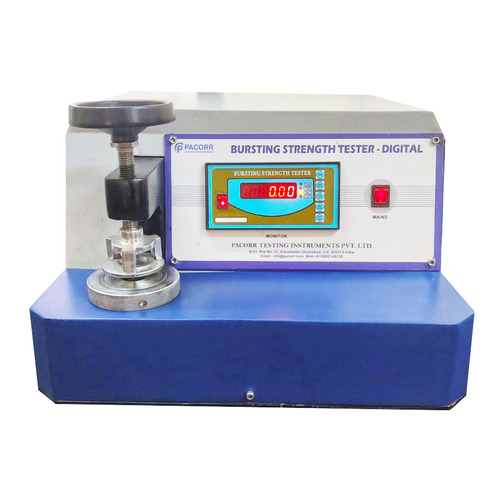
Pacorr’s bursting strength tester measures the pressure at which a clamped specimen ruptures under an expanding hydraulic diaphragm. The PCBSTD model provides a digital readout for routine material testing and quality-control records.
For paper and packaging applications, compare material batches using a defined test method and consistent sample preparation. Share your material, expected pressure range and required standard so Pacorr can confirm the appropriate instrument configuration.
Looking for the bursting strength tester price in India? Review the indicative price range and quotation checklist below, along with specifications and model options.
- Shipping Area: All over the world
- Model: PCBSTD
- Brand: Pacorr
- Availability: In Stock


Applications and Materials
Burst testing helps a quality-control team assess a material’s resistance to rupture under the conditions of the selected test. Typical purchasing enquiries cover paper, paperboard and corrugated packaging materials; textile applications require a material-specific method and suitable apparatus.
- Check incoming material against an agreed purchase specification.
- Compare supplier samples and production batches tested under the same conditions.
- Evaluate a material change using the relevant test method and acceptance criteria.
- Record results for internal quality control and discussions with suppliers or customers.
Paper, corrugated board and fabric do not automatically use the same test configuration. Confirm the required clamp, diaphragm, pressure range and fluid delivery conditions before selecting a model.
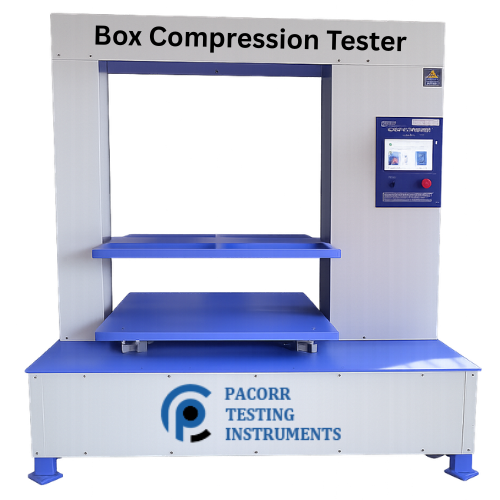
Bursting strength describes one aspect of material performance. It does not, by itself, establish how much load a finished carton can withstand during stacking. For that requirement, consider a box compression tester and the applicable packaging test procedure.
Digital Bursting Strength Tester Specifications
| Specification | Details |
|---|---|
| Brand and model | Pacorr PCBSTD |
| Display | Digital LCD with backlight |
| Listed maximum pressure | 40 kgf/cm² |
| Display resolution / least count | 0.1 kgf/cm² |
| Listed accuracy | ±1% within 10%–90% of the measurement range |
| Upper clamp opening | 35.5 mm diameter |
| Lower clamp opening | 38.1 mm diameter |
| Fluid displacement rate | 95 cc/min |
| Hydraulic test fluid | Glycerin |
| Clamping arrangement | Operating-wheel clamping with a grooved specimen holder |
| Operation | Single push-button operation |
| Motor | ¼ HP, single phase |
| Peak-hold facility | Available |
| Tare facility | Available |
| Instrument dimensions | 61 × 44 × 44 cm |
For procurement, request a configuration-specific specification sheet. Confirm whether the stated accuracy is expressed as a percentage of the reading or full scale, and request the calibration scope and measurement uncertainty needed for your quality system.
Features for Routine Testing
- Backlit digital display: read the pressure result directly from the instrument.
- Peak hold: retain the maximum indicated value for recording after the test.
- Tare facility: use the zero-setting function as directed in the operating procedure.
- Push-button operation: start the test using the instrument control after preparing and securing the specimen.
- Grooved specimen holder: hold the sample with the operating-wheel clamp; correct placement and uniform clamping remain important for valid results.
The digital display and peak-hold function support routine reading and recording. If your process needs computer-connected reports, compare the computerized model and confirm the required reporting functions before ordering.
How Does a Bursting Strength Tester Work?
The specimen is secured over a flexible diaphragm. Hydraulic fluid expands the diaphragm against the specimen until rupture occurs. The instrument indicates the pressure associated with the test, rather than a force value in newtons.
- Select the required test method and confirm that the instrument configuration is suitable for the material.
- Prepare and condition specimens as required by that method.
- Inspect the diaphragm and clamping surfaces, then position and secure the specimen.
- Operate the instrument according to its manual and the selected test procedure.
- Record the result, review invalid or slipped specimens as specified by the method, and complete the required number of tests.
- Report the method, units, sample identification and any relevant test conditions with the results.
Use the applicable standard and operating manual for detailed preparation, conditioning, corrections and reporting requirements. Read the bursting strength tester working principle and buying guide for additional background.
Bursting Strength, Bursting Factor and Burst Index
Bursting strength
Bursting strength is a pressure result obtained using a specified test method. State the unit with every result, such as kPa or kgf/cm². Do not interchange force units and pressure units.
Burst index
Burst index relates bursting strength to the material’s grammage. Using pressure in kPa and grammage in g/m² gives the conventional unit kPa·m²/g.
Burst index (kPa·m²/g) = Bursting strength (kPa) ÷ Grammage (g/m²)
Illustrative calculation: a sample with a bursting strength of 400 kPa and a grammage of 200 g/m² has a burst index of 2 kPa·m²/g. These are example values, not a product specification or a claimed test result.
Bursting factor
For the conventional bursting factor calculation below, enter pressure in kgf/cm² and grammage in g/m². The multiplier converts kilogram-force to gram-force.
Bursting factor = [Bursting strength (kgf/cm²) × 1,000] ÷ Grammage (g/m²)
If the pressure value is already expressed in gf/cm², divide it directly by grammage in g/m² without multiplying by 1,000 again. Keep the method, units and calculation convention consistent when comparing reports.
Selecting the Right Test Method
Choose the test method from the material and customer specification, then confirm the matching instrument configuration. The following standards address different materials; listing them here does not mean that one PCBSTD configuration satisfies every method.
| Material / reference | What to confirm |
|---|---|
| Paper: ISO 2758 | Confirm that the paper and expected test pressure fall within the method’s scope, and specify the required apparatus conditions. |
| Board: ISO 2759 | Confirm the board type, expected pressure and the apparatus configuration required by the method. |
| Textiles: ASTM D3786/D3786M | This diaphragm bursting method addresses textile fabrics. Confirm specimen requirements and apparatus suitability for the fabric being tested. |
ASTM D774/D774M is a legacy paper bursting standard that ASTM lists as withdrawn in 2010. If a purchase specification still references it, clarify the required edition and acceptance method with the customer before ordering. View the ASTM D774/D774M status.
Include the standard number and edition in your enquiry. Ask for confirmation of the clamp openings, diaphragm, fluid delivery conditions, pressure measurement and calibration appropriate to that method.
Compare Digital, Pneumatic and Computerized Models
| Model | Selection guidance |
|---|---|
| Digital PCBSTD | Operating-wheel clamping, digital display and peak hold. Discuss this model for routine testing where readings are recorded by the operator. |
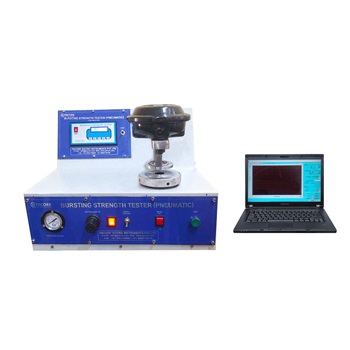
| Pneumatic PCBSTD-70P | Pneumatic clamping. Confirm the required pressure range, air supply and reporting functions for the quoted configuration. |
| Pneumatic computerized PCPBST-C | Pneumatic clamping with RS232 connectivity and software. Discuss this model when computer-connected data and reports are part of the requirement. |
Select the model according to the material, test method, expected pressure, number of samples and reporting needs. The computerized model’s published specification places the computer or laptop and air compressor within the customer’s scope; confirm the complete supply list in the quotation.
Before purchase, confirm the software functions, compatible computer setup, accessories, consumables and any external air-supply requirement. A digital readout alone does not establish that computer reporting is included.
Bursting Strength Tester Price in India
Pacorr’s published indicative bursting strength tester price range is ₹50,000 to ₹2,50,000, depending on the model and features. This is general buying guidance, not a fixed selling price for the PCBSTD or a quotation for a specific configuration.
For an exact digital bursting strength tester price, share the material, required test method and preferred model. Compare quotations using the same instrument configuration and supply scope.
| Quotation item | Details to request |
|---|---|
| Instrument configuration | Model, pressure range, clamping arrangement and the required test method. |
| Reporting and accessories | Digital reading or computer-connected reporting; software and accessories included in the quoted supply. |
| Calibration documentation | Calibration points, certificate scope, traceability and any additional documentation requested by your quality team. |
| Installation and training | Location, delivery method, scope and any separate charges. |
| Taxes and delivery | GST, freight, packing, destination and the delivery schedule. |
| Support and consumables | Warranty terms, diaphragm availability, maintenance support and replacement-part charges. |
Details to include with your enquiry
- Material type, construction and intended application.
- Expected bursting pressure range, if known.
- Required test standard and edition.
- Approximate number of samples tested per day.
- Manual recording or computer-connected reporting requirements.
- Installation city and any calibration or documentation requirements.
Ask for the instrument price and any additional charges to be identified separately so you can compare the total supply cost.
Get a Bursting Strength Tester Price Quote
Calibration, Installation, Training and After-Sales Support
Pacorr provides application guidance, troubleshooting and operator-training support, with online or onsite assistance discussed according to the requirement. Confirm the service arrangements and charges for your location before purchase.
- Calibration: specify the pressure range, calibration points and certificate details your quality system requires.
- Installation: agree the installation scope and confirm the utilities or external equipment needed for the selected model.
- Training: request guidance on specimen preparation, clamping, operation, recording results and routine checks.
- Warranty and maintenance: obtain the applicable written warranty terms, maintenance arrangements and spare-part availability.
- Consumables: confirm the correct diaphragm and replacement procedure for your instrument configuration.
Contact Pacorr technical support for application or service enquiries. Warranty duration, calibration documentation and installation inclusions should be stated in the quotation or agreed service scope.
Related Paper and Packaging Tests
Select complementary tests according to the material and finished package requirements. A burst result should not be treated as a substitute for every other packaging performance measure.
- Box compression testing for the compressive performance of a finished box.
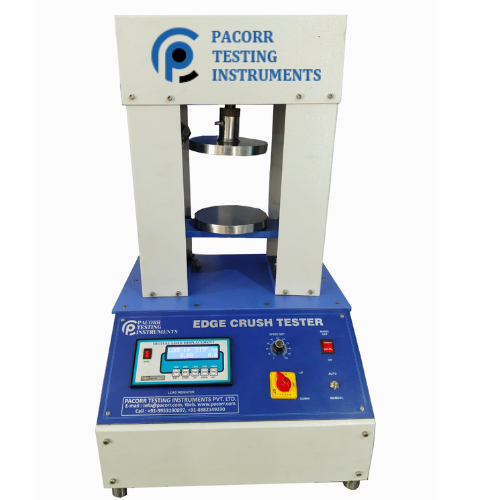
- Edge crush testing for the edgewise compression strength of corrugated board.
- Cobb testing for water absorptiveness under the selected test conditions.
- GSM measurement for grammage data used in material comparisons and calculations.
Frequently Asked Questions
What is the price of a bursting strength tester?
The indicative range published by Pacorr is ₹50,000–₹2,50,000, depending on the model and features. Request a configuration-specific quotation to confirm the instrument price, taxes, delivery, accessories and service scope.
Is the digital PCBSTD a computerized model?
The PCBSTD is listed with a digital display and peak-hold facility. For computer connectivity and software-based reporting, review the separate PCPBST-C computerized model and confirm the functions included in the quotation.
Can one configuration test paper, corrugated board and textiles?
Do not assume that it can. These materials may require different test methods, diaphragms, clamps, fluid delivery conditions and measurement ranges. Share your material and required standard so the configuration can be confirmed.
Does pneumatic clamping mean the burst pressure is applied by air?
Not necessarily. On the Pacorr pneumatic models described here, compressed air operates the clamping arrangement, while the diaphragm test uses a hydraulic fluid system. Confirm both the clamping and testing arrangements when comparing equipment.
Which hydraulic fluid is listed for PCBSTD?
Glycerin is the fluid specified for the PCBSTD. Follow the operating manual and Pacorr’s service instructions for the correct fluid, filling procedure and maintenance. Do not substitute another fluid without technical confirmation.
What should I do if the diaphragm is damaged?
Stop testing and contact technical support. Replace the diaphragm with the correct part and complete the checks required by the operating procedure before returning the instrument to service.
Can the instrument be used for plastics or flexible films?
Suitability depends on the material, construction, test method and apparatus. Do not assume that a paper or board configuration is appropriate for a plastic film. Send sample details and the required method for technical review.
Does a higher burst result prove that a box will stack safely?
No. Bursting strength measures resistance to rupture under the burst-test conditions. Finished-box compression, board construction, moisture and other packaging factors also affect stacking performance. Select the tests required for the intended package and distribution conditions.
Request a Bursting Strength Tester Quotation
Tell us what you need to test, the required standard and your preferred reporting method. Pacorr can review the requirement and provide a model-specific price quotation. Include your installation city and any calibration, training or documentation needs.
Email: info@pacorr.com
Phone: +91-8882149230
Write Your Review

Rahul Sharma
Easy to use and quick to complete testing.
Harish
Getting best results. Thanks
Lakhwinder
Thank you for Best machine
S.S Jha
Machine quality is the best.
Nilesh
Getting Accurate results.
Sunil Kumar
you always deliver work ahead of schedule and never forget any details
Amit Verma
A useful machine for checking paper and packaging strength.
Priya Singh
Clear display and easy-to-read results.
Vikas Gupta
Good build quality and convenient for daily testing.
Neha Patel
Simple controls make this tester easy to operate.
Suresh Kumar
This tester has made our quality checks much easier.
Rohit Mehta
A good experience testing packaging materials with this machine.
Get a Quote
Share your requirement and our team will reply shortly.
+91-8882149230
Related Products
Our Clients























Explore Related Tests
Find more testing instruments by test standard, application and industry.
By Test Standard
By Test Application
Our USP's
Demonstration of Machine
- Try Before You Decide
- Experience Before You Invest
- See It in Action – Free Demo
Global Reach
- Delivering Excellence Worldwide
- Serving Across Borders
- Your Global Supply Partner
On-Site Support
- Support That Comes to You
- On-Ground Assistance, Anywhere
- We Reach Where You Are
Team Strength
- Powered by Expert Minds
- Driven by Skilled Professionals
- Engineering Excellence Team
Manufacturing
- Precision-Driven Manufacturing
- Smart & Automated Production
- Engineered In-House Excellence
