
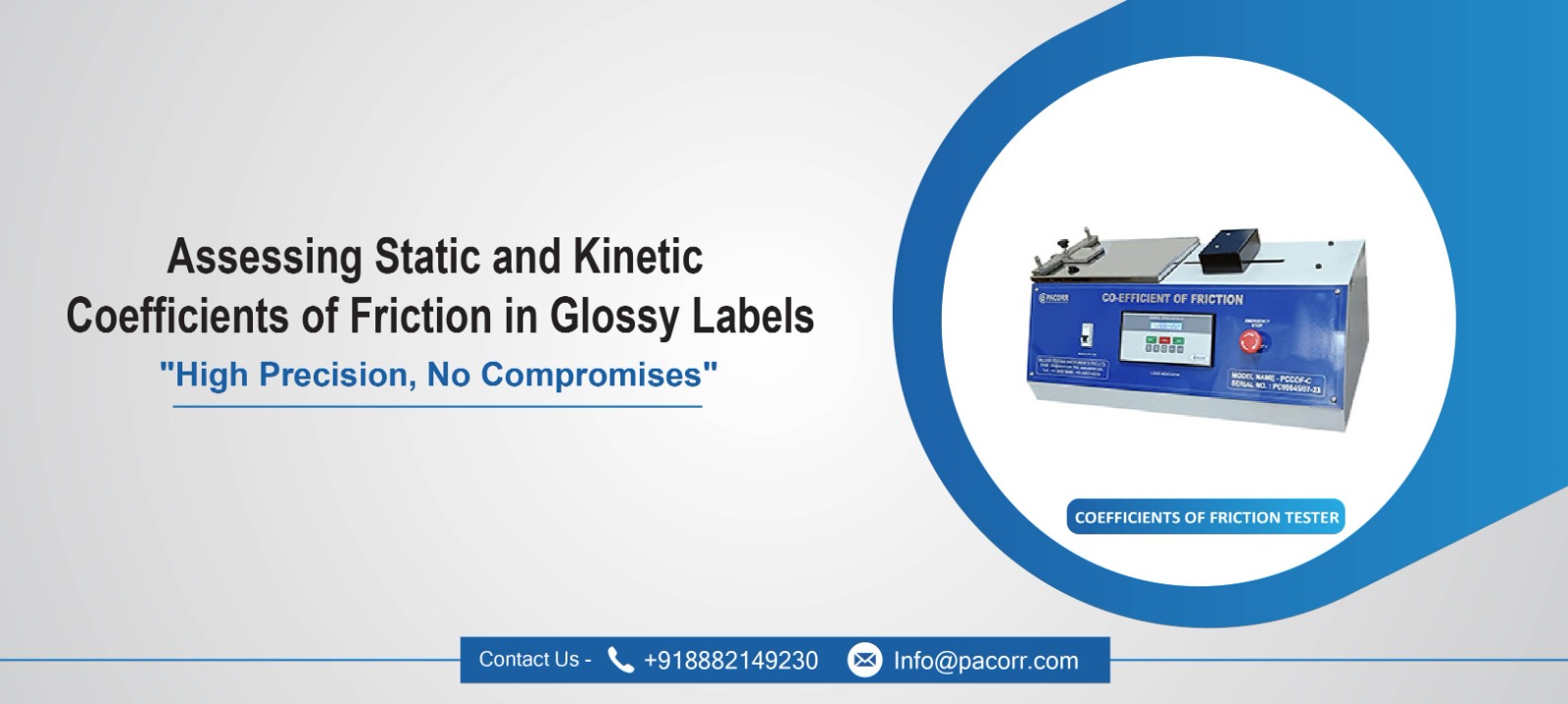
 Glossy labels are commonly used in various industries, such as packaging, branding, and advertising, where appearance and functionality are crucial. Understanding the frictional properties of these labels, especially the static and kinetic coefficients of friction, is vital in ensuring their proper performance during production, application, and transportation. One effective tool for measuring these coefficients is a coefficient friction tester.
What are Static and Kinetic Coefficients of Friction?
Before delving into the testing process, let's define static and kinetic coefficients of friction. The static coefficient of friction refers to the resistance to initial motion between two surfaces in contact when they are stationary. In contrast, the kinetic coefficient of friction pertains to the resistance to motion between the surfaces when they are already in motion.
Assessing Frictional Properties with a Coefficient Friction Tester:
A coefficient friction tester is an instrumental device used to measure the frictional forces between two materials in contact. Here's how you can use this equipment to assess the static and kinetic coefficients of friction in glossy labels:
1. Sample Preparation:
Begin by preparing samples of glossy labels that you intend to test. Ensure the samples are uniform in size and shape to acquire accurate and consistent results.
2. Testing Procedure:
- Place the glossy label sample on the flat surface of the coefficient friction tester.
- Adjust the tester's settings to initiate the test for static friction measurement.
- Gradually increase the force applied to the sample until it starts moving. Note the force required to overcome the static friction and initiate motion.
- For kinetic friction measurement, set the tester to a constant speed and measure the force required to maintain that speed while the sample is in motion.
3. Data Collection and Analysis:
Record the measurements obtained during the static and kinetic friction tests. Calculate the coefficients of friction using the formula:
Static Coefficient of Friction = Force required to initiate motion / Normal force applied
Kinetic Coefficient of Friction = Force required to maintain constant motion / Normal force applied
4. Interpretation of Results:
The obtained coefficients of friction provide valuable insights into the label's behavior. A higher static coefficient indicates more resistance to initial movement, which might affect the label's peel-off or application. A higher kinetic coefficient suggests difficulties in sliding or moving the labels during transportation or handling.
5. Repeated Trials and Validation:
Perform multiple tests on different glossy label samples to ensure consistency and reliability of the results. This helps in validating the findings and drawing accurate conclusions about the frictional properties of the labels.
Accurately measuring the static and kinetic coefficients of friction in glossy labels using a coefficient friction tester is essential for various industries. Understanding these frictional properties aids in optimizing the label's performance during production, application, and transportation, ensuring customer satisfaction and efficient operations within the respective industry.
By utilizing the steps outlined above with a coefficient friction tester, industries can gain crucial insights into the frictional behavior of glossy labels, allowing for informed decision-making and quality improvement initiatives.
Recent Blogs
Enhance your understanding of testing and precise quality control indistinct applications with our
knowledge based articles coming from top editors of industry leaders.

Our USP's
Demonstration of Machine
- Try Before You Decide
- Experience Before You Invest
- See It in Action – Free Demo
Global Reach
- Delivering Excellence Worldwide
- Serving Across Borders
- Your Global Supply Partner
On-Site Support
- Support That Comes to You
- On-Ground Assistance, Anywhere
- We Reach Where You Are
Team Strength
- Powered by Expert Minds
- Driven by Skilled Professionals
- Engineering Excellence Team
Manufacturing
- Precision-Driven Manufacturing
- Smart & Automated Production
- Engineered In-House Excellence
