
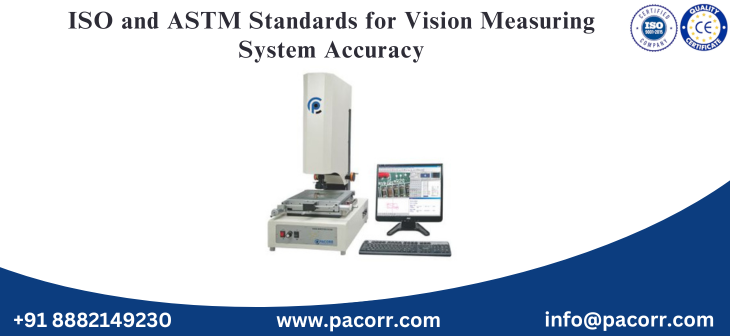
Pacorr understands that in precision manufacturing, accuracy is not just a technical feature it is the foundation of product quality, customer trust, and compliance. A Vision Measuring System plays a vital role in helping manufacturers inspect dimensions, verify tolerances, and maintain consistent quality without physically touching the component being measured.
As industries move toward tighter tolerances and faster inspection cycles, the demand for reliable optical measurement systems continues to grow. From automotive parts and plastic components to electronics, medical devices, rubber products, and packaging materials, manufacturers need measurement equipment that delivers repeatable and dependable results. This is where ISO and ASTM standards become highly important.
A Vision Measuring System is more than a camera-based inspection tool. It is a precision measurement machine that combines optics, lighting, software, motion control, and calibration methods to measure complex geometries with high accuracy. When such equipment is aligned with recognized ISO calibration standards and ASTM testing standards, manufacturers gain greater confidence in their inspection process, audit documentation, and manufacturing quality assurance.
This guide explains how ISO and ASTM standards support Vision Measuring System accuracy, why compliance matters, what factors influence measurement performance, and how Pacorr helps industries choose dependable precision inspection tools.
Introduction to Vision Measuring Systems
A Vision Measuring System is a non-contact measurement equipment solution used to inspect the physical dimensions of a component through optical imaging. Instead of touching the product with a probe or gauge, the system captures a magnified image and uses advanced software to calculate dimensions from edges, contours, holes, slots, angles, radii, and profiles.
This type of dimensional inspection system is widely used when traditional measuring tools are not suitable. For example, soft rubber parts may compress under contact pressure, transparent parts may be difficult to measure manually, and micro-components may be too small for conventional gauges. A vision-based system solves these challenges by measuring parts visually and digitally.
A standard Vision Measuring System may include a high-resolution camera, precision lens, LED illumination, stable measuring stage, digital readout, software interface, and optional motorized movement. Advanced models may also include CNC control, automatic edge detection, programmable inspection routines, and digital reporting features.
In industrial quality control, the system is often used as a video measuring machine, optical measurement system, coordinate measuring system, or automated measurement system, depending on its configuration and application.
Importance of Accuracy in Industrial Measurement
Accuracy directly affects manufacturing decisions. If a measuring system provides incorrect results, it can lead to wrong approvals, unnecessary rejections, assembly problems, production delays, and customer complaints. For this reason, a Vision Measuring System must not only measure quickly but also measure correctly.
In modern production, even a small deviation can create serious quality issues. A plastic cap that is slightly out of tolerance may fail to seal properly. A metal component with an incorrect hole position may not fit during assembly. A PCB with inaccurate spacing may affect electrical performance. A rubber gasket with uneven dimensions may cause leakage.
Accurate industrial inspection equipment helps manufacturers prevent these problems before products reach customers. It allows quality teams to confirm whether every critical dimension matches design requirements.
A reliable Vision Measuring System improves:
- Dimensional accuracy
- Inspection repeatability
- Process control
- Product consistency
- Batch approval confidence
- Supplier quality inspection
- Production troubleshooting
- Compliance documentation
For quality control engineers and laboratory professionals, accuracy is not only about measurement numbers. It is about whether those numbers can be trusted repeatedly across operators, shifts, locations, and production batches.
Understanding ISO Standards for Vision Measuring Systems
ISO standards provide internationally recognized guidance for quality systems, calibration, measurement traceability, and equipment performance verification. For Vision Measuring Systems, ISO standards are important because they help define how accuracy should be checked, documented, and maintained.
One of the most relevant standard families for dimensional measurement equipment is the ISO 10360 series. This series addresses performance testing of coordinate measuring systems and related measuring equipment. Vision-based measurement systems are often evaluated using principles connected to coordinate measurement, imaging probes, optical sensing, and dimensional verification.
Why ISO Standards Matter for Vision Measuring System Accuracy
A Vision Measuring System depends on several connected elements to generate a measurement result. These include the camera, lens, lighting, stage movement, scale system, software algorithm, and calibration method. If any one of these elements is unstable, the final measurement can be affected.
ISO-based calibration and verification help ensure that the system performs within acceptable limits. Instead of assuming the machine is accurate, the user verifies its performance using known reference artifacts and controlled procedures.
This is important for manufacturers that follow ISO 9001 quality management systems or supply products to industries where documented inspection is required. Customers and auditors often expect measurement equipment to be calibrated, traceable, and suitable for the required inspection task.
ISO Calibration Standards and Traceability
Calibration is the process of comparing the Vision Measuring System’s output with a known reference standard. This may involve certified glass scales, grid plates, step gauges, gauge blocks, or other traceable calibration artifacts.
When calibration is performed correctly, the user can identify measurement error and determine whether the equipment is suitable for use. If the error is outside acceptable limits, corrective action may be required.
Traceability means that measurement results can be linked back to recognized national or international standards through an unbroken chain of calibration records. This is essential for industries where measurement data must be defensible and repeatable.
A properly calibrated Vision Measuring System supports:
- Measurement confidence
- Audit readiness
- Process validation
- Customer compliance
- Reliable inspection reports
- Reduced measurement uncertainty
- Better manufacturing quality assurance
ASTM Standards and Their Role in Measurement Accuracy
ASTM standards are widely used in industrial testing, material evaluation, product inspection, and laboratory procedures. While ISO standards often focus on calibration systems and international quality frameworks, ASTM standards are frequently connected to specific test methods, product requirements, specimen dimensions, and performance evaluations.
For a Vision Measuring System, ASTM standards become important when the equipment is used to verify dimensions required by an ASTM test method or product specification.
For example, many ASTM methods require samples to be prepared with specific dimensions. These may include length, width, thickness, notch geometry, radius, gauge area, hole spacing, or edge profile. If the specimen is not dimensionally correct, the test result may become unreliable.
A Vision Measuring System helps confirm that such samples are properly prepared before testing begins.
How ASTM Standards Support Dimensional Inspection
ASTM testing standards are useful because they create consistency across laboratories and manufacturers. If two companies follow the same ASTM method, they should prepare and inspect samples in a comparable way.
Using a Vision Measuring System for ASTM-related inspection allows users to measure critical dimensions without damaging the sample. This is especially useful for flexible materials, thin films, molded products, soft polymers, coated components, and small precision parts.
Industries commonly using ASTM-supported dimensional verification include:
- Plastics
- Rubber
- Packaging
- Metals
- Coatings
- Films
- Adhesives
- Automotive materials
- Consumer products
- Laboratory test specimens
When ASTM dimensional requirements are combined with reliable optical measurement, manufacturers can improve the consistency of test preparation and final evaluation.
ISO vs ASTM: Understanding the Difference
ISO and ASTM both support quality, but they serve different purposes in the measurement process.
ISO standards generally help define how measurement equipment should be calibrated, verified, managed, and documented. They support equipment reliability and international quality consistency.
ASTM standards often define how specific materials, products, or samples should be tested. They may include dimensional requirements for specimens or inspection conditions that must be followed for valid results.
For a Vision Measuring System, the difference can be understood simply:
ISO helps verify the measuring system.
ASTM helps define what must be measured for a specific test or product.
When used together, ISO and ASTM create a stronger inspection process. ISO supports machine accuracy, while ASTM supports application-based measurement requirements.
This combination is valuable for manufacturers that need both accurate equipment and standardized testing procedures.
Key Factors Affecting Vision Measuring System Accuracy
The accuracy of a Vision Measuring System depends on many technical and environmental factors. Understanding these factors helps buyers choose the right equipment and use it correctly.
Optical Quality
The lens is one of the most important parts of any optical measurement system. A high-quality lens reduces image distortion and improves edge clarity. Poor optics can cause inaccurate measurements even when the software appears to function correctly.
Camera Resolution
Camera resolution determines how much detail the system can capture. Higher resolution can improve measurement capability, especially for small features. However, resolution alone does not guarantee accuracy. It must work together with correct calibration, stable optics, and proper lighting.
Lighting Arrangement
Lighting has a major impact on edge detection. Backlighting can highlight outer profiles, surface lighting can reveal top features, and coaxial lighting can help inspect reflective surfaces. Incorrect lighting can create shadows, glare, or unclear edges, leading to measurement variation.
Machine Structure
The frame, stage, guideways, and movement system must be stable. Mechanical vibration, poor alignment, or loose movement can affect repeatability. A strong structure helps ensure that the part and camera remain properly positioned during inspection.
Calibration Condition
A Vision Measuring System should be calibrated at regular intervals. Calibration confirms whether the system is still performing within acceptable limits. The frequency may depend on usage level, industry requirements, environmental conditions, and internal quality procedures.
Environmental Control
Temperature changes can cause material expansion or contraction. Dust can affect optics. Vibration can disturb measurement stability. Humidity may affect certain components or samples. For best results, precision measurement equipment should be used in a clean and controlled environment.
Software and Edge Detection
Measurement software interprets the image and calculates dimensions. Advanced software can reduce human error through automatic edge detection, programmed measurement routines, tolerance comparison, and report generation.
Operator Method
Even the best metrology equipment requires correct operation. Focus setting, lighting selection, part placement, measurement feature selection, and software use all influence results. Proper training improves repeatability and reduces variation between users.
Benefits of Using ISO and ASTM Compliant Systems
A Vision Measuring System aligned with ISO and ASTM expectations provides significant advantages for manufacturing and laboratory environments.
Better Measurement Reliability
Standard-based inspection reduces uncertainty and improves confidence in measurement results. This helps quality teams make accurate approval or rejection decisions.
Stronger Compliance Documentation
ISO and ASTM alignment supports better records for audits, customer reviews, and internal quality control. Documentation is especially important for regulated and export-oriented industries.
Reduced Product Rejection
Accurate measurement helps identify process issues early. This can reduce scrap, rework, and unnecessary rejection of good parts.
Improved Customer Confidence
Customers prefer suppliers that use reliable quality control equipment and documented inspection methods. A calibrated Vision Measuring System can strengthen supplier credibility.
Faster Inspection Process
Vision-based inspection is faster than many manual methods, especially for complex or repetitive measurements. Automated measurement system features can further improve inspection speed.
Non-Contact Measurement Advantage
Since the system does not physically touch the part, it is ideal for delicate, soft, thin, flexible, or small components.
Applications Across Industries
A Vision Measuring System is suitable for many industrial applications where accurate dimensional inspection is required.
Automotive Industry
Automotive manufacturers use vision measuring machines for seals, washers, gears, clips, connectors, fasteners, molded parts, and precision-machined components. Accurate inspection supports assembly performance and product safety.
Electronics Industry
In electronics, small dimensions matter. A Vision Measuring System can inspect PCB layouts, solder areas, connectors, spacing, holes, and micro-components with non-contact accuracy.
Plastic Manufacturing
Plastic parts can have complex shapes and tight tolerances. Vision measurement helps inspect molded components, caps, closures, housings, and technical plastic parts.
Rubber Industry
Rubber parts are flexible and may deform under contact tools. Non-contact measurement equipment is ideal for gaskets, O-rings, seals, profiles, and molded rubber products.
Packaging Industry
Packaging manufacturers use optical measurement systems to inspect caps, containers, films, labels, closures, and formed packaging components. Accurate dimensions support sealing, filling, and handling performance.
Medical Device Industry
Medical components require reliable dimensional control. A precision measurement machine helps inspect small, delicate, and transparent components used in medical products.
Aerospace and Precision Engineering
Aerospace and high-precision engineering industries require strict tolerance control. Vision systems support accurate inspection of profiles, holes, slots, edges, and complex geometries.
How Pacorr Ensures Precision and Compliance
Pacorr provides industrial testing and inspection solutions designed to support accurate quality control. Pacorr’s Vision Measuring System is developed for manufacturers and laboratories that require dependable dimensional inspection with professional usability.
Pacorr focuses on practical precision by offering equipment that supports clear imaging, stable measurement, user-friendly software, and reliable inspection performance. The system helps users measure complex parts efficiently while supporting quality documentation and repeatable results.
Pacorr’s approach includes:
- Application-focused equipment selection
- Precision optical inspection capability
- Stable and durable machine design
- Reliable dimensional measurement performance
- Support for quality control and inspection workflows
- Professional guidance for industrial users
- Solutions suitable for laboratories and production floors
For manufacturers searching for precision measurement equipment, Pacorr offers a dependable solution that supports modern inspection needs and long-term quality improvement.
Tips for Choosing the Right Vision Measuring System
Choosing the right Vision Measuring System requires a clear understanding of your inspection goals.
Identify Your Part Size and Features
Before selecting a system, define the dimensions and features you need to measure. This may include diameter, radius, length, width, angle, pitch, gap, slot, or edge profile.
Review Accuracy Requirements
Every application has different tolerance requirements. Choose a system that can measure within the accuracy range needed for your product.
Check Measurement Range
The stage size and travel range should match your part dimensions. A small system may be suitable for micro-parts, while larger components require a bigger measurement area.
Evaluate Lighting Options
Different materials require different lighting. Transparent, reflective, dark, white, flexible, and textured surfaces may need different illumination methods.
Consider Automation
If you measure the same part repeatedly, an automated measurement system can save time and reduce operator variation.
Look for Reporting Features
Digital reports help with documentation, traceability, and customer communication. Choose software that supports measurement data export and tolerance evaluation.
Choose a Reliable Brand
A Vision Measuring System is a long-term investment. Working with a trusted brand like Pacorr ensures better support, guidance, and product reliability.
Future Trends in Optical Measurement Technology
Optical measurement technology is advancing quickly. Manufacturers now want systems that are not only accurate but also intelligent, connected, and faster.
Future Vision Measuring System developments may include more automation, improved image processing, AI-supported edge detection, advanced 3D optical measurement, robotic integration, cloud-based quality data, and real-time inspection analytics.
As Industry 4.0 continues to expand, measurement systems will become more connected to production lines. Instead of checking quality only after production, manufacturers will increasingly use measurement data to control processes in real time.
This shift will make the Vision Measuring System even more important in modern manufacturing quality assurance.
FAQs About Vision Measuring System Accuracy
1. What is a Vision Measuring System used for?
A Vision Measuring System is used to measure part dimensions without physical contact. It helps inspect features such as length, diameter, radius, angle, hole position, slot width, edge distance, and profile geometry. It is widely used in manufacturing quality control and laboratory inspection.
2. Why is accuracy important in a Vision Measuring System?
Accuracy is important because measurement results guide quality decisions. If a Vision Measuring System is inaccurate, manufacturers may approve defective parts or reject acceptable parts. Accurate measurement improves product quality, reduces rework, and supports customer compliance.
3. What ISO standards are relevant to Vision Measuring Systems?
ISO standards related to dimensional measurement, calibration, and coordinate measuring systems are relevant to Vision Measuring Systems. These standards help verify equipment performance, measurement traceability, accuracy, and repeatability.
4. How do ASTM standards apply to Vision Measuring System inspection?
ASTM standards often define test methods and specimen dimensions. A Vision Measuring System can verify whether a sample or product meets those dimensional requirements before testing or inspection.
5. What is the difference between a Vision Measuring System and a manual measuring tool?
A manual measuring tool requires physical contact and depends heavily on operator skill. A Vision Measuring System uses optical imaging and software to measure without touching the part. It is better for small, delicate, flexible, transparent, or complex components.
6. How often should a Vision Measuring System be calibrated?
Calibration frequency depends on usage, industry requirements, operating environment, and internal quality procedures. Many manufacturers calibrate measurement equipment annually, while high-precision or heavily used systems may require more frequent verification.
7. Which industries use Vision Measuring Systems?
Vision Measuring Systems are used in automotive, electronics, packaging, plastics, rubber, aerospace, medical devices, precision machining, and laboratory testing. They are suitable for any industry requiring accurate dimensional inspection.
8. How can Pacorr help in selecting a Vision Measuring System?
Pacorr helps manufacturers choose the right Vision Measuring System based on part size, measurement accuracy, inspection needs, software requirements, and industry application. Pacorr provides reliable solutions for precision dimensional inspection and quality control.
A reliable Vision Measuring System is essential for manufacturers that want accurate dimensional inspection, stronger compliance, reduced rejection, and improved production quality. With ISO and ASTM-aligned inspection practices, businesses can build greater confidence in every measurement result.
To explore advanced Vision Measuring System solutions for your industry, contact Pacorr today.
Email: info@pacorr.com
Phone: 8882149230
Contact Pacorr now for advanced Vision Measuring System solutions designed for precision, reliability, and modern industrial quality control.
Recent Blogs
Enhance your understanding of testing and precise quality control indistinct applications with our
knowledge based articles coming from top editors of industry leaders.

Our USP's
Demonstration of Machine
- Try Before You Decide
- Experience Before You Invest
- See It in Action – Free Demo
Global Reach
- Delivering Excellence Worldwide
- Serving Across Borders
- Your Global Supply Partner
On-Site Support
- Support That Comes to You
- On-Ground Assistance, Anywhere
- We Reach Where You Are
Team Strength
- Powered by Expert Minds
- Driven by Skilled Professionals
- Engineering Excellence Team
Manufacturing
- Precision-Driven Manufacturing
- Smart & Automated Production
- Engineered In-House Excellence
