
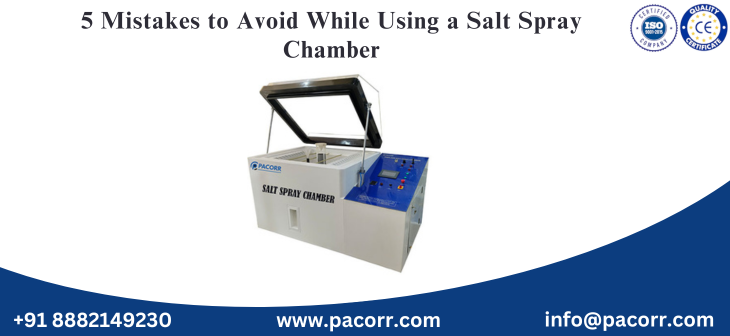
Pacorr helps manufacturers and testing laboratories evaluate the corrosion resistance of metals, coatings, painted parts, and plated components under controlled salt-fog conditions. However, accurate results do not depend on the equipment alone. Incorrect solution preparation, poor specimen placement, or irregular maintenance can make test results inconsistent and difficult to compare.
Here are five common mistakes that should be avoided while operating a Salt Spray Chamber.
1. Preparing the Salt Solution Incorrectly
The quality of the saline solution directly affects the corrosion test. Using ordinary tap water, low-purity salt, or an incorrect concentration can change the behaviour of the specimens.
For many standard neutral salt spray tests, a sodium chloride solution of approximately 5% is used. However, operators should always follow the requirements of the selected test method.
Use purified water and suitable-grade sodium chloride. Check the solution concentration and pH before filling the reservoir. The solution should also be free from dirt, oil, and other contaminants.
2. Placing Specimens in the Wrong Position
Improper sample placement can prevent uniform exposure to the salt fog. Test pieces should not touch each other, block the spray nozzle, or allow condensed solution to drip onto another specimen.
Overloading the chamber is another common problem. When too many samples are placed inside, fog circulation may become uneven.
Maintain sufficient space between specimens and position them at the angle required by the applicable standard. Each sample should receive consistent exposure throughout the test.
3. Opening the Chamber Frequently
Opening the Salt Spray Chamber during an active test causes sudden changes in temperature and fog concentration. Frequent interruptions can disturb the controlled environment and reduce the reliability of the results.
Plan all observations before beginning the test. Open the chamber only when required by the testing procedure. Where possible, use the viewing arrangement or monitoring system to check the test without interrupting the chamber conditions.
4. Ignoring Cleaning and Maintenance
Salt deposits can gradually collect inside the chamber, nozzles, pipelines, and solution tank. Without regular cleaning, these deposits may restrict the spray system and create uneven fog distribution.
After completing a test, clean the chamber according to the manufacturer's instructions. Inspect the spray nozzle, air line, reservoir, seals, sensors, and drainage system regularly.
Periodic calibration of temperature controllers and other measuring devices is also important. A well-maintained chamber delivers more stable results and remains reliable for a longer period.
5. Using the Wrong Test Conditions
Not every corrosion test uses the same temperature, exposure time, solution, or evaluation method. Running a test without confirming the required standard may produce results that are not relevant to the product or accepted by the customer.
Common salt spray testing references include ASTM B117 and ISO 9227, along with industry-specific and customer-defined procedures.
Before starting the test, confirm:
- Required salt solution and concentration
- Chamber temperature
- Solution pH
- Fog collection rate
- Sample orientation
- Exposure duration
- Method of evaluating corrosion
Test duration should not be used alone to predict the exact service life of a product. Salt spray testing is generally more useful for comparing materials, coatings, production batches, or surface treatments under controlled conditions.
Tips for More Reliable Salt Spray Testing
For consistent corrosion test results, operators should prepare specimens carefully, record all test settings, monitor chamber conditions, and avoid touching the test surface with bare hands. Any oil, dust, fingerprints, or cleaning residue can influence the corrosion pattern.
The same preparation and inspection method should be followed for every sample when comparing multiple products or coatings.
Choose a Reliable Salt Spray Chamber
A dependable Salt Spray Chamber should provide controlled heating, uniform fog generation, corrosion-resistant construction, stable air pressure, and easy adjustment of testing parameters.
Pacorr offers Salt Spray Chambers for industrial quality control, research laboratories, coating evaluation, and corrosion resistance testing. The equipment can be used for painted components, electroplated parts, fasteners, automotive components, metal sheets, and other coated products.
Conclusion
A Salt Spray Chamber can provide valuable information about corrosion resistance, but only when the test is performed correctly. Proper solution preparation, suitable sample positioning, limited chamber opening, regular maintenance, and correct test conditions all contribute to reliable results.
Avoiding these five mistakes helps manufacturers improve test consistency, compare protective coatings more effectively, and maintain better control over product quality.
For more information about the Pacorr Salt Spray Chamber, contact our team:
Email: info@pacorr.com
Contact Number: +91 8882149230
About the Author
Anand Rathor is a Technical Content Writer at Pacorr Testing Instruments. He specializes in creating informative content on laboratory testing equipment, quality control, and material testing to help manufacturers understand testing standards and choose the right testing solutions.
Recent Blogs
Enhance your understanding of testing and precise quality control indistinct applications with our
knowledge based articles coming from top editors of industry leaders.


Our USP's
Demonstration of Machine
- Try Before You Decide
- Experience Before You Invest
- See It in Action – Free Demo
Global Reach
- Delivering Excellence Worldwide
- Serving Across Borders
- Your Global Supply Partner
On-Site Support
- Support That Comes to You
- On-Ground Assistance, Anywhere
- We Reach Where You Are
Team Strength
- Powered by Expert Minds
- Driven by Skilled Professionals
- Engineering Excellence Team
Manufacturing
- Precision-Driven Manufacturing
- Smart & Automated Production
- Engineered In-House Excellence
