
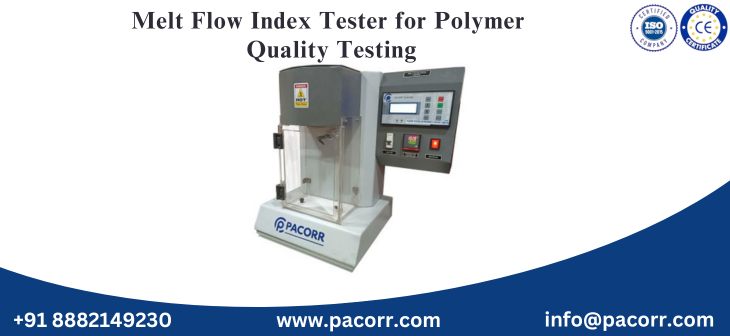
Pacorr brings advanced polymer testing solutions for manufacturers, laboratories, and quality control teams that need accurate, repeatable, and dependable test results for plastic materials. In modern plastic production, material performance cannot be judged only by appearance or weight. A polymer may look suitable on the surface, but its actual processing behavior depends on how it flows under heat and pressure. This is where a Melt Flow Index Tester for Polymer Quality Testing becomes an essential instrument. It helps manufacturers understand the flow properties of thermoplastic materials and ensures that every batch of polymer meets the required processing and quality standards.
Introduction to Melt Flow Index Testing
The plastic and polymer industry depends heavily on consistency. Whether a company manufactures packaging films, molded components, pipes, containers, caps, automotive parts, electrical fittings, or recycled plastic products, the raw material must behave predictably during processing. Even a small change in polymer flow behavior can affect production speed, product strength, surface finish, dimensional accuracy, and final product performance.
The Melt Flow Index, commonly known as MFI, is one of the most important quality parameters used to evaluate thermoplastic polymers. It measures how easily a molten polymer flows through a standard die under a specific load and temperature. The result is generally expressed in grams per 10 minutes. This value helps manufacturers determine whether a polymer is suitable for injection molding, extrusion, blow molding, film production, or other plastic processing methods.
A Melt Flow Index Tester provides a controlled testing environment where the polymer sample is heated, melted, and pushed through a die using a defined weight. The quantity of material that flows out within a fixed time is measured to calculate the melt flow rate. This simple yet highly valuable test gives deep insight into polymer viscosity, molecular weight behavior, processability, and batch-to-batch uniformity.
What is a Melt Flow Index Tester?
A Melt Flow Index Tester for Polymer Quality Testing is a precision laboratory instrument designed to measure the melt flow rate of thermoplastic materials. It is widely used in plastic manufacturing units, polymer research laboratories, resin production plants, recycling facilities, packaging industries, and quality assurance departments.
The instrument mainly consists of a heated barrel, piston, standard die, load weights, temperature controller, sample cutting system, and digital display. During testing, the polymer granules or sample pieces are placed inside the heated barrel. After the material melts at the selected test temperature, a piston applies a specified load and forces the molten polymer through the die. The extruded material is then collected and weighed to determine the melt flow index.
This test is commonly used for polymers such as:
Polyethylene, polypropylene, polystyrene, ABS, nylon, polycarbonate, PVC compounds, acetal, thermoplastic elastomers, engineering plastics, and recycled plastic materials.
Why Melt Flow Index is Important in Polymer Quality Testing
Melt Flow Index testing is important because polymer flow behavior directly affects processing performance. A material with unsuitable flow properties may create serious production challenges. It may not fill a mold properly, may cause uneven wall thickness, may create weak weld lines, or may lead to poor surface appearance.
For example, in injection molding, a polymer with a high melt flow index flows easily into complex mold cavities. However, if the MFI is too high, the final product may lose mechanical strength. On the other hand, a polymer with a very low MFI may have better strength but may be difficult to process because it does not flow easily.
In extrusion applications, flow consistency is equally important. If the melt flow value changes from batch to batch, the thickness, shape, and quality of the extruded product can become inconsistent. This can result in rejection, wastage, machine downtime, and increased production cost.
By using a Pacorr Melt Flow Index Tester, manufacturers can identify these variations before the material enters full-scale production. This helps improve process control, reduce defects, and maintain consistent product quality.
Understanding the Relationship Between MFI and Polymer Viscosity
Melt Flow Index is closely related to polymer viscosity. Viscosity refers to the resistance of a material to flow. When a polymer has high viscosity, it flows slowly. When it has low viscosity, it flows easily.
A higher MFI value usually means the polymer has lower viscosity and can flow more easily when melted. A lower MFI value usually means the polymer has higher viscosity and requires more pressure or temperature for processing.
This relationship is extremely useful for manufacturers. It helps them choose the right grade of polymer for a specific application. For thin-wall molded products, a polymer with better flow may be required. For products requiring higher toughness or impact strength, a lower MFI material may be preferred.
However, MFI should not be seen as the only indicator of polymer quality. It is an important quality control parameter, but it should be used along with other tests such as tensile strength, impact resistance, density, ash content, moisture content, hardness, and thermal behavior. Together, these tests provide a more complete understanding of polymer performance.
Working Principle of Melt Flow Index Tester
The working principle of a Melt Flow Index Tester is based on controlled thermal flow measurement. The process begins by selecting the required test temperature and load according to the material type and applicable testing standard. The polymer sample is then placed into the heated barrel of the instrument.
Once the sample reaches the required molten state, the piston applies pressure through the selected weight. The molten polymer flows through a standard die at the bottom of the barrel. The extruded material is collected at fixed time intervals and weighed using a precision balance. The final MFI value is calculated as the weight of polymer extruded in 10 minutes.
The general formula is:
MFI = Weight of extruded material in grams / Time in minutes × 10
For example, if 3 grams of molten polymer flows out in 5 minutes, the melt flow index will be:
3 / 5 × 10 = 6 g/10 min
This value helps the quality control team compare the tested material with the required specification.
Key Features of Pacorr Melt Flow Index Tester
The Pacorr Melt Flow Index Tester for Polymer Quality Testing is designed to deliver accurate and repeatable test results for industrial and laboratory applications. It is built to support reliable polymer testing where precision, durability, and ease of use are essential.
1. Accurate Temperature Control
Temperature accuracy is one of the most important factors in MFI testing. Even a small temperature variation can affect the flow behavior of the polymer and lead to inaccurate results. Pacorr’s Melt Flow Index Tester is designed with precise temperature control to maintain stable heating conditions throughout the test.
2. Strong and Durable Construction
The instrument is manufactured using high-quality materials to ensure long working life and stable performance. Its sturdy structure makes it suitable for frequent use in production laboratories and quality testing environments.
3. Digital Display and Easy Operation
The digital display allows users to monitor test parameters clearly. Operators can set temperature, observe readings, and perform tests with better control. The user-friendly design helps reduce operator error and improves testing efficiency.
4. Standardized Testing Process
The tester is suitable for performing tests according to recognized industry standards such as ASTM D1238 and ISO 1133. Standardized testing helps manufacturers maintain reliable documentation and compare results with global quality requirements.
5. Reliable Flow Measurement
The instrument provides dependable results for different thermoplastic materials. It helps manufacturers identify material variation, check supplier quality, and verify production consistency.
6. Suitable for Multiple Industries
The Pacorr Melt Flow Index Tester can be used in plastic processing plants, packaging industries, raw material inspection labs, recycling units, automotive component manufacturing, and polymer research centers.
Applications of Melt Flow Index Tester in Different Industries
Plastic Raw Material Manufacturing
Resin producers use melt flow testing to classify polymer grades and confirm product consistency. Each polymer grade has a defined flow range. Testing helps ensure that the manufactured resin meets the required specification before dispatch.
Injection Molding Industry
Injection molding requires precise material flow. If the polymer does not flow correctly, it may result in incomplete filling, sink marks, warpage, surface defects, or poor mechanical strength. MFI testing helps select the right material grade for molded components.
Extrusion Industry
In extrusion processes, polymer flow consistency affects product thickness, shape, and surface finish. Pipes, sheets, films, profiles, and wires require stable flow behavior. MFI testing helps maintain uninterrupted extrusion quality.
Packaging Industry
Plastic packaging products such as films, bottles, caps, containers, and flexible packaging materials must meet strength and performance requirements. Melt flow testing helps ensure that packaging materials are processed properly and perform reliably.
Automotive Industry
Automotive plastic parts require high durability, dimensional accuracy, and thermal stability. MFI testing supports material selection and quality control for parts such as dashboards, trims, clips, housings, and under-the-hood components.
Recycling Industry
Recycled plastic often contains mixed material sources and may show wide variation in flow behavior. MFI testing is extremely important for recycled polymers because it helps determine whether the recycled material can be reused in manufacturing. It also helps in blending recycled and virgin materials in the correct proportion.
Importance of MFI Testing for Recycled Plastics
The use of recycled plastic is increasing across industries due to sustainability goals and environmental responsibility. However, recycled polymers can vary significantly in quality because they may come from different sources, previous applications, and processing histories.
During recycling, polymers may experience thermal degradation, contamination, moisture absorption, or molecular weight reduction. These changes directly affect melt flow behavior. A recycled polymer with a very high MFI may have reduced strength, while a material with inconsistent MFI may create processing difficulties.
Using a Melt Flow Index Tester allows recycling companies and plastic manufacturers to evaluate the quality of recycled materials before reuse. It helps determine whether the recycled plastic is suitable for extrusion, molding, compounding, or blending.
Benefits of Using Pacorr Melt Flow Index Tester
Better Quality Control
The tester helps manufacturers detect material variations before production begins. This ensures only approved material is used in manufacturing.
Reduced Production Waste
When unsuitable polymer material is identified early, manufacturers can avoid defective production batches and reduce material wastage.
Improved Process Efficiency
Knowing the melt flow value allows operators to adjust machine parameters more effectively. This helps improve cycle time, flow stability, and output consistency.
Stronger Supplier Verification
Manufacturers can verify whether raw material supplied by vendors matches the required specification. This reduces dependency on supplier claims and supports better purchasing decisions.
Support for Product Development
Research and development teams can use MFI data to compare different polymer grades, develop new materials, and improve product performance.
Better Compliance and Documentation
Accurate MFI testing supports quality records, audit requirements, and compliance with industry standards.
Factors That Can Affect Melt Flow Index Results
Several factors can influence MFI test results. To obtain accurate readings, manufacturers must control these conditions carefully.
Temperature must be set correctly according to the polymer type. Incorrect temperature can change viscosity and produce misleading results.
Load selection must match the testing standard and material requirement. Different loads can produce different flow values.
Sample condition is also important. Moisture, contamination, dust, and improper sample size can affect the test outcome.
Barrel and die cleanliness must be maintained. Any leftover material from previous testing can contaminate the next sample.
Preheating time should be controlled properly so that the polymer melts uniformly before testing begins.
Operator training is also important because incorrect sample loading, cutting, or weighing may affect repeatability.
How Pacorr Helps Manufacturers Improve Polymer Testing
Pacorr focuses on providing testing instruments that support accurate quality inspection and better manufacturing decisions. The Pacorr Melt Flow Index Tester is developed to help polymer manufacturers, plastic processors, and laboratories perform reliable melt flow testing with confidence.
The instrument supports routine quality checks, incoming raw material inspection, production control, research testing, and recycled material evaluation. Its precision and ease of operation make it a valuable part of any polymer quality testing laboratory.
By using Pacorr’s testing solution, manufacturers can reduce uncertainty in material selection, improve product reliability, and maintain stronger quality assurance systems.
Value of Melt Flow Index Tester in Modern Manufacturing
For businesses searching for dependable polymer testing equipment, a Melt Flow Index Tester is not just a laboratory machine; it is a production support tool. It helps companies make data-based decisions about raw materials, processing conditions, supplier quality, and final product performance.
In competitive plastic manufacturing markets, quality consistency plays a major role in customer satisfaction. Companies that invest in reliable testing equipment can reduce complaints, improve brand reputation, and strengthen their position in domestic and international markets.
Pacorr provides a practical solution for industries looking for accurate, durable, and performance-driven polymer testing instruments.
Why Choose Pacorr Melt Flow Index Tester?
Choosing the right testing instrument can directly impact quality control efficiency. Pacorr offers a dependable Melt Flow Index Tester designed for industrial use, laboratory testing, and material evaluation.
Manufacturers choose Pacorr because of:
- Reliable testing performance
- Accurate temperature control
- Strong machine construction
- Easy-to-use design
- Suitable testing for multiple polymers
- Support for quality assurance processes
- Useful for virgin and recycled plastics
- Industry-focused testing solutions
Pacorr’s commitment to quality makes it a trusted choice for companies that require accurate polymer testing equipment.
Conclusion
A Melt Flow Index Tester for Polymer Quality Testing is an essential instrument for evaluating the flow properties of thermoplastic materials. It helps manufacturers understand how a polymer will behave during processing and whether it meets the required quality standards. From raw material inspection to final production control, MFI testing plays a major role in improving product consistency, reducing defects, and supporting better manufacturing decisions.
The Pacorr Melt Flow Index Tester is designed to deliver accurate, repeatable, and reliable results for plastic manufacturers, polymer laboratories, recycling units, packaging companies, and industrial quality control departments. With advanced functionality and dependable performance, it helps businesses maintain strong quality standards in polymer processing.
For more information about the Melt Flow Index Tester for Polymer Quality Testing, contact Pacorr today.
Brand: Pacorr
Email: info@pacorr.com
Contact Number: 8882149230
Recent Blogs
Enhance your understanding of testing and precise quality control indistinct applications with our
knowledge based articles coming from top editors of industry leaders.


Our USP's
Demonstration of Machine
- Try Before You Decide
- Experience Before You Invest
- See It in Action – Free Demo
Global Reach
- Delivering Excellence Worldwide
- Serving Across Borders
- Your Global Supply Partner
On-Site Support
- Support That Comes to You
- On-Ground Assistance, Anywhere
- We Reach Where You Are
Team Strength
- Powered by Expert Minds
- Driven by Skilled Professionals
- Engineering Excellence Team
Manufacturing
- Precision-Driven Manufacturing
- Smart & Automated Production
- Engineered In-House Excellence
