
A fume hood, also called a chemical hood or fume cupboard, is a ventilated laboratory enclosure that draws air inward to control exposure to airborne chemical contaminants. Effective extraction depends on the installation, substances handled and operating practices.
Selection requires airflow, chemical compatibility, duct routing and containment assessment. This guide explains these decisions, illustrates them and reviews Pacorr PC-FM-90 specifications. Procedures are educational; the approved laboratory procedure, competent ventilation assessment and supplied manual govern actual use.
What is a fume hood, and what does it control?
A chemical fume hood combines an enclosure with local exhaust ventilation. Air entering the access opening helps keep contaminants generated inside from reaching the operator's breathing zone. The process may produce vapours, gases or airborne particles; the control arrangement must suit the particular hazard and generation rate.
A fume hood does not measure chemical toxicity, concentration or specimen quality. Separate instruments assess hood performance through quantities such as velocity, airflow or tracer concentration. Its protective function differs from measurements performed on samples inside it.
What are the main uses of a laboratory fume hood?
Applications include compatible chemical transfers, analytical sample preparation, solvent handling and other contaminant-generating procedures. Quality-control, research and teaching laboratories may need containment; the process determines the appropriate hood.
Identify chemicals, concentrations, quantities, temperatures and possible abnormal releases. An ambient-temperature transfer and a heated digestion may require different construction and exhaust. Review Safety Data Sheets and the task assessment before assigning a hood to a new process.
What does a fume hood not guarantee?
A conventional chemical hood does not create a sterile work environment, neutralise every contaminant or make any chemical operation safe. It does not replace suitable PPE, training, compatible apparatus or an emergency plan. A transparent sash provides a physical barrier, but a general-purpose hood must not be represented as an explosion-proof enclosure.
Contaminants also need management at the discharge point: extraction does not prove harmless outdoor release. A basin does not authorise drain disposal, and a lower cabinet does not automatically qualify as a flammable-liquid store.
How does a fume hood differ from a biosafety cabinet or clean bench?
Choose the enclosure according to the hazard and the protection needed. Similar glass-fronted equipment can have very different airflow paths.
| Equipment | Main purpose and selection boundary |
|---|---|
| Chemical fume hood | Controls compatible airborne chemical hazards through a designed ventilation arrangement; does not provide sterile product protection. |
| Biological safety cabinet | Controls biological aerosols according to its class, type and installation; some classes also protect the product. Chemical use needs specific assessment. |
| Laminar-flow clean bench | Supplies filtered air to protect the work product; must not be substituted for personnel protection from hazardous chemicals or infectious materials. |
| Glovebox or isolator | Provides a different enclosure strategy for defined tasks; atmosphere, pressure and containment depend on its design. |
The University of Tennessee's biosafety guidance explains these equipment boundaries. A biological safety cabinet is not automatically a chemical-vapour control device simply because it contains a filter.
What are the main parts of a fume hood?
Typical components include the enclosure, access sash, work surface, airfoil, baffles, exhaust plenum, duct connection and exhaust fan. Lighting and utility services support the work. Some systems include airflow monitoring, alarms and controls that respond to sash movement.
The enclosure helps define the capture zone. The sash controls the access opening. Baffles and the plenum guide air towards the exhaust; an airfoil helps manage entry airflow. Their presence and geometry vary by design. An alarm, automatic sash or variable-volume controller is not an assumed standard feature: confirm the exact supplied equipment. The product overview below identifies published PC-FM-90 features without claiming unlisted options.
How should you read a labelled fume hood diagram?
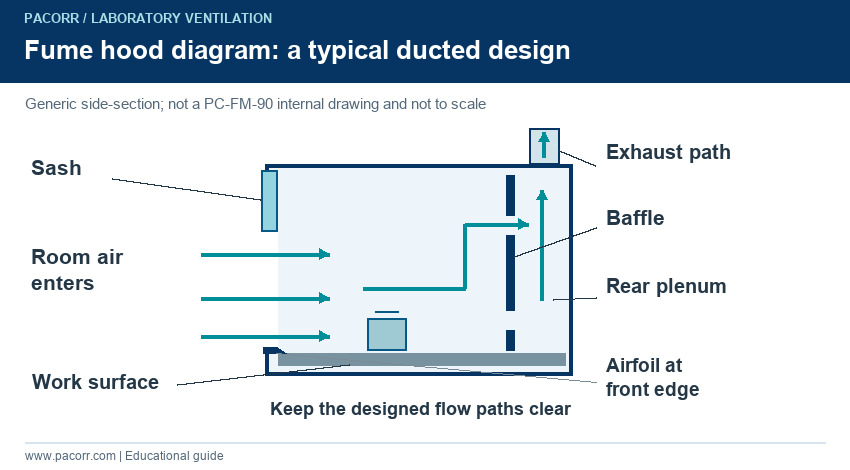
In the generic side-section diagram, follow air from the laboratory through the opening, across the work area, past the baffle openings and into the exhaust path. The drawing separates the work chamber from the space behind the baffle so the flow route is easier to understand.
The educational schematic is not a PC-FM-90 drawing. Confirm component geometry from model documentation. Arrows indicate direction, not measured velocity or verified containment.
What is the working principle of a fume hood?
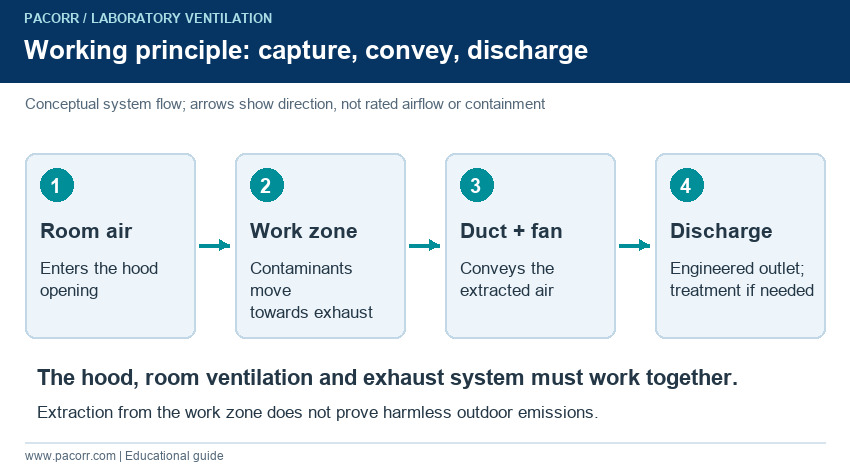
Exhaust extraction draws laboratory air through the opening and other designed entry paths. Inward movement carries contaminants towards the exhaust; a ducted installation conveys them to an engineered discharge arrangement.
The fan, duct resistance, room supply and hood geometry work together. Running a fan does not by itself demonstrate adequate protection. Princeton's explanation of hood airflow describes the importance of baffles and an unobstructed exhaust path. A crowded chamber can disrupt that path even while the motor sounds normal.
How are room pressure and hood airflow related?
Exhausted laboratory air needs replacement. Building supply and exhaust affect hood operation, doors and airflow between spaces. Hood containment and room pressure are related, distinct controls.
Adding a large exhaust device without reviewing replacement air can change the room balance. Opening a door to compensate for poor airflow is not a designed correction. The UC Davis overview of laboratory ventilation controls distinguishes room ventilation from local exhaust. Have the ventilation team assess the hood in the room where it will operate, including other equipment that exhausts air.
What is face velocity, and why is there no universal setting?
Face velocity is the speed of air moving through the hood's access opening, commonly expressed in metres per second or feet per minute. It is assessed at a defined sash position. A single reading at the centre cannot describe the entire opening, especially where the flow is uneven.
Published institutional targets differ by hood design and programme. For example, University of Washington guidance distinguishes standard-flow and low-flow equipment. Do not transfer an institution's number to an unverified model. The approved operating range, sash opening, test method and containment evidence must be considered together; higher velocity is not automatically better performance.
How are face area and airflow calculated?
For a simple opening with reasonably characterised flow, an educational relationship is Q = v × A, where Q is volume flow in m³/s, v is average velocity in m/s and A is opening area in m². Multiply m³/s by 3,600 to obtain m³/h. This is a relationship between quantities, not a fan-selection specification.
Suppose an illustrative opening is 0.90 m wide and 0.40 m high, with a hypothetical average velocity of 0.50 m/s. Area is 0.36 m²; calculated face flow is 0.18 m³/s, or 648 m³/h. These are not PC-FM-90 operating settings. They do not include every bypass or leakage path, duct loss or exhaust-system requirement.
Reducing that hypothetical height to 0.20 m while holding the same face flow would double calculated average velocity. A real bypass or variable-volume system behaves differently. Its controls and other air-entry paths must be included in the assessment.
Why does sash position matter?
The sash determines the access opening and provides a physical separation between the operator and the work. Use the marked, approved operating position rather than raising it fully for convenience. A larger opening changes the conditions under which containment was assessed.
Keep your head outside the plane of the opening. Close the sash when the hood is not being accessed, following the site's operating procedure. Do not equate closing the sash with permission to switch off ventilation while a process remains inside. OSHA's chemical fume hood guidance also stresses correct sash height, airflow checks and unobstructed baffles.
How do cross-drafts and equipment placement affect containment?
Doors, supply-air jets, portable fans, passing people and rapid arm movements can disturb the air near a hood opening. Equipment inside can create sheltered regions or redirect airflow. A satisfactory average face velocity can coexist with undesirable local flow patterns.
Keep the setup within the tested operating arrangement and maintain the specified clearance around apparatus. Do not bridge the opening with large equipment or cover entry slots with paperwork. Penn's fume hood guidance identifies room drafts, equipment and the operator as influences on performance. Where a large apparatus is necessary, evaluate the loaded arrangement rather than relying only on an empty-hood check.
What are the main types of fume hoods?
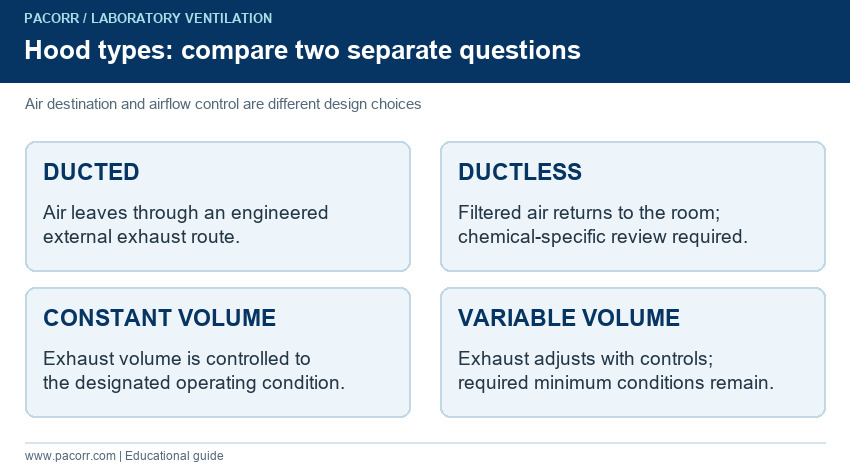
Classify hoods along separate axes. Ducted versus ductless describes where air goes. Constant versus variable volume describes the ventilation-control strategy. Bench-mounted versus floor-mounted describes the physical arrangement. Special-purpose construction addresses particular process hazards.
| Classification | What it tells the buyer |
|---|---|
| Ducted or recirculating | Whether air leaves through an exhaust route or returns through a defined filtration system. |
| Constant or variable air volume | How the system manages exhaust flow as operating conditions change. |
| Bench or floor mounted | The apparatus envelope and access arrangement; a floor-mounted hood is not a place to stand during work. |
| General or special purpose | Whether construction and services suit a defined unusual chemical, heat or radiation duty. |
Categories overlap: a ducted hood can also be variable-volume and bench-mounted.
When should a ducted fume hood be considered?
A ducted hood carries extracted air through a connected exhaust system for assessed, compatible chemical work. The cabinet, duct, fan and outlet must function together.
Check routing, building penetrations, maintenance access, fan duty and discharge location before ordering. PC-FM-90 includes a blower and duct; confirm whether the proposed building route is included in the installation scope.
What must be checked before choosing a ductless hood?
A recirculating enclosure returns filtered air to the room. Document suitability for the chemicals, quantities, concentrations and procedures, with monitoring and filter-management plans. It is not a universal ducted-hood replacement.
Institutional policies may prohibit its use. UC Berkeley's published ductless-hood policy is one such example; it is a campus rule, not a claim about every jurisdiction. Confirm the site's policy before procurement. Changes in chemistry or process can invalidate the original assessment even if the enclosure and filter look unchanged.
Do HEPA and activated-carbon filters do the same job?
No. HEPA filtration removes particles; it does not remove gases and vapours merely because they are hazardous. Gas-phase sorbents such as activated carbon work through different mechanisms and must be selected for the chemicals and loading involved. A label saying filtered is not enough to establish suitability.
The University of Illinois explanation of HEPA filtration explicitly separates particle removal from gas and vapour control. Ask for the approved chemical list, capacity assumptions, breakthrough-management approach, replacement criteria and disposal arrangements. Do not use smell as the sole filter-change indicator, or assume that adding a HEPA filter makes a chemical hood a biological safety cabinet.
How do constant-volume, bypass and VAV hoods differ?
A constant-air-volume system aims to maintain its designated exhaust volume. A bypass arrangement provides another air-entry path as the sash position changes. Variable-air-volume, or VAV, systems adjust exhaust in response to a control strategy, commonly involving sash position or airflow feedback, while maintaining required minimum conditions.
VAV needs coordinated controls and adequate response, not simply a variable-speed motor. Ask how the hood behaves during sash movement, low-flow conditions and control failure. Some installations use two-state controls instead. MIT's laboratory ventilation guidance provides useful context on ventilation equipment. Confirm the PC-FM-90 control configuration separately; its published motor blower does not establish VAV capability.
Which applications need a special-purpose hood?
Heated perchloric-acid work requires a dedicated assessment and appropriate special-purpose equipment, including the required wash-down arrangements. A general-purpose stainless-steel hood must not be presumed suitable. High heat, aggressive acid service and radioactive-material work can also change construction, exhaust and verification requirements.
The BS EN 14175 series distinguishes general requirements from parts addressing high heat/acidic loads and radioactive-material work. These distinctions are useful procurement questions, not proof that a model covers every category. For unusual duties, obtain a documented application review before choosing the hood, duct material or accessories.
Is SS304 suitable for every chemical?
No. A stainless-steel grade is a material description, not universal chemical-resistance approval. Suitability depends on the substance, concentration, temperature, exposure duration, cleaning method and the materials of all affected components. The work surface, seals, sash, duct and fan may need separate review.
Ask for a component-by-component compatibility statement for the proposed process. Do not describe a worktop as chemical-proof. Where corrosive duty is anticipated, discuss the actual operating and cleaning conditions instead of assuming that a polished metallic appearance is enough. Pacorr specifies SS304 construction for PC-FM-90, but the published listing does not provide an unrestricted chemical-compatibility guarantee.
How do working dimensions differ from overall dimensions?
Working dimensions describe interior workspace; external dimensions describe the equipment envelope. Identify access, utility, duct and maintenance clearances separately on the purchase drawing.
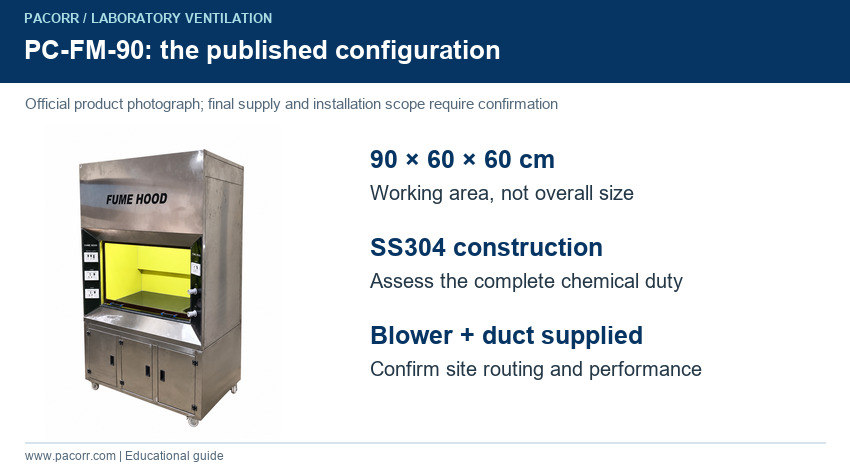
Check apparatus height with the sash in its permitted position, and leave the required flow paths clear. A nominal chamber volume does not tell you whether a tall condenser or bulky fixture can be used effectively. For PC-FM-90, the published 90 × 60 × 60 cm figure is explicitly the working area. Confirm dimension order and overall dimensions before planning a bench, doorway or service route.
What specifications are published for Pacorr PC-FM-90?
The current PC-FM-90 product page and linked Pacorr brochure describe the following configuration. Confirm the final supplied scope in the quotation.
| Published item | Specification or included feature |
|---|---|
| Model and construction | PC-FM-90; SS304 stainless steel. |
| Working area | 90 × 60 × 60 cm; not overall external size. |
| Lighting | 25 W / 36 W fluorescent light assembly; confirm the supplied wattage. |
| Water facilities | Water tap and basin. |
| Storage | Compartment below the work surface; chemical-storage rating not specified. |
| Electrical fittings | 15/5 A socket; light and exhaust switches. |
| Supply | 220 V AC, single phase, 50 Hz. |
| Exhaust equipment | Motor blower and fume exhaust duct provided. |
The reviewed data does not establish face velocity, volume flow, fan duty at installed resistance, noise, containment-test results, alarm specification or a fixed current price. Request those items where relevant. Company or generic website badges should not be treated as model-specific containment evidence.
Where should a fume hood be installed?
Plan with ventilation and safety specialists: consider doors, diffusers, circulation, emergency access, adjacent equipment and actual building ventilation modes.
Include apparatus, access and services on the layout. Stanford's laboratory design guidance illustrates coordinated placement and ventilation planning. Apply local requirements and the project specification; institutional dimensions and limits are not universal.
What should be considered for ducts, fans and discharge?
Specify the exhaust route, construction, joints, access, supports and discharge. Select the fan for required flow at system resistance; motor power alone is insufficient. Bends, long runs and treatment devices affect the operating point.
The discharge assessment must consider potential re-entry through air intakes or openings and exposure around the building. Do not terminate a chemical exhaust casually into an occupied space or assume outdoor discharge needs no review. The HSE guide to local exhaust ventilation treats the hood, ducts, air mover, cleaning equipment and documentation as related parts of an effective system.
Does every fume hood need a scrubber?
No single exhaust-treatment arrangement suits every process. A scrubber or other treatment stage may be required by the chemical duty, emission assessment or applicable conditions. Treatment equipment must be selected for the contaminants, loading and operating chemistry; it is not a generic attachment that makes any exhaust harmless.
Assign responsibility for treatment maintenance and collected liquids, residues or spent media. Include pressure drop and operating states in the design. Hood containment and treatment efficiency need separate evidence; neither proves the other, and no universal removal percentage applies.
What should be checked for electrical, water and storage facilities?
Confirm the electrical supply, earthing, protective arrangements and service loads with the installation team. Socket ratings do not establish an explosion-protection classification. Plan water connections and drainage so they do not create avoidable obstructions or undermine the laboratory's waste controls.
For PC-FM-90, ask how the stated 15/5 A provision is configured and which lamp is supplied. Treat the lower compartment as unspecified storage until its intended contents and rating are confirmed. Decide where compatible waste containers and routinely used materials belong before operation; available cupboard space is not permission to store incompatible chemicals together.
What should an operator check before starting?
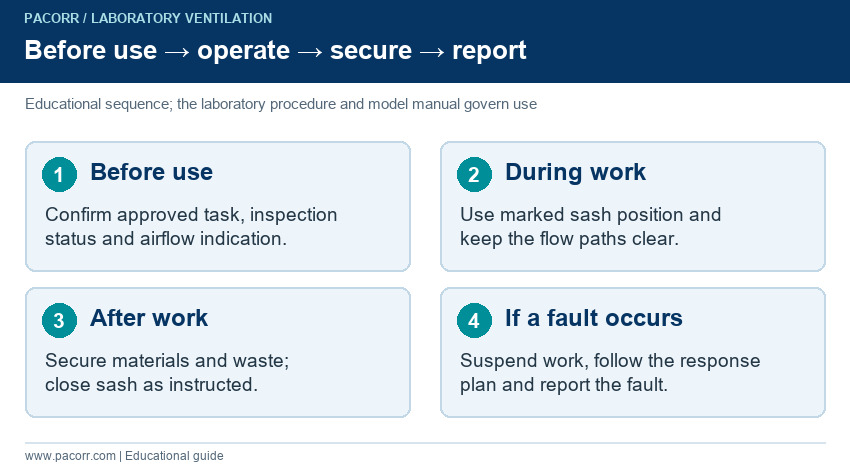
Review the approved task, chemicals, inspection status and instructions. Check apparatus arrangement, utilities, emergency controls, airflow indication and alarms as required by the laboratory procedure.
An indicator provides an operating signal, not a complete chemical-exposure measurement. If the hood lacks a suitable monitoring arrangement, obtain competent guidance rather than assuming motor sound is sufficient. Vanderbilt's safe-work guidance emphasises checking airflow before use. Resolve faults before introducing hazardous work into the chamber.
What is an educational procedure for using a fume hood?
Use the following sequence as a planning aid, then follow the approved task-specific procedure and model manual for actual work.
- Confirm that the hood and exhaust system are approved for the chemicals and operation.
- Check inspection status, ventilation operation and the airflow indication; respond to faults before starting.
- Put on the PPE specified by the chemical and task assessment.
- Arrange only necessary apparatus inside the approved work zone, preserving required airflow paths.
- Set the sash to its marked operating position and keep your head outside the opening.
- Carry out the approved operation with controlled movements, keeping containers closed when practicable.
- Monitor the operating indication and process; stop and follow the response plan if abnormal conditions arise.
- Secure samples and waste, clean compatible surfaces as instructed and close the sash when finished.
- Leave ventilation in the state required by the laboratory procedure; record defects and service needs.
This sequence does not prescribe a universal purge time, sash height or chemical-specific reaction method.
How far inside should apparatus be placed?
Use the work zone and setbacks required by the hood's instructions and site procedure. As general guidance, OSHA recommends keeping materials at least six inches inside the sash opening and elevating large equipment to preserve airflow beneath it. Six inches is approximately 150 mm; this is not a substitute for a model-specific layout assessment.
Keep baffles and front air-entry paths clear. Assess bulky equipment in place: visible clearance alone does not establish adequate airflow or containment.
What should happen if an airflow alarm sounds or power fails?
Treat an airflow fault as a loss of an important control. Suspend the operation and follow the laboratory's emergency procedure. Where it is safe to do so, secure containers and lower the sash; if a release or exposure is suspected, follow the site's evacuation and incident-response arrangements. Do not continue by silencing or disabling the alarm.
Report the fault and keep the hood out of service until the required checks permit its return. NIH guidance on airflow faults separates ventilation repair from subsequent verification. A restarted motor or restored power does not, by itself, confirm restored containment.
Which standards and guidance are relevant?
Specify the required document, edition, scope and acceptance criteria in the project. The references below address different functions; none certifies a Pacorr model simply by being listed here. Listings were reviewed on 17 November 2026.
| Reference | Relevant scope |
|---|---|
| ANSI/ASHRAE 110-2016 (RA 2025) | Qualitative and quantitative methods for evaluating laboratory fume containment; includes conventional, bypass, auxiliary-air and VAV hoods. |
| ANSI/ASSP Z9.5-2022 | Laboratory ventilation requirements and responsibilities, with defined exclusions. |
| BS EN 14175 series | Separate parts address safety/performance, type tests, on-site tests and specific hood categories. |
| OSHA chemical fume hood guidance | US laboratory operating guidance; not a model certificate or a statement of Indian legal requirements. |
Check amendments and errata with the publisher. Use the applicable local legal and project requirements; a list of international references is not a declaration of universal compliance.
What does commissioning establish?
Commissioning checks the installed cabinet, exhaust, room ventilation, controls and working practices against the agreed specification. Factory assessment cannot establish performance for every destination duct route, room draft or apparatus arrangement.
Record configuration and baseline performance for future comparison. HSE's commissioning guidance distinguishes installation checks, performance, control effectiveness and reporting. Agree who performs and accepts commissioning before routine use.
How are face velocity, airflow visualisation and tracer tests different?
Velocity measurements characterise air movement through defined locations. Airflow visualisation can reveal undesirable patterns around the opening and apparatus. A tracer-gas test evaluates containment under a specified challenge and measurement arrangement. These observations answer different questions.
| Check | What it can establish within its method |
|---|---|
| Velocity survey | Distribution and average of measured entry velocities at the recorded sash condition. |
| Flow visualisation | Observed direction, disturbance or escape paths under the test arrangement. |
| Tracer containment assessment | Measured tracer response at defined locations and challenge conditions. |
| Control/alarm checks | Behaviour during specified changes or fault simulations. |
Testing requires competent personnel, instruments and a controlled protocol with acceptance criteria. Do not improvise hazardous smoke or tracer releases.
How should a fume hood test report be interpreted?
Identify the hood, location, sash position, room conditions, load, instruments, method and acceptance criteria. Empty factory and installed loaded-hood assessments are not automatically equivalent.
Ask what passed, under which conditions, and what operating restrictions follow. A low tracer reading is not a universal personal-exposure guarantee, and a face-velocity number without its measurement conditions is incomplete. ASHRAE explains in its fume hood testing FAQ that it publishes a test procedure rather than certifying products itself. Avoid unsupported statements such as ASHRAE-certified hood.
How often should a fume hood be inspected?
Set inspection intervals from the site programme, applicable requirements, risk assessment and manufacturer instructions. Annual institutional checks are not a universal prescription; operators also need pre-use checks.
Changes can justify reassessment before the next planned date: relocation, exhaust repairs, control changes, altered room ventilation or a substantially different apparatus arrangement. University of Michigan guidance specifically addresses checks after repairs and modifications. Keep service records and operating restrictions accessible rather than treating an inspection sticker as a permanent approval for every future process.
What maintenance and cleaning does a fume hood need?
Maintain the sash, surfaces, utilities and monitors as instructed. Qualified personnel should service fans, controls and contaminated exhaust components. Match cleaning methods to residues and materials; do not mix cleaning chemicals.
Before maintenance, assess contamination and communicate the work history to the service team. Removing a baffle or opening a duct can expose hazards that are not visible from the front. Special-purpose hoods may require specialist decontamination. Keep a log of faults, repairs and post-service checks so a repeated problem is investigated rather than repeatedly reset.
What common problems should be investigated?
Treat observations as diagnostic clues, not instructions to adjust airflow without assessment.
| Observation | Investigation priority |
|---|---|
| Low-flow indication | Ventilation operation, controls, restrictions and room-air balance. |
| Odour near the opening | Stop and assess the release and containment; absence of odour does not prove safety. |
| Noise or vibration change | Mechanical condition, installation and fan operation. |
| Problems after new equipment is added | Blocked flow paths, altered loading and room ventilation changes. |
| Poor sash movement | Mechanical condition and required service; do not force or modify the mechanism. |
Keep the fault history with the hood identification and involve facilities and safety personnel. Verify performance after airflow adjustments.
How can energy use be reduced without weakening control?
Exhausting conditioned laboratory air creates replacement-air demand. Where the approved design permits variable-volume operation, sash management and coordinated controls can reduce unnecessary flow while preserving required operating conditions. Savings depend on system design, climate, operating hours and the laboratory's minimum ventilation needs.
Do not alter flow or switch off ventilation for an arbitrary energy target. Compare energy estimates using explicit baselines and schedules, identifying whether they include fan electricity, heating and cooling.
What is the price of a fume hood in India?
A fixed current PC-FM-90 price was not verified. Request a defined quotation: cabinet-only and complete installed-system prices cover different purchases.
Cost can depend on workspace, construction, services, monitoring, blower duty, duct routing, treatment equipment, commissioning and documentation. Freight, taxes, building work and training should be clarified separately. Include recurring inspection, maintenance, replacement consumables where applicable and ventilation energy when comparing ownership costs. Ask which responsibilities remain with the purchaser rather than assuming every item needed for operation is included in the hood price.
What information should a buyer send for a quotation?
Send chemicals, concentrations, quantities, temperatures, process and abnormal-release scenarios; apparatus dimensions, services, location, exhaust route and operating schedule; and test/acceptance requirements.
For PC-FM-90, confirm external dimensions, exhaust duty, ducts, lamp, monitoring, installation and verification scope. Agree inclusions and exclusions with the laboratory, facilities team and supplier before comparing quotations.
How does fume hood planning fit into a wider laboratory?
Coordinate heat-producing apparatus, environmental test equipment and local exhaust as distinct systems. A furnace's temperature capability does not prove it can be placed inside a particular hood. An environmental chamber controls its test space; it does not replace contaminant extraction from a chemical work area.
For complementary equipment planning, read Pacorr's muffle furnace working-principle and procedure guide and humidity chamber guide. Review each device's utilities, heat load, exhaust and operating clearances together before finalising the laboratory layout.
Frequently asked questions
What is the main purpose of a fume hood?
A fume hood helps control exposure to airborne chemical contaminants by drawing air into an enclosure and carrying contaminated air through an appropriate exhaust arrangement. Protection depends on installation, process suitability and correct use.
Is a fume hood the same as a fume cupboard?
Fume cupboard and chemical fume hood are commonly used names for the same general type of laboratory enclosure. Confirm the actual design and exhaust arrangement rather than relying on the name alone.
Does a fume hood measure chemical concentration?
The enclosure itself does not measure chemical concentration. A separate suitable instrument is needed for concentration or exposure assessment; an airflow indication is not a chemical analyser.
Is 0.50 m/s the correct face velocity for every hood?
No. The approved operating range depends on the hood, sash condition, intended work and performance assessment. The 0.50 m/s value in the worked example is illustrative, not a PC-FM-90 setting.
Can a HEPA filter remove chemical vapours?
HEPA filters remove particles, not gases or vapours. Chemical-vapour treatment requires an appropriate, assessed technology; a HEPA label alone does not establish suitability.
Can a fume hood be used instead of a biosafety cabinet?
Do not substitute one for the other. Biological aerosol work requires the appropriate biosafety controls, while chemical hazards need their own assessment. Mixed hazards require a coordinated equipment review.
Is the Pacorr PC-FM-90 ducted?
The official listing describes a ducted fume hood with an exhaust motor blower and duct. Confirm the complete route, discharge arrangement and installed performance for the proposed site.
Are 90 × 60 × 60 cm the external dimensions?
No. Pacorr identifies these as the PC-FM-90 working-area dimensions. Obtain the overall equipment dimensions and installation clearances separately.
Does SS304 construction mean all acids can be used?
No. Chemical compatibility depends on the substance, concentration, temperature and all exposed components. Obtain an application-specific assessment rather than assuming universal acid resistance.
Can the lower storage compartment hold flammable chemicals?
A flammable-chemical storage rating is not specified in the reviewed PC-FM-90 information. Confirm the compartment's suitability before using it for chemical storage.
Does a spinning blower prove the hood is working correctly?
No. Motor operation does not establish adequate airflow or containment. Check the required operating indication and maintain the specified inspection and performance-verification programme.
What should I do if the airflow alarm activates?
Suspend work and follow the laboratory's emergency procedure. Secure the operation only where safe, report the fault and keep the hood out of service until the required checks permit reuse.
Is a current PC-FM-90 price published?
A fixed current selling price was not verified. Request a quotation covering the required hood configuration, exhaust route, installation, services and performance checks.
Discuss your fume hood application with Pacorr
Review the Pacorr PC-FM-90 Fume Hood. Share your layout, process, chemicals and location for a configuration-specific quotation defining supply, installation and verification responsibilities.
Use Pacorr's enquiry page, call +91-8882149230 or email info@pacorr.com to discuss your application.