

A muffle furnace is an insulated laboratory furnace that heats compatible samples to a controlled high temperature. It is commonly used to prepare ash or ignition residues and to carry out selected thermal treatments. The furnace controls heat; an analytical balance measures the mass needed for an ash calculation. A temperature display alone does not measure ash content, identify minerals or prove that a material has passed a quality specification.
For buyers, the useful question is not simply how hot the furnace becomes. The important question is whether the selected furnace, crucibles, measurement system and operating method can deliver a repeatable result for the actual material. Sample chemistry, ventilation, working space and the permitted heating cycle all affect that decision.
This guide explains the muffle furnace working principle, diagram, testing procedure, calculation, standards and quotation factors. It includes published Pacorr specifications while distinguishing those specifications from general educational guidance. Operating temperatures, durations and acceptance limits must come from the applicable method and the supplied equipment manual.
What does a muffle furnace do?
The working chamber provides an enclosed, insulated space in which samples receive heat from the surrounding hot surfaces and atmosphere. In modern electric laboratory equipment, resistance heating avoids a fuel flame directly contacting the specimen. Depending on construction, elements may sit behind refractory material or be exposed within the chamber. The name alone does not establish the exact arrangement.
In an ash determination, a weighed sample undergoes a defined thermal treatment in a suitable crucible. Combustible material is removed under the prescribed conditions, and the remaining residue is weighed. The result describes that residue relative to the starting test portion. It does not automatically describe the original filler composition because some ingredients change chemically, volatilise or oxidise during heating.
A normal air-operated muffle furnace is not inherently oxygen-free, vacuum-tight or suitable for a protective gas. Ashing often requires oxygen. Closing the door does not create an inert atmosphere. If a process requires gas control, a reducing atmosphere or vacuum, select equipment specifically designed and approved for that process.
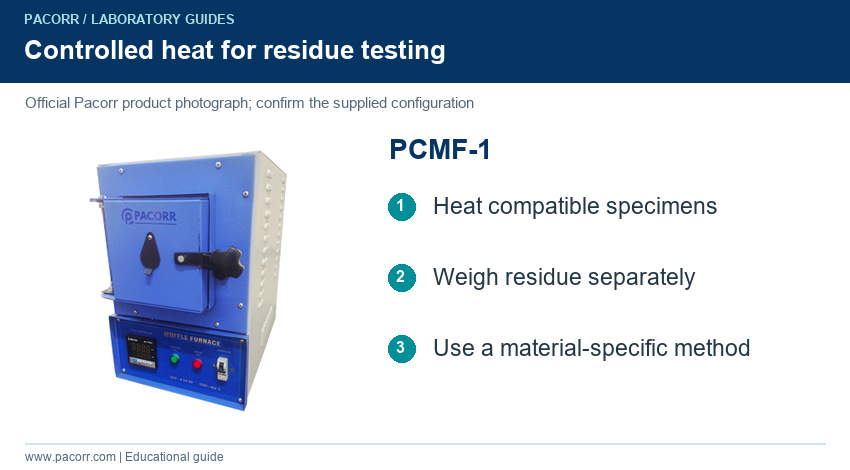
Which materials and applications are suitable?
Laboratories use furnace-based methods for compatible plastics, mineral-containing compounds, selected reinforced materials and other samples for which a validated thermal method exists. Applications can include residue determination, ignition loss, calcination and preparation for further analysis. Some thermal treatments also use chamber furnaces, but the permissible atmosphere and workpiece requirements must be checked separately.
For a compound manufacturer, residue measurement can help investigate a batch that differs from its approved formulation. For a receiving laboratory, it can support comparison of incoming lots tested by the same method. For an investigation, it can provide one piece of evidence alongside density, mechanical properties or further chemical analysis. None of these uses makes residue mass a complete material identity test.
| Application | What the laboratory must establish |
|---|---|
| Ash or inorganic residue | Material-specific method, representative sample and appropriate endpoint. |
| Ignition loss | Whether mass loss can be interpreted as resin content for that particular composite. |
| Calcination or thermal treatment | Compatible crucible, atmosphere, temperature and reaction products. |
| Comparative batch investigation | Consistent preparation, heating conditions and calculation basis. |
Unknown materials deserve a compatibility assessment before heating. Sealed containers, volatile solvents, explosive substances and samples that release aggressive fumes are not routine loads for a general-purpose furnace. The laboratory must evaluate the sample and extraction arrangement rather than treating a high maximum temperature as universal permission to process anything.
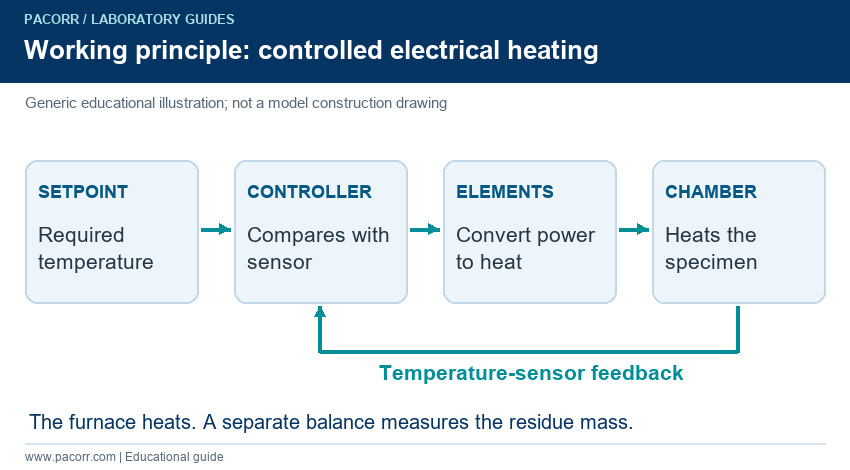
How does the working principle operate?
Electrical resistance elements convert electrical energy into heat. Hot chamber surfaces transfer energy to the crucible and specimen, with radiation becoming increasingly important at high temperature. Conduction through the crucible and local gas movement also contribute. Insulation reduces heat loss, while the temperature sensor provides feedback to the controller.
A PID controller compares the measured temperature with the chosen setpoint and adjusts heating output. It responds to present error, accumulated error and the rate of change of error. This control can reduce oscillation, but it cannot make a poorly arranged load uniform or compensate for an unsuitable sample method. Sensor placement, element condition and the load influence what actually happens inside.
The display represents the temperature measured by the control system at its sensing location. A dense sample may lag behind chamber air or wall temperature. Opening the door introduces another disturbance. For this reason, a method needs a clear definition of when the holding period begins and what counts as adequate stabilization. Reaching the displayed setpoint is not always the same as completing the required specimen exposure.
Why does loading affect the result?
Crucibles placed too close together can change heat transfer and restrict access of air where oxidation is required. An overloaded chamber also takes longer to recover after opening. A reproducible arrangement uses a qualified working zone, suitable supports and consistent spacing. Maximum physical capacity should therefore be separated from the number of specimens that can be processed within the required tolerance.
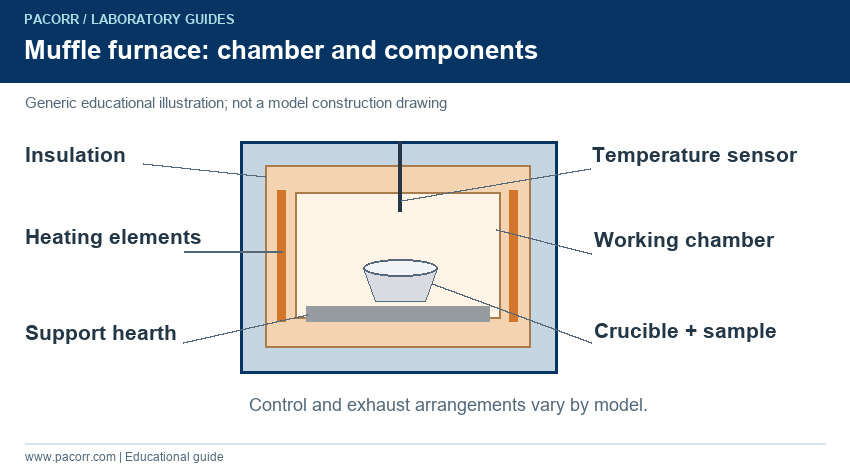
Muffle furnace diagram and component functions
The diagram below is a generic educational section. It explains functions and is not a construction drawing of the Pacorr PCMF-1. Heating-element position, insulation layers, vent arrangement and protective devices depend on the actual furnace supplied.
| Component | Function and practical relevance |
|---|---|
| Insulated chamber and hearth | Contain the hot working space and support compatible crucibles. |
| Resistance elements | Supply heat; element material and installation define operating limitations. |
| Temperature sensor | Provides the temperature signal used for control or monitoring. |
| Controller and power switching | Regulate heating output according to the selected program or setpoint. |
| Door and closure | Limit heat loss and provide access; safe operation depends on the supplied design. |
| Vent or exhaust connection | Manages process gases where provided; extraction must suit the sample and manual. |
| Crucible and handling tools | Contain the test portion and permit controlled transfer without contamination. |
The balance and desiccator sit outside the furnace but are part of a complete analytical workflow. Crucible material must withstand the temperature and remain compatible with the sample and residue. A crucible that reacts with the specimen can change the final mass even when the temperature controller performs correctly.
What types of furnace configurations are available?
General laboratory chamber furnaces provide a hot working space for a range of compatible tasks. Dedicated ashing configurations may include additional air-management or exhaust features. Programmable controllers can execute defined ramps and holds, while a simpler controller may maintain a single setpoint. These are functional differences to confirm in a quotation, not features to assume from an exterior photograph.
Furnaces also differ in element material, chamber lining, insulation, usable volume and continuous-duty rating. A maximum rating is the highest permitted operating condition under specified circumstances. It should not automatically be used as a continuous working setpoint. Frequent operation close to a rating can have different service implications from occasional short exposures.
A hot air oven is generally chosen for method-defined drying and conditioning tasks within its own range. A tube furnace provides a tubular working zone and may support controlled gas processes when properly configured. These instruments are not interchangeable merely because each has a temperature display. Choose according to atmosphere, load geometry, operating cycle and required measurement performance.
What specifications should buyers verify?
The Pacorr muffle furnace product page lists the following PCMF-1 options. Confirm the exact configuration and current technical schedule with the quotation; the table is not an operating prescription.
| Published item | PCMF-1 listing |
|---|---|
| Temperature options | Ambient to 900°C or ambient to 1200°C. |
| Inner chamber options | 4 × 4 × 9, 5 × 5 × 10 or 6 × 6 × 12 inches. |
| Display resolution | 1°C; digital LED indication. |
| Temperature sensor | J-type or K-type, according to selected range. |
| Electrical listing | 220 V, single phase, 50 Hz; 20 A stated. |
| Timer | Up to 999 hours. |
Resolution is the smallest displayed increment; it is not a statement of accuracy or uniformity. Ask for the continuous operating limit, temperature stability, usable uniform working zone, calibration coverage and protective functions. Confirm the specified sensor is suitable for the selected temperature option. The published current value should not be converted into a guaranteed energy-consumption figure: actual consumption depends on operating cycle and load.
Dimensions also need interpretation. Physical chamber dimensions do not define usable spacing between crucibles, and a larger chamber does not automatically improve analytical throughput. Request a proposed loading layout for the actual crucible dimensions and the number of tests needed each day.
How should the test be prepared?
Start with the material specification and the approved analytical method. Identify the relevant standard edition, sample preparation, test portion size, crucible requirements, atmosphere, heating conditions, cooling sequence and endpoint. Record whether the result is to be expressed on an as-received or dry basis. These choices belong in the method before testing begins.
Prepare a representative portion from the material or batch being investigated. A single pellet taken from an uneven blend may not describe the whole lot. Where grinding, cutting, drying or mixing is required, use the method and avoid contamination from preparation tools. Keep the sample identity attached to every crucible and worksheet throughout the process.
Check the furnace's condition, extraction, temperature verification and balance performance. Establish safe transfer space for hot crucibles and use tools appropriate to their shape. Where a desiccator is specified, confirm that the transfer temperature and vessel materials are compatible. Putting an extremely hot crucible into unsuitable glassware creates a separate hazard and can invalidate the handling sequence.
Before the first measurement, decide how failed runs will be handled. Examples include spilled residue, unidentified crucibles, an interrupted temperature cycle or a balance reading that never stabilizes. Documenting invalidation rules in advance is more defensible than deciding whether to keep a result after seeing whether it meets a target.
What is the muffle furnace testing procedure?
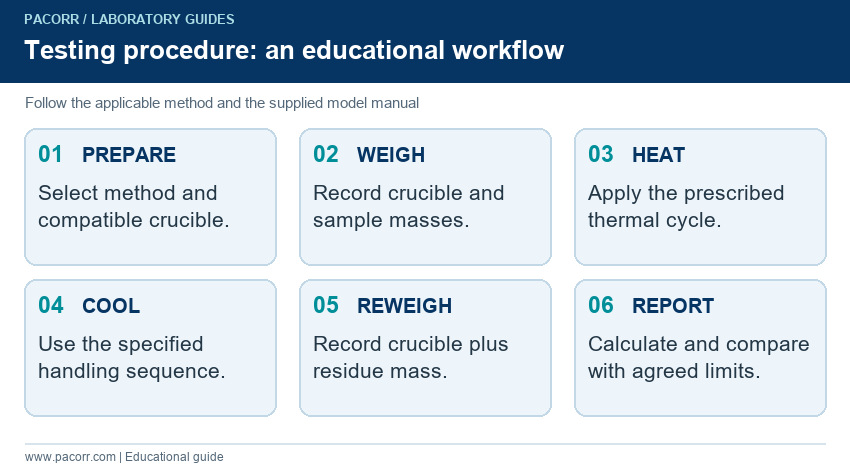
The following sequence is educational guidance for a gravimetric ash workflow. It does not replace the material-specific test method, laboratory risk assessment or model operating manual. It intentionally avoids a universal setpoint, sample mass or holding time because those choices depend on the material and method.
- Identify the sample and approved method. Record the lot, test purpose, reporting basis, required repetitions and acceptance criteria before beginning. Confirm that the material can be safely processed in the selected furnace configuration.
- Prepare and identify the crucible. Clean and condition it as directed by the method, then cool under the specified conditions. Record the stable empty-crucible mass as m0. Keep the crucible identity visible in the worksheet.
- Add the representative test portion. Record the mass of crucible plus sample as m1. Calculate the starting sample mass by subtraction. Do not substitute an intended nominal portion for the actual measured mass.
- Complete any required preliminary treatment. Some methods specify controlled preparation before the final furnace exposure. Follow that method and the approved extraction arrangements; do not improvise an ignition process from a general blog description.
- Load and heat according to the method. Position crucibles in the qualified working area, respecting permitted spacing and loading. Apply the prescribed heating sequence and record deviations, door openings or controller alarms that could affect exposure.
- Complete the defined holding period or endpoint. Use the method's stabilization and timing rule. A residue's colour alone is not a universal endpoint, and an arbitrary extension of heating may change the residue rather than improve the result.
- Cool and weigh as prescribed. Use suitable tools and the specified cooling conditions, then record crucible plus residue mass as m2. If repeated heating, cooling and weighing is required, apply the method's constant-mass criterion without inventing a substitute tolerance.
- Calculate, review and report. Check arithmetic, units, blank or correction requirements and repeatability. Investigate deviations before comparison with the agreed specification. Retain the mass readings and thermal records so another reviewer can reconstruct the result.
A completed worksheet should connect each sample to the furnace run, crucible, balance, operator and method. This traceability is valuable when an unusual result leads to a raw-material investigation weeks later. It also prevents a worksheet containing only a final percentage from concealing a transcription or tare error.
How is ash content calculated and interpreted?
For an uncorrected gravimetric example, sample mass equals m1 − m0 and residue mass equals m2 − m0. Ash percentage is [(m2 − m0) ÷ (m1 − m0)] × 100. Apply any method-specific blank corrections, preparation adjustments or dry-basis calculations separately and state them explicitly.
| Illustrative reading | Mass or calculation |
|---|---|
| Empty crucible, m0 | 28.0000 g |
| Crucible plus sample, m1 | 33.0000 g |
| Crucible plus residue, m2 | 28.7500 g |
| Sample and residue | 5.0000 g sample; 0.7500 g residue. |
| Calculated ash | 0.7500 ÷ 5.0000 × 100 = 15.00%. |
These numbers demonstrate arithmetic, not a recommended balance specification or an acceptance limit. A result of 15.00% passes only if the applicable material specification and decision rule permit it. The number of reported decimal places should be appropriate to the method and measurement capability rather than copied from the example.
Ignition loss describes mass lost during the prescribed treatment. In a simple mass balance without other corrections, it is 100% minus the remaining residue percentage. However, interpreting this loss as resin content requires the material assumptions of the selected method. Water, additives, decomposition products and reinforcement behaviour can affect that interpretation.
An unusually high residue can arise from contamination or incomplete removal of combustible material. A low residue can arise from sample loss or constituents changing under unsuitable conditions. Averages should not conceal an invalid test. Review individual determinations, investigate unexplained spread and retest according to the laboratory procedure rather than discarding inconvenient measurements.
Which standards apply, and what is their scope?
ASTM D5630-22 addresses ash content in plastics through destructive ashing. Its public scope distinguishes the quantity of residual solids from identification of individual ash constituents. This is why a furnace result must not be described as a complete chemical composition report.
ISO 3451-1:2026 gives general methods for determining ash in plastics, with material-specific conditions addressed through the applicable parts of the series. The 2026 edition replaced the 2019 edition. Use the edition required by the laboratory's contract and quality system rather than assuming an old reference remains the correct contractual method.
ASTM D2584-25 concerns ignition loss of cured reinforced resins. Interpretation as resin content has limitations related to what is lost or retained during ignition. It is not a universal substitute for every plastics ash method and does not independently establish real-world fire performance.
Owning a furnace with a sufficiently high rating does not demonstrate compliance with a standard. The complete method also governs specimens, apparatus, preparation, timing, calculations and reporting. Obtain the full applicable document and verify the equipment against its actual requirements. A standards reference in a quotation should be supported by a configuration-specific explanation of suitability.
What is the muffle furnace price in India?
A current, model-specific transaction price has not been verified from the supplied Pacorr product page. A quotation is required. Compare written offers for the same chamber, temperature option, duty requirement and supporting documentation. A low headline price is not useful if it excludes essential installation or measurement requirements.
Temperature capability and working volume influence construction and heating requirements. A programmable controller, independent protection, additional recording, installation assistance, calibration documentation and suitable accessories can also change the proposal. Ask which items are standard, which are optional and which must be arranged by the laboratory.
Budget for the complete workflow: compatible crucibles, handling tools, a suitable balance, extraction, electrical provision and any required cooling equipment. Confirm freight, taxes, commissioning, training, warranty terms and service arrangements in writing. These are quotation questions, not assumptions that every supplier includes the same package.
For recurring testing, evaluate cost per valid batch as well as purchase cost. Loading capacity, recovery time, cooling time and operator availability affect useful throughput. Choosing a larger chamber without checking daily sample flow may increase occupied space and operating costs without shortening the actual reporting cycle.
How should a laboratory choose the right model?
Build the enquiry around the method and sample rather than the largest temperature number. Supply the required operating temperatures, hold times, approximate load mass, crucible dimensions and number of specimens per run. Include any atmosphere or fume-related restrictions that affect suitability.
Ask how the manufacturer defines the usable working zone and what evidence supports the required temperature performance. A demonstration with an empty chamber answers a different question from a representative loaded run. If the laboratory routinely uses several setpoints, verification should address those working conditions rather than only one convenient temperature.
For documentation, request the supplied manual, equipment identification, calibration scope and operating limitations. Clarify whether protective features are independent of the normal controller and how faults are indicated. Maintenance access and replacement-element availability matter because a laboratory cannot release routine results while critical equipment is unavailable.
Pacorr's muffle furnace operating guide provides related reading. For the analytical purpose, see ash percentage determination. Always resolve operating details through the approved method and supplied manual, particularly where general guidance differs from a specific material requirement.
What errors, maintenance and calibration checks matter?
Common errors include confusing display resolution with accuracy, weighing a hot crucible, losing residue during transfer, using the wrong tare, mixing reporting bases and treating an incomplete burn as a finished determination. Another frequent problem is changing the heating cycle without documenting that the method has changed.
Keep a maintenance record covering chamber condition, door closure, contamination, abnormal heating behaviour and service interventions. Clean only by methods permitted by the manufacturer and only under appropriate isolated, cool conditions. Avoid damaging refractory surfaces or generating dust from insulation. Electrical, element and sensor work should be carried out by qualified personnel.
Calibration compares a measurement system with a suitable reference; mapping evaluates differences across positions in the working space. Neither is replaced by controller auto-tuning. Select a verification interval based on use, drift history, repairs and the laboratory quality system. After a significant repair, assess whether requalification is needed before relying on previous performance records.
When results drift, review sampling and weighing as well as the furnace. A temperature correction will not resolve an unrepresentative sample or moisture uptake during cooling. Investigating the whole measurement chain usually gives a more useful answer than repeatedly adjusting the controller to force results toward an expected number.
Frequently asked questions
Does a muffle furnace directly measure ash content?
No. It provides the thermal treatment. Ash content is calculated from measured sample and residue masses using a suitable balance and the prescribed test method.
Is the chamber oxygen-free when the door is closed?
No. A standard air-operated chamber is not automatically inert, gas-tight or vacuum-rated. Ashing commonly needs oxygen, while other atmospheres require equipment specifically designed for them.
Can the highest furnace temperature be used for every sample?
No. The test method and sample chemistry determine the required temperature. Excessive heat can change or volatilise the residue and give a misleading result.
Does a 1°C display mean accuracy of ±1°C?
No. Display resolution, measurement accuracy, stability and spatial uniformity are different characteristics. Request evidence for the performance required at the intended working conditions.
Is ash percentage always equal to filler percentage?
No. Fillers and other ingredients can change during heating, and several constituents may contribute to the residue. Interpret the result using the material system and applicable method.
How long does a muffle furnace test take?
There is no universal duration. Preparation, heating, stabilization, holding, cooling and any repeated weighing cycles depend on the approved method and load.
What information is needed for a price quotation?
Provide the sample type, test method, operating temperature, crucible dimensions, specimens per run, daily workload, installation conditions and required calibration or recording features.
Can a furnace residue identify individual minerals?
No. Residue weighing measures mass remaining after treatment. Identifying specific elements or compounds requires additional analytical techniques appropriate to the material.
Discuss your muffle furnace requirement with Pacorr
Share your material, applicable method, test temperature, crucible quantity and reporting requirement with Pacorr. A clearly defined application helps the team evaluate chamber size, control needs and the supporting equipment required for a useful laboratory workflow.
Review the Pacorr muffle furnace or contact Pacorr's enquiry team. Call +91-8882149230 or email info@pacorr.com for a configuration-specific quotation. Confirm performance, supplied accessories and operating limitations before finalising the purchase.