

An ultra-low deep freezer is insulated refrigeration equipment used to maintain a very cold environment for compatible materials or samples. Its suitability depends on the actual temperature range, load, monitoring and intended use. The equipment controls temperature; a separate test or inspection determines whether an exposed specimen still meets its quality requirements.
The temperature label needs particular care. Many laboratories associate ultra-low temperature storage with equipment operating around −80°C. The supplied Pacorr product page instead lists the PCDF125 with a range of −10°C to −50°C. This guide keeps that distinction explicit: a model rated to −50°C must not be treated as a −80°C freezer.
For purchasing and quality-control teams, selecting the correct unit involves more than reaching a low number on a display. The chamber must accommodate the load, maintain the required conditions, recover appropriately after access and provide useful records. This article explains the working principle, diagram, verification procedure, cold-exposure workflow, standards and quotation factors without prescribing storage conditions for a particular biological or pharmaceutical material.
What does an ultra-low deep freezer measure and control?
A freezer removes heat from an insulated working space and rejects that heat to the surrounding environment. A sensor measures temperature for the control system, which operates the refrigeration equipment to maintain the selected condition. The display describes the sensor reading; it does not directly measure specimen strength, biological viability or product shelf life.
In a materials laboratory, a freezer may provide a controlled cold exposure before a separate dimensional, mechanical or functional assessment. In storage, the objective is to keep approved contents within their specified temperature conditions. These activities require different records and acceptance criteria even when they use similar-looking cabinets.
Distinguish air temperature, wall temperature and sample temperature. Air can change quickly when a door opens. The centre of a substantial load changes more slowly because the load has thermal mass. A reading near a cooling surface can therefore differ from a reading near the door or inside a representative container. One displayed value cannot demonstrate the condition of every item.
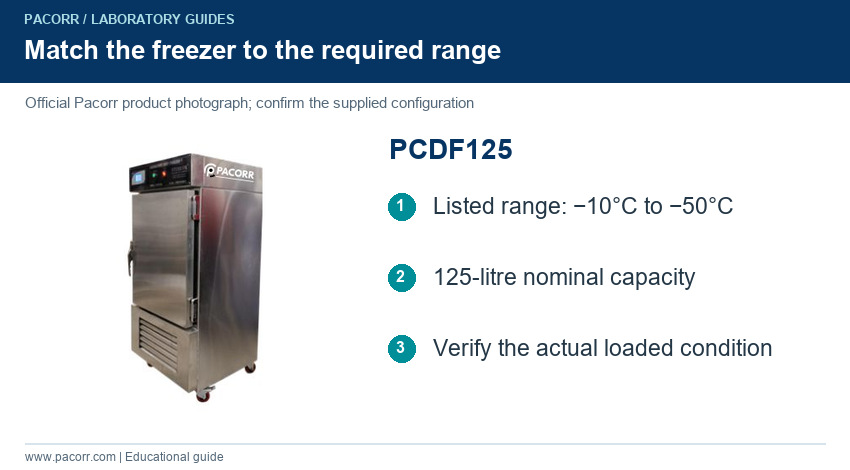
Is a −50°C freezer the same as a −80°C freezer?
No. A −50°C model cannot meet a protocol that requires −80°C. The label used in a catalogue is less important than the documented operating range and performance at the required load. This distinction also affects refrigeration design, insulation, power demand and qualification requirements.
The U.S. Department of Energy's laboratory freezer guidance discusses conventional ULT operation at −80°C and the energy implications of operating conditions. That broader context does not extend the range of a particular Pacorr model or authorise changing the storage condition of a sensitive sample. Any setpoint change must be justified for the actual contents and approved procedure.
| Requirement | Correct interpretation |
|---|---|
| A protocol requires −80°C | Select equipment documented and qualified for that requirement; the listed −50°C unit is unsuitable. |
| A material requires exposure within −10°C to −50°C | Evaluate the listed model against the complete load, duration and tolerance requirements. |
| Only a marketing name is available | Obtain the technical schedule and performance evidence before selecting equipment. |
| A storage range is specified on a label | Follow that requirement and verify the selected equipment under intended conditions. |
Avoid assuming that colder is always better. Some materials have restricted storage ranges, and changes in handling or freezing can affect their properties. The product or sample protocol must define what is acceptable. This article does not provide a substitute temperature recommendation for clinical specimens, medicines or vaccines.
Where is a deep freezer used in quality control?
Cold exposure is useful when a material or component may encounter low temperatures during storage, transport or service. Examples include polymer parts, elastomer components, packaging materials, seals and suitable mechanical assemblies. The exposure can be followed by a defined examination for cracking, dimensional change, sealing behaviour or another property selected by the test plan.
The freezer does not automatically perform a brittle-point test, impact test or tensile test. Those measurements require their own apparatus and method, including control of the specimen condition during transfer. If a specimen warms appreciably between removal and measurement, the reported result may no longer represent the intended cold condition.
Storage applications need an independent suitability assessment. Container compatibility, access frequency, contamination control, alarms and backup arrangements can be as important as minimum temperature. A freezer should not be described as suitable for every biological material simply because it can become very cold.
Define the load before buying: dimensions, mass, material, initial temperature and number of items. A cabinet containing a small pre-cooled load experiences a different demand from the same cabinet receiving several warm containers. The stated chamber volume does not describe the maximum safe loading rate or establish a guaranteed pull-down time.
How does the refrigeration working principle operate?
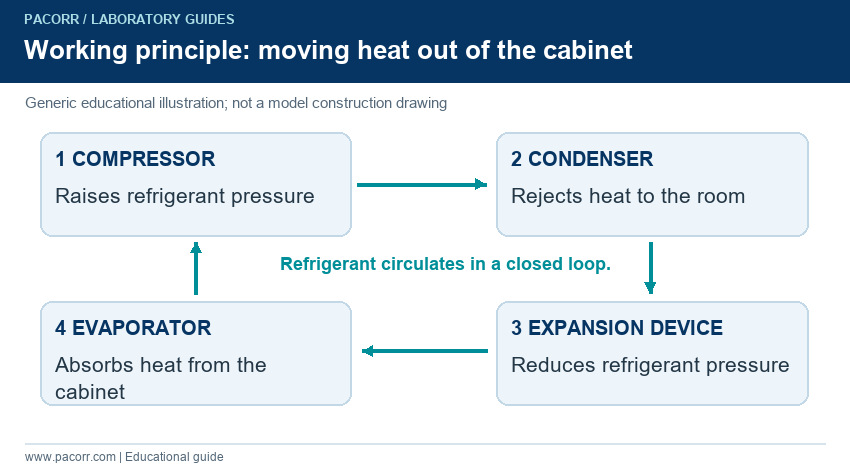
In a vapour-compression refrigeration cycle, refrigerant absorbs heat in the evaporator at low pressure. The compressor raises the pressure of the vapour. The condenser releases heat to the surrounding environment as the refrigerant condenses. An expansion device reduces pressure before the refrigerant returns to the evaporator. Continuous circulation moves heat out of the cabinet.
The compressor supplies work to the cycle, so the room receives both heat removed from the cabinet and energy used by the equipment. This is why room ventilation and installation clearances matter. A freezer crowded against an unsuitable enclosure may struggle even though the interior door remains closed.
Insulation and door seals limit heat entering the chamber. Warm air entering during access introduces both heat and moisture, which can lead to frost on cold surfaces. The amount of frost and its location depend on design and operating conditions. Defrost arrangements must be understood before qualifying a storage or exposure process.
Very low temperature systems can use different refrigeration architectures, including multi-stage or cascade arrangements. Do not infer the number of stages from the term ultra-low. The listed Pacorr model specifies one compressor and direct cooling. Its exact refrigerant and supplied refrigeration configuration should be confirmed from the current technical schedule and nameplate.
Why does the load take longer to cool than the air?
Heat must move from the specimen centre to its surface and then to the surrounding cold environment. Thick, insulated or densely packed items slow that transfer. A stable cabinet display therefore does not prove that every specimen has reached the required exposure condition. Use the stabilization rule in the test method and appropriate measurement of a representative load where required.
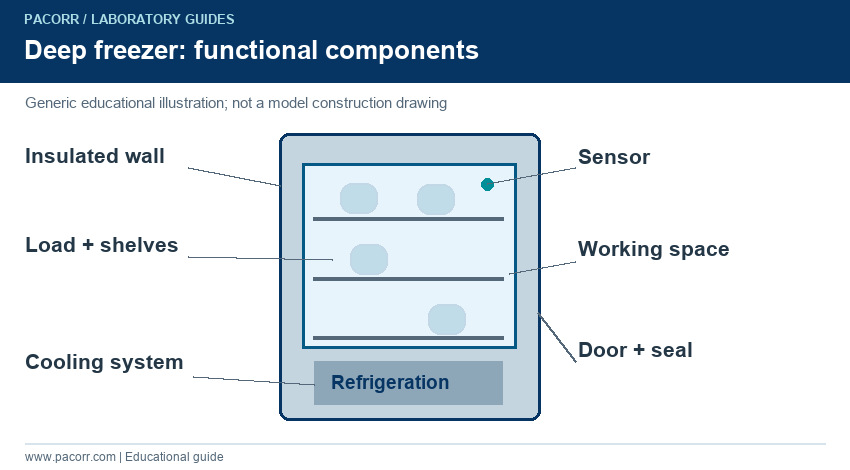
Deep freezer diagram and component functions
The component diagram is a generic educational representation of an upright freezer. The separate cycle diagram shows heat flow and refrigerant circulation conceptually. Neither image is a service drawing or a claim about the hidden pipe routing of the PCDF125.
| Component | Function and selection question |
|---|---|
| Insulated cabinet and door seal | Restrict heat entry; verify access, closure and maintenance requirements. |
| Shelves or load supports | Organise contents while preserving the qualified usable space. |
| Evaporator or cooled surfaces | Absorb heat from the working space; keep loading within the manual's restrictions. |
| Compressor and condenser | Move heat out and reject it to the room; provide the required ventilation. |
| Temperature sensor and controller | Measure and regulate conditions; identify the sensor and its calibration scope. |
| Recording and alarm functions | Preserve evidence and flag departures where fitted; confirm actual supplied capabilities. |
An independent monitoring probe can provide a separate measurement path, but it also needs suitable placement and calibration. Positioning a probe beside the controller sensor may verify local agreement while missing a warmer load position. Mapping, routine monitoring and controller calibration answer different questions.
Which configurations should be compared?
Upright cabinets provide access through a vertical door and can support organised shelf layouts. Chest configurations use a top opening and have different access and footprint considerations. Select the arrangement that fits the sample inventory and working procedure rather than assuming one format is universally more efficient.
Direct-cooling and forced-air designs distribute cooling differently. A fan, if fitted, affects air movement around the load; a direct-cooling cabinet may rely on cold surfaces and natural circulation. A generic freezer should not be assumed to provide the controlled air velocity needed by every environmental test. Powered specimens also add heat that must be included in the capability assessment.
Compare fixed-temperature storage with programmable cold-exposure requirements. A storage freezer is not automatically a thermal-shock chamber or a temperature-cycling system. Rapid transitions, two-zone transfers, programmed ramps and energized testing require appropriate equipment and documented performance. The intended method should determine whether a freezer is sufficient.
What does Pacorr publish for the PCDF125?
The Pacorr Ultra-Low Deep Freezer product page lists the specifications below. The range is −10°C to −50°C; it is not −100°C to −500°C, which would be an incorrect interpretation of poorly formatted degree symbols.
| Published specification | PCDF125 listing |
|---|---|
| Nominal volume | 125 litres. |
| Internal dimensions | 455 × 455 × 609 mm, width × depth × height. |
| Temperature range and sensor | −10°C to −50°C; PT100. |
| Shelves and interior | Eight removable steel wire-mesh shelves; stainless steel 304 chamber. |
| Cooling and compressor count | Direct cooling; one compressor. |
| Controller and records | PLC-based HMI; data recording and USB transfer listed. |
| Supply and ambient condition | 220 V, 50 Hz; ambient temperature below 32°C. |
The page also lists automatic defrost and alternative refrigerants. Confirm the delivered configuration, defrost behaviour, alarm functions and temperature performance under load before ordering. No numerical accuracy, uniformity, pull-down time or energy-consumption guarantee is inferred from these listed specifications.
Ask whether nominal capacity is gross internal volume or usable storage volume after shelves, clearances and monitoring positions are considered. Verify external dimensions and access route separately: an internal chamber measurement does not establish whether the complete cabinet fits through a laboratory doorway.
How should installation and test planning be prepared?
Prepare a written requirement covering the contents, temperature range, permissible excursions, access pattern and intended duty. For cold exposure, include specimen geometry, duration, operating state and the property measured afterward. For storage, use the approved requirement for the material and define who responds to an alarm.
Check electrical supply, room conditions, ventilation and manufacturer clearances. A dedicated assessment of the load and supporting electrical installation is more useful than assuming that any available outlet is adequate. Do not use improvised extensions, modify protection or change refrigerant settings to force the cabinet to achieve an unsupported temperature.
Identify the instruments used to verify temperature. They must cover the required range and have suitable calibration information, uncertainty and recording interval. Decide which positions represent the working zone and which represent likely warm or cold locations. The number and placement of sensors should be justified by the study rather than copied from an unrelated room-size example.
Use representative non-critical loads for qualification where appropriate. Document shelf arrangement and container spacing so the results can be related to routine use. An empty-cabinet study alone may not represent a full working load, frequent access or a warm delivery placed inside during a normal shift.
What is the freezer verification procedure?
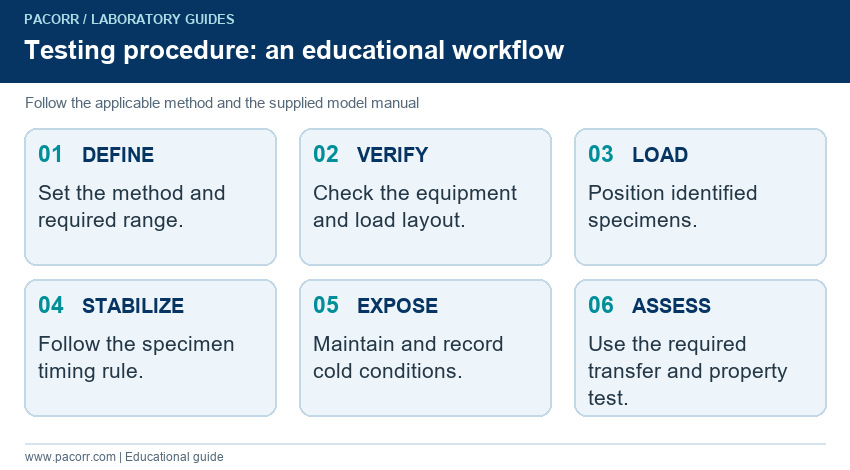
This educational sequence describes equipment verification planning. It is not a model-specific operating instruction or a prescribed qualification protocol. Study duration, logger count, sampling interval and acceptance limits must be approved for the application before testing.
- Record equipment identity and installation conditions. Capture model, serial number, location, room temperature, supply information and relevant configuration. Confirm that the unit is commissioned according to the supplied manual.
- Define the operating requirement. State the test setpoint, acceptable temperature limits, load condition and planned challenges. Separate mandatory performance criteria from observations being collected for information.
- Check and position calibrated loggers. Record each sensor identity and location. Avoid accidental contact with walls unless surface temperature is the intended measurement. Ensure the recording equipment is suitable for the complete temperature range.
- Establish a baseline at the selected condition. Operate the freezer according to its manual and the approved stabilization rule. Start the formal study when the specified prerequisites are met, not merely when the display first crosses the target.
- Evaluate representative loaded operation. Document contents, shelf arrangement and initial load condition. Record the temperature distribution over the approved period and review variations between locations and over time.
- Conduct only approved operational challenges. Where required, assess defined door access, recovery, defrost or alarm behaviour with non-critical contents and appropriate safeguards. Do not create an uncontrolled power interruption around valuable samples.
- Review complete records against the criteria. Assess all required positions and events, including any excursions. Record deviations and investigation outcomes. A favourable average cannot cancel an unacceptable maximum temperature at a relevant location.
- Approve the operating configuration and monitoring plan. Identify usable positions, access restrictions, alarm response and requalification triggers. Preserve raw records, sensor certificates and study conclusions for future review.
The WHO temperature-mapping resource explains mapping as recording temperatures throughout a three-dimensional storage space. It supports the distinction between a single display reading and a study of distribution. Its cold-chain guidance does not constitute certification of a particular freezer or a universal protocol for every industrial material.
How is a material cold-exposure test performed?
After equipment suitability is established, use a separate specimen test plan. Record the material, lot, specimen preparation and baseline measurements. Identify whether the sample is tested packed or unpacked and whether it is powered during exposure. These details change the thermal load and the meaning of the result.
Arrange the specimens in the qualified working zone with the required spacing and supports. Apply the specified temperature and allow the required specimen stabilization. Begin timing according to the chosen method. A fixed number of minutes after loading is not a universal substitute for thermal equilibrium.
Maintain the approved exposure and record conditions throughout it. If the freezer alarms, the door is opened unexpectedly or the recording fails, handle the event under the deviation procedure. Repeating only the final minutes of an interrupted exposure may not reproduce the required test and should not be improvised.
After exposure, transfer or recover the specimens exactly as the method requires. Some evaluations need testing while cold; others specify a controlled recovery period. Record transfer time and relevant environmental conditions. Perform the intended inspection or mechanical test using its own validated apparatus and acceptance criteria.
Pacorr's article on polymeric materials at low temperature gives related application context. For broader environmental equipment selection, see the climatic chamber guide. Match the equipment to the actual test profile instead of treating cold exposure, humidity exposure and rapid thermal cycling as the same operation.
How should temperature and specimen results be interpreted?
Report temperature performance and specimen performance separately. Temperature records show whether the exposure conditions were achieved. Specimen measurements show what happened to the material. A specimen that appears unchanged after an invalid exposure does not establish compliance with the intended test.
Use clearly defined metrics. Pull-down time depends on starting temperature, setpoint, ambient condition and load. Door-opening recovery depends on the opening duration, contents and definition of recovery. Stability describes variation over time at a location, while uniformity describes differences between locations. Different suppliers may calculate these values differently, so request the calculation method.
| Illustrative observation | Interpretation |
|---|---|
| Two simultaneous probes read −40.8°C and −38.9°C | Their difference is 1.9°C; this snapshot alone is not a complete uniformity study. |
| A control display shows −40°C | This establishes the displayed reading, not every specimen's temperature. |
| A specimen warms during transfer | The later measurement may not represent the required cold condition. |
| An average lies inside limits but one required probe exceeds them | Review the excursion against the approved decision rule; averaging does not erase it. |
For a specimen property, state the original and post-exposure values, units and calculation. For example, a change from 100.0 mm to 99.7 mm is a decrease of 0.3 mm, or 0.3% relative to the original dimension. This arithmetic is illustrative and does not set an acceptable dimensional change for any product.
Which standards and guidance are relevant?
IEC 60068-2-1:2025 addresses cold testing of components, equipment and other articles, including heat-dissipating and non-heat-dissipating specimens. Its scope includes low-temperature use, transport and storage conditions. It does not define tests for the effects of temperature changes, so it should not be described as a general thermal-shock method.
The full method and relevant product specification determine chamber capability, stabilization, exposure and reporting requirements. A freezer's low-temperature range alone cannot demonstrate conformity, particularly where air velocity, energized specimens or temperature distribution matter. Obtain confirmation for the specific procedure and load.
For storage applications, WHO's temperature mapping guidance provides an authoritative reference on assessing storage-space distribution. Use the guidance within its scope and combine it with the actual material's labelled or approved storage requirements. Do not describe a general laboratory cabinet as medically validated or certified solely because mapping is discussed in a blog.
Test standards, storage protocols and equipment specifications have different roles. The standard describes a method, the specimen specification defines the required outcome, and the equipment schedule describes capability. A defensible test requires all three to agree.
What determines the ultra-low deep freezer price?
A current purchase price for the supplied Pacorr configuration has not been verified; request a written quotation. The required temperature range is a major starting point because a −50°C cabinet and equipment designed for −80°C should not be compared as equivalent products.
Capacity, usable load arrangement, refrigeration architecture, insulation, controller, monitoring, alarms and documentation influence cost. Additional access ports, remote notifications, backup provisions or qualification services may be options rather than included features. Ask the supplier to identify every inclusion and exclusion.
Installation and lifetime costs also matter. Consider room heat rejection, energy use under comparable conditions, servicing, calibration and contingency capacity. A low purchase price can be offset by unsuitable access, insufficient usable space or missing monitoring. Request energy information with stated ambient and load conditions rather than relying on an unsupported daily-consumption estimate.
Provide the required range, contents, dimensions, load mass, door-opening frequency, records, alarms and installation location in the enquiry. This allows a proposal to be assessed against a measurable need rather than a broad request for the coldest available freezer.
What maintenance, calibration and common errors matter?
Inspect door seals, closure, frost accumulation and unusual operating behaviour according to the manual. Maintain permitted condenser or intake cleaning and keep surrounding ventilation clear. Defrost, drainage and cleaning must follow the supplied design; do not chip ice with sharp tools or apply uncontrolled heat to speed the process.
Before planned maintenance, arrange approved temporary storage for any critical contents. After maintenance, restore the documented shelf arrangement and verify readiness before reloading. A successful restart is not automatically evidence that the previous qualified performance remains unchanged after a major refrigeration repair.
Calibrate the controller sensor and independent monitoring system as required by the quality system. Mapping checks distribution and cannot be replaced by a single-point sensor comparison. Select intervals based on risk, use, drift history and service events; there is no universal interval suitable for every laboratory.
Common errors include choosing by name rather than temperature range, overloading, blocking required clearance, ignoring room temperature, treating the display as specimen temperature and transferring cold specimens without controlling warming. For storage, another important error is relying on alarms without an assigned response procedure. Define who receives the alert, how contents are assessed and what backup equipment is available.
Frequently asked questions
Can the listed Pacorr PCDF125 reach −80°C?
The supplied product page lists −10°C to −50°C. It must not be represented as a −80°C freezer. A −80°C requirement needs an appropriately specified and qualified model.
Does a deep freezer measure low-temperature material strength?
No. It provides a cold environment. Strength, impact resistance, dimensions or other properties require separate measurements using the applicable test apparatus and procedure.
Is cabinet air temperature the same as sample temperature?
Not necessarily. Samples can take longer to cool than the air, especially when thick, insulated or densely packed. Use the method's specimen-stabilization requirements.
What is temperature mapping?
Temperature mapping records conditions at multiple defined positions over time to assess distribution and identify relevant warmer and colder locations within the working space.
Can any deep freezer be used for thermal-shock testing?
No. Thermal-shock and rapid-cycling methods require specific transition capabilities and procedures. A storage or cold-exposure freezer is not automatically suitable.
How long should a specimen remain inside?
Use the applicable test method or approved storage protocol. There is no universal exposure time, and the timer start may depend on specimen stabilization rather than the display reaching its setpoint.
What should be included in a price enquiry?
Include the required temperature range, usable capacity, sample dimensions and mass, access frequency, monitoring and alarm needs, installation conditions and qualification requirements.
Are all biological samples suitable for the listed freezer?
No. Suitability depends on each sample's approved storage requirements, container, monitoring and validated handling process. The equipment name alone does not establish biological or clinical suitability.
Request an application-specific freezer quotation
Share the temperature requirement first, followed by the load, daily access pattern and intended purpose. Tell Pacorr whether you need storage, material cold exposure or a broader environmental test profile so that equipment capability can be checked against the application.
Review the Pacorr Ultra-Low Deep Freezer and contact the Pacorr enquiry team. Call +91-8882149230 or email info@pacorr.com. Request written confirmation of the supplied configuration, performance conditions, documentation and quotation inclusions before purchase.