

A humidity chamber is an enclosed environmental instrument that controls temperature and relative humidity around a specimen. It is used to condition materials before measurement or to expose products to specified humid conditions before, during or after a performance assessment. The chamber measures environmental conditions; it does not directly measure product life, moisture resistance or strength without a separate defined evaluation.
For packaging, textiles, electronics and other moisture-sensitive materials, uncontrolled surroundings can make two otherwise similar tests difficult to compare. A chamber creates a documented environment so that the influence of temperature and moisture can be studied more consistently. The test still needs representative specimens, an appropriate method and agreed acceptance criteria.
This guide explains the humidity chamber working principle, diagram, specifications, testing procedure, standards and price factors. It also distinguishes steady conditioning from cyclic exposure and identifies configuration details that should be confirmed before ordering a Pacorr chamber.
What does a humidity chamber control?
The two principal controlled quantities are temperature, normally expressed in degrees Celsius, and relative humidity, expressed as % RH. Relative humidity describes water-vapour pressure as a percentage of saturation vapour pressure at the same temperature. Because saturation conditions change with temperature, the same amount of water vapour can produce a different relative humidity when temperature changes.
Relative humidity is not the same as moisture content inside a specimen. Paper, textile fibres, adhesives and other materials exchange moisture with their surroundings at different rates. A stable chamber display does not demonstrate that a thick specimen or sealed package has reached moisture equilibrium. The method must define whether exposure time, mass stability or another endpoint is required.
A chamber can support controlled conditioning before a mechanical test, or an environmental exposure intended to reveal changes such as warping, blistering or functional deterioration. These are different purposes. Conditioning aims to establish a defined starting state; a durability exposure intentionally challenges a material under specified conditions.
Which materials and applications benefit?
Packaging laboratories can condition board, cartons, labels and other moisture-sensitive materials before performing the relevant strength or performance test. Textile laboratories can establish the atmosphere required by a fabric test method. Electronics and component laboratories can assess the effect of a defined damp-heat environment when the chamber and electrical arrangements are suitable for the procedure.
Coatings, seals, adhesives and polymer components may also require controlled exposure followed by visual, dimensional or functional assessment. The method should identify the property being investigated and how it will be measured. A photograph of an unchanged specimen is not a universal substitute for a specified adhesion, leakage or electrical test.
| Purpose | What the test plan must define |
|---|---|
| Conditioning before measurement | Atmosphere, specimen preparation, equilibration rule and transfer conditions. |
| Steady humid exposure | Temperature, RH, duration, operating state and post-exposure assessment. |
| Cyclic temperature and humidity exposure | Complete cycle, transition requirements, condensation conditions and equipment capability. |
| Product-development comparison | Baseline, repeat specimens, controls and a consistent comparison method. |
Pharmaceutical stability work has additional protocol, qualification and documentation requirements. A general humidity chamber is not automatically a validated stability system. Similarly, a humidity chamber is not automatically a salt-spray chamber, rain-test rig or immersion apparatus. Those methods expose specimens to different mechanisms and require different equipment.
How does the humidity chamber working principle operate?
A controller compares temperature and humidity measurements with the selected targets and adjusts the available heating, moisture-generation and, where fitted, cooling or dehumidification systems. Air movement distributes conditioned air around the specimens. Insulation reduces unwanted heat exchange, while the enclosure limits uncontrolled moisture exchange with the room.
Humidity can be increased by adding water vapour through the chamber's designed humidification system. Reducing humidity may require a cooling and condensation process, a dry-air supply or another dedicated arrangement, depending on the design. A chamber that can add heat and moisture does not necessarily have the ability to cool below room temperature or reduce humidity below ambient conditions.
Temperature and RH control interact. Heating air without adding moisture generally lowers its relative humidity. Cooling can increase relative humidity and, if a surface becomes cold enough, cause condensation. The controller and conditioning system must manage this interaction to achieve the specified combination at the specimen locations.
The operating envelope is therefore more useful than two separate maximum numbers. A chamber advertised with a temperature range and an RH range may not achieve every possible combination of those values. Ask for the permitted temperature–humidity envelope and performance information at the exact condition required by the method.
Why are airflow and loading important?
Dense stacking, large packages or blocked air passages can create local conditions different from the controller reading. A specimen near a moisture inlet may experience a different environment from one in a poorly circulated corner. Follow the approved loading layout and preserve the required clearances. Useful capacity is the space that meets the test requirements under load, not simply all the space behind the door.
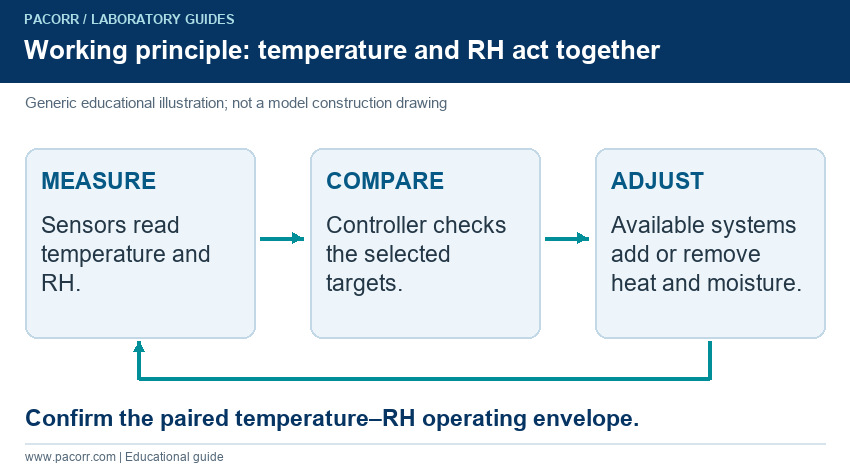
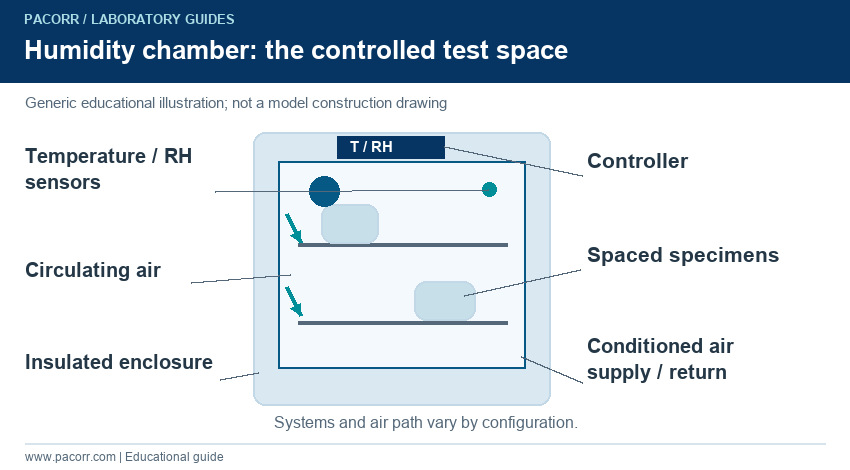
Humidity chamber diagram and component functions
The diagram is a generic educational representation, not a construction drawing of a verified Pacorr configuration. It identifies the functions used to control the specimen environment. Cooling and dehumidification remain configuration-dependent capabilities and should not be assumed from the illustration.
| Component | Function and practical importance |
|---|---|
| Insulated test space | Holds specimens within the defined working environment. |
| Temperature and RH sensors | Provide measurements for control or monitoring; placement affects interpretation. |
| Controller and display | Compare measured conditions with selected targets and regulate available outputs. |
| Heater and humidifier | Add heat and water vapour as required by the control system. |
| Circulation fan and air passages | Move conditioned air through the working space; loading must not obstruct them. |
| Water supply, level indication and drain | Support humidification and water management according to the supplied design. |
| Cooling or dehumidification, if fitted | Extend achievable conditions; verify the actual operating envelope. |
Specimens and monitoring probes should not be positioned arbitrarily against walls or outlets. Those positions may measure local surface effects instead of the environment intended by the method. Record the layout used during qualification so routine work can reproduce the configuration that was demonstrated to be suitable.
How do conditioning, steady-state and cyclic chambers differ?
A conditioning chamber maintains the atmosphere needed to prepare specimens for another test. The relevant method can include preconditioning, equilibration and restrictions on transfer to the testing area. A steady-state humidity exposure maintains defined temperature and RH conditions over a specified period to examine the response of a specimen.
A cyclic test changes conditions according to an approved profile. The cycle may intentionally produce condensation, or may have other tightly controlled transitions. Programmability, ramp performance, cooling capacity and humidity response matter. A digital timer and a high RH setting alone do not establish cyclic-test capability.
Benchtop, floor-standing and walk-in arrangements serve different sample sizes and access needs. The appropriate choice depends on the load and required working zone. Oversizing a chamber without understanding throughput can create unnecessary installation demands, while undersizing can force unacceptable crowding or repeated batches.
When comparing humidity and climatic chambers, focus on the actual capabilities instead of the label. Both temperature and humidity are relevant to humidity testing. A broader climatic system may add cooling, wider operating ranges or programmable profiles. Ask whether the quoted unit can reproduce the complete required condition under the intended load.
What specifications does Pacorr publish?
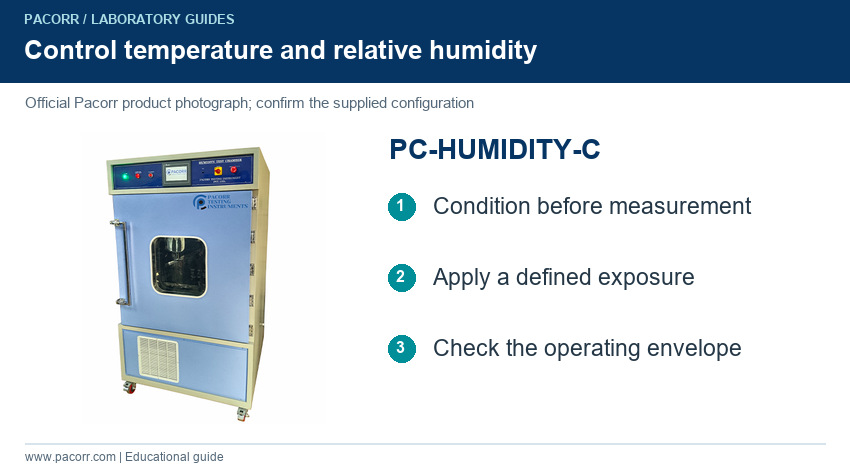
The Pacorr humidity chamber product page lists the following in its specification section. The same page also describes broader configuration-dependent capabilities, so the order should identify the exact supplied technical schedule.
| Published specification | Listed configuration |
|---|---|
| Product-page model | PC-HUMIDITY-C. |
| Temperature range | Ambient to 60°C. |
| Humidity range | Ambient to 90% RH. |
| Listed temperature accuracy | ±2°C; the page does not establish a numerical RH accuracy here. |
| Chamber dimensions | 24 × 24 × 24 inches. |
| Shelves and interior | Two stainless steel shelves; stainless steel inner chamber. |
| Display and timer | Digital LED; up to 999 minutes, with hours selectable as stated. |
Confirm whether cooling, active dehumidification, programmable cycles, logging and remote alarms are included in the selected configuration. The linked brochure uses a different model designation, so obtain written confirmation of the ordered model. Do not combine features from different configurations into an assumed single specification.
The listed ±2°C value is a temperature statement, not ±2% RH. Also distinguish accuracy from stability, spatial uniformity and display resolution. Request the conditions, loading and measurement method behind performance figures before comparing two offers. A chamber may meet a broad temperature range while failing a particular method's tighter tolerance at the required operating point.
What should be prepared before testing?
Begin with the product specification and applicable method. Define specimen identity, sampling, preparation, orientation, temperature, RH, duration, stabilization rule, operating state and assessment criteria. Confirm whether condensation is required, prohibited or irrelevant to the method. This changes the appropriate equipment and procedure.
Record baseline observations and measurements before exposure. Useful records may include mass, dimensions, coating appearance, adhesion result or functional output, depending on the purpose. Identify each specimen and any untreated control so the post-exposure comparison remains traceable. The number of specimens must come from the approved plan, not a generic recommendation.
Check chamber readiness, calibration status, water quality requirements and the planned loading arrangement. Use water specified by the manufacturer; unsuitable water can introduce deposits or affect humidity-system operation. Check drainage and any water-level protection according to the manual. Do not add chemicals or improvise cleaning mixtures in the humidifier supply.
Verify that the target temperature–RH combination is inside the demonstrated operating envelope. For example, a chamber whose stated lower temperature is ambient cannot be assumed to provide 23°C when the room is at 30°C. If the required condition needs cooling or dehumidification, confirm that capability before preparing a batch of specimens.
If electrical specimens will operate during exposure, assess power, cabling, feedthroughs, heat generation and electrical safety under the approved procedure. Do not trap cables in the door seal. A powered specimen changes the heat load and may change local humidity, so qualification should address the actual operating arrangement.
What is the humidity chamber testing procedure?
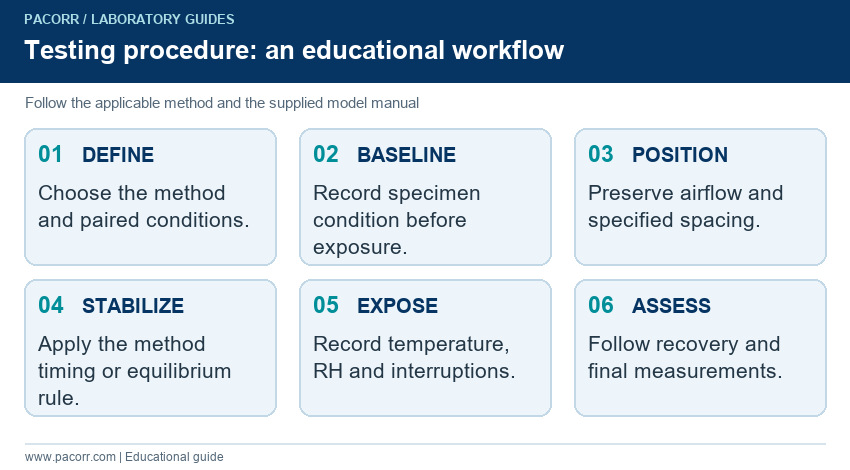
This sequence is educational and applies only after a suitable method and chamber configuration have been selected. Use the supplied operating manual for controls, water handling, alarms and safe operation. Temperature, RH, duration and acceptance limits are deliberately not prescribed here.
- Define and record the test. Identify the method edition, product specification, sample lot and intended purpose. Distinguish conditioning from durability exposure and state the required final measurements.
- Prepare and examine specimens. Complete the required preconditioning, cleaning or assembly. Record baseline values, specimen dimensions, packaging condition and any existing defects so later changes can be interpreted correctly.
- Verify chamber readiness. Check water supply, drainage, cleanliness, seals, sensor status and calibration records. Confirm the target condition and load are within the approved operating envelope.
- Position the load and monitoring devices. Preserve specified clearances around specimens and air passages. Record shelf locations and orientation. Use monitoring positions justified by qualification rather than only the most convenient location.
- Establish the required environment. Apply the method's loading and stabilization sequence. Confirm when exposure timing should start. A display reaching setpoint does not automatically establish specimen moisture equilibrium or completion of preconditioning.
- Maintain and record the exposure. Monitor temperature, RH and relevant alarms throughout the required period. Avoid unnecessary access. Document water replenishment, door openings or interruptions that may affect the validity of the run.
- Apply the prescribed recovery and assessment. Some methods require measurements promptly in the conditioned state; others specify recovery. Follow the correct transfer conditions and complete the agreed visual, dimensional, mechanical or functional evaluation.
- Review and report. Compare results with predefined criteria, document deviations and retain environmental records. Explain whether the chamber exposure was valid separately from whether the specimens passed the subsequent assessment.
Do not restart a timer casually after an interruption and assume the exposure is equivalent. Moisture uptake and drying have history-dependent effects, and a specimen may not return immediately to its former condition. The method or approved deviation procedure should determine whether the run continues, repeats or is invalidated.
How should results be interpreted?
Separate environmental evidence from product evidence. Environmental records establish whether the required conditions were maintained in the relevant working zone. Product measurements establish the response to that exposure. Both are necessary when claiming that a specimen passed a specified humidity test.
A change in mass can be expressed as [(final mass − initial mass) ÷ initial mass] × 100, provided the method permits that calculation and the measurements are comparable. An illustrative specimen increasing from 10.000 g to 10.120 g has gained 0.120 g, or 1.20%. This example demonstrates arithmetic; it is not a moisture-content method or a universal acceptable gain.
| Observation | What to establish before concluding |
|---|---|
| Mass increases after exposure | Weighing conditions, surface water, equilibrium and the method's reporting basis. |
| A coating blisters | Defined defect rating, baseline condition, replicate behaviour and valid exposure. |
| A package loses strength | Applicable strength method, conditioning history and transfer conditions. |
| The average RH meets target | Whether required locations and individual periods also meet the approved limits. |
Do not translate a laboratory exposure directly into years of outdoor service without a validated correlation. A humid environment may accelerate some mechanisms while failing to reproduce ultraviolet light, mechanical stress, pollutants or other real-use influences. The conclusion should describe the tested condition and observed response rather than promise a universal service life.
What does condensation change?
Condensation introduces liquid water at a surface and is not equivalent to exposure to humid air without visible water. A cold specimen brought into warm humid air may condense moisture even when the chamber setpoints appear correct. Whether that is acceptable depends on the method. Record the prescribed preconditioning and transitions so accidental condensation is not mistaken for the intended exposure.
Which humidity testing standards apply?
ASTM D1776/D1776M-20(2024) addresses conditioning and testing textiles when required by a test method, including preconditioning where relevant. It concerns preparation and atmosphere; it does not by itself assign a strength or durability pass limit to every fabric.
ISO 2233:2000 concerns conditioning complete, filled transport packages and unit loads for testing. A package-conditioned drop or compression result still needs the applicable mechanical test and specification. Conditioning is one stage of the evaluation, not a replacement for it.
IEC 60068-2-78:2025 addresses damp heat at constant temperature without condensation on the specimen. IEC 60068-2-30:2025 concerns cyclic damp heat with changing temperature and generally producing condensation. These methods should not be presented as interchangeable tests.
The correct standard depends on the specimen and objective. Obtain the full applicable method and verify chamber performance against its requirements. A product page naming a standard does not prove that every listed configuration can meet all its conditions. A fixed-condition cabinet, for example, should not be assumed to perform a cyclic profile without demonstrated capability.
Use the edition specified by the customer, laboratory system or product requirement. Where an older method is contractually required, document that choice. When adopting a revised edition, review changes to apparatus, conditioning, limits and reporting instead of changing only the year printed on the report.
What is the humidity chamber price in India?
Pacorr's product-page FAQ lists an indicative range of ₹95,000 to ₹3,50,000, checked on 12 November 2026. This is a published guidance range, not a confirmed offer for a specified configuration. Request a current quotation covering the exact temperature–RH envelope, working volume, controls and supplied services.
The required operating envelope strongly influences the proposal. Heating and humidification requirements differ from refrigeration, active dehumidification and programmed cyclic testing. Working volume, specimen heat load, uniformity requirements, records and protective functions also affect the appropriate configuration and cost.
Compare quotations using a common requirement sheet. Ask whether installation, training, water-treatment needs, calibration, mapping, freight, taxes and documentation are included. Confirm warranty terms and availability of sensors, seals and service support. A low initial price does not demonstrate that the chamber can maintain the required condition with the actual specimens inside.
Consider throughput as well as chamber size. Conditioning time, specimen preparation, transfer to the next test and cleaning between incompatible loads can determine daily capacity. A second shelf or larger cabinet helps only if the load remains within the qualified working zone and the rest of the laboratory workflow can use the additional capacity.
How should buyers select the correct humidity chamber?
Write down the exact conditions you need as paired values, including tolerance and duration. Add specimen dimensions, total mass, heat generation, shelf arrangement and required access. Include whether the test is steady, cyclic, condensing or non-condensing. This gives the supplier a usable technical requirement.
Ask for evidence at the intended operating point and loading condition. Separate temperature accuracy, RH accuracy, temporal stability and spatial uniformity. Confirm how the values were measured and whether a calibration certificate covers only sensors or also the chamber's working-space performance. These details make comparisons meaningful.
Evaluate recording and alarm needs before purchase. A display allows an operator to see a current value; it does not necessarily preserve a complete exposure record. If exported data, restricted settings or remote alerts are required, specify those functions explicitly and confirm their inclusion in the quotation.
For related reading, see Pacorr's climatic chamber guide and its conditioning chamber operating overview. Packaging teams can connect conditioning with the separate compression testing workflow. Use these explanations alongside the selected method and supplied manual.
What maintenance, calibration and common errors matter?
Maintain the water system, drain, seals, fans and accessible surfaces according to the manufacturer's instructions. Deposits, contamination, leaks or blocked passages can affect control and circulation. Cleaning methods must be compatible with the supplied materials and sensors; aggressive chemicals can create new measurement and maintenance problems.
Check temperature and humidity sensors with suitable calibrated references at relevant operating conditions. A controller adjustment is not the same as an independent calibration. A single reference position cannot establish uniformity throughout the loaded working space. Mapping and sensor calibration should be planned as complementary activities.
Choose intervals from the laboratory quality system, usage, drift history and risk. Investigate changes after repairs, sensor replacement, relocation or major load-layout changes. Keep records that show what was measured, which reference was used and what corrections or restrictions were applied. An undocumented adjustment makes later comparison difficult.
Common mistakes include setting RH without checking temperature, assuming every temperature–RH combination is achievable, blocking airflow, using unsuitable water and beginning the exposure timer too early. Others include ignoring recovery requirements, confusing condensation with humid-air exposure and reporting a product pass when the environmental record contains an unresolved deviation.
If a chamber cannot reach the selected condition, review the operating envelope, room environment, water supply, loading and maintenance history before changing control settings. Stop and seek qualified service when the behaviour indicates a fault. Repeatedly altering settings to obtain a desired display can conceal the cause and compromise the test record.
What belongs in a useful humidity test report?
A useful report identifies the specimens, lot, method edition, chamber and measuring instruments. It records preparation, baseline measurements, loading arrangement, target conditions, actual environmental data, timing rules, exposure duration and recovery. The final observations should retain their units and identify how each property was measured.
Include deviations and their disposition rather than hiding them in a general statement that testing was completed. If the environmental conditions were valid but the specimen failed, report that clearly. If the exposure itself was invalid, do not present the specimen outcome as a clean pass. These distinctions allow a manufacturing team to act on the evidence without drawing a stronger conclusion than the test supports.
For comparative development trials, retain control specimens and explain what changed between runs. A new adhesive, different board grade or changed coating cure should be traceable. If several variables change together, the experiment may show a difference but cannot necessarily identify which variable caused it. Careful records make the chamber more useful as an investigation tool.
Frequently asked questions
Does a humidity chamber measure moisture content directly?
No. It measures and controls the surrounding temperature and relative humidity. Specimen moisture content requires a separate suitable method and cannot be read directly from the chamber RH display.
Is relative humidity independent of temperature?
No. Relative humidity depends on temperature as well as water vapour. Temperature changes can change RH and can cause condensation when a surface becomes sufficiently cold.
Can the listed chamber cool below room temperature?
The product-page specification states ambient to 60°C. Cooling below ambient must not be assumed; confirm the selected configuration and its demonstrated operating envelope.
Does ±2°C mean humidity accuracy of ±2% RH?
No. Degrees Celsius describe temperature. The product-page specification does not establish a numerical RH accuracy in that field. Request separate humidity performance information.
Are steady-state and cyclic damp-heat tests the same?
No. They have different profiles and condensation requirements. IEC 60068-2-78 addresses steady damp heat without condensation, while IEC 60068-2-30 addresses cyclic damp heat generally producing condensation.
How long should samples remain in the chamber?
Use the applicable method's exposure or equilibration requirement. There is no universal duration, and a stable display does not necessarily mean the specimen has reached moisture equilibrium.
Can humidity testing predict an exact product lifespan?
Not by itself. A laboratory exposure describes performance under specified conditions. Predicting service life requires an appropriate validated relationship to the real operating environment.
What details are needed for a quotation?
Provide paired temperature and RH conditions, tolerances, duration, specimen dimensions, load, steady or cyclic profile, condensation requirements, recording needs and installation conditions.
Discuss your humidity testing requirement with Pacorr
Share your specimen, test method and complete temperature–humidity profile with Pacorr. Include whether you need conditioning before another test or a dedicated durability exposure. This helps identify the required operating envelope, usable chamber space and documentation.
Review the Pacorr humidity chamber and contact the Pacorr enquiry team. Call +91-8882149230 or email info@pacorr.com for a current configuration-specific quotation. Confirm the model, performance conditions, accessories and services before ordering.