

A cyclic corrosion chamber exposes specimens to a programmed sequence of corrosive and environmental conditions. Depending on the method and equipment, stages include salt fog, humidity, drying and temperature changes. It supports comparisons of materials, coatings or components under a defined exposure history.
This guide connects quality teams, coating manufacturers, component suppliers and laboratory buyers with the principles, configurations, applications, preparation, evaluation and cost factors that matter. Published Pacorr specifications are separated from capabilities requiring quotation confirmation. Procedures are educational: the controlled standard, customer specification and operating manual govern actual testing.
What does a cyclic corrosion chamber do?
The chamber controls exposure; it does not directly measure a universal corrosion-resistance value. Its controller runs the stages, sensors and checks verify achieved conditions, and operators assess specimens using agreed measurements or ratings.
A laboratory might compare coating rusting, blistering or damage spreading from a deliberate scribe; another might examine fasteners or assembled joints. Each needs appropriate specimens and acceptance rules. Define the decision first, then choose exposure and evaluation methods. A cycle name alone is insufficient.
How does cyclic corrosion testing work?
Metal corrosion involves electrochemical reactions. Moisture containing dissolved salts can provide an electrically conducting surface film, while material, oxygen availability, temperature and surface condition influence the response. Changing the environment changes that film and the conditions at exposed metal, coating defects and joints.
During a suitable cyclic exposure, a wet stage introduces or maintains moisture and electrolyte; subsequent stages alter wetness, temperature or humidity. Drying can concentrate salts before a surface dries, and later wetting can reactivate deposits. It is therefore incorrect to describe a dry stage as reversing corrosion. The sequence changes the exposure mechanism; the complete sequence matters more than an isolated temperature setting.
Why can cycling reveal problems that continuous fog misses?
Constant fog and alternating environments impose different histories. A coating system that behaves well under continuous wetting may respond differently when deposits dry, moisture returns and interfaces repeatedly change condition. Seams, damaged edges and dissimilar-metal contacts can also behave differently from an undamaged flat panel.
Select a method supported by evidence for the material and failure mechanism. Cyclic screening can identify differences, support development and check consistency, but cannot reproduce every combination of sunlight, pollutants, abrasion, loading and natural weather.
How is a cyclic chamber different from a salt spray chamber?
Continuous salt-fog equipment maintains the conditions required by its selected method. A cyclic system must additionally achieve the required stages and transitions. A programmable timer that switches fog on and off does not by itself demonstrate controlled humidity or drying capability.
| Equipment question | Practical distinction |
|---|---|
| Exposure | Continuous fog maintains a specified environment; cyclic testing repeats a defined sequence. |
| Control capability | A cyclic requirement may need humidity control, forced drying, transitions and stage-specific records. |
| Comparison | Equal elapsed hours in different methods do not imply equal severity or equivalent results. |
| Acceptance | The product specification or agreed plan supplies acceptance criteria; a chamber label does not. |
Compare Pacorr's Salt Spray Chamber with the Cyclic Corrosion Test Chamber against your actual method. For complementary procedure detail, read the cyclic salt spray testing guide.
Is CASS the same as cyclic corrosion testing?
No. CASS means copper-accelerated acetic acid salt spray. It describes a particular salt-spray chemistry and method, whereas cyclic describes a sequence of exposure conditions. Do not use the names interchangeably or assume every cyclic chamber is approved for CASS chemistry.
Where the specification calls for CASS, review the appropriate Pacorr CASS Test Chamber configuration and contamination controls. Changing solutions can require cleaning, dedicated components or a dedicated cabinet. An aggressive solution is not automatically a more representative exposure for an unrelated coating or substrate.
What are the main components of a cyclic corrosion chamber?
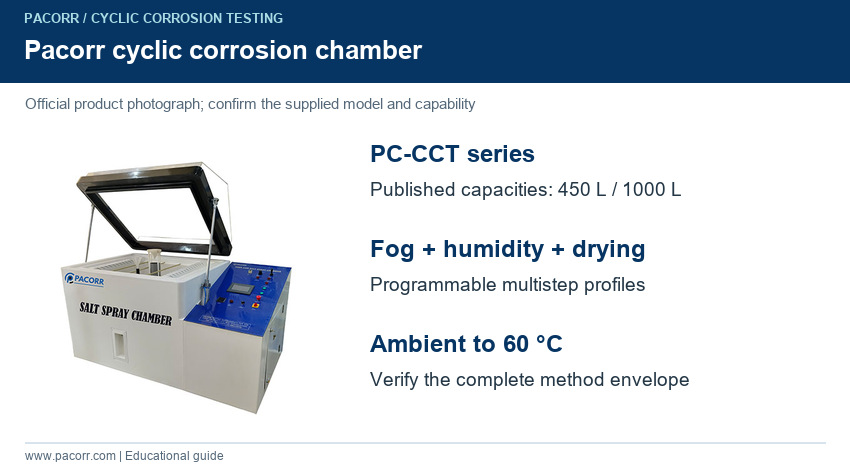
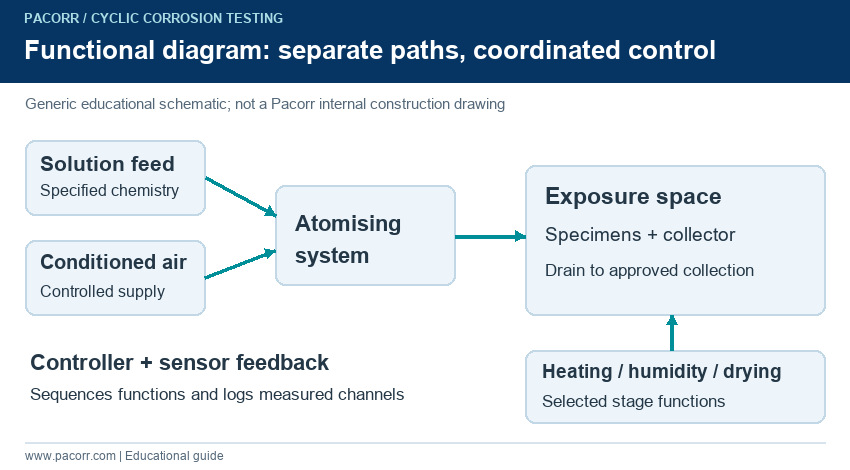
Typical functional groups include a corrosion-resistant exposure enclosure, specimen supports, solution reservoir and feed, conditioned compressed-air supply, atomising system, heating, humidity and drying arrangements, sensors, controller and drainage. The exact layout depends on the manufacturer and configuration.
A collector checks deposited fog; a temperature sensor checks its location; a controller sequences commands. Logging selected channels does not verify every condition throughout a loaded chamber. Confirm measured channels, verification and exportable records before relying on automated reports.
How should you read the chamber diagram?
The functional diagram separates the solution path, compressed-air path, exposure space, environmental controls and recorded data. Solution and conditioned air meet at the atomising system during fog operation. Heating, humidity and drying functions establish the other specified stages; the controller coordinates them using its available feedback.
This educational diagram is not a verified Pacorr construction drawing or an instruction to run fog, humidification and drying simultaneously. Follow the supplied valve, sensor, duct and control documentation. Collect and dispose of used solution and condensate appropriately; do not return contaminated drainage to the feed reservoir.
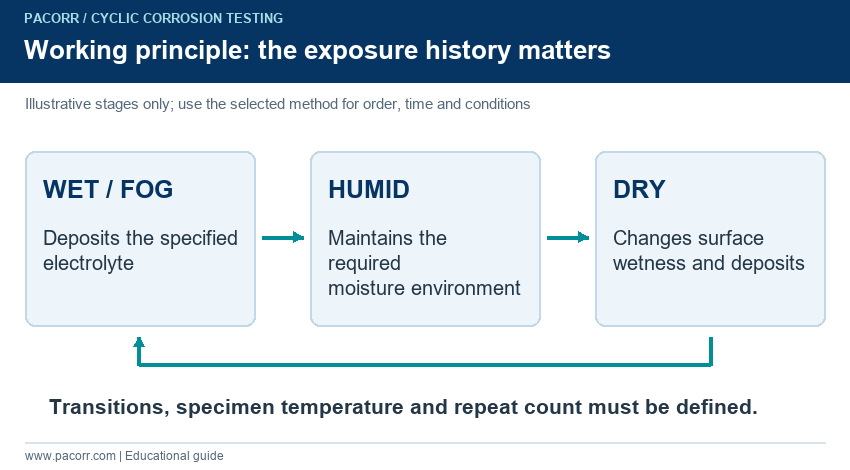
What happens during wet, humid and dry stages?
A fog stage deposits droplets prepared from the specified solution. A humid stage maintains a defined moisture environment, which may involve condensation depending on the method and specimen conditions. A drying stage uses the prescribed environment and airflow to change surface wetness. Some methods include additional ambient, immersion, temperature or other exposures.
The illustration is conceptual. Obtain stage order, duration, temperature, humidity and solution from the selected method. A diagram does not authorise additional stages: fog/dry and fog/dry/humid are different programmes.
Why do transitions and specimen temperature matter?
Changing a controller setpoint does not instantly change the chamber atmosphere or the specimen. Large components, wet fixtures and a heavily loaded cabinet can respond differently from lightweight panels. Residual water can delay drying, while warm or cold surfaces can change condensation behaviour.
Establish whether the method counts transition time within a stage and when the dwell timer starts. Review achieved-condition records, not only programmed settings. A capability demonstration should use a representative load where practical. If the cabinet cannot achieve a required stage in the permitted time, extending the programme without approval changes the test rather than correcting it.
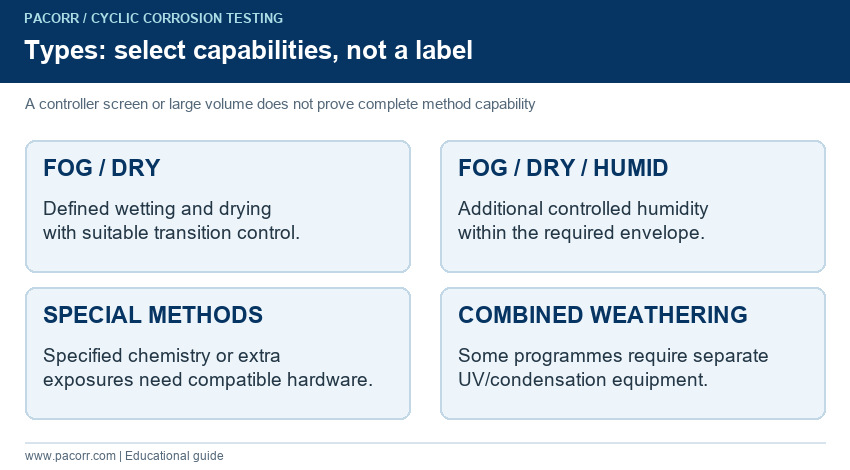
What types of cyclic corrosion chambers are available?
Classify equipment by capability. Fog/dry, controlled fog/dry/humidity and specialised sequences need different hardware. A larger chamber does not necessarily support more methods than a suitably configured smaller unit.
| Configuration | What the buyer should establish |
|---|---|
| Fog/dry cycling | Required wetting, drying environment and transition performance. |
| Fog/dry/humidity cycling | Achievable temperature–humidity combinations and feedback during each stage. |
| Special-method equipment | Compatibility with specified solutions, additional gases or unusual environmental stages. |
| Combined weathering programme | Whether separate UV/condensation equipment and specimen transfers are required. |
An HMI corrosion chamber offers a particular control interface; the screen alone does not prove that all required cyclic functions are installed.
Which industries and products benefit from cyclic corrosion testing?
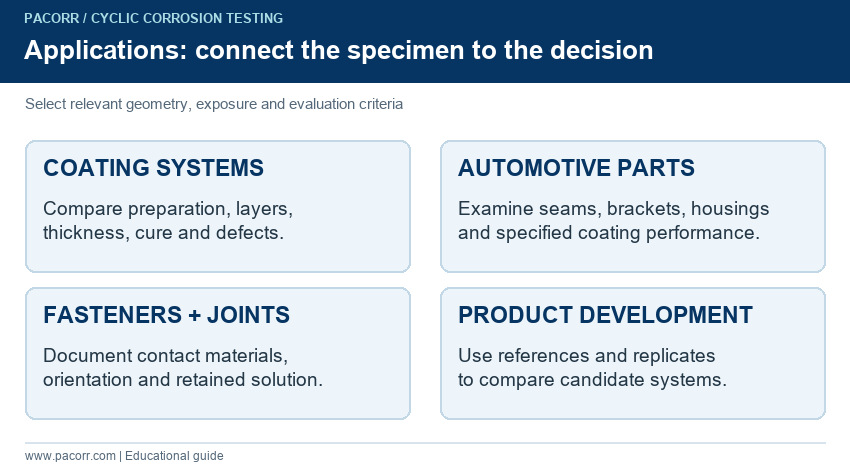
Common applications include painted metal panels, coated fasteners, automotive brackets, housings, appliance components, protective finishes and suitable assembled products. Development teams can compare pretreatments or coating formulations; quality teams can investigate changes in production or supplier performance.
Define the intended outcome: cosmetic corrosion, damaged-coating degradation, loss of joint protection and impaired function are distinct. An acceptable-looking panel does not establish assembly function. Testing energised equipment requires an expressly approved setup.
How is cyclic testing useful for automotive components?
Automotive programmes often examine coatings, substrates, joining details and exposure to road-salt-related environments. Include the relevant geometry: a flat witness panel cannot reproduce every seam, drainage pocket, fastener interface or stone-damaged edge of a manufactured component.
SAE's official J2334 scope identifies coating, substrate, process and design evaluation, while requiring field correlation for mechanisms beyond its stated cosmetic/general-corrosion context. Customer requirements still govern the chosen programme. Pacorr's automotive material and parts testing range provides context for complementary laboratory measurements.
What should coating and plating laboratories compare?
Compare complete systems: substrate preparation, pretreatment, coating layers, thickness, cure and any specified damage. Keep these details consistent unless one is the intended experimental variable. Otherwise, a difference attributed to paint chemistry might actually arise from preparation or thickness.
Record baseline coating thickness with an appropriate coating thickness gauge and retain the location map. Thickness data helps explain results but does not replace corrosion exposure. Similarly, gloss is an appearance measurement; Pacorr's gloss meter measurement guide explains its interpretation. A glossy surface is not proof of corrosion protection.
What changes when testing fasteners, joints and complex assemblies?
Document contact materials, tightening condition, coatings, orientation, drainage and any deliberate electrical connection. Dissimilar-metal contact and retained solution can change local corrosion. Fixtures should not introduce unintended contact or shield critical surfaces.
Define inspection access before the run. Disassembling a joint halfway through changes its condition and can disturb the exposure. Use separate specimens for destructive interim assessment where the test plan requires it. For fastener programmes, the Pacorr fastener testing range can help identify complementary mechanical checks; those checks answer different questions from surface corrosion ratings.
Which standards apply to cyclic corrosion testing?
Specify the document, revision, annex or cycle, customer amendments and evaluation criteria. Publisher listings were checked on 18 November 2026. A list of standards on a product page is not proof that every method can be run with the supplied configuration.
| Reference | Scope and selection point |
|---|---|
| ASTM G85-19 | Modified salt-spray practices. Annex A1 is continuous; other annexes define different cyclic modifications. State the annex. |
| ISO 11997-1:2026 | Coating resistance under four defined wet/salt-fog, dry and humid cycles with specified solutions. Select the cycle. |
| SAE J2334_201604 | Laboratory cyclic corrosion evaluation for specified coating, substrate, process or design questions. |
| ASTM D5894-21 | Alternating exposure using fog/dry and UV/condensation cabinets; not a salt-fog-only programme. |
| ASTM B117-26a / ISO 9227 | Salt-spray apparatus or methods; not interchangeable names for a complete cyclic programme. |
Consult the official ASTM G85 scope and ISO 11997-1 listing. ISO identifies the 2026 edition as replacing 2017. Obtain controlled documents for actual operation; this article does not reproduce their full procedures.
How do you choose a method instead of an arbitrary cycle?
Start with contractual requirements. Otherwise, define the material, service environment, failure mechanism and decision, then agree a defensible programme with qualified corrosion specialists and retain a reference material.
Avoid choosing a method solely because it produces visible damage quickly. An unsuitable environment can favour one coating system over another for reasons unrelated to service performance. If the customer specifies an OEM procedure, obtain its controlled revision and any approved alternatives. Do not substitute a similarly named standard without written agreement from the responsible parties.
Can one corrosion chamber perform UV weathering as well?
Only if the specified equipment and programme actually provide the required exposures. ASTM D5894 uses alternating exposure in two different cabinet types: fog/dry and fluorescent UV/condensation. Its official scope and interpretation guidance also limits how laboratory results should be related to outdoor performance.
Where your method requires it, assess a compatible UV accelerated weathering tester alongside corrosion equipment. Confirm lamps, irradiance control, moisture conditions, specimen holders and transfer arrangements. Do not imply that the reviewed Pacorr cyclic chamber includes UV lamps or that adding any UV cabinet automatically meets the whole programme.
What specifications does Pacorr publish?
The official cyclic chamber listing gives the following values. They describe published equipment information, not mandatory settings for every test. Confirm the supplied model and application-specific capability before placing an order.
| Item | Published information |
|---|---|
| Models and capacities | PC-CCT-500 / PC-CCT-1000; capacity list states 450 L / 1000 L. Confirm model-to-volume mapping. |
| Chamber and controls | FRP construction; touchscreen HMI with PLC control. |
| Test functions | Salt fog, controlled temperature/humidity and forced-air drying; programmable multistep profiles and data logging. |
| Temperature | Ambient to 60 °C; displayed least count 0.1 °C; stated repeatability ±2 °C. |
| Humidity | 95–98% RH controlled, as listed. A broader RH envelope is not established. |
| Air saturator | 45–55 °C; least count 0.1 °C; stated repeatability ±2 °C. |
| Solution and collection | 25 L reservoir; collector and external measuring cylinder; listed salt-spray collection 1–2 mL per 80 cm² per hour. |
| Operation | Pneumatic canopy, air purge, timer and low-air-pressure/low-solution alarms. |
The page also lists internal dimensions of 1650 × 750 × 820 mm without clearly assigning them to each capacity. Obtain the model drawing and usable loading envelope. Published repeatability is not a statement of calibration uncertainty, spatial uniformity or compliance with every method.
Which specification gaps matter most before buying?
Request the achievable temperature–humidity envelope under representative load, transition performance, drying capability, solution compatibility and method-specific verification. An ambient-to-60 °C listing does not establish refrigerated or sub-zero operation. A 95–98% RH listing does not establish controlled low-humidity stages.
The product page expresses pressure in kg/cm²; confirm whether kgf/cm² is intended, the gauge location and the required supply flow and quality. Do not treat the regulator scale as the operating setting. Confirm utilities, power, export formats and alarm recovery behaviour. These details determine whether the chamber can execute the required programme, regardless of how many recipes the controller can store.
How should chamber capacity and loading be selected?
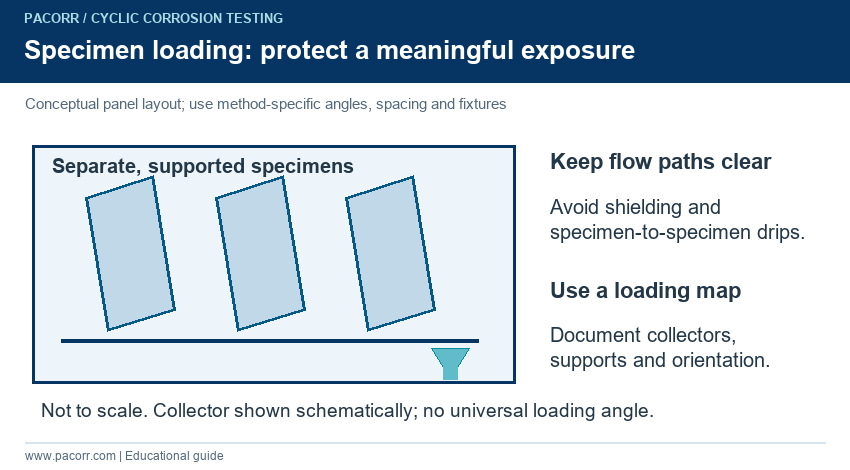
Choose by the largest specimen, fixtures, approved spacing and useful exposure zone—not litres alone. Allow for access, collectors, airflow and the ability to prevent one specimen dripping onto another. A nominal rectangular volume does not establish the number of assemblies that can be tested correctly.
Request a proposed loading drawing with specimen dimensions and orientations. Evaluate a representative full load during acceptance where required. Consider whether several smaller batches offer better traceability than crowding one large batch. Pacorr's chamber-selection guide provides broader purchasing questions; the cyclic method adds its own stage and transition requirements.
What installation services need planning?
Confirm electrical supply, compressed air, specified water quality, drainage, exhaust or vent arrangements, room conditions and maintenance clearances. Include access for the canopy and loading equipment. Corrosive aerosols and contaminated wastewater require controls appropriate to the site and chemistry.
Check pressure, flow and air quality separately: reaching nominal pressure does not establish adequate operating flow. Clear-looking water may still fail quality requirements. Obtain installation requirements before delivery and commission with the actual services and load.
How should specimens be prepared and identified?
Create a specimen register covering substrate, batch, surface treatment, coating system, thickness, curing history and dimensions. Photograph the initial condition and identify inspection regions. Use the preparation required by the selected method; arbitrary polishing, degreasing or handling can change the surface being evaluated.
Record edges, cut surfaces, holes and masking. Document sealing materials and geometry; do not hide edges intended for assessment. Use durable identifiers that do not contaminate the test. Without traceability, results cannot reliably support supplier or process decisions.
When should panels be scribed, and why?
A deliberate scribe can expose the substrate so that degradation spreading from a defined coating defect can be assessed. It answers a different question from the performance of an intact coating. Scribing is therefore specified by the test plan, not automatically added to every sample.
Control the tool, geometry, location and substrate exposure according to the applicable method. Record initial scribe condition and avoid confusing edge damage with scribe-related failure. Use the prescribed post-exposure treatment and evaluation. Scraping, rinsing or removing loose coating differently between specimens can change the apparent result even when exposure was identical.
How should samples be positioned inside the chamber?
Follow the specified angle, spacing and support requirements. Keep the relevant surfaces exposed, avoid direct atomiser impingement where the method excludes it, and prevent runoff from one specimen reaching another. Supports should suit the chemistry and avoid unintended galvanic contact.
Retain a chamber-position map. Move specimens or rotate batches only where the method permits and the plan records it. The illustration establishes no universal angle or clearance. Complex parts may need dedicated fixtures; orientation determines drainage or accumulation in cavities.
How should solution chemistry and fog collection be controlled?
Use the specified salts, water quality, concentration, pH and preparation method. There is no universal solution for all cyclic corrosion tests. Track preparation date, batch and checks; do not alter concentration to make a test appear more severe or reuse contaminated collected solution without an expressly permitted procedure.
Fog collection is a deposited-volume measurement over area and time, not total reservoir consumption. For illustration, 12 mL collected over eight applicable fog hours on an 80 cm² collector corresponds to 1.5 mL per 80 cm² per hour. Whether that result is acceptable depends on the selected method, sampling interval and stage definition. Do not divide by drying time unless the method instructs it.
How is humidity control different from simply adding moisture?
Relative humidity depends on temperature, and the moisture state of a specimen also depends on its surface temperature. A wet chamber wall does not prove that a specified humidity condition exists at all specimen locations. Salt contamination and condensation can also complicate sensor performance.
Ask how RH is generated, measured and verified during the relevant stages. Confirm the operating envelope rather than assuming any temperature can be combined with any RH. A separate humidity chamber serves different exposure requirements; the humidity chamber guide explains controlled-moisture testing without implying that it replaces salt-containing cyclic exposure.
What is an educational testing procedure?
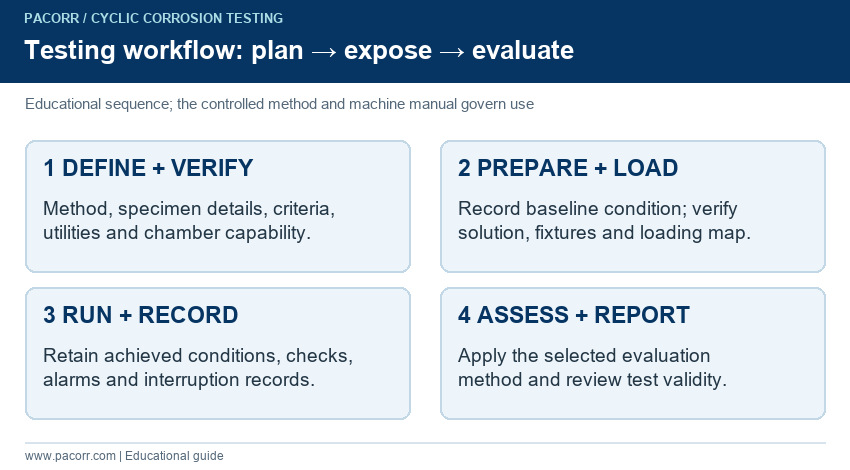
Use this sequence to organise a test plan. The exact recipe, safe operating steps and tolerances must come from controlled instructions.
- Confirm the method, revision, cycle, specimen preparation and acceptance criteria.
- Verify that the installed chamber can achieve every required stage and transition.
- Register specimens, references and replicates; document baseline condition and coating details.
- Prepare the specified solution and check services, collectors, sensors and inspection status.
- Load specimens using the approved layout, supports and orientation.
- Review the complete recipe, including stage durations, conditions, transitions and repeat count.
- Run the exposure, retaining actual-condition records, checks, alarms and interruptions.
- Inspect at authorised intervals without introducing unrecorded exposure changes.
- Complete the specified post-exposure treatment and evaluate defined regions using the selected method.
- Review validity, compare results with agreed criteria and issue a traceable report.
Do not create a compliance report from the controller's elapsed-time display alone.
What should calibration and performance verification cover?
Calibration concerns the measuring system and its relationship to references. Performance verification asks whether the operating chamber achieves the required exposure. Both matter: a calibrated probe in one location does not establish uniform conditions across a loaded chamber.
Plan checks for relevant temperature channels, humidity measurement, timers, pressure indication, collection equipment and solution measurements. Assess stage transitions, recovery and loaded performance as required. Keep traceability and uncertainty information where relevant to decisions. Set intervals through the laboratory's programme, method and manufacturer guidance; an arbitrary annual certificate cannot replace routine checks or reassessment after a significant repair.
What should happen after an alarm or power interruption?
Preserve the record of when the event occurred, which stage was active, the conditions reached and how long exposure was interrupted. Follow the machine's safe response instructions. Determine whether the method permits continuation and how the deviation must be reported.
Do not delete alarms, restart the cycle counter or silently add hours until the intended total appears on the screen. An interruption can affect drying, deposits and specimen wetness, so elapsed time alone cannot reconstruct the exposure. Quarantine questionable results until the responsible laboratory reviewer decides whether they remain usable, need qualification or require a repeat test.
How are corrosion-test results evaluated?
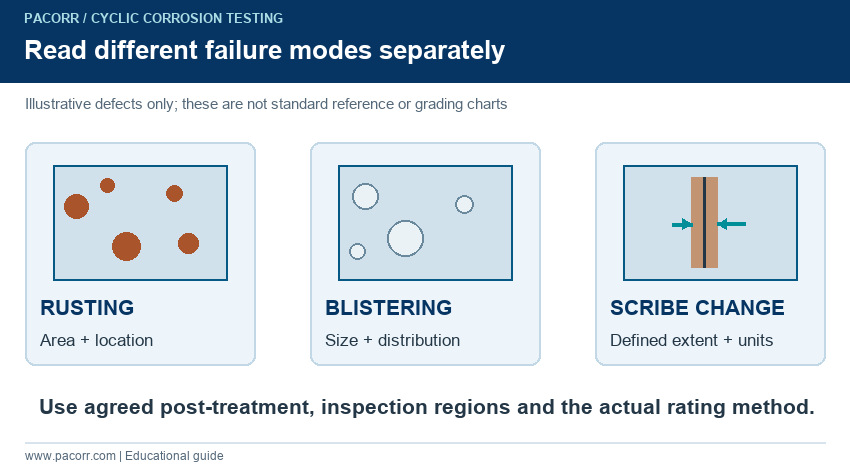
Evaluate the failure mode specified in the plan, using consistent inspection conditions and documented post-treatment. Rusting, blistering, scribe-related degradation and functional performance are separate observations. Record both severity and location rather than compressing every outcome into a single unsupported pass/fail label.
| Observation | Useful reporting discipline |
|---|---|
| Rusting | Identify substrate, assessed area and the selected rust-rating method. |
| Blistering | Record size/distribution using the selected system; do not call every surface mark a blister. |
| Scribe-related change | State the measurement definition, locations, treatment and units. |
| Component function | Report the agreed functional check separately from visual appearance. |
ASTM D610 addresses rusting on painted steel and ASTM D714 addresses paint blistering. ASTM D1654 addresses evaluation of exposed painted/coated specimens, including specified film-failure observations. Use the actual rating references; the illustrative defects below are not official grading charts.
How do controls and replicates improve confidence?
Test a suitable reference alongside candidates where the programme requires or benefits from it. A reference helps identify an unusual run and provides a comparison under the same exposure history. Replicates help reveal specimen variability that a single panel can hide.
Keep preparation, positions and inspection consistent; choose analysis before seeing results. Exclusions need documented technical reasons. Small differences between averages may be inconclusive against large within-batch variation. Investigate preparation, exposure records and evaluation practice before attributing interlaboratory disagreement to changed materials.
Can chamber hours be converted into years outdoors?
There is no universal conversion from chamber hours or cycles to outdoor service years. Corrosion mechanisms, materials, environments and the test sequence all affect the relationship. Even an established correlation is limited to its validated materials and conditions.
Report exposure and observed performance directly: for example, the specified rating after a stated number of valid cycles. Do not convert that result into an unverified warranty. Combine laboratory evidence with relevant field history, natural exposure or other validation where service-life decisions require it. The aim is a defensible comparison, not an impressive acceleration factor unsupported by the application.
What belongs in a useful test report?
Include specimen identity and preparation, coating information, method revision, programmed sequence, actual-condition evidence, chamber identification, loading map, solution checks and exposure duration. Add interruptions, deviations, inspection timing, post-treatment, evaluation methods, photographs and results with units.
Separate observation from interpretation. State any out-of-requirement stage and resulting qualification in the conclusion. Link acceptance to the agreed specification so customers can understand the decision without reconstructing it from a controller screenshot.
How should a cyclic corrosion chamber be maintained?
Follow the supplied manual for cleaning the enclosure, reservoir, nozzles, collectors, drainage and relevant sensors. Remove deposits using approved methods and materials. Do not enlarge nozzle openings with an improvised tool or treat FRP construction as immunity from every chemical or cleaning agent.
Qualified personnel should handle electrical, pneumatic and control-system service. Record chemistry changes and investigate carryover before testing another method. Pacorr's corrosion chamber maintenance article provides general reminders; the actual schedule and procedures must suit the supplied model, chemistry and laboratory workload.
Which common mistakes make results misleading?
Frequent problems include an incorrect recipe revision, incomplete specimen records, crowded loading, uncontrolled preparation, contaminated solution, unsuitable collection calculations and inspection outside the agreed interval. Another error is accepting a humidity setpoint as evidence that the specimen environment achieved it.
Use a short pre-run review and a documented final validity check. If fog distribution, drying or repeatability changes, investigate the chamber and services before changing the product formulation. A useful corrective action addresses the cause—such as blocked flow, a damaged nozzle or a recipe error—rather than merely repeating the same test until a preferred result appears.
What is the price of a cyclic corrosion chamber in India?
A fixed current selling price for the reviewed Pacorr cyclic chamber was not verified, so a quotation is required. Do not substitute the price of a basic continuous salt-spray cabinet or an old generic online range for a configured cyclic system.
Cost depends on capacity, required methods, environmental controls, drying and transition performance, construction, fixtures, monitoring, logging and documentation. Installation, utilities, freight, taxes, training and acceptance testing should be itemised. Compare the scope first: a lower cabinet-only price may exclude services or verification needed for your programme. Ask whether the proposed price covers the actual representative load and required test methods.
What affects total ownership cost and laboratory throughput?
Budget for utilities, solution preparation, consumables, inspection time, cleaning, verification, service and any required waste handling. Long tests also occupy chamber capacity; loading and turnaround matter alongside purchase price. Separate UV exposures or transfers can add equipment and coordination requirements.
Estimate throughput from approved loading, complete cycles, preparation and evaluation. Retain required spacing and collectors; crowding can invalidate a run and force repetition. Assess service support and data export against practical operating needs.
What should a buyer send to Pacorr for a quotation?
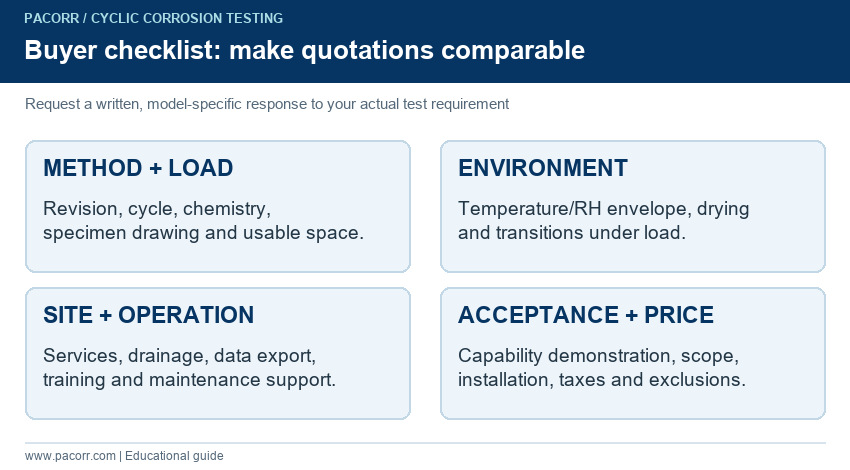
Send the controlled standards and revisions, cycle requirements, solutions, specimen drawings, largest load, inspection approach and acceptance requirements. Include the site services, expected utilisation and reporting needs. Request a model-specific capability response against each requirement, with exclusions stated clearly.
Clarify the PC-CCT model/capacity mapping, chamber drawing, usable loading space, achievable RH conditions and transition performance. Agree how delivery acceptance will be demonstrated and documented. This makes quotations comparable and helps avoid buying a chamber that can store a recipe but cannot physically achieve its conditions.
Frequently asked questions
What is the full form of CCT?
In this context, CCT means cyclic corrosion testing or cyclic corrosion test. It refers to a defined sequence of exposure stages, not one universal recipe or acceptance criterion.
Does a cyclic corrosion chamber measure corrosion automatically?
The chamber controls exposure and may log operating conditions. Specimen damage is evaluated separately using the agreed visual, dimensional, mass-loss or functional methods appropriate to the programme.
Is continuous salt spray equivalent to cyclic corrosion testing?
No. The exposure histories differ. Equal hours do not establish equivalent severity, and a continuous-fog chamber may lack the controls required for a cyclic programme.
Can every cyclic chamber run SAE J2334 or ISO 11997-1?
No. Confirm the required method, revision, cycle, solution, stage conditions and transitions against the supplied chamber's demonstrated capability under a representative load.
Does the Pacorr listing establish sub-zero operation?
No. Its published chamber range is ambient to 60 °C. Refrigerated or sub-zero capability must not be assumed from general descriptions of temperature cycling.
Is PC-CCT-500 necessarily a 500-litre chamber?
The reviewed page lists PC-CCT-500 and PC-CCT-1000 model names, while its capacity list states 450 and 1000 litres. Confirm the exact model-to-capacity mapping and drawing in the quotation.
Does the listed 0.1 °C least count mean 0.1 °C accuracy?
No. Display resolution, repeatability, calibration uncertainty and spatial uniformity describe different aspects of performance. The listing states a 0.1 °C least count and ±2 °C repeatability; verify requirements separately.
Should every test use the same salt solution?
No. Use the chemistry and preparation required by the selected method. Different cyclic and salt-spray methods can require different solutions and contamination controls.
Can test hours be converted directly into outdoor years?
No universal conversion exists. Any service-performance relationship needs evidence for the specific materials, test method and environment; report cycles and measured outcomes without inventing a lifetime factor.
Can the same chamber provide UV exposure for ASTM D5894?
Do not assume this. ASTM D5894 uses alternating exposure in fog/dry and UV/condensation cabinet types. Confirm the complete equipment and transfer programme required by the controlled method.
What should happen if a test is interrupted?
Record the event, stage, duration and achieved conditions. Follow the approved recovery procedure and have the responsible reviewer decide whether results remain valid, need qualification or require repetition.
How can I obtain an accurate chamber price?
Request a quotation with your standards, specimens, loading, cycle conditions, utilities and reporting requirements. Ask for the complete supply, installation, training and verification scope instead of relying on an unspecified price range.
Discuss your cyclic corrosion testing requirement with Pacorr
Review the Pacorr Cyclic Corrosion Test Chamber and share your method, specimens and installation requirements. A model-specific discussion should establish required capability, loading, services and verification before purchase.
Contact Pacorr through the enquiry page, call +91-8882149230 or email info@pacorr.com for an itemised quotation.